 QIDAMT
Aluminium Disc Blanks for Cookware: Alloy, Diameter and Deep Drawing
Aluminium Disc Blanks for Cookware: Alloy, Diameter and Deep Drawing
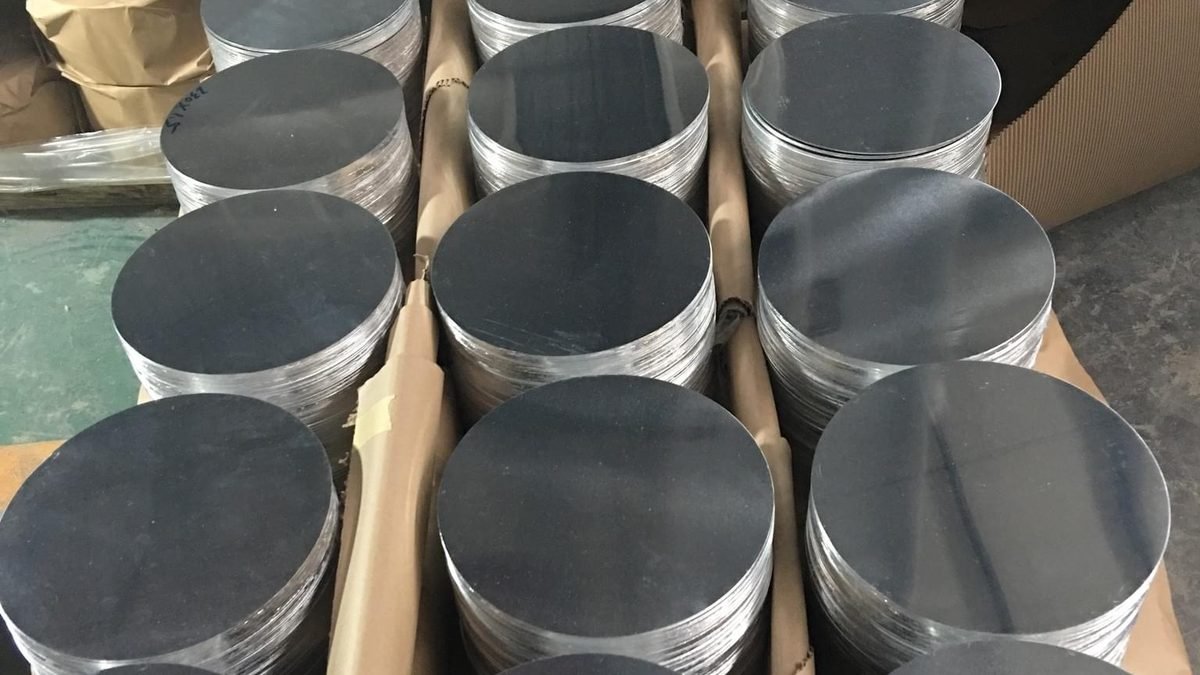
An aluminium disc blank is a circular piece of sheet or plate, punched or sawn from coil, supplied flat and annealed ready for the cookware press. It is the input to almost every stamped pot, pan, frying pan and pressure cooker body made from aluminium, and it is also used for lamp reflectors, cookware lids, road sign blanks and electrical enclosures. The product looks simple, which is exactly why so many orders go wrong: a disc is defined by five numbers and a temper, and a buyer who specifies only diameter and thickness has left the rest to chance.
This guide covers aluminium discs for cookware only: the alloys normally used, the mechanical condition that makes a disc drawable, the diameter and thickness tolerances that matter on a press, how the blank diameter is calculated, and the mistakes that show up as cracked pans, ears, orange peel or scratched non-stick coatings.
The disc is not a commodity in the sense that one specification fits all cookware. A shallow anodised pan and a deep non-stick saucepan are different forming problems, and they want different alloys and different tempers. Choosing the cheaper alloy for the deeper draw usually costs more in scrap than it saves in metal.
Product Definition and Where Discs Are Used
A disc blank is produced by blanking a coil or a sheet on a mechanical press with a circular tool, or by laser cutting and deburring where the diameter is large or the quantity is low. The blanking operation leaves a sheared edge with a small burr on the punch side; that burr is removed by tumbling or by a deburring station, because a burr on the edge of a deep drawn part becomes a crack initiation site and a scratch source on handling.
The dominant use is cookware. A frying pan body is drawn from a disc in one or two operations, then trimmed, spun, coated and fitted with a handle. A saucepan is drawn deeper and usually needs an intermediate anneal. A pressure cooker body is drawn from a thicker disc and then spun to form the rim. Lids, steamers, and the inner pot of a rice cooker follow the same route.
Outside cookware, discs appear as reflector blanks for lamps, sign blanks, gasket blanks, and as the starting stock for spinning and flow forming. In every case the disc specification is set by the forming operation that follows: the press tonnage, the draw ratio, the number of stages and the surface finish that the customer will anodise or coat.
Alloys Used for Cookware Discs
Five alloys cover the great majority of cookware discs. The pure grades are chosen for anodising response and thermal conductivity; the manganese grades are chosen for strength after deep drawing; the magnesium bearing grade is chosen where the pan must resist denting and distortion.
| Alloy | Si | Fe | Cu | Mn | Mg | Typical use |
|---|---|---|---|---|---|---|
| 1050 | 0.25 | 0.40 | 0.05 | 0.05 | 0.05 | Bright anodised pans, lids |
| 1060 | 0.25 | 0.35 | 0.05 | 0.03 | 0.03 | General cookware, spinning stock |
| 1100 | 0.95 combined | with Si | 0.05 to 0.20 | 0.05 | 0.05 | Utensils, shallow pans |
| 3003 | 0.60 | 0.70 | 0.05 to 0.20 | 1.00 to 1.50 | 0.10 max | Deep drawn pans, non-stick bodies |
| 3004 | 0.30 | 0.70 | 0.25 | 1.00 to 1.50 | 0.80 to 1.30 | Heavy pans, pressure cooker bodies |
Values are maximums for the impurity elements and ranges where the alloying element is deliberate. Aluminium is the balance. Ordering to a registered alloy such as 3003 is safer than ordering a generic “aluminium disc” because the manganese range is what controls the strength after drawing, and two suppliers can deliver very different 3003 within the same nominal specification.
The choice comes down to three questions. Will the pan be anodised and must the finish be bright and uniform? Then use 1050 or 1060, because the pure grades anodise to a clear, even film and the low iron content keeps the colour neutral. Is the draw deep, with a draw ratio above about 1.8? Then use 3003, because the manganese gives work hardening capacity and resists thinning at the wall. Must the finished pan resist denting and hold its shape on an induction hob? Then 3004, whose magnesium content raises the strength further, is the better base.
Temper and Mechanical Properties
A disc for deep drawing must be soft and ductile. That means the O temper, fully annealed, with a controlled grain size. Discs supplied hard, in H14 or H24, will form shallow parts but will crack or split in a deep draw, and no amount of press tuning will fix it.
| Alloy and temper | Tensile strength, typical | Yield strength, typical | Elongation, typical | Forming behaviour |
|---|---|---|---|---|
| 1050 O | 75 MPa | 30 MPa | 35 percent | Very soft, best anodising |
| 1060 O | 75 MPa | 30 MPa | 35 percent | Soft, good all round draw |
| 1100 O | 90 MPa | 35 MPa | 35 percent | Soft, slightly stronger |
| 3003 O | 110 MPa | 40 MPa | 30 percent | Drawable, work hardens |
| 3004 O | 115 MPa | 45 MPa | 25 percent | Stronger, less ductile |
| 3003 H14 | 150 MPa | 145 MPa | 8 percent | Shallow forming only |
Grain size is as important as temper and is invisible on a certificate unless it is stated. A coarse grain, above about 100 micrometres, produces the surface defect known as orange peel when the disc is drawn: the individual grains deform differently and the surface takes on a stippled, leathery texture that no polishing removes. Fine, uniform grain, typically 30 to 60 micrometres, draws to a smooth surface. Specify the grain size on the purchase order when the part will be anodised or coated after forming, because those processes amplify the defect rather than hide it.
Diameter, Thickness and Tolerance
Cookware discs normally run from 120 mm to 600 mm in diameter and from 0.8 mm to 6 mm in thickness, with larger diameters and thicker sections used for pressure cooker bodies and commercial equipment. The table below summarises the tolerances that a press shop needs to specify.
| Characteristic | Typical commercial tolerance | Effect if missed |
|---|---|---|
| Diameter | plus or minus 0.5 mm below 300 mm, plus or minus 1.0 mm above | Poor centring in the draw die, uneven wall |
| Thickness | plus or minus 0.05 mm up to 1.5 mm, plus or minus 3 percent above | Wall thickness variation, weight variation |
| Flatness | 0.3 mm maximum on a 300 mm disc | Difficult blank feeding, uneven draw |
| Burr height | 0.10 mm maximum, deburred | Edge cracks, scratches on coated pans |
| Concentricity of blank | 0.5 mm maximum between outer edge and centre | Off centre drawn part, trimmed waste |
| Surface | No scratches, dents, roll marks or lubricant residue | Defects visible after anodising or coating |
| Grain size | 30 to 60 micrometres, stated on request | Orange peel after drawing |
| Temper | O, fully annealed | Cracking or splitting in the draw |
Weight is the fastest check on a delivery. A 300 mm disc at 3 mm thickness in 3003 alloy weighs about 0.57 kg, calculated as the area of 0.0707 square metres times 0.003 metres times a density of 2700 kilograms per cubic metre. Weigh ten discs, average them, and compare with the theoretical figure. A shortfall of more than three percent means the thickness is running at the bottom of the tolerance or the diameter is undersized, and either will change the draw result.
How Discs Are Made
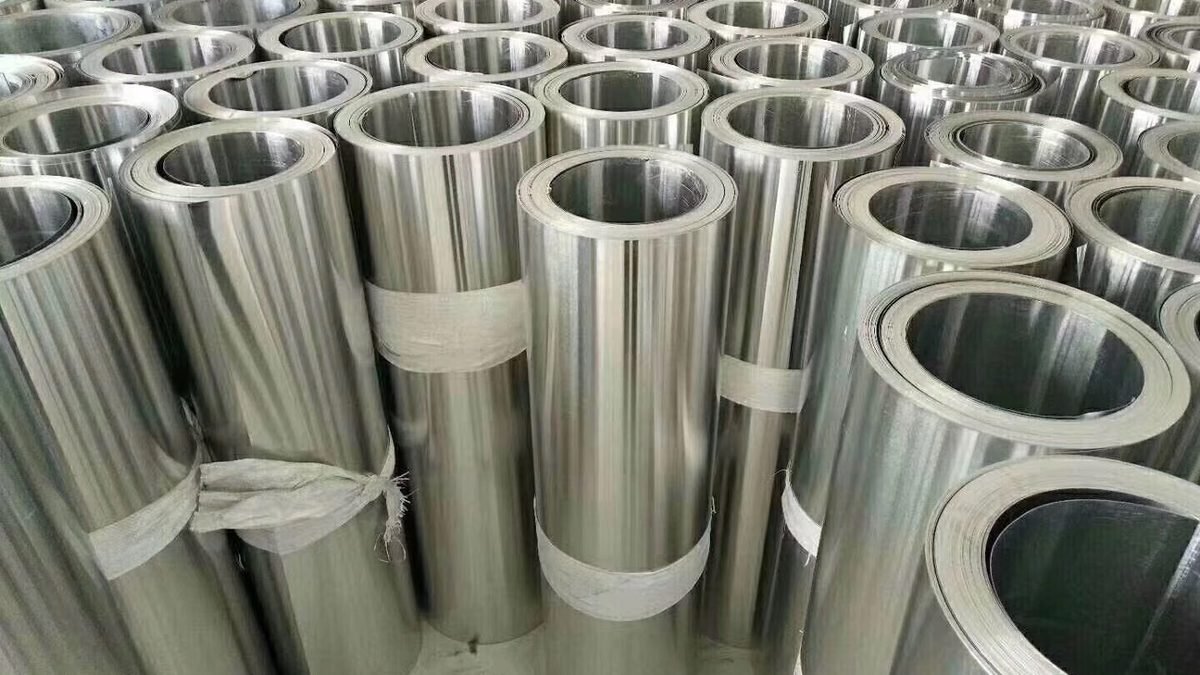
The route starts at the casthouse. Continuous cast coil or DC cast slab is homogenised, hot rolled to about 6 mm, cold rolled to the ordered thickness with intermediate anneals as required, and finally annealed to the O temper. The anneal is the step that sets the grain size, and it is controlled by holding the coil at temperature long enough for recrystallisation to complete without allowing grain growth.
Blanking follows on a mechanical press at 100 to 300 strokes per minute, with a hardened circular tool. The clearance between punch and die is set as a percentage of sheet thickness, usually 5 to 8 percent for aluminium; too little clearance increases the burr and the punch load, too much produces a torn edge and a heavy burr. The blanked discs fall through the die and are collected, then deburred by tumbling or by a dedicated deburring machine, inspected, counted and packed with interleaving paper or film.
Two details in that sequence matter to buyers. First, the discs must be blanked from the centre of the coil width where the flatness and thickness are best, not from the edges, or the disc will inherit the edge crown and the draw will be uneven. Second, the discs should be packed flat and supported, not stacked loose in a drum, because a disc that takes a set in transit will draw off centre and thin the wall on one side.
Blank Diameter Calculation and Draw Rules
The blank diameter is not the pan diameter. The metal has to cover the wall and the bottom, and the calculation assumes the wall thickness stays close to the blank thickness. For a simple cylindrical cup, the blank diameter is the square root of the pan diameter squared plus four times the pan diameter times the height.
Take a pan of 200 mm diameter and 60 mm depth. The pan diameter squared is 40,000 square millimetres. Four times the diameter times the height is 48,000 square millimetres. The sum is 88,000, and the square root is about 297 mm. In practice the blank is made 5 to 15 percent larger than that theoretical figure to allow for the flange needed to clamp the blank, for the trim allowance and for the thinning that occurs at the wall. A 320 mm blank is therefore a sensible starting point for that pan, and the press trial will refine it.
Three draw rules follow from the same logic. The draw ratio, which is blank diameter divided by punch diameter, should stay below about 2.0 in a single operation for 3003 and below about 1.8 for 3004; beyond that the wall thins excessively and the part needs an intermediate anneal. The punch and die radius should be generous, at least four times the sheet thickness on the punch and eight times on the die, to avoid tearing. And the blank holder force must be high enough to stop wrinkling but low enough to let the metal flow; on a hydraulic press the setting is found by trial, and on a mechanical press it is set by the cushion pressure.
Selection Rules for Cookware Buyers
Choose the alloy from the process, not from the price list. For a bright anodised shallow pan, 1050 or 1060 in O temper gives the clearest finish and enough ductility. For a non-stick pan with a draw ratio above 1.6, 3003 in O temper is the standard and the manganese content is what keeps the wall from thinning. For a heavy commercial pan or a pressure cooker body, 3004 gives the strength to resist denting, at the cost of a narrower forming window.
Choose the thickness from the duty, not from the last order. A frying pan at 2.5 mm to 3.0 mm is normal; a thin crepe pan at 1.5 mm to 2.0 mm; a stock pot at 3.0 mm to 4.0 mm; a pressure cooker body at 4.0 mm to 6.0 mm. Thickness below about 1.2 mm in a pan that will be used on a domestic hob will distort and is a warranty risk, not a cost saving.
Choose the temper and the grain size together. O temper without a grain size limit is an incomplete specification. Ask for the grain size in micrometres, and ask for the anneal practice, because a mill that anneals at the bottom of the temperature range for a long time and a mill that anneals hot for a short time can both hit the same hardness and deliver different grain structures.
Choose the packing to match the handling. Discs that will be fed automatically into a press need flat, burr free edges and consistent diameter. Discs that will be handled manually can tolerate a wider diameter tolerance but not a burr, because a burr cuts gloves and scratches coated parts.
Common Mistakes and Their Symptoms
The most common mistake is ordering a hard temper because the certificate looked stronger. A 3003 H14 disc will form a shallow tray and will split in a deep pan draw. The symptom is a split at the wall or a fracture at the draw radius, and the cure is a new delivery in O temper, not a change in press settings.
The second is ignoring grain size and then blaming the anodiser for orange peel. The defect is in the metal before it reaches the anodising line. The third is specifying thickness to the nominal and accepting a delivery at the minus tolerance; the pan comes out light, the wall thins faster, and the draw ratio effectively rises.
The fourth is a burr on the blank edge. It scratches the coated pans stacked below it in the press tray, and it starts an edge crack in the draw. The fifth is packing discs loose in a drum, which produces dished blanks and off-centre parts. The sixth is mixing alloys in one box because they look the same; a 1050 disc in a batch of 3003 will draw differently and will anodise differently, and the fault will appear as a random defect with no pattern.
The seventh is buying on price per kilogram without checking the actual disc weight and diameter. A supplier who delivers a 295 mm disc where 300 mm was ordered has saved metal and changed the draw. The eighth is storing discs in a humid warehouse without interleaving; aluminium forms a white oxide bloom and water stains that show through a clear anodised finish.
Frequently Asked Questions
Which alloy is best for a non-stick frying pan? 3003 in O temper is the standard choice. It has enough ductility for the draw and enough manganese to keep the wall from thinning. 3004 is used where the pan is heavy or the base must resist distortion.
Can I use 1060 for a deep saucepan? Yes for moderate depths, but 1060 work hardens quickly and the draw ratio should stay below about 1.5. For deeper parts, 3003 gives a wider forming window.
How much does a disc weigh? Multiply the disc area in square metres by the thickness in metres by 2.7 kilograms per cubic metre times 1000, or simply use 2.7 kg per square metre per millimetre of thickness. A 300 mm disc at 3 mm is about 0.57 kg.
What burr height is acceptable? 0.10 mm maximum on a deburred disc. Anything above that scratches adjacent discs and starts edge cracks in the draw.
Why do my pans show a leathery surface after drawing? That is orange peel, caused by a coarse grain structure. It cannot be polished out. Specify a grain size of 30 to 60 micrometres and verify the anneal practice with the mill.
Do discs need to be annealed before pressing? They arrive annealed in the O temper. If the discs are cut from hard coil by a local laser shop, they must be annealed before drawing, or the draw will crack.
Need Cookware Discs to Your Draw Specification?
We supply 1050, 1060, 1100, 3003 and 3004 disc blanks in O temper, blanked to your diameter, deburred, with grain size and thickness reports on request. Send the pan diameter, the depth, the alloy, the thickness and the expected draw ratio, and we will confirm the blank size and the price.
Related products on this site: 1060 pure aluminium sheet and plate and 6061-T6 aluminium plate.

