 QIDAMT
ERW Carbon Steel Pipe Q235B: Weld Seam, Wall Tolerance and Testing
ERW Carbon Steel Pipe Q235B: Weld Seam, Wall Tolerance and Testing
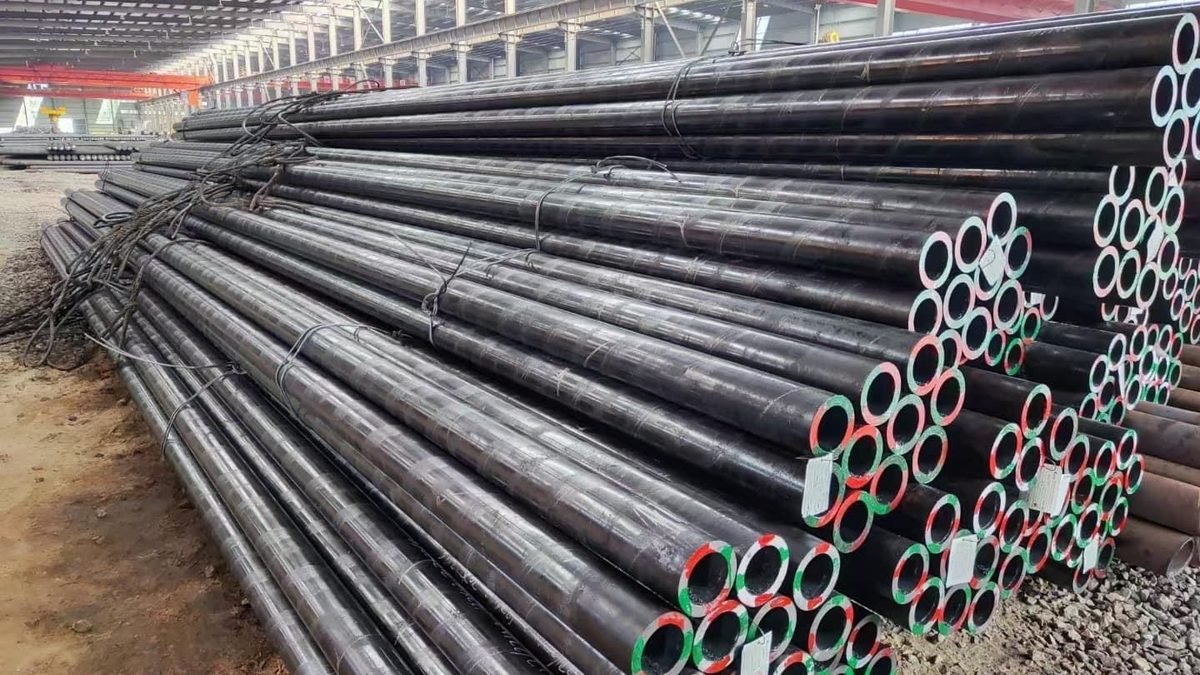
An ERW carbon steel pipe is made by uncoiling hot rolled steel strip, forming it into a tube and welding the longitudinal edges together with electric resistance heating, without any filler metal. The letters stand for electric resistance welded, and the process is the source of both the product’s economics and its limitations. It is fast, it uses no consumables, and it produces a pipe with a weld that is metallurgically part of the wall rather than an added bead.
The grade in the title, Q235B, is the Chinese structural carbon steel that dominates low pressure pipe in Asia. It is a 235 MPa minimum yield steel with controlled phosphorus and sulphur, cheap, weldable, and available in the sizes that general industry uses. This guide covers the welded pipe itself: the grade limits, the mechanical properties, the wall and diameter tolerances, how the strip width and the weld are controlled, what testing proves the seam, and where an ERW pipe should not be used.
Only one product is covered: round ERW pipe in Q235B for low pressure liquid, gas, structural and general engineering service. Seamless pipe, square and rectangular hollow sections and hot dip galvanized pipe each have their own tolerances and inspection rules and should be ordered separately.
Product Definition and Typical Service
The process starts with a coil of hot rolled strip, typically 2 to 6 mm thick and cut to a width calculated from the finished pipe diameter. The strip is uncoiled, levelled, edge trimmed, and formed through a series of rolls into a continuous tube with the edges brought together. A high frequency current is induced in the strip, the edges heat to forging temperature, and the forming rolls squeeze them together to make a solid phase weld. The outside and inside flash is then scarfed off, the pipe is sized through the finishing stands, cut to length, cooled, straightened and inspected.
The result is a pipe with a visible weld line along its length but no raised bead. Wall thickness at the weld is normally within the base metal tolerance, and the heat affected zone is narrow because the heating is local and fast. That is the advantage over a submerged arc welded pipe with a wide heat affected zone and a filler bead that must match the parent metal.
Typical service is water lines, fire protection pipe, compressed air, low pressure steam, structural frames, guard rails, fencing, scaffolding and general fabrication. It is also the input for hot dip galvanizing, threading and grooving. It is not a pressure pipe for high hazard service, and it is not the correct product where the design code demands a seamless or a normalized seam.
Grade Q235B: Chemistry and Limits
Q235B is defined by GB/T 700. The letter B denotes the second quality grade, with tighter phosphorus and sulphur than grade A and no impact test requirement at low temperature. The limits below are the standard composition ranges.
| Element, percent | Q235B limit | Effect on pipe |
|---|---|---|
| Carbon | 0.20 max | Weldability, hardness in the seam |
| Silicon | 0.35 max | Deoxidation, scale formation |
| Manganese | 1.40 max | Strength, toughness |
| Phosphorus | 0.045 max | Cold brittleness if high |
| Sulphur | 0.045 max | Hot shortness, weld porosity |
| Carbon equivalent, typical | 0.30 to 0.38 | Controls seam hardness and cracking risk |
The carbon equivalent is the number that matters at the weld. ERW does not use filler, so the seam chemistry is the strip chemistry, and a strip at the top of the carbon and manganese range will produce a harder, less ductile seam than one at the middle. For pipe that will be flattened, bent or expanded after welding, ask for a carbon equivalent at the lower end. For pipe that will only be cut and threaded, the middle of the range is fine.
Q235B is often supplied as a rimmed or semi killed steel in thin strip, and the deoxidation practice affects the internal soundness. For pipe that will be galvanized, the silicon content matters because high silicon interferes with the galvanizing reaction and produces a thick, brittle coating. Specify silicon below 0.10 percent for pipe destined for hot dip galvanizing, and check the certificate rather than assuming.
Mechanical Properties
The values below are the standard requirements for Q235B at the thickness range used for pipe. They apply to the base metal; the weld seam is expected to reach the same tensile strength but is not required to match the elongation of the base metal.
| Property | Requirement | Comment |
|---|---|---|
| Yield strength, min | 235 MPa | For thickness up to 16 mm |
| Tensile strength | 370 to 500 MPa | Upper limit matters for seismic detailing |
| Elongation, min | 26 percent | Measured on the base metal |
| Impact, longitudinal | 27 J at 20 C for grade B | Grade B requirement in GB/T 700 |
| Weld tensile strength | Not less than base metal minimum | Verified on a transverse weld specimen |
| Flattening test | No crack in the weld after flattening | The definitive seam ductility test |
Pipe is not tested like plate. The tensile test is taken from the pipe wall, often as a strip specimen, and the flattening test is the one that finds a brittle seam. In the flattening test a short ring is pressed flat between two plates so that the weld is at the top or bottom of the flattened section; the weld must show no crack or tear. A pipe that passes the tensile test but fails the flattening test has a seam problem, and the batch should be rejected.
Diameter, Wall and Length Tolerances
The table summarises the tolerances normally applied to GB/T 3091 and similar low pressure welded pipe. For export orders the purchase order should name the standard, because ASTM A53 and EN 10219 differ in the allowed wall deviation and in the straightness requirement.
| Characteristic | Typical tolerance | Inspection |
|---|---|---|
| Outside diameter, up to 48.3 mm | plus or minus 0.5 mm | Vernier or tape at both ends |
| Outside diameter, above 48.3 mm | plus or minus 1 percent | Circumference tape, both ends |
| Wall thickness | plus or minus 10 percent | Ultrasonic or micrometer at the ends |
| Length, fixed | plus 10 mm, minus 0 mm | Tape measure, end to end |
| Straightness | 1.5 mm per metre, 0.15 percent of length total | String line along the pipe |
| Ovality | 0.75 percent of diameter maximum | Two perpendicular measurements |
| End squareness | 1 mm maximum gap | Engineer square |
| Weld flash, inside | Scarfed, 0.5 mm maximum remaining | Visual and bore gauge |
| Weld flash, outside | Scarfed flush, no undercut | Visual and straight edge |
The wall tolerance of plus or minus 10 percent is the one that catches out pressure calculations, exactly as it does for seamless tube. A pipe ordered at 4.0 mm may arrive at 3.6 mm and be compliant. If the design used 4.0 mm, the margin is gone. The remedy is the same: calculate from the minimum wall, and if the design needs 4.0 mm minimum, order a nominal thickness above that and require the mill to work to the positive side of the tolerance.
Internal flash deserves a note. A scarfed weld leaves a small ridge on the bore. In a water line that is harmless; in a line that must pass a pig, a scraper or an internal inspection tool, even half a millimetre of ridge can stop the tool. If the pipe will be internally inspected or lined, specify the maximum internal flash height and require it to be verified.
How the Pipe Is Made and Where the Weld Is Controlled
The strip width is calculated from the finished diameter and wall. For a pipe of outside diameter D and wall t, the width is approximately pi times the quantity D minus t, with a small allowance for the edge squeeze and the forming stretch. A 114.3 mm pipe with a 4 mm wall therefore needs a strip about 346 mm wide: the mean diameter of 110.3 mm multiplied by pi gives 346.5 mm, less a squeeze allowance of a few millimetres.
Forming is done in a series of stands that progressively bend the strip from a flat section into a circle. The edges are then heated by a high frequency current, typically in the range of 100 to 400 kHz for small pipe, and squeezed together by the weld rolls. The key variables are the included angle of the V formed by the edges, the power input, the squeeze force and the speed of the line. If the speed is too high for the power, the edges do not reach forging temperature and the weld is cold, with a brittle, unbonded seam that passes a visual inspection and fails a flattening test.
After welding, the outside and inside flash is removed by scarfing tools, the pipe passes through sizing stands that bring the diameter and ovality into tolerance, and it is cut to length on a flying cut off. It is then cooled, straightened on a roller straightener, and inspected. Inspection normally includes a visual check of the seam, an eddy current or ultrasonic test of the weld, a hydrostatic test at the specified pressure, and destructive tests on samples cut from the ends of each lot: tensile, flattening and, where specified, a bend test.
Two quality signals are worth asking for. First, the weld seam should be continuous and free of pin holes, which are small voids at the weld line caused by mill scale or oil entering the weld zone. Pin holes are the most common cause of leak failures in ERW pipe, and they are found by the hydrostatic test or by an eddy current test, not by looking at the outside. Second, the seam should show a consistent, narrow heat affected zone; a wide, dark band suggests excessive heat input and a coarse grain structure that will be less tough.
Selection and Installation Rules
Select the pipe by service, not by availability. For potable water and fire protection, a welded pipe with a hydrostatic test and a documented seam inspection is acceptable in most codes; for high pressure steam, flammable gas or lethal service, the code usually requires seamless or a normalized weld, and an ERW pipe should not be substituted. For structural use, the design is governed by the section properties and the wall, and the weld quality requirement is lower, but the pipe must still be straight enough to erect.
Connection method decides the wall. Threading cuts away wall at the thread root, so a pipe that will be threaded needs a wall thick enough to leave a sound section after cutting; thin wall pipe is normally grooved or welded instead. Grooving removes less metal but requires a roll grooving tool matched to the wall and the diameter. Welding is the strongest connection and adds a heat affected zone that must be considered in the design; for a galvanized pipe, welding destroys the coating at the joint and the joint must be repaired with zinc rich paint or a thermal spray.
Support spacing follows the pipe size and the service. A water filled pipe is heavier than an empty one, and the deflection limit usually governs the span. For small bore pipe, the span is set by vibration and appearance rather than strength. Allow for thermal movement: a 12 metre carbon steel line heated by 60 degrees Celsius grows about 8 mm, which is small but enough to load a rigid connection at the end of the run.
Corrosion protection is the last selection decision. A bare Q235B pipe in a wet or coastal environment will rust through in a few years, and the wall loss is not uniform. Hot dip galvanizing gives a coating that protects the outside and, if the bore is coated, the inside; the coating thickness and the zinc mass should be stated on the order. Paint systems work where the surface is properly prepared, and the preparation standard matters more than the paint brand.
Common Mistakes
The first is treating ERW as interchangeable with seamless. The two products look the same in a stack and behave differently under pressure, fatigue and code review. The second is buying on nominal wall and checking the delivered wall against nominal, which rejects compliant pipe and accepts a design with no margin.
The third is ignoring the weld seam in the purchase specification. A pipe order that says only “Q235B 114 mm 4 mm” does not state a weld test, a flattening test or a hydrostatic pressure, and the supplier is free to deliver to the minimum. The fourth is threading thin wall pipe and expecting the joint to hold pressure; the thread root is the thinnest section in the system.
The fifth is storing pipe on the ground without support, which produces bending and ovality that no tolerance covers. The sixth is galvanizing after threading, which fills the threads with zinc and makes the joint unusable; thread after galvanizing, or use threaded fittings with a coating repair. The seventh is welding a galvanized pipe without removing the coating at the joint and without respiratory protection for the operator.
The eighth is accepting a mill certificate that lists chemistry and tensile only, with no flattening test and no hydrostatic result. For ERW pipe the seam is the risk, and the certificate should show the test that proves the seam.
Frequently Asked Questions
Is ERW pipe as strong as seamless pipe? In the base metal, yes, if both are made to the same grade and wall. The difference is the seam: a welded pipe has a weld line with its own toughness and inspection requirements, and pressure codes apply a joint factor to it. For high hazard service, seamless is specified because it has no seam to inspect.
Can Q235B ERW pipe be galvanized? Yes, and it is common. Specify silicon below 0.10 percent for a uniform coating, and state the zinc mass required. Galvanizing after threading is not acceptable because the zinc fills the threads.
What pressure can a 4 mm wall 114 mm pipe take? Using a conservative allowable stress for Q235B in low pressure service, the hoop stress calculation gives a capability far above the 1 to 2 MPa that such pipe normally sees. In practice the rating is set by the standard and the connection, not by the burst strength.
Why does my pipe leak at the weld after a few months? Most likely a pin hole that was not caught by the hydrostatic or eddy current test, or corrosion at the seam where the scarfing left a slight groove. Check the test records first, then inspect the seam for undercut and for coating damage.
What is the difference between ERW and HFW pipe? HFW, high frequency welded, is a subset of ERW that uses high frequency induction or contact welding. The terms are often used interchangeably in the trade; the important thing is the weld test and the standard, not the acronym.
How do I calculate the strip width for a pipe size? Multiply pi by the mean diameter, which is the outside diameter minus the wall, and add a small allowance for the weld squeeze. For 114.3 mm outside diameter and 4 mm wall, the strip is about 346 mm before allowance.
Need Q235B ERW Pipe with Weld Test Reports?
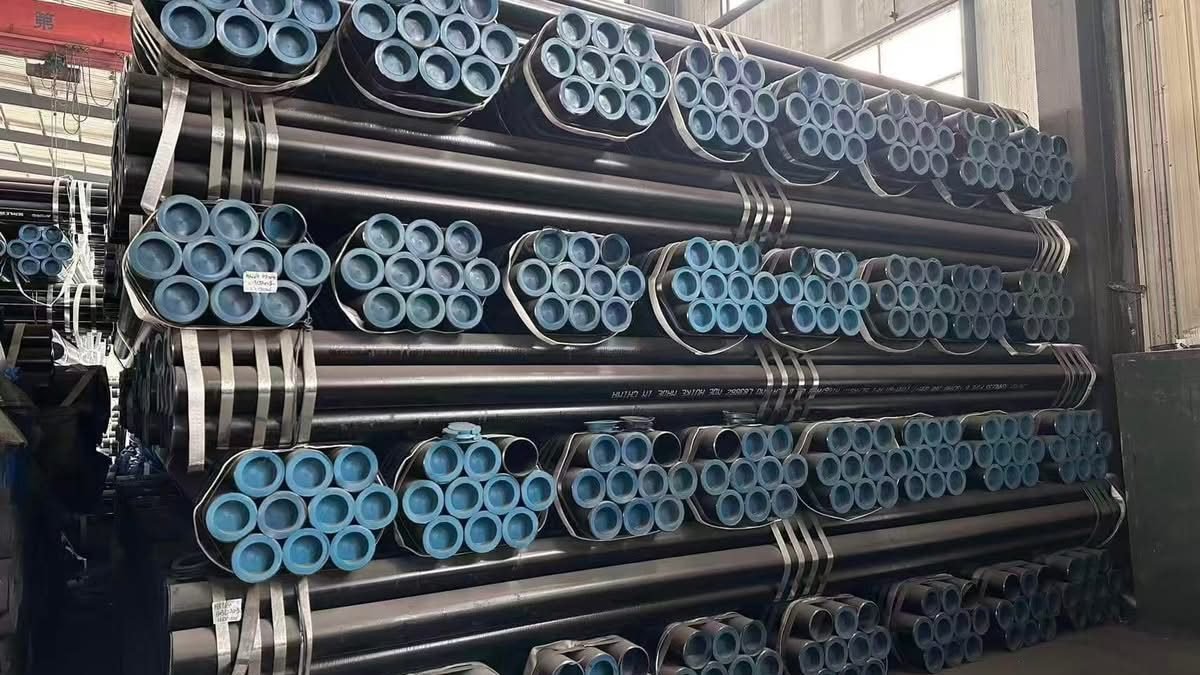
We supply Q235B ERW pipe from 21 mm to 219 mm outside diameter, with hydrostatic testing, flattening tests and eddy current inspection on request, cut to length and end capped for export. Send the diameter, wall, length, standard, test requirement and destination, and we will confirm stock and price.
Related products on this site: Q235B carbon steel flat bar and hot dip galvanized round steel tube.

