 QIDAMT
304 Stainless Steel Seamless Tube for Heat Exchangers and Instrument Lines
304 Stainless Steel Seamless Tube for Heat Exchangers and Instrument Lines
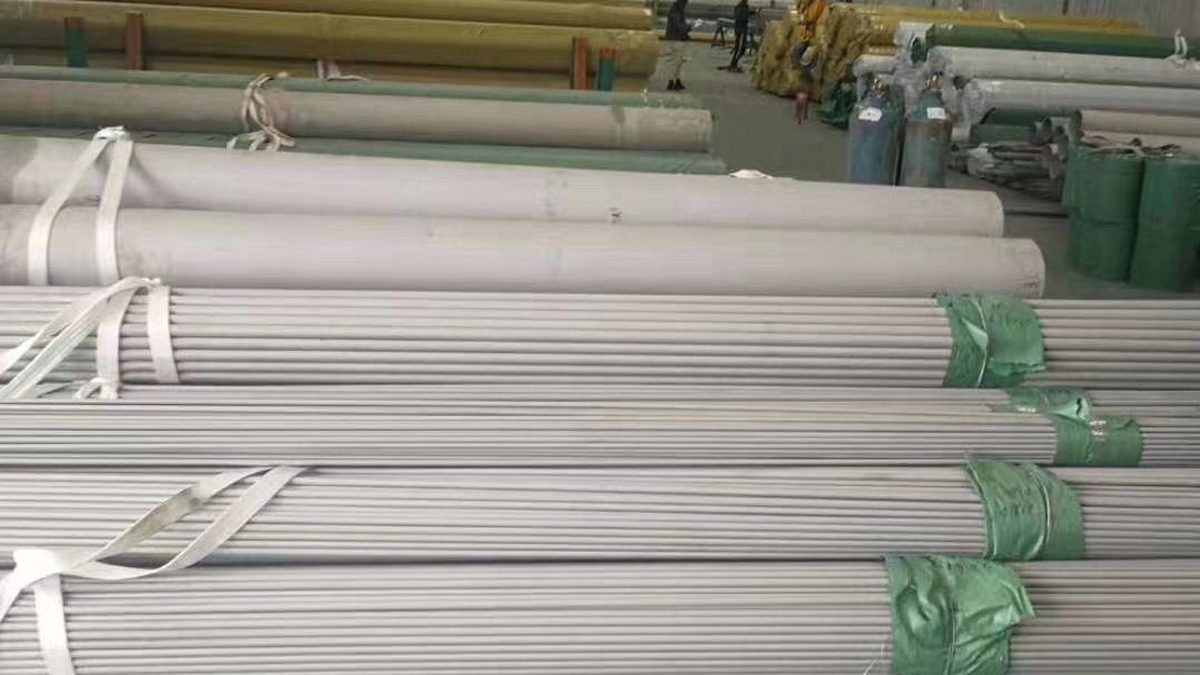
A 304 stainless steel seamless tube is a hollow section with no longitudinal weld anywhere in its body. The hollow is created from a solid billet by piercing and rolling, or from a Heavy wall hollow that is subsequently cold drawn to the finished size. Because the wall is metallurgically continuous around the circumference, there is no weld seam to radiograph, no heat affected zone in the body, and no filler metal to match to the parent metal. For buyers, that single structural fact explains both the price premium and the applications where the product is specified.
The grade in the title, 304, is the workhorse austenitic stainless steel of the tube trade. It combines 18 percent chromium with 8 percent nickel, which gives it a stable austenitic structure at room temperature, useful toughness, and good formability. It is not a high strength alloy, and it is not a seawater alloy. It is, however, the most widely available corrosion resistant tube grade in the world, which matters when a project needs a replacement length in a hurry.
This guide deals only with seamless 304 tube: what the grade contains, how the wall is toleranced, how pressure capacity is calculated, how the tube is manufactured and tested, and where buyers most often mis-specify the product. Welded tube, duplex tube and 316L tube are separate products with their own rules, and mixing the specifications on one purchase order is a common source of rejected deliveries.

What the Product Actually Is
Seamless describes a manufacturing route, not a quality grade. A billet is heated to roughly 1200 to 1260 degrees Celsius, pierced on a press to open a bore, and then elongated over a plug or mandrel until the shell reaches an intermediate size. That shell is then cold drawn or cold pilgered through a series of dies and mandrels until the final outside diameter and wall thickness are reached. The cold work raises strength and lowers ductility, so the tube is solution annealed after drawing and then pickled and passivated to restore a clean, passive surface.
The result is a tube with a homogeneous wall, no seam, and a grain structure that can be controlled by the final anneal. Those properties are why the product is chosen for heat exchanger tubes, boiler and superheater tubing, hydraulic and instrument lines, sanitary process piping, high pressure gas manifolds, and marine exhaust components where a welded seam would be a stress raiser.
Where the product is not needed is equally important. Low pressure decorative tube, structural handrail, furniture frames and general fabrication usually run on welded tube because it is cheaper and perfectly adequate. The premium for seamless is justified when the wall will be loaded in cyclic pressure, when the tube will be expanded into a tubesheet, when the bore must be inspected by eddy current along its full length, or when a seam failure would be a safety event rather than a maintenance item.
Grade Chemistry: 304, 304L and Where the Boundary Sits
Seamless tube is normally ordered to ASTM A312, ASTM A269 for instrumentation sizes, or EN 10216-5 in Europe. All three describe the same alloy family but differ in tolerances, testing and documentation. The chemistry limits below are the ones that appear on a mill certificate for the austenitic grades most often requested in this product family.
| Element, percent | 304 (TP304) | 304L (TP304L) | 316L (TP316L) |
|---|---|---|---|
| Carbon, max | 0.08 | 0.035 | 0.035 |
| Manganese, max | 2.00 | 2.00 | 2.00 |
| Phosphorus, max | 0.045 | 0.045 | 0.045 |
| Sulphur, max | 0.030 | 0.030 | 0.030 |
| Silicon, max | 1.00 | 1.00 | 1.00 |
| Chromium | 18.0 to 20.0 | 18.0 to 20.0 | 16.0 to 18.0 |
| Nickel | 8.0 to 11.0 | 8.0 to 12.0 | 10.0 to 14.0 |
| Molybdenum | Not specified | Not specified | 2.00 to 3.00 |
| Nitrogen, max | 0.10 | 0.10 | 0.10 |
The L suffix is not a marketing variant. It caps carbon at 0.035 percent so that chromium carbide does not precipitate in the 425 to 815 degrees Celsius sensitisation band during welding or slow cooling. A 304 tube welded into a header with a heavy wall can sensitise at the weld and then corrode intergranularly in a wet environment. If the assembly will be welded and will see moisture, order 304L, or order 304 and require the mill to demonstrate an intergranular corrosion test to ASTM A262 Practice E. The second option is rarely economical, which is why 304L dominates welded assemblies.
Molybdenum is the reason 316L exists. Two percent molybdenum raises resistance to pitting in chloride environments and to reducing acids. The trade-off is price and slightly lower thermal conductivity. A 304 tube in a coastal atmosphere will stain and eventually pit; a 316L tube in the same place will last far longer. Neither grade is a seawater material, and no austenitic tube should be used for continuous chloride service without a proper superalloy or duplex grade being evaluated.
Mechanical Properties and What They Mean for Fabrication
The values below are minimum requirements for the annealed condition. A mill normally reports results slightly above the minimum because the final anneal and the test scatter are controlled to leave a margin. The number that matters at the fabrication stage is the yield strength, because it governs springback in bending and the force needed in expansion.
| Property | 304 | 304L | 316L |
|---|---|---|---|
| Tensile strength, min | 515 MPa | 485 MPa | 485 MPa |
| Yield strength, min | 205 MPa | 170 MPa | 170 MPa |
| Elongation in 50 mm, min | 35 percent | 35 percent | 30 percent |
| Hardness, typical | 90 HRB max | 90 HRB max | 90 HRB max |
| Modulus of elasticity | 193 GPa | 193 GPa | 193 GPa |
| Thermal expansion, 20 to 100 C | about 17 x 10-6 per K | about 17 x 10-6 per K | about 16 x 10-6 per K |
An annealed 304 tube with a yield of 205 MPa springs back noticeably when bent on a small radius. Fabricators who bend thin wall tube on a three roll bender must overbend by roughly the elastic recovery of the section, otherwise the finished radius opens up after the load is released. Cold drawn tube that was not fully annealed behaves worse: it is stronger, less ductile, and it carries residual stress that later drives stress corrosion cracking at a weld or a chloride deposit.
The thermal expansion figure is the one that catches out piping designers. Austenitic stainless expands about 40 percent more than carbon steel over the same temperature rise. A 12 metre stainless line heated by 100 degrees Celsius grows about 20 mm. That movement has to be absorbed by expansion loops, bellows or sliding supports; otherwise the thrust lands on the tube wall and the supports.
Dimensions and Tolerances That Decide Acceptance
Seamless austenitic tube is produced from about 3 mm up to 762 mm outside diameter under ASTM A312, with walls from under 1 mm to more than 30 mm. Instrumentation sizes to ASTM A269 run smaller, typically 3 to 25 mm, and carry tighter concentricity and mandatory eddy current testing. The table below summarises the tolerances that appear in normal commercial practice. The governing standard always overrides this summary, and the purchase order should state which standard governs.
| Dimension | Typical range | Tolerance in common practice | Inspection method |
|---|---|---|---|
| Outside diameter | 3 to 762 mm | plus or minus 0.4 mm below 50 mm, plus or minus 0.8 percent above | Micrometer at four points, both ends |
| Wall thickness, cold drawn | 0.5 to 25 mm | minus 10 percent, plus 20 percent | Ultrasonic gauge, three points per end |
| Wall thickness, hot finished | 3 to 30 mm | minus 12.5 percent, plus 20 percent | Ultrasonic gauge or direct measurement |
| Length | 5.8 to 12 m | 0 to plus 25 mm on fixed lengths | Tape measure, end to end |
| Concentricity | Any | Wall variation within 10 percent around one section | Ultrasonic scan at one section |
| Straightness | Any | 1.5 mm per metre maximum | String line or bench check |
| End squareness | Any | 1 mm maximum gap on a square | Engineer square and feeler gauge |
The minus wall allowance is the single most expensive misunderstanding in tube purchasing. A tube ordered at 2.77 mm nominal wall can be delivered at 2.49 mm and be fully compliant with the standard. If the pressure calculation used 2.77 mm, the calculated margin has gone. The correct commercial route is to state the minimum wall required by the design, ask the mill to supply on nominal thickness, and accept the positive allowance as free margin. Designers who order to nominal and then check the delivered wall against that nominal number will reject good tube and delay the project.
Concentricity deserves its own line on the inspection report for heat exchanger work. A tube with a 10 percent wall eccentricity has a thin side that will expand unevenly into the tubesheet and a thick side that may not seal. Eddy current testing detects the eccentricity indirectly, but a direct ultrasonic wall scan at both ends is the cheaper and clearer evidence.
How the Tube Is Made and Where Quality Is Won or Lost
The route runs from billet to finished tube in six steps. First, the billet is cut, inspected and heated. Second, it is pierced to create a bore, which is the step that sets the inner surface condition for everything that follows. Third, the pierced shell is rolled over a mandrel to an intermediate wall. Fourth, the shell is cold drawn or cold pilgered in several passes, with an anneal between passes when the reduction exceeds what the alloy will tolerate. Fifth, the finished tube is solution annealed at 1040 to 1120 degrees Celsius and cooled rapidly enough to prevent carbide precipitation. Sixth, it is pickled in a nitric and hydrofluoric acid bath, passivated, straightened, cut and tested.
Two of those steps decide whether the tube will survive in service. The solution anneal decides the corrosion resistance of the wall, because a slow cool through the sensitisation band leaves chromium depleted zones at the grain boundaries. The pickle and passivation decide the surface chemistry, because a tube that leaves the mill with embedded iron, heat tint or a contaminated surface will start to rust in storage even though the alloy is correct.
Testing follows the standard and the purchase order. A312 requires a hydrostatic test or an alternative non-destructive test, a flattening or reverse flattening test on small sizes, a flare test, and product analysis. A269 additionally requires eddy current testing of the full length and tighter dimensional control. Buyers who need evidence for a pressure boundary should ask for the hydrostatic pressure, the hold time and the test medium on the certificate, not simply a statement that the test was performed.
Pressure Rating: The Calculation Buyers Actually Need
For thin wall tube the hoop stress governs, and the standard design expression is the Barlow formula in the form P equals 2 S t divided by D minus t, where P is internal pressure, S is allowable stress, t is the minimum wall and D is the outside diameter. Using the outside diameter rather than the inside diameter is deliberate, because the result is conservative and matches the boiler and pressure vessel codes.
A worked example makes the arithmetic concrete. Take a 38.1 mm outside diameter tube with 1.65 mm minimum wall, made of 304, and apply an allowable stress of 138 MPa at ambient temperature, which is the order of magnitude used for annealed austenitic tube in pressure vessel codes. The pressure is 2 times 138 times 1.65, divided by 38.1 minus 1.65. That gives 455.4 divided by 36.45, or about 12.5 MPa, which is about 125 bar. The same tube in 304L, with a lower allowable because the yield is lower, gives roughly 10.4 MPa. That difference of about 20 percent is the real cost of the L grade in a pressure design.
The calculation is only the start. Temperature derating, corrosion allowance, dynamic loads, water hammer and the code’s joint efficiency all modify the answer. For a seamless tube the joint efficiency is normally 1.0, which is the advantage over welded tube that is often quoted and rarely quantified. At the same wall, a welded tube with a joint efficiency of 0.85 needs about 18 percent more wall to reach the same rating, and that extra wall costs more than the seamless premium in many sizes.
Selection and Installation Rules
Select the grade first, then the wall, then the surface. Grade selection is a chloride question and a welding question. Below roughly 200 mg per litre chloride and with no welding of heavy sections, 304 is adequate. Above that, or where the assembly will be welded and cannot be fully annealed, move to 316L. Where the tube will carry high purity water, food or pharmaceutical product, the surface finish and the passivation record become as important as the grade.
Wall selection starts from the design pressure and temperature, not from the nearest stock size. Once the calculated minimum wall is known, add the corrosion allowance, then round up to the next standard wall. Do not round down and rely on the mill’s positive tolerance; a delivery at minus 10 percent is compliant and will quietly remove the margin.
Installation rules that matter in practice are few and firm. Support spacing should follow the pipe size and the wall, not the structural steel grid; thin wall austenitic tube sags more than carbon steel at the same span because the modulus is similar but the wall is thinner. Bending radius should be at least 2.5 times the outside diameter for a cold bend on annealed tube, and larger for thin walls or for tube that will see fatigue. Welds should be made with a matching filler, with an argon purge on the inside, and the heat tint must be removed and the joint repassivated. Tube should never be handled with carbon steel slings, wire brushes or grinding wheels that have previously touched carbon steel, because free iron embedded in the surface becomes a rust spot within days.
Where the tube is expanded into a tubesheet, the expansion sequence and the lubrication matter more than the tube tolerance. A dry expansion with too much clearance will score the bore; too little clearance will crack the tube. Follow the tube and tubesheet manufacturer’s clearance table and roll to the specified percentage of wall reduction.
Common Mistakes That Lead to Rejection or Early Failure
The first mistake is ordering 304 for a chloride environment and expecting stainless to mean maintenance free. Pitting in 304 starts at chloride levels that are routine in coastal air and in many cooling water circuits. The second is welding 304 into a heavy assembly without specifying 304L or an intergranular corrosion test; the weld sensitises and the tube fails at the grain boundaries rather than in the body.
The third is accepting a mill certificate that lists only chemistry. A tube certificate should carry the heat number, the tensile and yield results, the elongation, the hydrostatic pressure and hold time, the eddy current or radiography result where applicable, and the final anneal temperature. A certificate with chemistry alone is a material description, not evidence of a finished product.
The fourth is buying on nominal wall. The fifth is storing tube on the ground in a coastal yard, where condensation and chloride deposits start pitting within weeks. Tube should be stored under cover, on timber or plastic dunnage, with the ends capped, and it should not be stacked against carbon steel. The sixth is pickling only the weld and not the adjacent heat tint; the tinted zone is chromium depleted and is the site where corrosion begins.
The seventh is mixing A312 and A269 on one order. The two standards look similar on a certificate but differ in tolerance and testing. A buyer who writes A269 in the specification and receives an A312 tube has received a compliant A312 product and an uncompliant delivery, and the dispute is about the purchase order, not the quality.
Frequently Asked Questions
Is a seamless tube stronger than a welded tube of the same grade and wall? Not in the annealed body. The difference is the seam. A welded tube has a weld with a joint efficiency factor in pressure design and a heat affected zone that must be inspected; a seamless tube has neither. The body strengths are the same because both are annealed to the same specification.
What wall do I need for 10 bar of water pressure? For a 38 mm outside diameter tube in 304 at ambient temperature, a 1.5 mm minimum wall gives roughly 11 MPa of calculated capability, which is ten times the 10 bar requirement, so 1.5 mm is governed by handling and corrosion rather than pressure. Small diameter thin wall tube is almost always limited by mechanical damage, not by hoop stress.
Can 304 tube be used outdoors? Yes, in rural and most urban atmospheres, with the caveat that the surface will stain and that chloride deposits from coastal air, de-icing salt or industrial emissions will cause pitting. Outdoors near the sea, use 316L and accept that even 316L needs cleaning.
What is the difference between ASTM A312 and ASTM A269? A312 covers seamless and welded austenitic tube for general corrosive and high temperature service, with a hydrostatic or non-destructive test option. A269 covers seamless and welded austenitic tube for general service in instrumentation sizes, with mandatory eddy current testing, tighter tolerances and a cleaner surface requirement. Instrument lines and small bore impulse tubing normally specify A269.
How do I know the tube was properly annealed? Ask for the final anneal temperature range and the cooling method on the certificate, and for the intergranular corrosion test result if the tube will be welded. A hardness reading above the specification limit, or a yield strength well above the minimum with low elongation, is a sign that the anneal was incomplete.
Can I bend seamless tube after it has been pickled? Yes, but bend it before the final passivation if the bend is severe, or repassivate the bend afterwards. Cold bending leaves residual stress, and a stressed surface with a damaged passive film is the classic starting point for stress corrosion cracking in a chloride environment.
Need Seamless Tube Cut to a Specific Wall and Length?
We supply 304 and 316L seamless tube with mill certificates, hydrostatic or eddy current testing, and cut to length. Tell us the outside diameter, the minimum wall, the grade, the test standard and the delivery port, and we will come back with a priced offer and the available stock sizes.
Related reading on this site: 304 stainless steel sheet and plate and 316L stainless steel plate.

