 QIDAMT
430 Stainless Steel Sheet: Brushed Finish for Appliances and Panels
430 stainless steel sheet is a ferritic, 16–18% chromium grade used for indoor appliance panels, range hoods, refrigerator doors, elevator interiors, automotive trim and decorative cover plates. It is magnetic, nickel-free in practical terms and cheaper than 304, and it takes a brushed No.4 finish that hides fingerprints and small scratches. It is not, however, a coastal or wet-area substitute for 304.
What 430 Stainless Steel Sheet Is and Where It Is Used
430 is a ferritic stainless steel. Its microstructure is body-centred cubic at room temperature, which makes it magnetic and gives it a lower strain-hardening rate than the austenitic 304 grade. The alloy contains about 16–18% chromium and very little nickel, so it resists oxidation and many indoor corrodents at a lower cost than 304. It does not harden by heat treatment; strength comes from cold rolling and from the ferritic grain structure.
The largest use is visible appliance and interior surfaces. Washing machine tops, dryer drums, oven doors, microwave cavities, range hoods, refrigerator panels, dishwasher fascias, elevator walls and shop-fitting panels are commonly 430. The grade is also used for automotive trim, exhaust heat shields, kitchen utensil handles, decorative trim strips and some architectural cladding where the environment is dry and sheltered.
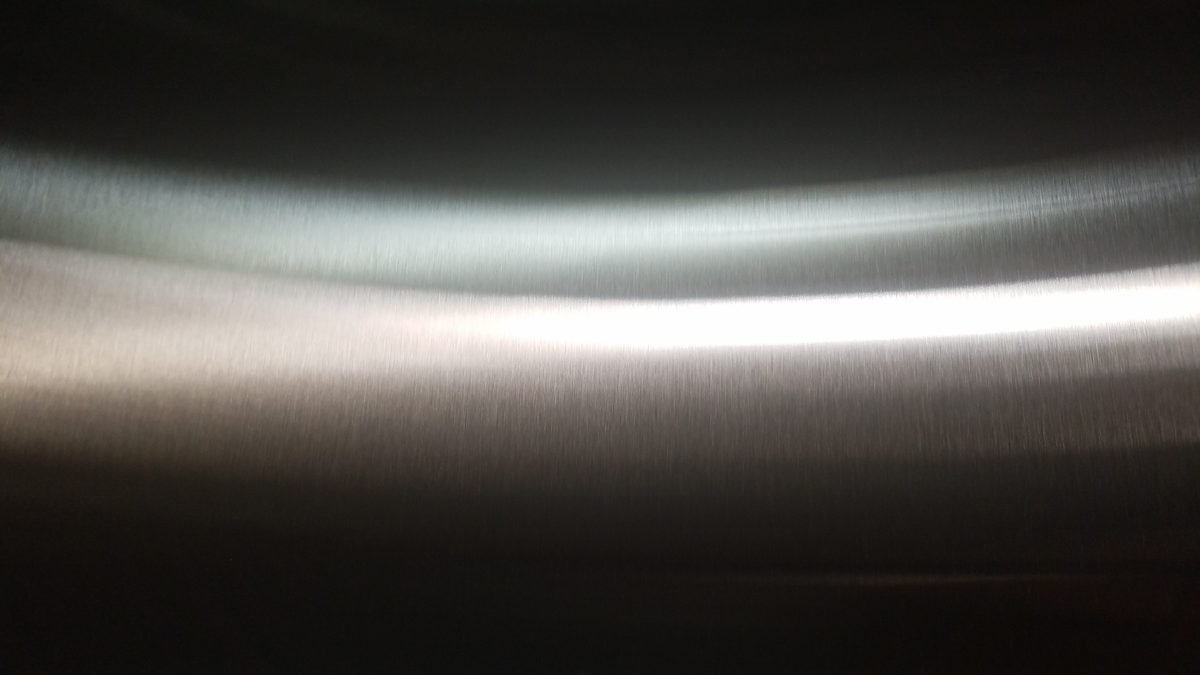
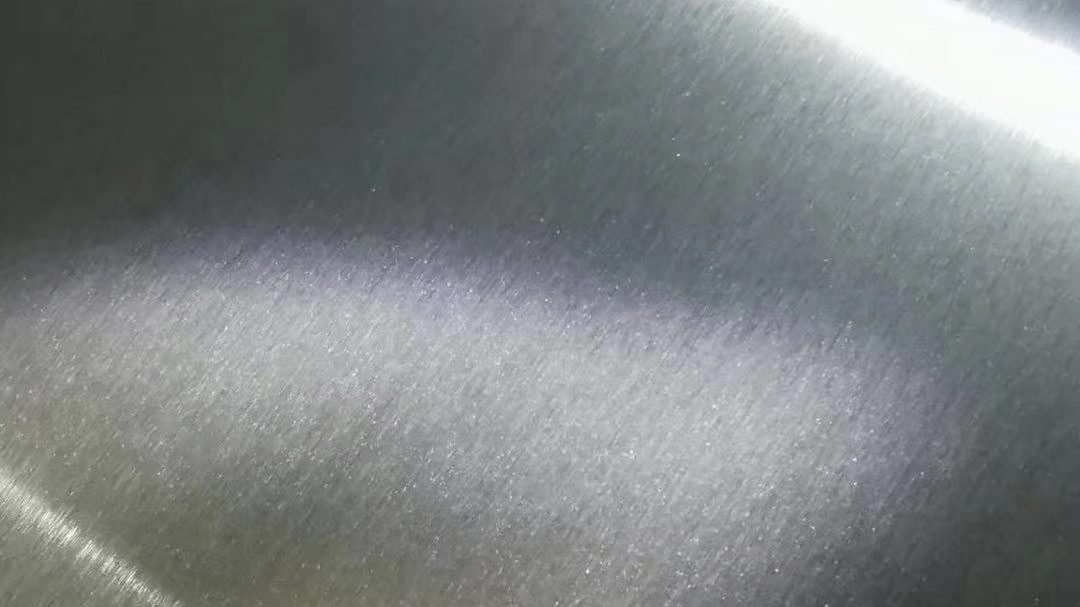
The brushed finish is the reason many buyers choose 430. A No.4 finish is produced by abrasive belts or brushes that cut short, parallel lines into the surface. Those lines scatter light, soften reflections and disguise fingerprints, dust and small handling scratches. On a large appliance panel, that is a practical advantage: a mirror finish shows every mark, while a brushed finish stays presentable with ordinary cleaning.
430 is not a general-purpose outdoor stainless. It has little resistance to chlorides, so coastal air, salt spray, swimming-pool chemicals and road de-icing salt will attack it. It is also susceptible to intergranular corrosion if it is overheated during welding or service. For a wet, chlorinated or marine environment, 304 or 316L is the correct grade, even though both cost more.
Grade Designation and Chemical Composition
430 is specified in ASTM A240, EN 10088-2 and GB/T 3280. The grade is intentionally simple: chromium provides the passive film, carbon is kept low to limit carbide precipitation, and nickel is limited because it is not needed for a ferritic structure. The table shows the standard composition window. The exact limits should be read from the applicable standard edition and the mill certificate.
| Element | Typical 430 range (%) | Role in the alloy | Purchasing note |
|---|---|---|---|
| Cr | 16.0–18.0 | Passive film; oxidation resistance | Below 16% reduces corrosion resistance |
| C | ≤ 0.12 | Strength and hardness | High carbon promotes carbide and intergranular attack |
| Mn | ≤ 1.00 | Deoxidation and toughness | Residual; not a substitute for nickel |
| Si | ≤ 1.00 | Deoxidation | Excess silicon reduces ductility |
| P | ≤ 0.040 | Impurity | Segregates at grain boundaries |
| S | ≤ 0.030 | Impurity | Improves machinability but hurts weldability |
| Ni | ≤ 0.75 | Residual | Low nickel is the cost advantage over 304 |
| Mo | ≤ 0.50 | Residual | Not a molybdenum-bearing grade |
| Fe | Balance | Matrix | Magnetic ferritic structure |
Typical ASTM A240 / EN 10088-2 window for 430. Confirm carbon and chromium limits on the mill certificate before welding or deep forming.
Carbon is the element that deserves the closest look. A sheet at 0.12% carbon is acceptable for a decorative panel, but it is less forgiving in a welded joint or in a part that will be stretched. Carbon promotes chromium carbide precipitation at grain boundaries during slow cooling, and those carbide networks are the starting point for intergranular corrosion. For a welded appliance part, a low-carbon 430 or a stabilised ferritic grade may be the better choice.
Mechanical Properties
430 sheet is normally supplied annealed and pickled, sometimes with a skin pass and a brushed finish. It is stronger than annealed 304 in yield but has lower elongation and a lower strain-hardening exponent. The table gives typical room-temperature values for 0.5–3.0 mm sheet; temper rolling and brushing can raise strength slightly and reduce elongation.
| Property | Annealed 430 | Skin-passed / brushed | Notes |
|---|---|---|---|
| 0.2% proof stress, Rp0.2 (MPa) | 205–260 | 230–300 | Ferritic grade; magnetic |
| Tensile strength, Rm (MPa) | 450–550 | 480–580 | Higher than annealed 304 |
| Elongation, A50 (%) | 20–28 | 15–22 | Lower than 304; bend radius matters |
| Hardness, HRB | 75–89 | 85–95 | Brushing work-hardens the surface lightly |
| Density (g/cm³) | 7.70 | 7.70 | Slightly lower than 304 |
| Thermal conductivity (W/m·K) | 15–20 | 15–20 | Lower than carbon steel |
| Electrical resistivity (µΩ·m) | 0.60–0.75 | 0.60–0.75 | Higher than carbon steel |
Typical mechanical values for annealed and brushed 430 sheet. Confirm the test direction and the mill’s temper designation.
The practical consequence is that 430 bends less forgivingly than 304. A 90-degree bend in 1 mm 430 sheet may need a radius of 1.5–2.0 times thickness, and the bend line should run across the rolling direction to avoid cracking at the outside fibre. A tight bend in a skin-passed or brushed sheet is more likely to crack than the same bend in the annealed condition, because the surface has already been work-hardened.
Dimensions, Tolerances and Supply Forms
430 sheet is ordered by thickness, width, length, finish and temper. Thickness is usually 0.3–3.0 mm; wider sheet is available but the choice of finish and flatness becomes more limited. The finish designation matters as much as the gauge: 2B is a smooth cold-rolled finish, BA is bright annealed, No.4 is a general brushed finish and hairline is a finer directional finish. A drawing that says only “brushed” leaves the grit and the line direction undefined.
| Feature | Common range | Typical tolerance | Ordering note |
|---|---|---|---|
| Thickness | 0.3–3.0 mm | ±0.03–0.08 mm | State gauge and whether the finish is on one or both sides |
| Width | 600–1500 mm | ±2 mm | Wide sheet may have a restricted finish range |
| Length | 1000–6000 mm | ±5 mm | Cut-to-length or coil-fed |
| Flatness | — | 1–5 mm per metre | Critical for appliance panels and elevators |
| Surface | — | 2B, BA, No.4, hairline | State grit, line direction and protective film |
| Camber | — | ≤ 3 mm per metre | Matters for automatic roll forming |
| Edge | — | Mill edge or slit | Slit edge can have a burr |
| Protective film | — | PVC or laser film | Specify if the panel will be handled before assembly |
Typical commercial windows for 430 sheet. Brushed finishes are directional; the line direction must be shown on the drawing or the panel will look different from the sample.
The finish specification should include the grit number and the line direction. A No.4 finish from one mill is not necessarily identical to a No.4 finish from another; the abrasive sequence, the belt wear and the final cleaning all affect the appearance. For a multi-panel appliance front, request a physical sample and approve it under the same lighting as the finished product. A photograph is not sufficient because brushed surfaces change with the angle of view.
Flatness and camber are the other common disputes. A sheet that is flat on a pallet can bow after slitting or after the protective film is applied. A sheet with camber will not track straight in a roll former, and the finished panel will have a visible edge wave. For a large visible panel, specify flatness in the finished part, not only in the coil or sheet, and agree on the measurement method.
How 430 Sheet and Brushed Finish Are Made
430 is made by melting ferritic stainless steel scrap and alloy additions in an electric furnace or AOD converter, casting into a slab or billet, and hot rolling to a coil. The coil is annealed and pickled to remove scale, then cold rolled to the final thickness. Cold rolling raises strength and improves thickness tolerance; annealing between passes restores ductility and recrystallises the grain.
The final anneal is critical. If the strip is under-annealed, it stays hard and bends poorly. If it is over-annealed, the grain coarsens and the surface becomes rough after brushing. The annealed strip is pickled, rinsed, skin-passed and then brushed. A skin pass of a few percent reduction improves flatness and surface consistency; it also slightly raises yield strength, which is why a skin-passed sheet behaves differently from a fully annealed one.
Brushing is a mechanical finishing operation. The strip passes under a series of abrasive belts or brushes that run in one direction. The grit sequence determines the line density and the gloss; a coarse grit gives a stronger, more visible line, while a fine grit gives a softer, more uniform appearance. The lines run along the strip direction, so the finished part’s orientation on the sheet determines whether the grain is vertical or horizontal on the appliance.
The defects to watch for are scratch marks across the grain, belt marks, heat tint from poor annealing, and residual oil. A cross-grain scratch is much more visible than a line along the grain, so handling and stacking matter. Belt marks appear as a rhythmic pattern and usually mean a worn or loaded belt. Heat tint is an oxide film from the anneal and will not brush out. Residual oil can stain the film or interfere with adhesive bonding.
Fabrication, Bending and Welding
430 sheet can be sheared, punched, roll-formed and bent with conventional stainless tooling. Its springback is lower than 304 but its elongation is also lower, so the bend radius should not be reduced just because the material is stronger. For a 1 mm sheet, a 1.5–2.0 mm inside radius is a practical starting point; a tight radius on a brushed sheet can crack the outside fibre and leave a visible line.
Laser cutting is common for appliance panels. The cut edge is usually clean enough for a decorative part, but it can have a narrow heat-affected zone and a slight dross at the bottom. For a visible edge, a secondary deburr or a machined edge is needed. Plasma cutting is faster for thick sheet but leaves a rougher edge and more heat tint; it is not the right process for a brushed face that will not be refinished.
Welding 430 is possible but not as forgiving as welding 304. The ferritic grain grows in the heat-affected zone, and the loss of toughness can cause cracking under restraint. Use a matching 430 filler or a austenitic filler such as 309 for dissimilar joints, keep the heat input low, and avoid preheating. Do not weld a brushed face without protecting it; weld spatter and heat tint are difficult to remove without destroying the brushed line.
After welding, a post-weld anneal may be needed to restore ductility, but it also risks grain growth and distortion. For a decorative panel, it is often better to design the joint so that welding is on a hidden flange or a separate frame, leaving the brushed face untouched. If the weld is visible, plan a local re-brushing operation and match the grain direction to the surrounding panel.
Selection Rules for Buyers
- Choose 430 for dry indoor appliance and elevator panels. It is cost-effective and takes a good brushed finish.
- Choose 304 for wet, chlorinated or coastal service. 430 has little resistance to chlorides and is not a marine grade.
- Choose 304 or 316L for deep-drawn sinks and complex formed parts. 430 has lower elongation and is more prone to cracking.
- Choose 430 for magnetic applications. It is ferritic and magnetic, which can be an advantage for clamps and sensors.
- Do not choose 430 for welded pressure or safety parts. Grain growth and intergranular corrosion risk are significant.
- Specify the finish by grit and direction. “Brushed” alone is not a finish specification.
Cost is the usual reason for choosing 430, but the comparison should include the total finished cost. 430 is cheaper per tonne, yet it may need more careful bending, a different welding procedure and a protective film. If the part is a large flat panel with no welding, the saving is real. If the part is a deep-drawn or welded assembly, the fabrication cost can erase the material saving.
Corrosion environment is the second filter. A heated indoor appliance sees condensation, detergent and food acids. 430 is adequate for many of those conditions, but it is not adequate for a commercial kitchen with chlorinated cleaners or a coastal installation. If the panel will be cleaned with hypochlorite or a strong acid, 304 or 316L is the safer choice. Do not assume that “stainless” means “no corrosion.”
Installation and Maintenance Rules
Brushed 430 panels should be handled with clean gloves and kept covered until installation. Fingerprints are more visible on a fresh brushed surface than on a 2B surface, and the protective film should stay on until the panel is in place. Remove the film within the manufacturer’s recommended time; a film left in the sun or in a hot workshop can leave adhesive residue that is difficult to remove without affecting the brushed line.
Clean with a soft cloth, mild detergent and water, and wipe along the grain, not across it. A circular motion leaves marks that cross the brushed lines and are much more visible. Do not use steel wool, abrasive pads or chloride-based cleaners. If a scratch appears, a local re-brush with the correct grit can restore the appearance, but the repair area must be blended along the full length of the panel or it will show as a patch.
Allow for thermal expansion in long panels. 430 expands at roughly 0.017% per °C, so a 2 m panel heated 40 °C grows by about 13 mm if it is unrestrained. In an appliance or elevator, the panel is usually small enough that the movement is absorbed by the mounting clips, but a long facade or a large cover plate needs slotted holes or a flexible fixing. Do not clamp a long panel rigidly at both ends.
Avoid contact with steel, aluminum and copper in wet conditions. 430 is less noble than 304 in some environments, and a galvanic couple can concentrate corrosion at the joint. Use compatible stainless fasteners or isolating washers, and keep the joint dry. In a dry indoor application, this is a minor issue; in a wet or coastal one, it becomes a maintenance problem.
Common Misconceptions
- “430 is magnetic, so it is not real stainless.” 430 is ferritic stainless and is magnetic by design. Magnetism is not a test for stainless steel.
- “430 is just a cheaper 304.” It is a different crystal structure with lower nickel, lower ductility and much lower chloride resistance.
- “Brushed 430 and brushed 304 look the same.” They can look similar, but the corrosion performance and the fabrication behaviour are different.
- “430 can be used outdoors if it is painted.” A paint coating helps, but cut edges, scratches and fasteners remain corrosion sites.
- “All No.4 finishes are identical.” Grit, belt sequence and line direction vary by mill; approve a physical sample.
- “430 welds like 304.” It is weldable, but grain growth and intergranular corrosion make it less forgiving, especially in restrained joints.
Inspection and Acceptance
Receiving inspection for 430 sheet should cover grade, thickness, flatness, finish and surface defects. Use a micrometer at several points across the width; a sheet can be thinner at the edge than in the centre. Check flatness on a surface plate and check camber with a straightedge. Inspect the brushed surface under grazing light for cross-grain scratches, belt marks and heat tint. A defect that is invisible under diffuse light can be obvious under the lighting of a showroom or a kitchen.
For a visible panel, approve a sample under the same lighting and at the same viewing angle as the finished product. Brushed surfaces are directional; a panel that looks correct on a horizontal table can look different when mounted vertically. If the panels are supplied in batches, compare them side by side; a batch-to-batch difference in gloss or line density is a common complaint that a certificate will not resolve.
For welded or formed parts, check the bend radius and the heat-affected zone before mass production. A bend that cracks in the first part will crack in every part unless the radius, the grain direction or the temper is changed. A weld that shows heat tint on the brushed face will need a re-finishing step that may not be economically viable.
Frequently Asked Questions
Is 430 stainless steel magnetic?
Yes. 430 is ferritic and magnetic at room temperature. Magnetism is normal for this grade and is not a sign of poor quality.
Can 430 be used outdoors?
Only in dry, sheltered conditions. It has poor resistance to chlorides and is not suitable for coastal, marine or de-icing salt exposure.
What is a No.4 brushed finish?
A directional abrasive finish produced with belts or brushes, typically 120–180 grit. It hides fingerprints and small scratches and is common on appliance panels.
Can 430 be welded?
Yes, but it is less forgiving than 304. Use low heat input, a matching or 309 filler, and avoid restrained joints. Visible welds on brushed faces need re-finishing.
Is 430 suitable for a kitchen sink?
Usually not for a high-quality sink. 430 has lower corrosion resistance and ductility than 304, and sinks are deep-drawn and exposed to chlorides.
How do I clean brushed 430?
Use mild detergent and a soft cloth, wiping along the grain. Avoid steel wool, abrasive pads and chloride-based cleaners.
Need 430 stainless steel sheet in 2B, BA or No.4 brushed finish?
QIDAMT supplies stainless sheet, plate, coil and strip from Liaocheng, with finish samples, protective film and export packing. Send thickness, width, finish and quantity for a quotation.