 QIDAMT
304 Stainless Steel Wire: Coil Weight, Diameter Tolerance and Annealing
304 stainless steel wire is cold-drawn, bright-annealed wire supplied in coils, used for woven mesh, springs, brushes, redraw stock and light structural ties. It is a drawing product rather than a rolling product: the diameter is set by a pass schedule of dies, the mechanical state by how much cold reduction remains after the last anneal, and the surface by pickling and lubrication. This guide explains what the 304 designation actually guarantees, how coil weight and carrier size are specified, which diameter tolerances are realistic, and where bright annealing stops being optional.
What 304 Stainless Steel Wire Is
Stainless steel wire starts as a hot-rolled wire rod, usually 5.5 mm or 6.5 mm coil, which is pickled, coated with a drawing lubricant carrier and then drawn down through a series of carbide dies to the finished diameter. Each pass reduces the section by roughly 15–25 %; between passes the wire may be annealed to restore ductility, or left in the cold-worked state when a high tensile strength is wanted. The result is a coil of wire with a circular section, a controlled diameter and a surface that ranges from matt grey to bright mirror depending on the last treatment.
Grade 304 — EN 1.4301, UNS S30400 — is the general-purpose austenitic stainless steel. Its 18 % chromium and 8 % nickel produce a stable austenitic structure with a self-renewing oxide film, so the wire resists rural and urban atmosphere, fresh water, most food acids and many mild chemicals. It is not seawater-resistant, and it is not immune to chloride pitting; 316L is the grade for coastal, marine and chloride-bearing service.
The product forms a buyer sees are:
- Bright annealed wire in the soft condition, used for weaving, knitting, filtration mesh and cable armouring.
- Cold-drawn spring wire with a high tensile strength and low elongation, used for springs, brushes and tension members.
- Soap-coated or lime-coated wire for redrawing or for wire cloth weaving, where the coating protects the surface during contact.
- Cut-length wire and pre-straightened lengths for welding, brazing and tie applications.
Chemical Composition and What It Means for Wire
The 304 window is narrow enough that most mills meet it without difficulty, but wire drawing amplifies two elements more than plate rolling does: carbon and sulphur. Carbon raises the cold-drawn strength but reduces ductility, so a wire at the top of the carbon range will draw to a high tensile but crack in tight bends. Sulphur improves machinability but harms weldability and hot ductility, and it segregates at grain boundaries during drawing.
| Element | Range (%) | Role | Wire-specific consequence |
|---|---|---|---|
| C | ≤ 0.08 | Austenite stability, strength | High C: fast work hardening, cracking in fine dies |
| Si | ≤ 1.00 | Deoxidation | High Si: scale, poor pickling |
| Mn | ≤ 2.00 | Austenite former | Balances S and keeps hot ductility |
| P | ≤ 0.045 | Impurity | Segregation, reduced drawability |
| S | ≤ 0.030 | Impurity | High S: stringers, breaks during drawing |
| Cr | 18.0 – 20.0 | Passive film | Below 18 %: reduced corrosion margin |
| Ni | 8.0 – 10.5 | Austenite former | Low Ni: ferrite stringers, magnetic response |
| N | ≤ 0.10 | Austenite stabiliser | High N: higher strength, lower ductility |
| Fe | Balance | Matrix | — |
Typical 304 composition to EN 10088-3 / ASTM A313; the mill certificate governs acceptance.
A magnetic test is a quick incoming check. Fully austenitic 304 wire should be essentially non-magnetic in the annealed condition; cold drawing produces some strain-induced martensite and a slight magnetic attraction, which is normal. Strong attraction in an annealed coil suggests the wire is not 304, or that it has been severely cold worked and not annealed.
Mechanical Properties by Condition
Wire is specified by condition as much as by grade. The same 2.0 mm 304 wire can be 620 MPa in the annealed state and 1 300 MPa after cold drawing, with the elongation falling from 40 % to 3 %. A purchase order that says only “304 wire 2 mm” leaves the most important variable open.
| Condition | Tensile strength Rm (MPa) | Elongation A (%) | Typical application | Notes |
|---|---|---|---|---|
| Soft annealed (bright) | 500 – 700 | ≥ 35 | Weaving, mesh, knitting, cable armour | Best ductility; lowest strength |
| Light drawn (quarter hard) | 800 – 1 000 | 10 – 20 | Fencing, ties, light springs | Compromise between formability and strength |
| Half hard | 1 000 – 1 200 | 5 – 10 | Springs, brush wire | Limited bending after drawing |
| Full hard / spring temper | 1 200 – 1 500 | 2 – 5 | Springs, tension members | Cracks if bent sharply; stress relieve after forming |
| Spring temper, fine wire (<1 mm) | 1 400 – 1 700 | 1.5 – 3 | Instrument springs,medical brushes | Diameter tolerance dominates performance |
Indicative ranges for 304 wire at 1–4 mm; fine wire tends to the upper end. Confirm by tensile test on the finished coil.
Tensile strength is not uniform along a coil. The head and tail of a drawn coil see different die conditions and different cooling, and a mill that tests only the middle can ship a coil whose ends are 10 % softer. For spring making, ask for a tensile result at both ends, or specify a minimum tensile that the mill must verify at head and tail.
Elongation matters more than strength for weaving. A bright annealed 304 wire at 0.25 mm must survive thousands of flex cycles over a loom reed; a high-tensile wire of the same diameter will snap at the first sharp shed change. Conversely, a spring made from annealed wire will sag permanently after the first load cycle. Condition, not grade, decides both outcomes.
Diameter Tolerance and Coil Weight
Wire diameter is quoted in millimetres, but the tolerance is usually expressed as a band that tightens as the diameter falls. Fine wire is sold with a tolerance of a few hundredths of a millimetre because the end use — a woven mesh opening, a spring index, a brush tuft — depends on it. A coil that runs 0.03 mm over size will weave a mesh with 3 % less open area, which is enough to fail a filtration specification.
| Nominal diameter (mm) | Typical tolerance (mm) | Ovality (mm, max) | Coil weight (kg) | Carrier |
|---|---|---|---|---|
| 0.20 – 0.50 | ± 0.010 | 0.010 | 1 – 5 | Spool or plastic reel |
| over 0.50 – 1.00 | ± 0.020 | 0.015 | 5 – 10 | Reel or coil without carrier |
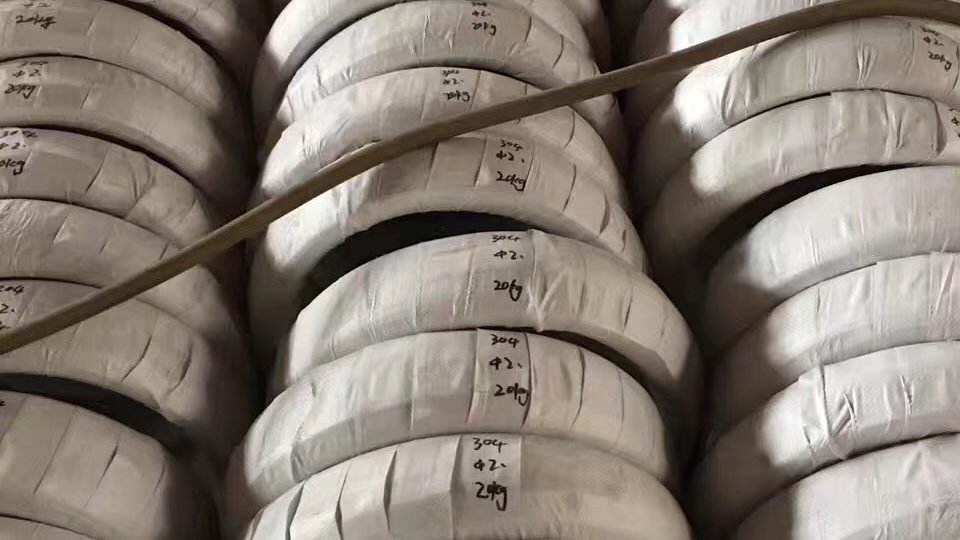
| over 1.00 – 2.00 | ± 0.030 | 0.020 | 10 – 20 | Coil, strapped |
| over 2.00 – 4.00 | ± 0.040 | 0.025 | 15 – 25 | Coil, strapped |
| over 4.00 – 8.00 | ± 0.050 | 0.030 | 20 – 30 | Coil, strapped or bundled |
Typical drawn-wire tolerances to ISO 9445 / GB/T 4357 class 2; tighter classes are available on request.
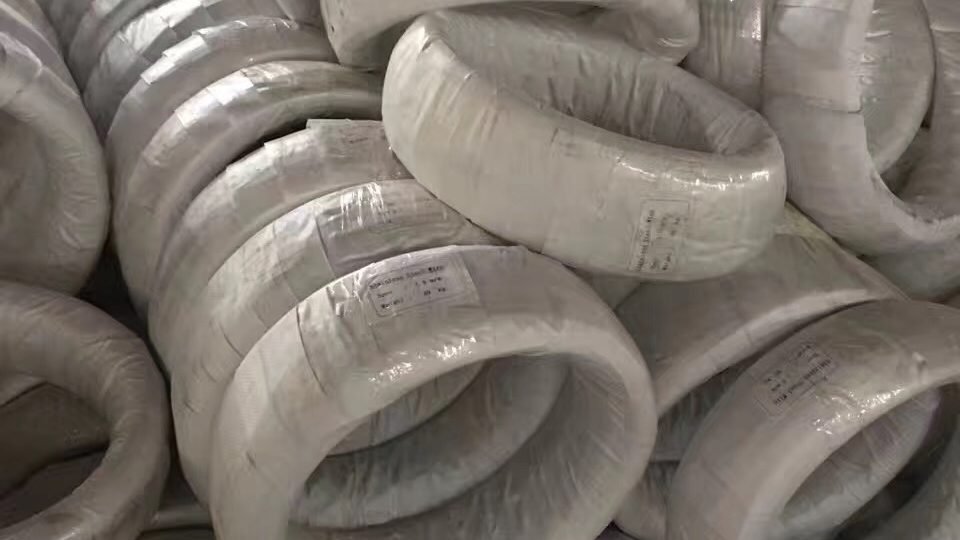
Coil weight is a handling parameter, not a quality parameter, but it changes the economics of the whole line. A 20 kg coil suits a drawing bench or a large weaving creel; a 5 kg spool suits a spring coiler that cannot pull a heavy coil without tension variation. Specify the coil weight and the carrier, and state whether the coil must be layer-wound or random-wound. Layer winding prevents the wire from crossing itself and reduces entanglement, at a slightly higher cost.
Inner diameter of the coil and the spool bore also matter for automated equipment. A coil wound on a 300 mm bore will not fit a creel designed for 200 mm; conversely a small spool runs out quickly and multiplies changeover time. Give the machine’s spindle or creel dimensions, not just the weight.
Drawing, Annealing and Surface Finish
The draw schedule is the heart of wire quality. Each pass reduces area; the total reduction between anneals is kept below roughly 60–70 % for 304, because above that the strain-induced martensite makes the wire too brittle to draw without breaks. Intermediate annealing dissolves the martensite and restores the austenite, and the final anneal decides whether the product is soft wire or spring wire.
Bright annealing is done in a continuous furnace with a hydrogen or hydrogen-nitrogen atmosphere at about 1 050–1 100 °C, followed by rapid cooling. The atmosphere prevents oxidation, so the wire comes out with a clean, reflective surface and no need for a final pickling step. Wire annealed in a poor atmosphere comes out grey or straw-coloured; pickling will clean it but leaves a matte surface and a slightly reduced diameter, which is why bright annealed wire carries a diameter advantage on fine sizes.
Surface state is part of the specification for three reasons. First, a soap or lime coating is needed for redrawing and for weaving, and it must be uniform or the wire will slip and wear the die. Second, any residual drawing lubricant will carbonise during annealing and leave dark spots that cannot be removed. Third, surface defects act as stress raisers: a scratch 10 % of the diameter deep will halve the fatigue life of a spring.
For wire that will be woven or knitted, ask for a surface free of laps, scratches and die marks, and state whether the coating is to be removed before delivery. For wire that will be welded or brazed, the surface must be clean and uncoated; residual lubricant causes porosity and poor wetting.
Selection and Incoming Inspection
A wire specification should fix six variables: grade, condition, diameter and tolerance, coil weight and carrier, surface and coating, and packing. Leaving condition or coating to the mill is how a weaving line receives spring-temper wire, or a spring shop receives soap-coated wire it cannot use.
- Grade: 304 for general corrosion and food service; 316L where chlorides, coastal air or cleaning chemicals are present; 310S or 904L for high temperature or severe acids.
- Condition: annealed for forming and weaving; quarter/half hard for ties and light springs; spring temper for energy storage, with stress relief after coiling.
- Diameter: nominal plus tolerance class; for mesh, state the aperture and wire diameter together, because both set the open area.
- Coil: weight, bore, layer-wound or random-wound, and whether spools must be returnable.
- Surface: bright annealed, pickled matte, soap coated, or bare clean for welding.
- Packing: coil in a moisture-barrier bag with desiccant for sea freight; wire is thin and a damp container will stain it before it reaches the loom.
Incoming inspection can be simple and still catch most problems. Measure diameter with a micrometer at three points along the coil and at both ends; check ovality; pull a short length through a 90° bend to look for cracking; verify the coil label against the certificate for heat number; and confirm the surface under a low-power loupe. A magnetic check separates 304 from 430, and a spot test with copper sulphate solution will quickly reveal any free iron contamination on the surface.
For a mill that also supplies flat and tubular stainless products, ordering wire with the plate for the same project keeps the heat records aligned. QIDAMT ships 304 wire alongside 304 2B stainless sheet and 316L plate, so a fabricator building a mesh panel and its frame can hold one certificate set instead of three.
What Drives Wire Cost and Minimum Order
Wire is priced by weight, but the cost per usable metre is decided by four factors that a buyer can influence. The first is diameter: drawing a 0.5 mm wire from 5.5 mm rod needs many more passes and more intermediate anneals than drawing a 4 mm wire, so the labour and energy per kilogram rise sharply as the size falls. The second is tolerance class: holding ± 0.010 mm on fine wire requires a final die in good condition and a slower line speed, and a tolerance band that is twice as wide can cut the reject rate in half. The third is condition: spring temper requires a controlled final reduction and often a stress-relief pass, while bright annealed wire requires a hydrogen furnace and tight atmosphere control. The fourth is coil format: layer winding, returnable spools and individual bagging all add cost that a random-wound bare coil does not carry.
Minimum order quantities follow the same logic. A mill runs a heat of steel, draws it to a schedule, and anneals in a batch furnace; a 500 kg order of a standard 2 mm bright annealed wire can often be filled from stock, while a 100 kg order of 0.3 mm wire in a tight tolerance class may require a dedicated drawing run. For project quantities, combining several diameters from the same grade and heat into one order usually lowers the unit price more than negotiating on a single size. It also gives the fabricator one certificate set for the whole project, which simplifies incoming inspection and traceability documentation.
Delivery format deserves the same attention. Coils shipped loose in a container rub against each other and develop surface marks; coils bagged with desiccant and packed in a wooden crate arrive clean. For sea freight, insist on a moisture barrier and a desiccant pack, and inspect the bag for tears on arrival before signing. Wire is a high surface-area product, and a small amount of condensation in a container will stain an entire coil.
Common Mistakes
- Ordering “304 wire” without a condition. The same coil can be soft or full hard; the mill will supply whichever is in stock, and the application may need the other.
- Using spring temper for a part that must be bent after delivery. Full-hard wire has 2–5 % elongation; a sharp bend will crack it. Form first, then stress relieve.
- Ignoring diameter tolerance on fine wire. A 0.02 mm oversize on 0.5 mm wire changes the mesh aperture and the spring index by 4 %, enough to miss a specification.
- Buying uncoated wire for redrawing. Without a lubricant carrier the wire will gall in the die, and the surface will be scraped and cracked.
- Storing coils on a damp floor. Condensation between wraps leaves stain and pitting that cannot be polished out; keep coils bagged with desiccant.
- Assuming 304 is seawater-proof. It pits in chloride; use 316L for coastal, pool and marine hardware.
Frequently Asked Questions
What does 304 mean on a wire coil label?
It identifies the austenitic grade (EN 1.4301, UNS S30400) with roughly 18 % chromium and 8 % nickel. The label should also carry the heat number, diameter, coil weight and condition; a label with only “304” is incomplete for any controlled application.
Can I weld 304 wire?
Yes, with TIG or resistance welding and a matching or higher-alloy filler. Fine wire is difficult to weld because the heat-affected zone is large relative to the section; for mesh, welded joints are usually made on the frame, not on the wire itself.
Why does my 304 wire become magnetic after drawing?
Cold drawing transforms some austenite to strain-induced martensite, which is magnetic. A slight attraction is normal and disappears after annealing. Strong magnetism in a supposedly annealed coil suggests it was not annealed, or that it is a different grade.
How is coil weight chosen?
Match it to the payout equipment: a 20 kg coil for a drawing bench or large creel, a 5–10 kg spool for a spring coiler with limited tension control. Also confirm the bore and the coil outside diameter fit the machine.
What is bright annealing?
Continuous annealing at about 1 050–1 100 °C in a hydrogen-bearing atmosphere, followed by rapid cooling. It restores ductility, dissolves carbides and leaves a clean reflective surface without a pickling step.
Is 304 wire suitable outdoors?
In rural, urban and most industrial atmospheres, yes. In coastal air, de-icing salt or chloride cleaning agents, use 316L. The tell-tale is brown staining followed by pitting on the wire surface within a few months.
Need 304 wire in a specific diameter, temper or coil weight?
Send the diameter, condition, coil weight and application; we will confirm mill availability and lead time.

