 QIDAMT
Stainless Steel Decorative Screen Partition: Grade, PVD Finish and Fabrication
A stainless steel decorative screen partition is a laser-cut and PVD-coated metal panel system used to divide space without blocking light. This guide covers the substrate grades, coating build-up, panel sizes, frame tolerances, installation rules and the failure modes that decide whether a screen still looks right after five years indoors.
What a Decorative Screen Partition Actually Is
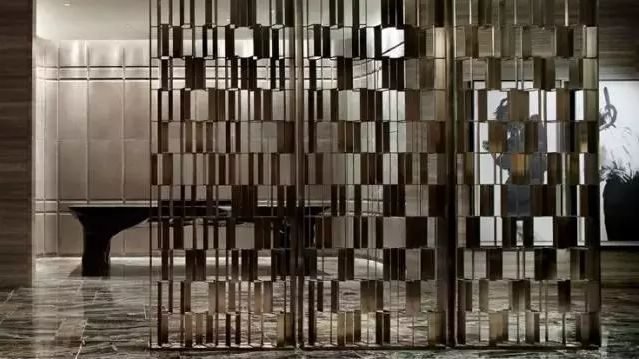
Decorative screens sit between architecture and furniture. They are not structural walls, and they are not pure decoration either. In practice a screen partition is a framed assembly of laser-cut stainless steel panels, usually 0.8 mm to 3.0 mm thick, fixed into a tube frame and installed as a free-standing divider, a ceiling-hung panel or a fixed partition in a lobby, restaurant, showroom or lift lobby.
The product is defined by three things: the substrate alloy, the surface finish and the fixing system. Change any one of them and the same drawing behaves differently. A 304 panel with a 2B finish and a 30 × 30 mm frame is a different product from a 201 panel with a mirror finish and a concealed spigot fixing, even though both are described as “stainless screens” in a quotation.
Where screens are used
- Interior space division — restaurant booths, hotel lobby dividers, office reception screens, clinic waiting areas.
- Decorative cladding panels — lift surrounds, feature walls, column wraps and shopfront inserts where a patterned metal surface is wanted.
- Security and privacy layers — perforated screens that cut sight lines in changing rooms, cash counters and consultation rooms while keeping airflow.
- Light and shadow features — backlit panels behind a screen, where the cut pattern controls how much light reaches the floor.
Because the panel is decorative rather than load-bearing, the specification is driven by appearance consistency, flatness and corrosion resistance in the actual environment, not by strength. That is exactly why most screen failures are cosmetic: colour drift, film residue, warp, rust staining at fixings or a pattern that reads differently under the installed lighting.
Substrate Grades and Chemical Composition
Nearly all interior screens in China are produced from cold-rolled stainless steel sheet in 201, 304 or 316L. The grade decides the nickel and chromium budget, and therefore the price, the corrosion margin and how the panel behaves after laser cutting and PVD coating.
| Grade | C | Si | Mn | P | S | Cr | Ni | Mo | N |
|---|---|---|---|---|---|---|---|---|---|
| 201 | ≤0.15 | ≤1.00 | 5.50–7.50 | ≤0.060 | ≤0.030 | 16.00–18.00 | 3.50–5.50 | — | ≤0.25 |
| 304 | ≤0.07 | ≤1.00 | ≤2.00 | ≤0.045 | ≤0.030 | 18.00–20.00 | 8.00–10.50 | — | ≤0.10 |
| 316L | ≤0.03 | ≤1.00 | ≤2.00 | ≤0.045 | ≤0.030 | 16.00–18.00 | 10.00–14.00 | 2.00–3.00 | ≤0.10 |
Typical composition ranges to GB/T 3280 and ASTM A240. Mill certificates govern the actual heat, not the grade name.
201 is the grade that makes decorative screens affordable. It replaces part of the nickel with manganese and nitrogen, keeps chromium at 16–18%, and still takes a good polish and a bright PVD coating. Its weakness is corrosion margin: in a humid coastal lobby, a 201 screen near an entrance that is washed every morning can develop tea-coloured stain at cut edges within a year. For inland, air-conditioned interiors it is usually fine and is what most budget projects specify.
304 is the default for commercial work: 18% chromium and 8% nickel give it enough passivation to survive cleaning chemicals, fingerprint residue and occasional condensation. 316L adds 2–3% molybdenum and is chosen for coastal sites, chlorine-rich environments such as swimming pools and spas, and any screen that will be cleaned with hypochlorite.
One practical point that rarely appears in drawings: the substrate must be annealed and pickled or 2B cold rolled before coating. Laser-cut edges from a bright annealed coil can carry a heat tint that the coater will not remove, and the tint shows through a light champagne coating as a dark outline around each cut hole.
Mechanical Properties of the Panel
Screens are not calculated as structural members, but the mechanical table matters for three decisions: how thin the panel can go without oil-canning, how the frame must be braced, and whether a long span needs a mid-rail.
| Property | 201 | 304 | 316L |
|---|---|---|---|
| Tensile strength, MPa | ≥520 | ≥515 | ≥485 |
| Yield strength (0.2%), MPa | ≥275 | ≥205 | ≥170 |
| Elongation in 50 mm, % | ≥40 | ≥40 | ≥40 |
| Hardness, HRB | ≤95 | ≤90 | ≤90 |
| Density, g/cm³ | 7.85 | 7.93 | 7.98 |
| Thermal expansion, 10-6/K | 16–18 | 17–18 | 17–18 |
Typical minimum values for cold-rolled sheet in the annealed condition. Thicker hot-rolled plate is not normally used for decorative screens.
The number that decides panel thickness is not yield strength but stiffness. A 1.0 mm 304 panel spanning 900 mm between frame members will visibly deflect under a light hand push, and under raking light the deflection reads as a wavy reflection. Most fabricators move to 1.2 mm, or add a hidden stiffener, once the free span passes about 700 mm. Mirror and PVD surfaces show deflection far more readily than a No.4 brushed surface, so a panel that looks acceptable in brushed finish may look unacceptable in mirror at the same thickness.
Sheet, Panel and Frame Tolerances
Decorative work fails on tolerances that would be irrelevant on a structural job. A 0.5 mm step between two adjacent panels is invisible on a painted wall and glaring on a mirror screen, because the reflection breaks at the joint.
| Item | Typical specification | Why it matters |
|---|---|---|
| Sheet thickness, 0.8–3.0 mm | ±0.05 mm (<1.0 mm); ±0.08 mm (1.0–2.0 mm); ±0.10 mm (>2.0 mm) | Coating thickness and colour depend on an even substrate; thin spots show as darker patches under PVD. |
| Panel width / height | ±0.5 mm cut, ±1.5 mm on the diagonal | Cumulative error shows as a visible taper in a run of identical panels. |
| Frame tube | 20×20, 25×25, 30×30 mm; wall 1.0–1.5 mm | Undersized wall twists when the frame is welded and the panel no longer sits flat. |
| Flatness | ≤2 mm per metre, ≤3 mm over a 2.4 m panel | Governs whether a mirror panel reflects a straight line. |
| Cut edge quality | No dross, no burr over 0.1 mm | Burr holds polishing compound and shows as a brown line after coating. |
| Colour difference | ΔE ≤1.5 within one batch; ΔE ≤2.5 batch to batch | Screens are viewed as one surface; a 3-unit shift reads as two different metals. |
Panel size is limited by the coil width and by handling, not by the drawing. One-piece panels are normally kept within 1500 mm width and 3000 mm height; anything larger is split, and the split line has to be designed into the pattern rather than added afterwards. If the design calls for a 4 m tall screen, the honest options are a stack of two panels with a deliberate reveal, a frame with a visible mid-rail, or a different material.
How the Panel Is Made
1. Cutting
Almost all screen patterns are fibre-laser cut from a flat sheet. The kerf is typically 0.2–0.5 mm depending on thickness and gas. Two rules keep the pattern clean: pierce from the outside of the cut path where possible, and leave at least 1.5 times the sheet thickness between adjacent holes. Anything closer and the ligament distorts, which is then amplified by polishing.
2. Edge finishing and polishing
After cutting, panels are deburred, then polished to the specified finish: 2B as supplied, No.4 or hairline for a brushed look, or mirror polish in stages down to 0.05 µm. Polishing is where most colour inconsistency is created. A panel polished in a different direction from its neighbour will reflect light differently even when both are nominally the same finish, so a screen is always polished as a set, in one direction, on the same line.
3. PVD colour coating
Colour is applied by vacuum arc or magnetron sputtering in a PVD chamber. Gold, champagne gold, rose gold, black, bronze and blue are produced by different target materials and gas ratios; the visible colour comes from a coating only 0.3–1.0 µm thick sitting on a plasma-cleaned surface. Coating thickness is usually quoted as 1–3 µm including a protective top layer, and the coating hardness is several times that of the substrate.
PVD is a line-of-sight process. Holes smaller than about 3 mm, deep narrow slots and the inside faces of a folded return will coat unevenly, and a screen designed with a dense micro-pattern may show a visible difference between the flat face and the cut walls. Where that matters, the pattern is either opened up or the panel is coated before final forming.
4. Frame fabrication and assembly
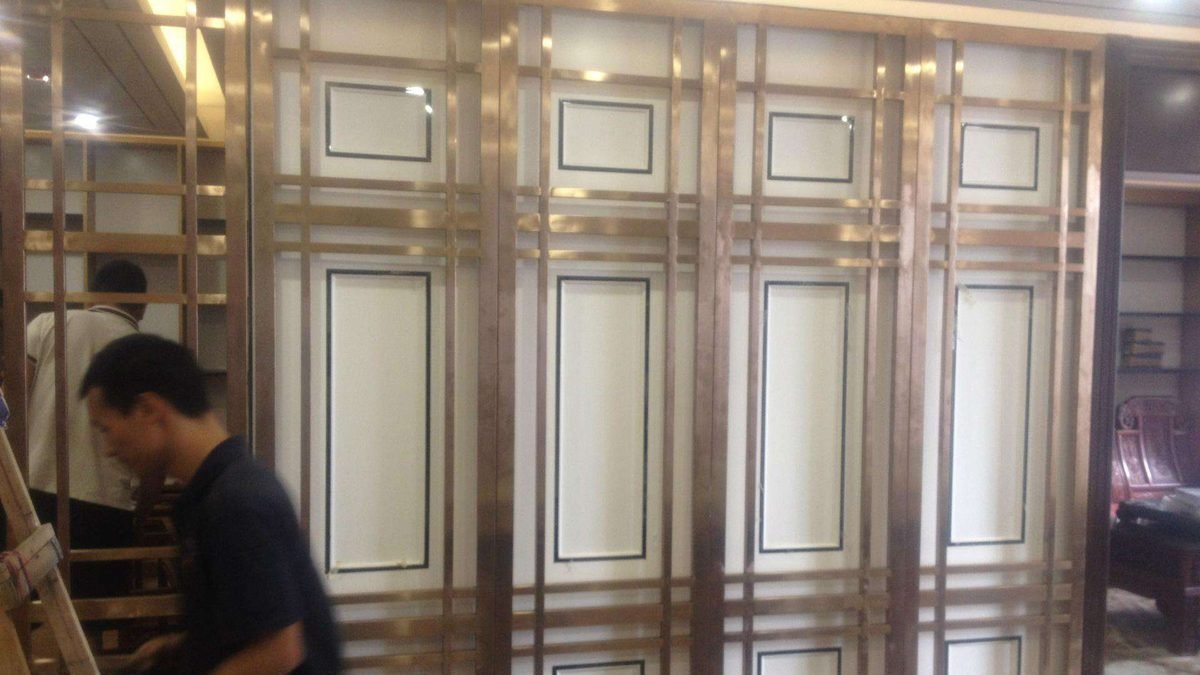
Frames are welded from 304 tube, dressed and polished, then the panels are set into a rebate or fixed with concealed clips. Welding heat discolours stainless, so frame welds are pickled and passivated or mechanically dressed before polishing. The panel is normally isolated from the frame with a thin gasket or structural silicone so that thermal movement and cleaning do not produce a rattle or a wear line.
5. Protection and packing
Every PVD panel leaves the factory with a PE or PVC protective film. The film must be specified by adhesion level: a low-tack film for mirror, a standard film for brushed. Removing a high-tack film from a mirror panel after three months in the sun can pull the coating. Panels are packed vertically in a timber crate with foam separators, never stacked flat without padding.
Selection and Installation Rules
Environment decides the grade
- Dry, air-conditioned interior — 201 is acceptable if the client accepts a shorter cosmetic life.
- Commercial interior with daily cleaning — 304, 2B or No.4 substrate, PVD optional.
- Coastal, pool, spa or chlorine cleaning — 316L, and no 201 anywhere in the fixing package.
- Exterior or semi-exterior — PVD colour is not the right choice; use uncoated 316L with a 2B or No.4 finish and expect the surface to weather.
Span and fixing
A free-standing screen needs a base that resists a 0.3 kN horizontal point load at hand height as a minimum, and a top rail that ties back to the wall or ceiling wherever the screen is longer than 2.4 m. Ceiling-hung screens are usually fixed through a slotted cleat so the panel can move vertically by a few millimetres without cracking the coating at the fixing point.
Leave a 5–10 mm shadow gap at floor and ceiling. A screen set hard against both surfaces looks like a wall, and any building movement will telegraph into the panel as a crease. The gap also gives the installer room to shim the frame before the final fixings are tightened.
Lighting
PVD colours are interference colours in part, and they shift with the light source. A champagne panel specified under 3000 K warm light reads gold under a 4000 K downlight and almost grey in daylight. Approve the colour against a physical sample on site, under the actual luminaire, not from a photograph or a colour chip viewed in an office.
Common Mistakes
- Treating PVD as an outdoor finish. Interior PVD will normally hold colour for years; a facade panel exposed to UV and rain will fade and chalk, and no supplier warranty covers that.
- Welding after coating. Any weld, grind or abrasive cleaning after PVD destroys the coating locally and there is no field repair that matches.
- Mixing batches. Two coils coated in different runs will not match, even at the same nominal colour. Order the whole screen from one coating batch and keep 5–10% spare panels from that batch.
- Designing holes below 3 mm in a coloured panel. The coating will not reach the cut walls evenly and the pattern will look dirty at a distance.
- Specifying mirror without a film and a handling plan. Mirror panels that are unpacked on site and leaned against a wall before installation are usually scratched before they are fixed.
- Using 201 fixings with a 304 panel. The fastener becomes the anode and the panel stains around every screw head within one wet season.
- Ignoring the substrate flatness. A screen is a mirror; a 3 mm wave in the substrate becomes an obvious distortion in the reflection and cannot be corrected on site.
FAQ
Is a stainless steel screen partition structural?
No. It is a decorative divider. It must resist occasional hand pressure and its own weight, and it must be fixed so it cannot fall, but it is not designed to carry floor or roof loads. Where a screen also has to act as a barrier — for example at a crowd control line — the frame and base are engineered for that load case separately and the panel is treated as cladding.
How thick should the panel be?
0.8 mm is the practical minimum for a small panel with a dense pattern; 1.0 mm is normal for interior screens up to about 700 mm free span; 1.2–1.5 mm is used for larger spans, mirror finishes and any panel that will be touched. Above 2.0 mm the weight and cost rise quickly and the benefit is mostly stiffness.
Will the gold colour fade?
Indoors, a quality PVD coating holds its colour for many years. What changes first is usually the surface under the coating: fingerprints, cleaning agents and abrasive cloths dull the top layer. Outdoors, UV and rain degrade both the colour and the substrate passivation, and the panel will visibly change within a couple of years.
Can the screen be made in one piece 4 m tall?
Usually not. Coil width and handling limit single panels to roughly 1500 mm wide and 3000 mm high. Above that the design is split, and the split is placed on a natural line in the pattern or hidden behind a frame rail. A split added after fabrication is always visible.
How do I clean a PVD panel?
Wipe with a soft damp cloth and a neutral detergent, then dry. Do not use abrasive powder, scouring pads, acid descalers or chlorine-based cleaners. Rinse any cleaner off promptly, because a dried detergent film leaves a watermark that is difficult to remove without polishing.
What should be on the purchase order?
Grade and standard, thickness and tolerance, finish, PVD colour with a ΔE limit, panel size and pattern drawing, frame section and wall thickness, fixing method, protective film type, packing method, and the spare panel percentage. A screen ordered on “304 gold, 1 mm” alone will almost always produce a dispute.
Related Product
The substrate for every screen is cold-rolled stainless sheet. If you are comparing finishes before choosing a screen pattern, the 304 stainless steel sheet 2B finish page lists thickness, width and surface options; for coastal and pool interiors, 316L stainless steel plate covers the molybdenum-bearing grade used for the panels and fixings.
Need a screen quotation with panel sizes and PVD colour?
Send the pattern drawing, panel heights, fixing condition and the light source on site. We will return a panel-by-panel breakdown with grade, coating batch and tolerance.

