 QIDAMT
Square and Rectangular Hollow Sections: Size, Wall Thickness and Load Capacity
Square and Rectangular Hollow Sections: Size, Wall Thickness and Load Capacity
Square hollow sections (SHS) and rectangular hollow sections (RHS) are the workhorses of structural steel: gate frames, pallet racking, machine guards, greenhouse frames, mezzanine columns, handrail posts, sign supports and truck bodies. They are efficient in bending and torsion because the material sits far from the neutral axis, and they are easy to connect because the flat faces accept bolted plates and welded joints.
The problem is that buyers order them by outside dimension only. “40 × 40” can mean anything from 1.2 mm to 4.0 mm wall, in Q235B or Q355B, in ERW or seamless, hot-dip galvanized or black. Each of those choices changes the load capacity, the weld procedure and the price by a factor of two or more. This guide sets out the parameters that actually govern performance.
How SHS and RHS Are Made
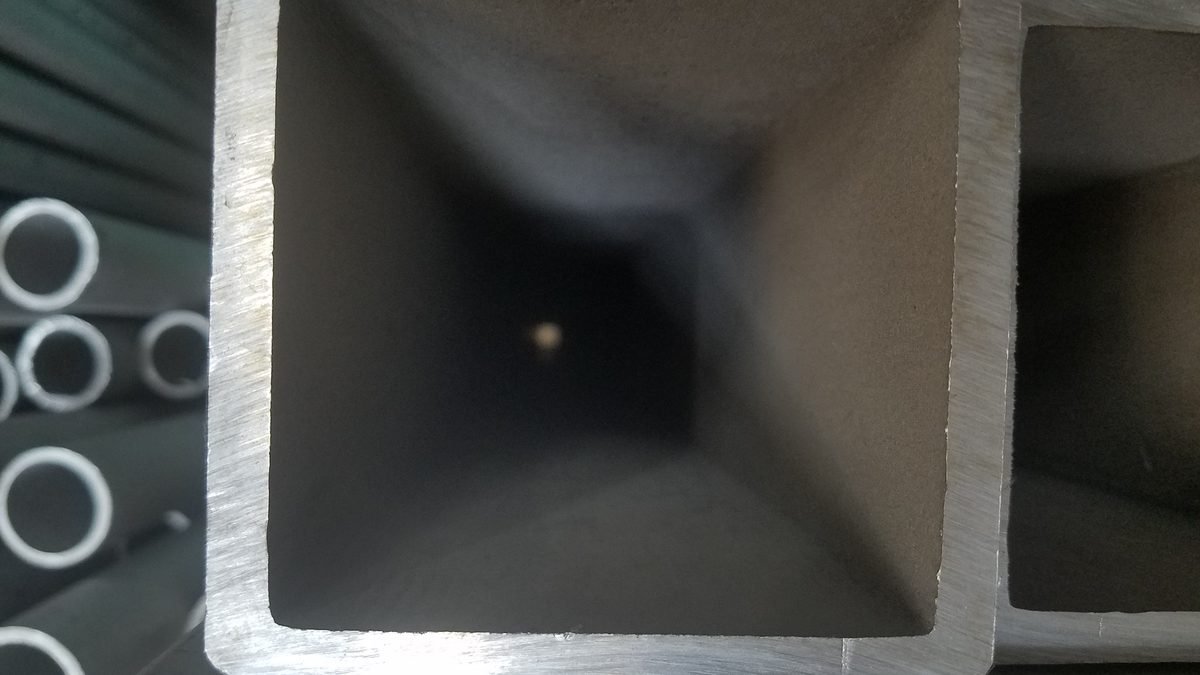
Most structural hollow sections are electric resistance welded (ERW). A steel strip is uncoiled, slit to width, roll-formed into a circular tube, and the longitudinal edges are welded together by high-frequency induction without filler metal. The tube then passes through Turks-head rolls that reshape it into square or rectangular form, followed by sizing and straightening.
Because the section is formed from strip, the wall thickness comes from the strip thickness, and the corner radius comes from the forming rolls. A well-set line produces a corner radius of about two times the wall thickness on the outside. Sharper corners require drawing the section over a mandrel, which is more expensive.
Seamless hollow sections exist but are rare and expensive. They are produced by piercing a solid billet and elongating it, which gives a homogeneous wall with no weld seam. They are used for pressure applications and for machined parts, not for general structural frames.
The weld seam position matters. On a formed SHS the seam usually sits at the centre of one face or at a corner, depending on the mill. For a member that will be bent or loaded in fatigue, the seam should be placed away from the highest tensile stress zone. Specify seam position if the section is critical.
Wall Thickness: Nominal, Actual and “Gauge”
The stated wall thickness is nominal. Actual thickness is governed by the strip tolerance, which for hot-rolled coil is typically ±0.2 mm to ±0.3 mm, and for cold-rolled coil ±0.05 mm to ±0.1 mm. That means a “2.0 mm” tube may arrive at 1.75 mm, and a “1.5 mm” tube at 1.3 mm. On a 40 × 40 section, going from 2.0 to 1.75 mm reduces the cross-sectional area by about 12 percent and the bending capacity by a similar amount.
Some suppliers quote wall thickness in “gauge” numbers borrowed from sheet metal, which do not translate cleanly. Always specify millimetres with a tolerance band, and require the mill certificate to state the actual measured thickness.
| Section | Wall | Weight | Typical use |
|---|---|---|---|
| 20 × 20 | 1.2 – 1.5 mm | 0.67 – 0.83 kg/m | Furniture, light frames |
| 25 × 25 | 1.5 – 2.0 mm | 1.07 – 1.39 kg/m | Gate frames, guards |
| 40 × 40 | 2.0 – 3.0 mm | 2.30 – 3.35 kg/m | Racking, mezzanine |
| 50 × 50 | 2.5 – 4.0 mm | 3.60 – 5.53 kg/m | Columns, heavy frames |
| 100 × 50 | 3.0 – 5.0 mm | 6.71 – 10.6 kg/m | Beams, trailer frames |
Grade: Q235B, Q355B and the Substitution Trap
Q235B is the common structural carbon steel in Chinese production, with a minimum yield strength of 235 MPa and a tensile range of 370 to 500 MPa. Q355B raises the yield to 355 MPa and is used where a smaller section must carry the same load.
The substitution trap is real. A frame designed in Q355B and built in Q235B loses roughly one third of its yield capacity. If the design was governed by deflection rather than strength, the frame may still perform; if it was governed by strength, it is unsafe. Any substitution should be checked by the designer, not by the purchasing department.
For welded structures, the carbon equivalent matters more than the yield strength. Q355B with a carbon equivalent above 0.40 requires preheat before welding in thick sections, and the weld procedure should be qualified. Q235B is more forgiving but still needs controlled heat input on thin walls to avoid burn-through.
Load Capacity: A Practical Way to Think About It
Bending capacity of a hollow section is proportional to its section modulus, which for a thin-walled square tube depends mainly on the outside dimension and the wall thickness. The exact formula is in every steel handbook, but the practical consequence is simpler: doubling the outside dimension at the same wall thickness increases bending capacity roughly fourfold, while doubling the wall thickness increases it roughly twofold.
That is why a 50 × 50 × 2.0 tube is much stronger than a 40 × 40 × 3.0 tube in bending, even though the latter uses more steel per metre. If the design is strength-governed, increase the dimension; if it is local-buckling or connection-governed, increase the wall.
Deflection is the other criterion, and it scales with the cube of span. A beam that deflects 10 mm at 3 metres will deflect 80 mm at 6 metres under the same load. Most serviceability failures in SHS frames are deflection failures, not strength failures, which is why specifying “L/250” or “L/360” on the drawing is more useful than specifying a steel grade.
Corner Radius and Its Consequences
Square hollow sections are never truly square at the corner. The outside corner radius is typically 1.5 to 2.5 times the wall thickness, and the inside radius is correspondingly larger. This affects three things: the appearance of a welded joint, the fit of a bolted plate, and the length of a bend.
When a plate is welded to the face of an SHS, the weld must run around the corner radius or stop short of it. A weld that stops short leaves a notch that concentrates stress. When a section is bent, the corner radius controls how much the flat faces distort; a tight radius makes the section easier to bend but more prone to wrinkling.
For architectural work where the corner must look sharp, a “sharp corner” section is drawn over a mandrel, which produces a radius close to one times the wall. It costs more and has a smaller available size range.
Galvanizing, Painting and Corrosion
Black SHS must be protected. The two common routes are hot-dip galvanizing after fabrication and pre-galvanized strip formed into tube. Hot-dip galvanizing gives a coating inside and outside, including at cut ends and weld zones, and is the correct choice for outdoor structures. Pre-galvanized tube has a zinc coating on the strip before forming, so the weld seam and the cut ends are bare and need repair.
For hot-dip galvanizing, the fabrication must include vent and drain holes. A sealed hollow section dipped into molten zinc will either trap air and leave an uncoated interior, or trap zinc and distort. The rule of thumb is a vent hole at each end of every closed member, sized at least 10 mm or 25 percent of the section’s internal dimension, whichever is larger.
| Environment | Protection | Expected life |
|---|---|---|
| Indoor, dry | Primer + topcoat | 15 – 25 years |
| Outdoor, rural | Hot-dip 60 μm | 20 – 30 years |
| Coastal | Hot-dip 85 μm + paint | 15 – 25 years |
| Chemical / wet | Epoxy + PU system | 10 – 20 years |
Cutting, Welding and Drilling Practice
Cut SHS with a cold saw or a band saw where possible. An abrasive disc generates heat that can temper the cut edge and, on galvanized tube, burns off the coating for 10 to 20 mm either side. If a grinder is used, the cut end must be re-protected with a zinc-rich coating.
For welding, use a matching filler and keep heat input low on thin walls. A 2.0 mm wall will burn through at 120 A on a short arc; 90 to 100 A with a fast travel speed is more controllable. TIG gives a cleaner bead on thin sections but is slower; MIG with a short-circuit transfer is the production choice.
Drilling should be done before galvanizing if the part is to be hot-dipped. Drill holes 1 to 2 mm larger than the final bolt size to allow for zinc build-up inside the hole, otherwise the bolt will not pass after coating.
Inspection Checklist
On delivery, measure the outside dimension at three points along each length and the wall thickness at the cut end with an ultrasonic gauge or a calliper. Check straightness over the full length; 1 mm per metre is normal, 2 mm per metre is a reject for visible work. Check the corner radius against the drawing, and check the weld seam for penetration and for any visible lack of fusion.
Confirm grade from the mill certificate and, for structural work, require a tensile test report on the actual lot. Check the galvanized coating mass in grams per square metre, not just “galvanized”. Finally, check that the cut ends are square and deburred; a burr on a hollow section edge is a handling hazard and a coating defect starter.
Connections: The Part That Usually Fails
A hollow section frame almost never fails in the middle of a member. It fails at a connection, because that is where the load is concentrated and where the geometry is least favourable.
Bolted connections to SHS require a plate welded to the section face, or a through-bolt with a sleeve, because a bolt cannot be tightened inside a closed section. The welded plate must wrap around the corner radius or stop short of it; a plate welded only across the flat leaves the corners unconnected and the weld toe becomes a stress concentration.
For a plate welded across the full face, the weld should be a fillet on both sides, sized for the load, with a throat thickness calculated rather than guessed. On thin walls, the limiting factor is often the wall itself rather than the weld: a 2 mm wall cannot carry a large fillet without burning through, so the design should use a larger weld length rather than a larger throat.
Through-bolts with internal sleeves are the cleanest solution for demountable frames. The sleeve prevents the walls from collapsing when the bolt is tightened, and the bolt carries the load in shear. The sleeve length must match the internal dimension exactly; a short sleeve allows the walls to deform and the bolt loses preload.
Welded connections between hollow sections — T-joints, Y-joints and corner joints — should follow a qualified procedure. The critical detail is the gap between the branch and the chord: a gap joint allows the weld to be made around the branch without overlapping welds, while an overlap joint requires a different procedure. Mixing the two on one drawing is a common source of confusion at fabrication.
Fire Protection and High Temperature Behaviour
Steel loses strength at elevated temperature. At 600 °C, the yield strength of carbon steel falls to roughly half its ambient value; at 700 °C it is a fraction of that. A hollow section has a lower mass-to-surface ratio than a solid section, so it heats faster and its fire resistance period is shorter for the same protection.
For structural frames in a fire-rated compartment, the section must be protected by intumescent paint, board or a sprinkler system, and the protection thickness depends on the section factor — the ratio of the heated perimeter to the cross-sectional area. A 100 × 100 × 3 section has a higher section factor than a 200 × 200 × 6 section and needs thicker protection for the same rating.
Intumescent coatings on hollow sections must be applied to all exposed faces, including the inside where the section is open at the ends. A closed section with uncoated interior surfaces behaves differently, and the fire engineer should confirm the assumption. Hollow sections also need internal protection where they form part of a fire-rated column, because heat conducts along the steel and the interior surface radiates into the void.
Frequently Asked Questions
Is SHS stronger than round tube of the same weight? In bending about a principal axis, a square section of equal weight is slightly less efficient than a round section because the corners add material close to the neutral axis but the flat faces are further out. In practice the difference is small, and the flat faces make SHS far easier to connect.
Can I bend square tube? Yes, with a mandrel or with a large radius. A radius under three times the width usually causes the faces to collapse.
Why is my galvanized tube rusting at the weld? Because the weld burned off the zinc and it was never repaired. Apply a zinc-rich cold galvanizing compound to every weld and cut on galvanized tube.
What does “ERW” mean on a certificate? Electric resistance welded — the seam was made by high-frequency welding without filler metal. It is standard for structural hollow sections.
Do I need vent holes for galvanizing? Yes, on every closed member, or the interior will not be coated and the part may distort in the zinc bath.
View Q235B carbon steel specifications or View hot-dip galvanized tube

