 QIDAMT
201 Stainless Steel Sheet: Grade, Work Hardening and Indoor Use
201 stainless steel sheet is a low-nickel austenitic grade that uses manganese and nitrogen to hold the austenitic structure while replacing part of the nickel with cheaper elements. It polishes to a bright finish, forms and welds like 304, and costs less. It is also less corrosion-resistant than 304, work-hardens faster and is unforgiving in coastal or chlorinated service. Knowing exactly where that line falls is the whole buying decision.
What 201 Sheet Is and What It Is Used For
201 is a chromium-nickel-manganese austenitic stainless steel, standardized as UNS S20100 and grade 12Cr17Mn6Ni5N in Chinese nomenclature. The 16–18% chromium provides the passive film; 3.5–5.5% nickel stabilizes austenite; 5.5–7.5% manganese and up to 0.25% nitrogen substitute for part of the nickel and keep the structure austenitic at room temperature. The result is a sheet that looks like 304, draws and welds in similar tooling, and costs materially less per tonne.
The main uses are indoor decorative and appliance work: elevator cabin panels, shop-fitting, kitchen cabinet doors, range hoods, sink cabinets, shelving, furniture frames, sanitary ware, screen partitions, signage, trim strips and dry indoor cladding. It is also used for some automotive interior parts, railway interior panels and household appliance wraps. It is not the grade to specify for coastal facades, swimming pools, salt-water equipment, chemical tanks, medical instruments or potable-water piping.
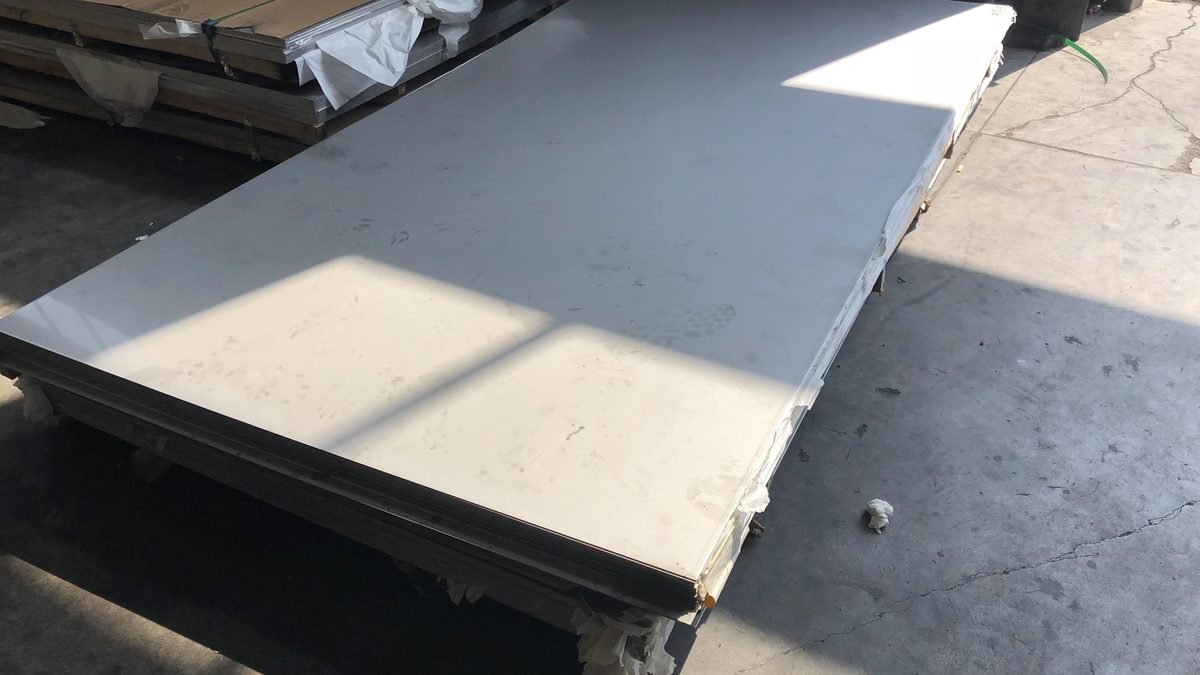
The visual similarity to 304 is the source of most disputes. A polished 201 sheet can match a 304 sheet in colour and reflectivity, and a simple magnet test will not separate them reliably because cold-worked 201 is magnetic while annealed 304 is not. The only dependable separation is chemical analysis, usually by X-ray fluorescence or spectrography, backed by a mill certificate.
Chemical Composition
The table below gives the standard window for 201. The wide manganese and nitrogen ranges are deliberate: mills adjust them to balance cost and formability. A sheet at the high end of manganese and nitrogen is stronger and work-hardens faster than one at the low end, even though both meet the same grade name. That is why two 201 suppliers can deliver sheets that behave differently in the same press.
| Element | 201 range (%) | Typical (%) | Function |
|---|---|---|---|
| C | ≤ 0.15 | 0.05–0.10 | Higher carbon lowers corrosion resistance and toughness |
| Si | ≤ 1.00 | 0.40–0.70 | Deoxidation; excess raises hardness |
| Mn | 5.50–7.50 | 6.0–7.0 | Austenite stabilizer; replaces nickel |
| P | ≤ 0.060 | 0.020–0.040 | Residual; high levels hurt weldability |
| S | ≤ 0.030 | 0.005–0.015 | Forms MnS inclusions; affects pitting |
| Cr | 16.00–18.00 | 16.5–17.5 | Passive film; primary corrosion element |
| Ni | 3.50–5.50 | 4.0–5.0 | Austenite stability; lowers work hardening |
| N | ≤ 0.25 | 0.10–0.20 | Strength and austenite stability |
| Cu | ≤ 1.00 | 0.20–0.60 | Residual; slight improvement in some acids |
Typical 201 window. Confirm the actual heat analysis, not only the grade name, because manganese and nitrogen at the top of the range change forming behaviour.
Mechanical Properties and Work Hardening
Annealed 201 sheet is strong and ductile, but its work-hardening rate is steep. The initial yield is higher than 304 and the elongation is lower, so a part that draws easily in 304 may need more press force, a larger bend radius or an intermediate anneal in 201. The table gives typical annealed and cold-worked values; the cold-worked columns are the reason 201 is sometimes chosen for structural or wear-resistant panels.
| Condition | Rp0.2 (MPa) | Rm (MPa) | Elongation (%) | Hardness |
|---|---|---|---|---|
| Annealed, 2B | 280–350 | 650–750 | 40–50 | ≤ 95 HRB |
| 1/4 hard | 450–550 | 750–850 | 25–32 | ≈ 25 HRC |
| 1/2 hard | 600–750 | 850–1000 | 15–22 | ≈ 32 HRC |
| Full hard | 850–1050 | 1000–1200 | 5–10 | ≈ 40 HRC |
Typical room-temperature values for 201 sheet. Standard minimum values are lower than these typical ranges; design to the standard minimum, not to a mill’s typical.
Work hardening has two practical consequences. First, bending and roll-forming leave the bend zone stronger and less ductile, so a subsequent flattening or straightening operation can crack it. Second, a deep-drawn part may need annealing between draws; 201 tolerates fewer draws than 304 before cracking. If the part has a tight bend or a deep draw, run a trial with the actual coil, not with a generic 201 sample.
At elevated temperature, 201 is not a substitute for 304 or 316. It can be used for intermittent service around 800 °C, but prolonged exposure causes grain growth and sigma-phase formation, and the high manganese content does not improve high-temperature oxidation resistance. For furnace parts, use a stabilized or high-nickel grade.
Dimensions and Tolerances
201 sheet is commonly stocked from 0.3 mm to 3.0 mm thickness, in widths from 1000 mm to 1500 mm and lengths from 2000 mm to 6000 mm. It is also supplied as slit strip and as cut blanks. Thickness tolerance is the first thing to pin down, because a “0.5 mm” sheet can be 0.45 mm at the low end of a normal rolling window, and a 10% thickness shortfall changes stiffness by about 30%.
| Feature | Common range | Typical tolerance | Notes |
|---|---|---|---|
| Thickness | 0.3–3.0 mm | ±0.03 to ±0.15 mm | Tighter for precision blanking |
| Width | 1000–1500 mm | +5 / 0 mm | Slit edge or mill edge |
| Length | 2000–6000 mm | +10 / 0 mm | Cut to length on request |
| Flatness | — | ≤ 3 mm/m | Tension-leveled sheet is better |
| Crown | — | ≤ 10 mm over width | Affects laser cutting fit-up |
| Surface | 2B, BA, No.4 | Per agreed sample | 2B is the default cold rolled finish |
| Edge | Slit or mill | Burr ≤ 0.1 mm | Deburr for handling safety |
Typical commercial windows for 201 cold-rolled sheet. For laser cutting, ask for flatness and crown limits, not only thickness.
Surface finish is usually 2B: cold rolled, annealed, pickled and skin-passed. BA (bright annealed) is available for decorative parts that will be polished or plated. No.4 brushed finish is produced by grinding and is used for elevator and appliance panels where a directional grain is wanted. A “mirror” 201 sheet is usually 8K polished from a 2B substrate; the polish does not change the corrosion resistance of the base metal.
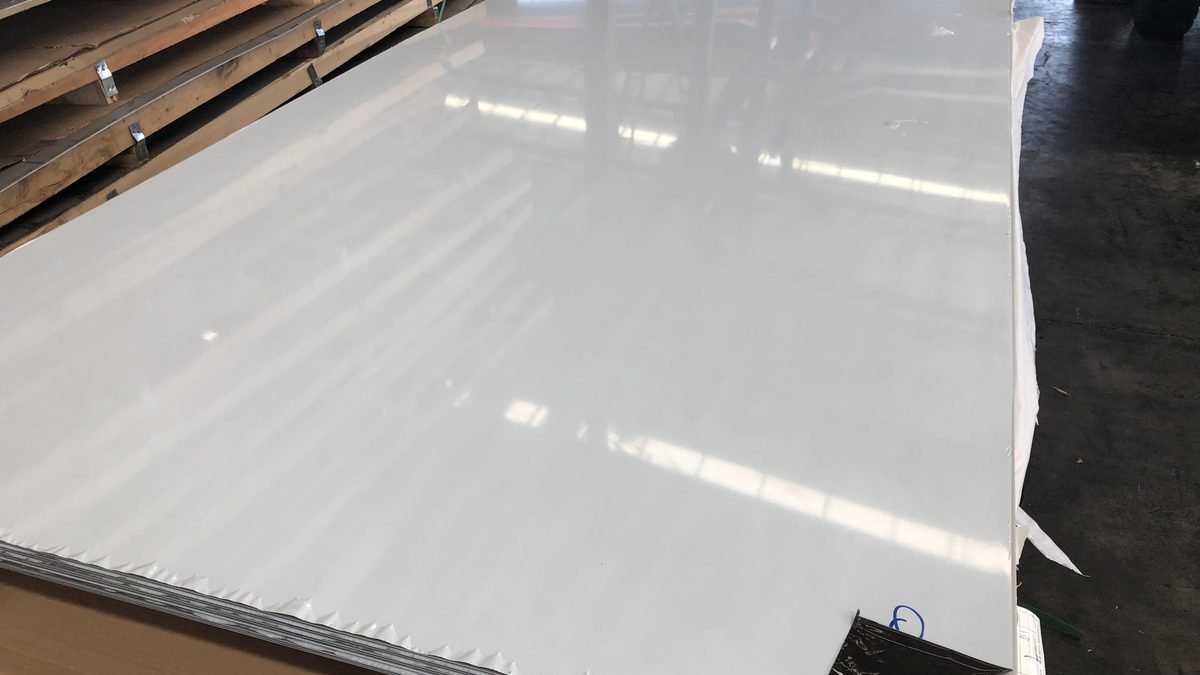
Storage and handling decide whether a good sheet arrives in usable condition. Keep the bundle under cover, on dunnage, with the sheets interleaved and the edges protected. Water trapped between sheets produces stain and, in a chloride environment, pitting before the material ever reaches production. Do not drag a sheet across a concrete floor; the grit leaves scratches that are impossible to polish out on a thin decorative panel. If the sheet carries a protective film, leave it on until the part is formed, but remove it before welding or annealing.
How 201 Sheet Is Made
The melt shop uses a high-manganese charge, often with ferronickel and nitrogen additions. Because manganese is easily oxidized, the melt is killed and cast under controlled conditions; a dirty cast will produce inclusions that show up as pits or polish defects in the finished sheet. The slab is hot rolled, annealed and pickled, then cold rolled in several passes with intermediate annealing. The final anneal is at roughly 1050–1100 °C, followed by pickling and a light skin pass that gives the 2B finish.
Tension leveling is important for thin 201 sheet. Cold rolling leaves shape defects and residual stress; tension leveling stretches the strip plastically to flatten it and to reduce coil set. A sheet that has not been tension-leveled will show oil-canning after cutting and may not sit flat on a frame. For elevator panels and long facade trim, specify tension-leveled sheet and check flatness on a surface plate after cutting, not only in the coil.
The most common manufacturing defects are slivers, pits, scratch marks and edge cracks. Slivers come from rolled-in scale or inclusions; pits come from pickling overexposure or from manganese sulphide inclusions; edge cracks come from poor slit quality or from a hard cold-worked edge. None of these are visible on a coiled surface until the sheet is cut and formed, so a receiving inspection should include a sample cut from the coil edge and a bend test.
Fabrication Rules
Bending: 201 needs a larger bend radius than 304 for the same thickness. As a starting rule for 2B sheet, keep the inside radius at least 2.5 times the thickness for a 90° bend across the rolling direction and 1.5 times along the rolling direction. Bend across the grain where possible, and use a radiused punch rather than a sharp die edge. If the bend is critical, anneal after forming.
Deep drawing: 201 work-hardens quickly, so a deep draw may need two or three stages with interstage annealing. Use a high-viscosity drawing lubricant, keep the blank holder pressure moderate and avoid sharp die radii. A drawn part that is left in the hard condition will be stronger but may crack in service; stress-relieve it if it will see vibration.
Welding: 201 can be welded by TIG, MIG or resistance welding. Use a 308L filler for general work, or a 201-compatible filler when colour match matters. Keep heat input low, purge the back of the joint with argon and avoid excessive weaving. The weld zone of 201 is more sensitive to hot cracking than 304 when sulphur and phosphorus are high, so a high-sulphur heat needs a qualified procedure.
Cutting: laser cutting gives a clean edge but can leave a nitride-rich layer on 201 because of the nitrogen content; the layer is thin and usually removed by pickling if the part will be welded. Plasma cutting leaves a rough, oxidized edge that must be ground before welding. Waterjet cutting avoids thermal damage and is preferred for thick sections and for parts that will be polished after cutting.
Polishing and plating: 201 takes a bright polish, but the polished surface is still 201. Do not use a polished 201 part in a wet chloride environment on the assumption that the polish protects it. For plating, a nickel strike is used before the decorative deposit; the high manganese content can complicate activation, so the plating line should be qualified on the actual heat.
Corrosion Limits and Selection Rules
- Indoor, dry or occasionally damp: 201 is a reasonable cost-saving choice for decorative panels, appliance wraps and furniture.
- Coastal, marine, swimming pool or de-icing salt: do not use 201. Use 316L or a higher-molybdenum grade.
- Chlorinated water or cleaning chemicals: do not use 201 for wet parts; pitting can start at manganese sulphide inclusions.
- Food contact: 201 is not a generally accepted food-contact grade; use 304 or 316L with the appropriate certification.
- High-strength or wear-resistant panel: cold-worked 201 can be attractive, but check ductility and weldability before choosing it.
- Welded structure exposed outdoors: choose 304 or 316L; the weld and heat-affected zone of 201 are the first places to rust.
A simple way to frame the decision is “indoor visual, not outdoor structural.” If the part is seen but not wetted, 201 can do the job at lower cost. If the part is wetted, welded and expected to last, the savings from 201 are usually spent again on replacement. The gap is not in the appearance; it is in the pitting resistance and in the weld zone.
Where a project insists on 201 for budget reasons, reduce the risk by keeping the part dry, designing drainage, avoiding crevices, specifying a smooth weld and applying a protective clear coat on cut edges. None of these measures turns 201 into 304, but they can extend life in a benign indoor environment.
Lifecycle cost is the honest comparison. A 201 panel may cost 15–25% less per tonne than a 304 panel of the same thickness, but if it fails at a weld or a cut edge in three years, the replacement labour and downtime usually exceed the saving. For a dry indoor part with no welds near moisture, the saving is real. For an outdoor or wet part, the cheaper sheet is usually the more expensive decision. Buyers should compare installed cost per year of service, not price per tonne.
Common Misconceptions
- “201 is just a cheaper name for 304.” No. It has 3.5–5.5% nickel instead of 8–10.5%, and it relies on manganese and nitrogen for austenite stability.
- “If it is magnetic, it is not stainless.” Cold-worked 201 is magnetic; annealed 304 is essentially non-magnetic. Magnetism is not a grade test.
- “A mirror polish makes it corrosion-proof.” Polish improves appearance and cleanability, not the alloy’s pitting resistance.
- “201 can replace 304 outdoors if the thickness is increased.” Thickness does not fix chloride pitting; the alloying does.
- “All 201 heats form the same.” Manganese and nitrogen ranges are wide, and the work-hardening rate varies from heat to heat.
Inspection and Acceptance
Verify the grade by chemical analysis on a sample from the actual coil, not by a certificate alone. Check thickness at five points across the width and at both ends, check flatness after cutting, and inspect the surface for slivers, pits and scratches under oblique light. For a part that will be formed, run a bend test across and along the rolling direction; for a part that will be welded, make a test weld and check for cracking and discolouration.
If the sheet is supplied with a protective film, check that the film is uniform and that no adhesive residue remains after peeling. Residue can cause uneven pickling or coating adhesion later. For export packing, confirm that the sheets are interleaved, edge-protected and strapped, because thin 201 sheet is easily bent at the coil edge during handling.
Frequently Asked Questions
Is 201 food safe?
It is not a grade that is generally certified for food contact. Use 304 or 316L with a food-contact certificate if the surface will touch food.
Can 201 be used outdoors?
Only in a dry, sheltered environment. Rain, coastal air, pool chemicals and de-icing salt will pit it, especially at cut edges and welds.
Why does 201 rust at the weld?
The weld and heat-affected zone lose chromium through oxidation and may retain sulphur-rich inclusions. Clean, purge and pickle the weld, or choose 304 for wet service.
Can 201 be deep drawn?
Yes, but it work-hardens faster than 304 and may need interstage annealing. Trial the actual heat before committing to a progressive die.
Is 201 stronger than 304?
Annealed 201 typically has a higher yield strength, but lower elongation. Cold-worked 201 is much stronger and much less ductile.
How can I tell 201 from 304?
Use XRF or spectrography. A magnet test is unreliable because cold work changes the magnetic response.
Need a stainless sheet with documented grade and consistent formability?
For wet, coastal or food-contact service, QIDAMT supplies 304 and 316L sheet with mill certificates. Send thickness, width, finish and quantity.