 QIDAMT
Stainless Steel Square Tube 304: Size, Wall Thickness and Welding
Stainless Steel Square Tube 304: Size, Wall Thickness and Welding
A stainless steel square tube is a hollow section with a square outside profile and a uniform wall, made from flat strip that is roll formed into a square and welded along one edge, or from a seamless hollow that is square cold drawn. Grade 304 is the standard austenitic choice, and it covers the great majority of handrail, frame, furniture, guard and architectural tube demand.
The square shape matters more than it looks. A round tube is efficient in torsion and in all-direction bending, but it is awkward to joint at a corner and it presents a curved face to a bolt or a clamp. A square tube gives four flat faces for drilling, bolting, welding and fixing, and a corner that mitres cleanly into a frame. That is why square tube dominates the visible structure of handrails, machine guards, display stands, trolley frames and balustrades.
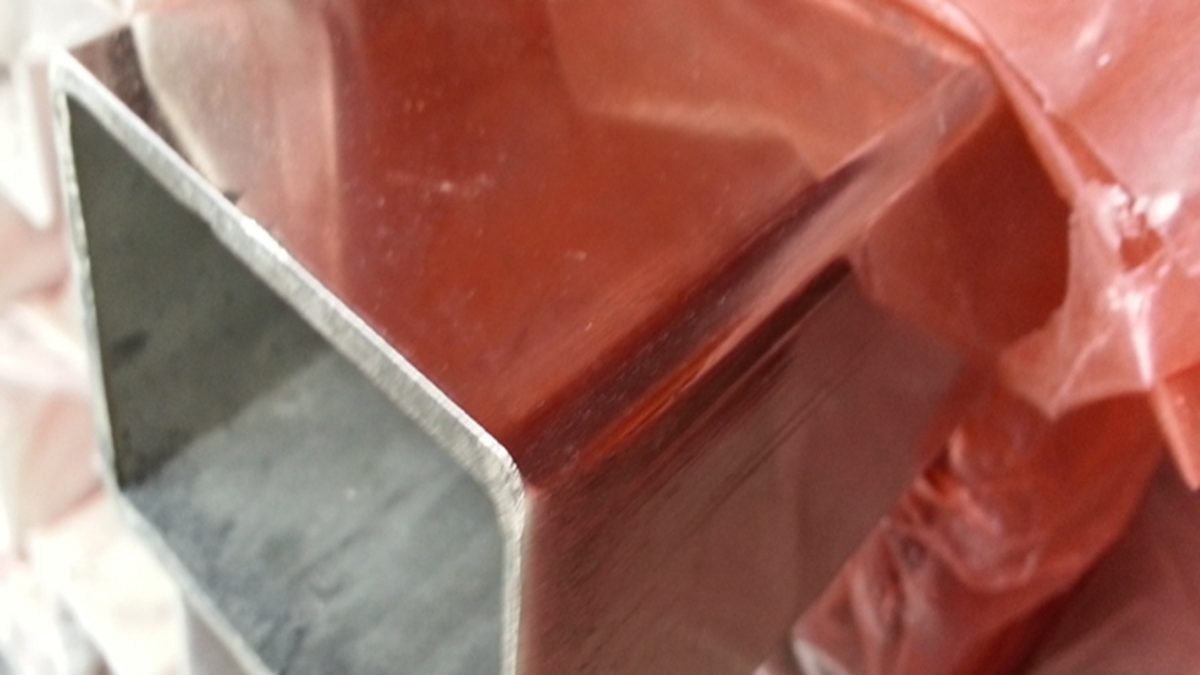
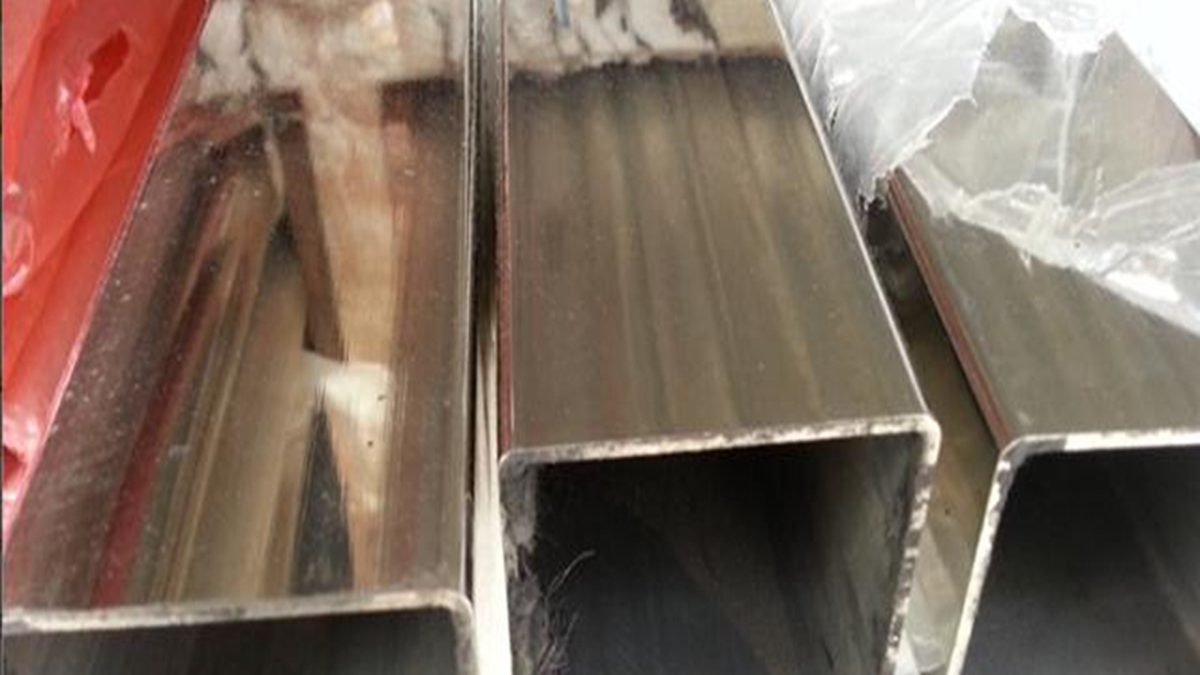
The photographs show square tube still wrapped in red protective film after forming, and a stack of unwrapped square tubes with visible mill marks on the faces. The two images together show the two conditions in which the material is normally bought: protected for delivery and bare for fabrication.
1. What the Product Is and Where It Is Used
Square tube is specified by outside side length, wall thickness, grade, surface finish and length. A 40 × 40 × 1.5 mm tube in 304 is a different product from a 40 × 40 × 1.5 mm tube in 201, and a mill finish tube is different again from a 400-grit polished tube, even though the three look identical on a delivery note that says only “40 square tube”.
The common applications follow the flat faces. Handrail and balustrade systems use 40 × 40, 50 × 50 and 60 × 60 mm posts and rails, with a wall of 1.5 to 2.0 mm. Machine frames and guards use 25 × 25 to 50 × 50 mm, often with a 2.0 mm wall for stiffness. Furniture legs and display frames use 20 × 20 to 30 × 30 mm with 1.0 to 1.5 mm walls. Light structural work, such as mezzanine handrail, walkway frame and signage supports, uses 60 × 60 to 100 × 100 mm with 2.0 to 4.0 mm walls. Architectural screens and partitions use thin walls of 1.0 to 1.2 mm with a polished finish, where the tube is a visual element rather than a load path.
Grade 304 is chosen for the same reason in every case: the tube will be exposed to weather, to washing, or to a food or medical environment, and a painted carbon tube would need maintenance that the owner does not want. In coastal or chloride-rich locations, 316L is the correct substitution, and it is worth deciding this at the design stage rather than after the first rust stain appears.
A square tube is also easier to detail than a round tube. A mitred corner gives a continuous welded joint with no gap; a drilled hole lands on a flat face and a bolt seats properly; a clamp or a bracket can be bolted to a face without a saddle. These are the practical reasons why the square form wins in fabricated frames, even though the round form is structurally more efficient for the same weight.
2. Grade 304 and Chemical Composition
304 is an austenitic stainless steel with 18 to 20 percent chromium and 8 to 10.5 percent nickel, a maximum carbon of 0.08 percent, and a balanced manganese and silicon content. The nickel stabilises the austenitic structure, which gives the grade its ductility, its weldability and its toughness. The chromium provides the passive film that makes the steel stainless.
| Element | 304 range, % | Function |
|---|---|---|
| Chromium | 18.0 to 20.0 | passive film, corrosion resistance |
| Nickel | 8.0 to 10.5 | austenite stability, ductility, toughness |
| Carbon | 0.08 max | strength; too high reduces weld corrosion resistance |
| Manganese | 2.00 max | austenite former, substitutes for part of the nickel |
| Silicon | 0.75 max | deoxidation |
| Phosphorus | 0.045 max | impurity, kept low for weldability |
| Sulphur | 0.030 max | impurity; free-machining grades use higher sulphur |
| Molybdenum | not specified | absent, which is why 304 pitting resistance is limited |
Two practical consequences follow. First, 304 is not a chloride-resistant grade. The pitting resistance equivalent number of 304 is around 18, which is adequate for fresh water and for urban atmospheres but marginal in coastal air and inadequate in a salt-spray wash-down. Second, 304 is only weakly magnetic in the annealed condition but becomes slightly magnetic after cold working or welding, which is normal and not a sign of the wrong grade; a fabricator who rejects a welded 304 tube because a magnet sticks to the weld is rejecting sound material.
304L, the low-carbon variant with 0.030 percent maximum carbon, is used for heavy welded sections where intergranular corrosion is a risk. For square tube with walls up to 3 mm, 304 is usually adequate, but for thick walls and for tube that will be welded and then exposed to a corrosive environment without solution annealing, 304L is the safer specification.
3. Mechanical Properties
Tubing standards for welded stainless tube generally specify minimum tensile strength, minimum yield strength and minimum elongation, with the values set for the annealed condition. The table below gives the values that apply to 304 tube in normal commercial supply; a particular mill may deliver higher values, but the minimum is what the design should use.
| Property | 304 square tube | Note |
|---|---|---|
| Tensile strength | 515 MPa min | annealed condition |
| Yield strength, 0.2 % | 205 MPa min | design value for structural use |
| Elongation in 50 mm | 35 % min | indicates a properly annealed weld |
| Hardness | 90 HRB max, typical 70 to 85 | hardness rises after cold working |
| Density | 7.93 g/cm³ | used for the weight formula |
| Elastic modulus | about 200 GPa | about 3 % lower than carbon steel |
| Thermal expansion | about 1.7 × 10⁻⁵ per K | about 1.5 times carbon steel |
| Thermal conductivity | about 16 W/(m·K) | low, so heat stays at the weld |
The thermal expansion figure explains a common field problem. A stainless handrail that is fixed hard at both ends on a long run will develop a stress of several hundred MPa over a 40 K temperature change, which is enough to buckle the tube or to crack a weld. Long runs need slip joints, flexible fixings, or a design that allows the rail to move. This is not a defect of the material; it is a detail that has to be designed.
The low thermal conductivity explains the welding behaviour. Heat applied to a stainless tube stays near the weld instead of spreading, so the weld pool is easy to control but the surrounding metal gets hot quickly and distorts. Square tube is especially prone to corner distortion, because the four flat faces are free to bow outward when the corner weld shrinks.
4. Sizes, Wall Thickness and Tolerance
Square tube is available from about 10 × 10 mm to 150 × 150 mm, with walls from 0.5 mm to 6.0 mm. The table below lists the sizes that move in volume, with the theoretical weight calculated from the standard formula for a square hollow: mass per metre equals 4 × wall × (side minus wall) × density, with all dimensions in millimetres and the result in kilograms per metre.
| Size, mm | Wall, mm | Weight, kg/m | Typical use |
|---|---|---|---|
| 20 × 20 | 1.0 | 0.60 | furniture, light frames |
| 25 × 25 | 1.2 | 0.90 | guards, display frames |
| 30 × 30 | 1.5 | 1.34 | frames, trolleys |
| 40 × 40 | 1.5 | 1.83 | handrail posts and rails |
| 40 × 40 | 2.0 | 2.40 | machine frames, guards |
| 50 × 50 | 2.0 | 3.03 | structural frames, posts |
| 60 × 60 | 2.0 | 3.66 | walkway frames, balustrade posts |
| 80 × 80 | 3.0 | 7.27 | light structural columns |
| 100 × 100 | 3.0 | 9.17 | frames, supports |
Dimensional tolerance is where cheap tube and good tube separate. The outside side length is usually held to plus or minus 0.5 mm for small sizes and plus or minus 1.0 mm for large sizes, the wall to plus or minus 10 percent, the corner radius to a maximum related to the wall, the straightness to about 1 mm per metre, and the twist to about 1 mm per metre. For a handrail that has to line up with a mitred corner and a glass panel, the twist and the corner radius matter as much as the side tolerance.
Corner radius deserves a note because it is often ignored in drawings. A roll-formed square tube cannot have a sharp corner; the outside corner has a radius of roughly two to three times the wall thickness, depending on the mill and the size. A drawn or extruded square can be sharper but is more expensive. If a design shows a square corner with a visible radius of 1 mm on a 2 mm wall tube, the design is asking for something the process does not produce, and the joint gap will show.
Wall thickness tolerance is the other hidden variable. A “2.0 mm” tube supplied at minus 10 percent is 1.8 mm, which reduces the section modulus by about 10 percent and the stiffness by about 19 percent. For a handrail that is judged by how rigid it feels, that difference is noticeable. Orders for visible or loaded tube should specify the minimum wall, not the nominal wall, or should specify a tighter class.
5. How Square Tube Is Made
The dominant process is roll forming and welding. A wide stainless coil is slit to the developed width of the section, then formed through a series of rolls into a square with a small corner radius, and welded along the seam by high-frequency induction or by tungsten inert gas. The weld is on one face, and it is either left as welded, scarfed inside and outside, or polished flush depending on the product class.
After welding, the tube passes through a sizing stand that brings the outside dimensions and the corner radii to tolerance, and then through an in-line anneal that restores the ductility lost in forming and welding. The anneal is the step that decides whether the tube can be bent and mitred without cracking. A tube that is sold as “annealed” but was actually only stress relieved will crack at a tight bend, and the fracture will look like a material failure when it is a process failure.
Surface finish follows the anneal. Mill finish tube is pickled or bright annealed and left with a dull grey or bright reflective surface. Polished tube is ground and polished to a specified grit, usually 180, 320, 400 or 600, and the grit has to be stated because “polished” alone means nothing. A 400-grit polished tube has visible directional lines and a soft sheen; a 600-grit tube is close to mirror. For architectural work, the direction of the polishing lines and the consistency between tubes matter as much as the grit.
Cutting to length is normally by cold saw or by a cut-off wheel, with the ends deburred. For handrail, the ends are often mitred at 45 degrees for a corner joint, and the mitre has to be accurate: a one-degree error over a 50 mm face leaves a visible gap on the outside of the corner. Laser cutting of mitres and of drilled holes is increasingly common because it gives a repeatable fit that hand tools cannot match.
Seamless square tube is made by cold drawing a round seamless hollow through a square die, sometimes with a plug, and then annealing. It is used where the weld seam is unacceptable, for pressure or for a fully polished appearance with no seam line, and it costs more than welded tube. For most handrail and frame work, welded tube is entirely adequate, provided the weld is scarfed and the tube is annealed.
6. Fabrication and Welding
Cutting should be done with a cold saw, a bandsaw or a laser. An abrasive cut-off wheel works but leaves a heat-affected edge and embedded abrasive that must be removed before welding. More importantly, a wheel that has been used on carbon steel must never be used on stainless, because the embedded iron will rust and the rust will be read as a failure of the tube.
Welding 304 square tube is normally done by TIG with 308L filler, or by MIG with 308LSi filler for thicker walls. The joint is usually a mitre or a butt against a flat face, and the fit-up should leave a small gap of 0.5 to 1.5 mm so that the root pass penetrates. A joint that is butted tight with no gap will show incomplete penetration on the inside, which is both a strength and a corrosion issue.
Heat input must be controlled. Stainless conducts heat about one third as well as carbon steel, so the pool stays hot and the surrounding metal overheats quickly. For a 1.5 mm wall, a current of 60 to 80 A with a 1.6 mm electrode is typical; for a 3 mm wall, 90 to 120 A. Interpass temperature should be kept below about 150 °C, and the joint should be allowed to cool between passes rather than being welded continuously around a corner.
Distortion control is the practical skill. Square tube distorts at the corners, where four flat faces meet and the weld shrinks. The standard approach is to weld in a fixture or with the frame clamped to a flat table, to balance the sequence, to weld the short sides before the long sides, and to check the diagonals before the frame cools. Back-step welding, in which each run is started behind the previous one, spreads the shrinkage and reduces the bow.
After welding, the joint must be cleaned and passivated. Heat tint is a chromium-depleted oxide that has lost its corrosion resistance, and it must be removed by pickling paste, by an electrochemical cleaning brush or by mechanical grinding followed by passivation. A welded handrail that is left with a blue-black halo will show rust at the weld within a season, and the rust will come from the weld, not from the tube.
Where the tube is drilled or bolted rather than welded, the hole should be deburred and the bolt should be stainless, with a stainless washer under the head. A carbon steel bolt in a stainless handrail is a galvanic couple, and the bolt will corrode and stain the tube. Threaded inserts or blind rivets in stainless are the usual details for a bolted handrail that has to look clean.
7. Selection Rules
Choose the wall from the load, not from the look. A handrail post in 40 × 40 × 1.5 mm is adequate for normal crowd loading; a 60 × 60 × 1.2 mm tube looks stronger but has less than half the stiffness. The wall thickness, not the outside size, controls the strength.
Decide the grade by the environment. Indoor dry work can use 304 with confidence. Coastal, pool, marine and chloride-rich work should use 316L. Food and medical work should use 304 with a documented surface finish and a passivated weld. Grade 201 should not be used for wet or outdoor work.
State the surface finish and the polishing direction. “Polished” is not a specification. State the grit, the direction and whether the weld seam is to be polished flush. For visible work, ask for a sample tube before the order is placed.
State the corner radius and the twist. A mitred frame with four tubes of different corner radius will not close cleanly. State the maximum radius and the maximum twist per metre, and check both on receipt.
State the minimum wall, not the nominal. If stiffness or weight matters, the minimum wall is the number that has to be guaranteed. A nominal 2.0 mm with minus 10 percent tolerance is a 1.8 mm tube.
Plan for expansion. Long handrail runs need a slip joint or a flexible fixing, because stainless expands about 1.7 × 10⁻⁵ per K. A 10 m rail moving through 30 K grows by 5 mm, and a rigidly fixed rail will either buckle or crack.
8. Common Mistakes
Buying by outside size only. A 40 × 40 tube with 1.2 mm wall and one with 2.0 mm wall look the same from a distance and behave very differently. Always quote the wall.
Using 201 for outdoor work. The lower nickel and manganese content gives much lower corrosion resistance. A coastal handrail in 201 stains within a year.
Not pickling the welds. Heat tint is the first place to corrode. Pickle or electro-clean every weld on visible or wet service work.
Using carbon steel tooling and brushes. Embedded iron rusts and looks like a material failure. Keep stainless-only brushes, files and cutting wheels.
Welding without a gap. A tight butt joint gives incomplete penetration, which is a crack starter and a corrosion cell. Leave a small gap and use a root pass.
Welding all four corners in one pass. The frame pulls out of square. Weld in a fixture, balance the sequence, check the diagonals.
Assuming the tube is seamless. Most square tube is welded, and the seam is visible on one face. If the seam must not show, specify scarfing or seamless tube.
Ignoring the corner radius in the design. A drawing with a sharp corner and a tube with a 3 mm radius leaves a gap at the joint. Design the detail around the real radius.
Anchoring both ends of a long rail. Thermal movement has to go somewhere. Provide a slip joint or a flexible fixing.
Storing tube on the ground. A stack of tube on a damp floor stains and dents. Store on racking, under cover, with the ends protected.
9. Frequently Asked Questions
Is 304 square tube magnetic? Annealed 304 is essentially non-magnetic, but it becomes slightly magnetic after cold working or welding. A slight pull on a magnet at a weld is normal and is not a reason to reject the tube.
What is the standard length? Six metres is the common mill length, with 12 m available. Cut-to-length supply is normal for fabrication, and the cut tolerance should be stated.
Can square tube be bent? Yes, with a proper mandrel or a roller bender and an annealed tube. A hard tube or a tube with a thick wall will crack or flatten at the bend; the minimum bend radius is usually several times the side dimension.
Which filler for 304 tube? 308L for TIG and MIG, matching the base metal. For 304L tube, 308L is also correct. Do not use 316L filler unless the joint will be exposed to chlorides and the extra molybdenum is wanted.
Can I weld 304 to carbon steel? It can be done with a 309L filler, which is over-alloyed to tolerate dilution. The joint will have a galvanic couple and should be painted or isolated in wet service.
What is the difference between square tube and square bar? Tube is hollow with a wall; bar is solid. Tube is used where weight and stiffness matter; bar is used where a solid section, a machined face or a heavy fixing is needed.
How is the weight calculated? For a square hollow, mass per metre in kg equals 4 × wall × (side minus wall) × 7.93 / 1000, with dimensions in millimetres. The table in this article uses that formula.
Does the weld seam reduce strength? A properly made and annealed weld develops the full strength of the parent metal in tension. The seam is more susceptible to corrosion if the weld is not pickled, which is a surface issue rather than a strength issue.
Can square tube be used structurally? Yes, where the design is checked against the actual section properties and the governing standard. Square hollow sections are widely used in light structures, but the design must use the real wall thickness and the real corner radius.
What surface finish should I choose for a handrail? 320 to 400 grit polished is the common architectural choice: it hides fingerprints better than a mirror finish and is easier to repair on site. Specify the polishing direction and whether welds are to be polished flush.
Need 304 square tube in a specific size and finish?
Send the size, wall, grade, surface finish, cut length and quantity. We will confirm the mill programme, the corner radius, the wall tolerance and the packing, and quote against the real section rather than a nominal size.
Related reading: 304 2B stainless sheet · 316L stainless plate · 304 2B stainless coil

