 QIDAMT
Aluminium Checker Plate: Alloy, Pattern and Slip Resistance
Aluminium Checker Plate: Alloy, Pattern and Slip Resistance
Aluminium checker plate is a rolled or embossed sheet with a raised pattern on one face, used wherever a walking surface, a loading surface or a decorative panel needs grip, durability and low weight. It is also called tread plate, diamond plate or five-bar plate, and the names describe the pattern rather than the alloy. The alloy behind the pattern is what decides whether the sheet survives a wet deck, a truck bed or a decorative facade.
The product is common in truck beds and side guards, stair treads, workshop platforms, ramps, dock boards, toolboxes, marine decks, machine covers and architectural cladding. In each case the buyer is solving one of three problems: grip under foot, resistance to abrasion, or a durable metallic finish that hides scratches and dents.
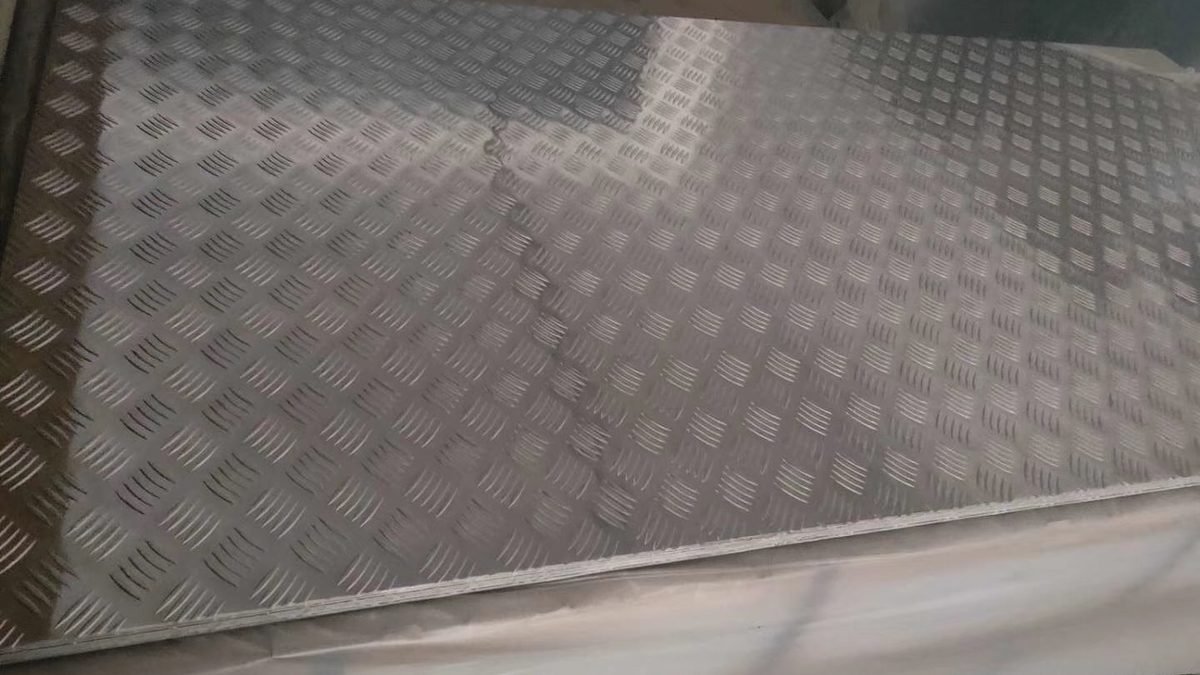
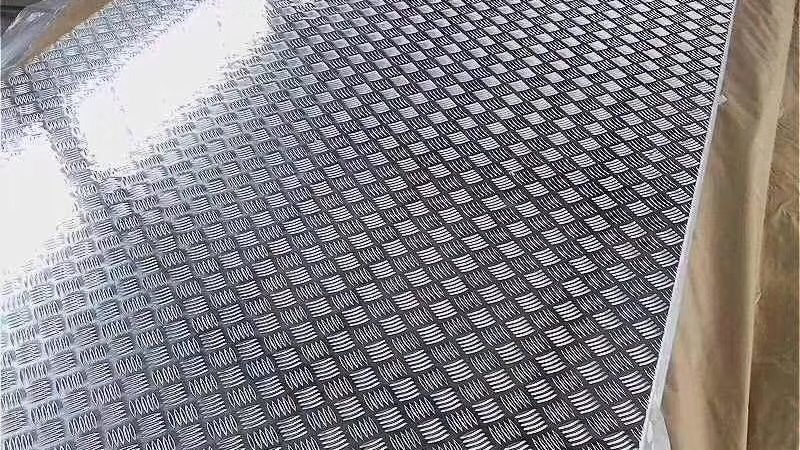
The photographs in this article show the raised five-bar pattern in close-up and a full sheet viewed at an angle with protective film partly peeled. The pattern is uniform, the bars are fully formed, and there is no evidence of roll marking or of a flattened pattern, which are the two defects most often found in cheap material.
1. What the Product Is and Where It Is Used
Checker plate is produced by passing a sheet between rolls that carry the pattern, or by embossing a pattern into a flat sheet. Hot rolling is the process for thicker plate; cold rolling with patterned rolls is used for thinner sheet. The pattern is formed on one face, and the reverse face is flat or lightly textured. The base thickness is the thickness of the flat web between the raised bars, not the total height over the pattern, and this distinction is the source of a great deal of confusion in ordering.
The five-bar pattern, also called lenticular, has five raised bars arranged in a repeating group, with the bars angled alternately. It gives good grip in several directions and drains well. The diamond pattern has raised diamonds at 45 degrees and is the classic industrial floor plate. The two-bar pattern is a simpler arrangement used for lighter decorative work.
Each pattern has a direction. Walking along the bars feels different from walking across them, and a ramp should be laid with the pattern oriented so that the bars run across the direction of travel, which gives the foot something to catch on the way up. Laying the sheet the other way is not a defect in the material, it is a detailing mistake, and it is one of the most common reasons a customer reports that the plate “does not grip”.
2. Alloys and Chemical Composition
Five alloys cover most of the market. 1060 is commercially pure aluminium, used for decorative panels and light duty covers where strength is not required. 3003 is an aluminium-manganese alloy with moderate strength and good corrosion resistance, used for general purpose tread plate. 5052 is an aluminium-magnesium alloy with good strength and excellent marine corrosion resistance. 5083 is a higher magnesium alloy for marine and structural work. 6061 is a heat treatable alloy that can be supplied in the T6 temper for structural platforms and heavy duty applications.
| Alloy | Main additions | Strength level | Corrosion | Typical use |
|---|---|---|---|---|
| 1060 | 99.6 percent Al | Low | Good in air, poor in chloride | Decorative panels, light covers |
| 3003 | 1.2 percent Mn, 0.12 percent Cu | Medium | Good | General tread plate, toolboxes |
| 5052 | 2.5 percent Mg, 0.25 percent Cr | Medium to high | Excellent in salt water | Marine decks, truck beds, ramps |
| 5083 | 4.5 percent Mg, 0.7 percent Mn | High | Excellent, weldable | Ship decks, heavy marine work |
| 6061 T6 | 1.0 percent Mg, 0.6 percent Si | High, heat treated | Good | Structural platforms, heavy duty |
| Property | 3003 H24 | 5052 H32 | 5083 H116 | 6061 T6 |
|---|---|---|---|---|
| Tensile strength, MPa | 145 to 195 | 215 to 275 | about 305 | about 310 |
| Yield strength, MPa | 115 to 145 | 160 min | 215 min | 275 min |
| Elongation, % | 10 to 20 | 12 min | 12 min | 12 min |
| Density, g/cm3 | 2.73 | 2.68 | 2.66 | 2.70 |
| Weldability | Good | Good | Excellent | Good, needs 4043 or 5356 filler |
The alloy choice is not cosmetic. A 1060 checker plate on a marine deck will pit at the pattern edges within a season, because the pure grade has little resistance to chloride and the pattern edges are where water collects. A 5052 plate on the same deck will last for years. The price difference is small compared with the cost of replacing a deck, which is why marine work should never be specified by pattern and thickness alone.
3. Pattern, Thickness and Weight
The base thickness is the thickness of the sheet before the pattern is formed, and it is the thickness that governs the strength. The overall height over the pattern is the base thickness plus the pattern height, which is typically 0.8 to 2.5 mm depending on the pattern and the sheet gauge. A 3 mm base with a 1.0 mm pattern is about 4 mm over the bars, and a buyer who measures only the overall height will overestimate the strength of the sheet.
| Base thickness (mm) | Pattern height (mm) | Approximate weight (kg/m2) | Typical use |
|---|---|---|---|
| 1.5 | 0.8 | 4.1 | Light covers, decorative panels |
| 2.0 | 0.9 | 5.4 | Toolboxes, machine guards |
| 2.5 | 1.0 | 6.8 | Truck side guards, walkways |
| 3.0 | 1.0 | 8.1 | Truck beds, stair treads |
| 4.0 | 1.2 | 10.8 | Heavy platforms, ramps |
| 5.0 | 1.5 | 13.5 | Marine decks, dock boards |
| 6.0 | 2.0 | 16.2 | Heavy duty structural plate |
The weight figures are approximate and include the pattern volume. The pattern adds material, so a 3 mm base plate weighs more than three square metres of 3 mm flat sheet would. For shipping and for structural calculations, use the actual weight per square metre from the mill, not a figure calculated from the base thickness alone.
Standard sheet sizes are 1220 by 2440 mm, 1250 by 2500 mm and 1500 by 3000 mm, with custom sizes available. Width tolerance is usually plus 3 and minus 0 mm, length plus 5 and minus 0 mm, and flatness 4 mm per metre. Diagonal difference should be checked on large sheets, because a sheet that is out of square will not fit a framed opening.
4. Slip Resistance and Pattern Direction
Slip resistance is a system property, not just a surface property. The pattern helps, but the grip also depends on the footwear, the contaminant on the floor, the slope and the direction of travel. In dry conditions, a five-bar plate gives a secure footing. In wet or oily conditions, the grip falls sharply, because the fluid fills the valleys between the bars and the foot Hydroplanes on the film.
The standard test for ramp slip resistance is DIN 51130, which classifies a floor from R9 to R13 based on the angle at which a person slips while walking up a ramp with a controlled oil film. A new five-bar aluminium plate typically reaches R10 or R11, depending on the pattern height and the direction of the bars. A worn or flattened plate drops to R9 or below, which is why old tread plate should be replaced rather than cleaned.
Pattern direction matters for two reasons. First, grip: walking across the bars gives a different coefficient than walking along them, and the better direction should be used on stairs and ramps. Second, drainage: the bars should be oriented so that water runs off the sheet rather than standing in the valleys. On an outdoor platform, the sheet should be laid with a fall and with the pattern oriented to drain.
Where the plate is used on a stair, the tread should be fixed with the pattern running across the direction of travel, and the nosing should be a separate edge strip rather than a bent lip. A bent lip on checker plate cracks at the bend because the pattern is already a stress raiser, and the crack starts at the base of a bar.
5. How Checker Plate Is Made
Hot rolled checker plate is produced on a plate mill with patterned rolls in the last stand. The slab is rolled down to the required base thickness, then passed through the pattern rolls at a temperature high enough for the metal to flow into the grooves. The pattern height is set by the roll engraving, and the rolls must be kept clean and cool enough to avoid sticking.
Cold rolled checker plate is produced from coil on a rolling mill with patterned work rolls, then annealed and levelled. The pattern is shallower than on hot rolled plate, and the base thickness is more uniform. Cold rolled material is the usual product for thin decorative sheet and for light duty panels.
Embossed plate is a third route, where a flat sheet is pressed between a patterned die. It is used for small quantities and for patterns that are not available as rolls, but the pattern is usually shallower and the sheet may be slightly distorted.
After rolling, the plate is straightened, cut to length, and annealed if the alloy and temper require it. 5052 is usually supplied in the H32 temper, which is strain hardened and stabilised; 6061 is supplied in T6, which requires solution heat treatment and artificial ageing. The temper matters because a checker plate that has been annealed after patterning is softer than one that has been work hardened, and the difference shows in the resistance to denting on a truck bed.
6. Fabrication and Fixing
Cutting checker plate is done with a guillotine, a plasma cutter, a waterjet or a saw. Guillotine shearing works well on thin sheet but distorts the pattern at the cut edge, and the distortion is visible on a decorative panel. Plasma cutting is fast but leaves a dross edge and a heat-affected zone; on 5052 and 5083 the cut edge should be dressed before painting or anodising. Waterjet cutting leaves a clean edge and no heat effect, and it is the right choice for thick plate and for precise openings.
Drilling through the pattern is awkward because the drill tends to wander on the raised bar. The standard practice is to centre punch on a flat area between the bars, or to drill from the flat face with a backing plate. A hole that is drilled through a bar has a reduced bearing area under the bolt head, and a washer should be used to spread the load.
Welding 5052 and 5083 is done with 5356 filler, and 6061 with 4043 or 5356 depending on the service. The pattern should not be welded across a joint, because the pattern creates a gap that traps porosity. The joint should be prepared by grinding the pattern flat in the weld zone, welding on the flat base, and then dressing the weld.
Fixing methods depend on the application. On a truck bed, the plate is usually fixed with countersunk screws or with a welded sub-frame. On a walkway, it is fixed with self-drilling screws through the flat web, with the screw heads flush or covered by a nosing. On a marine deck, it is welded to the structure, and the weld is continuous to avoid crevice corrosion.
Where aluminium plate is fixed to a steel structure, the two metals must be isolated. A neoprene or nylon washer under the screw head and a isolating strip along the joint prevent galvanic corrosion, and the isolation must be maintained at every fixing point, not just at the most visible ones.
7. Selection Rules
Choose the alloy for the environment. Dry indoor floors and decorative panels can use 3003 or 1060. Wet, coastal and marine work should use 5052 or 5083. Structural platforms and heavy duty ramps should use 6061 T6 or 5083, with the design checked for the actual load.
Choose the base thickness for the load. The pattern is not structural. A 2 mm base with a 1 mm pattern is still a 2 mm sheet for bending, and a truck bed that carries a pallet load needs a base thickness that will not dent. A common mistake is to order by overall height and assume the sheet is thicker than it is.
Choose the pattern for the use. Five-bar is the general purpose pattern for walking and loading surfaces. Diamond is traditional for industrial floors and for decorative work. Two-bar is lighter and used where grip demand is modest. The pattern height should be enough to drain and to grip, but not so high that it catches trolley wheels or pallet feet.
Specify the temper. 5052 H32 is the standard for tread plate, with a good balance of strength and formability. 6061 T6 is stronger but less formable, and it should not be bent sharply. 3003 H24 is adequate for light duty.
Specify the surface. Mill finish, anodised, painted or laminated are different products. Anodised plate keeps the metallic look and improves abrasion resistance, but the pattern edges can show a slight colour difference. Painted plate hides the pattern less well than a mill finish, and the paint must be specified for the service.
Specify the flatness and the squareness. A sheet that is bowed will rock on a floor and will not sit flat on a frame. A sheet that is out of square will not fit an opening. These are measurable properties, and they should be on the purchase order.
8. Common Mistakes
Ordering by overall height. The strength depends on the base thickness, not on the height over the pattern. State the base thickness and the pattern height separately.
Using 1060 on a marine deck. It pits at the pattern edges in chloride service. Use 5052 or 5083.
Laying the pattern the wrong way. The grip and the drainage both depend on orientation. Lay the bars across the direction of travel on ramps and stairs.
Bending a bent lip on a stair tread. The pattern is a stress raiser, and the bend cracks at the bar root. Use a separate nosing strip.
Welding across the pattern. The gap traps porosity and the joint is weak. Grind the pattern flat in the weld zone first.
Fixing aluminium to steel without isolation. The steel corrodes at the joint, and the aluminium is protected only until the coating fails. Use isolating washers and strips.
Assuming the plate is slip resistant when wet. A five-bar plate with an oil film can be slippery. Provide drainage, use the correct pattern direction, and consider a profiled or coated product for oily environments.
Measuring thickness with a caliper over the pattern. The reading includes the pattern height. Measure the base thickness on a flat area, or ask for the mill certificate.
Storing sheets flat on the ground. Water collects under the sheet and stains the surface. Store on bearers, with the pattern up, and keep the sheets dry.
9. Frequently Asked Questions
What is the difference between checker plate and tread plate? Nothing structural. Both names describe a sheet with a raised pattern. Checker plate is the more common term in export markets, and tread plate is the more common term in North America.
Is the pattern on one side or both sides? Usually one side. Double-sided plate is available for applications where both faces are exposed, such as a platform edge or a partition.
What is the most common alloy for checker plate? 3003 for general purpose and 5052 for marine and truck applications. 6061 T6 is used where strength matters.
Can checker plate be anodised? Yes, and the result is a hard, abrasion resistant surface with a metallic appearance. The pattern edges may show a slight colour variation, and the anodiser should know the alloy.
Can checker plate be painted? Yes, with a proper pretreatment and a suitable primer. The pattern must be cleaned and etched, and the paint should be specified for the service environment.
How much does 3 mm checker plate weigh? About 8.1 kilograms per square metre for a 3 mm base with a 1 mm pattern. The exact figure depends on the pattern and the alloy.
Is checker plate strong enough for a truck bed? A 3 mm 5052 plate is adequate for a light truck bed with a sub-frame. A heavy load or a long unsupported span needs a thicker base or a structural sub-frame.
Why does my checker plate have flat spots? The pattern rolls were worn, or the sheet was rolled at the wrong temperature, or the plate was flattened by storage or handling. Flat spots reduce grip and are a quality defect.
Can I weld checker plate to steel? Not directly. Aluminium and steel cannot be fusion welded to each other in a shop process. Use a bolted connection with isolation, or a transition joint.
What sizes are available? 1220 by 2440 mm, 1250 by 2500 mm and 1500 by 3000 mm are standard, with custom cut sizes available. Thickness from 1.5 to 8 mm in the common range.
Need aluminium checker plate in a specific alloy and pattern?
Send the alloy, temper, base thickness, pattern, sheet size, surface and quantity. We will confirm the pattern height, weight per square metre, tolerance and packing, and quote against the base thickness rather than the overall height.
Related reading: 5052 H32 aluminium sheet · 6061 T6 aluminium plate · 1060 pure aluminium plate

