 QIDAMT
Stainless Steel Coil: 2B, BA and No.4 Finish Compared
Stainless Steel Coil: 2B, BA and No.4 Finish Compared
Three coils can carry the same grade, the same thickness and the same certificate, and still be different products. A 2B coil, a BA coil and a No.4 coil in 304 are metallurgically identical and commercially distinct, because the finish decides how the surface looks, how it responds to fabrication, how it cleans, and what it costs per square metre. Buyers who treat the finish as a cosmetic option usually discover the difference after the parts have been cut.
This guide sets out what each finish is, how it is produced on a continuous line, what the measurable surface parameters are, how the finish interacts with bending, welding and deep drawing, and where each one belongs. It covers cold-rolled stainless coil in 304, 304L, 316L and 430, thickness 0.30–3.00 mm, the range used for kitchen equipment, architectural panels, appliances, elevator interiors and process vessels.
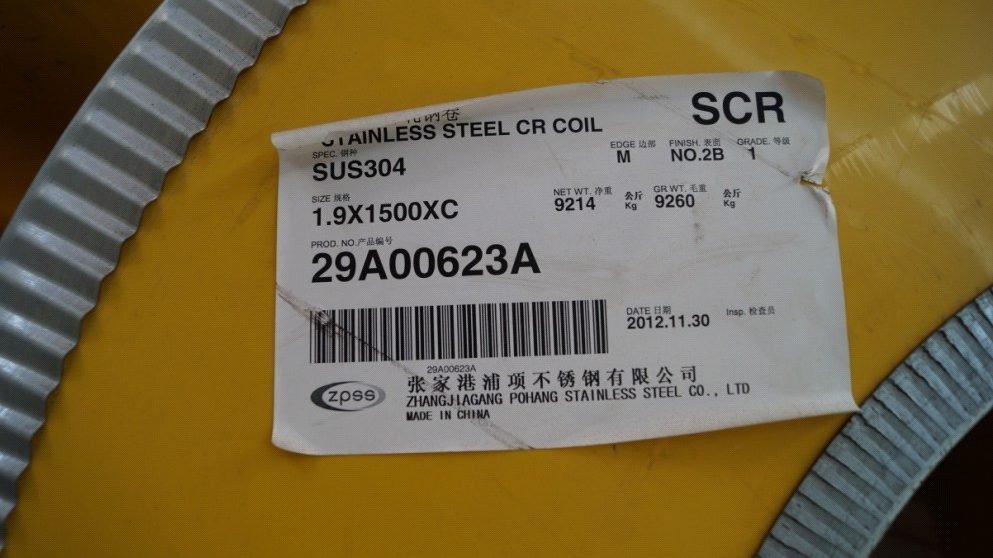
1. What a Finish Actually Is
A stainless finish is not a coating. Nothing is added to the surface; the surface is the metal, modified by cold reduction, heat treatment, pickling and mechanical treatment. That is why a finish can be repaired by re-polishing but cannot be repaired by painting, and why a scratch on a BA surface is permanent in a way that a scratch on a painted panel is not.
The finishes in EN 10088-2 and ASTM A240 are designated by number and by process. 2B is cold rolled, annealed and pickled, then skin-passed. BA is cold rolled and bright-annealed in a controlled atmosphere, with no pickling. No.4 is a polished finish produced by abrasive belts, and it is a mechanical finish applied after the mill finishes. 2D is the dull, pickled, unskin-passed surface used where appearance is irrelevant. 8K is a mirror polish, and No.8 is a mirror produced by progressively finer abrasives.
The practical consequence is that the mill finish and the polished finish come from different parts of the supply chain. A 2B or BA coil is a mill product. A No.4 coil is a mill product that has been re-polished, usually by a service centre, and the quality of that polishing operation — belt grit sequence, pressure, and the condition of the base coil — matters as much as the base material.
2. How Each Finish Is Produced
2B. The coil is cold rolled to final thickness, annealed at 1,040–1,120 °C for austenitic grades, cooled, pickled in nitric–hydrofluoric acid to remove the oxide and the chromium-depleted layer, then skin-passed with a light reduction of 0.5–1.5 % on polished rolls. The skin pass gives a uniform, slightly reflective grey surface with a defined roughness, and it suppresses the yield-point elongation that would otherwise cause stretcher strains when the sheet is formed.
BA. The coil is cold rolled and then annealed in a bright-annealing furnace with a hydrogen or hydrogen–nitrogen atmosphere and a dew point below −40 °C. In that atmosphere no oxide forms, so no pickling is needed and the surface stays reflective. The result is a bright, slightly bluish-white surface with a lower roughness than 2B, and it is usually supplied with a protective film because a bright surface shows every fingerprint.
No.4. The coil is polished with a sequence of abrasive belts, typically starting at 60–80 grit and finishing at 120–180 grit, in one direction. The result is a directional, satin surface with visible short scratches running along the coil length. The finish is measured by roughness and by the uniformity of the direction; a No.4 surface polished across the strip rather than along it will look different under raking light and cannot be matched to adjacent panels.
2D. Cold rolled, annealed and pickled, without a skin pass. The surface is matte and slightly rough, with a dull grey appearance. It is the cheapest mill finish and is used where the surface will be hidden, painted, or further processed.
3. Measurable Surface Parameters
| Finish | Typical Ra, µm | Gloss (60°) | Directionality | Relative cost |
|---|---|---|---|---|
| 2D | 1.6–3.0 | low, matte | none | lowest |
| 2B | 0.3–0.8 | medium, semi-reflective | none | baseline |
| BA | 0.05–0.25 | high, mirror-like haze | none | +8–15 % |
| No.4 | 1.0–3.0 | low, satin | strong, along coil | +15–30 % |
| No.8 / 8K | 0.01–0.08 | very high, mirror | none | +60–120 % |
Ra is the arithmetic mean roughness and it is the number to put on a specification if surface appearance is being bought to a standard. Gloss is a secondary indicator and it is sensitive to the measuring angle; a No.4 surface can read 20–40 gloss units at 60° and still look correct, while a BA surface reads 300–500 and looks like a mirror only when it is clean.
The directionality is not a defect. A No.4 finish is deliberately directional. The problem arises when panels are cut and installed with different orientations, so that adjacent sheets catch the light differently and the facade looks patchy. That is a fabrication and installation issue, and the fix is to specify the grain direction and to mark it on every sheet.
4. Grades Under the Finish
| Element, % | 304 | 304L | 316L | 430 |
|---|---|---|---|---|
| C, max | 0.07 | 0.03 | 0.03 | 0.12 |
| Si, max | 1.00 | 1.00 | 1.00 | 1.00 |
| Mn, max | 2.00 | 2.00 | 2.00 | 1.00 |
| P, max | 0.045 | 0.045 | 0.045 | 0.040 |
| S, max | 0.030 | 0.030 | 0.030 | 0.030 |
| Cr | 18.0–20.0 | 18.0–20.0 | 16.0–18.0 | 16.0–18.0 |
| Ni | 8.0–10.5 | 8.0–12.0 | 10.0–14.0 | — |
| Mo | — | — | 2.0–3.0 | — |
430 is a ferritic grade with no nickel, and it is the grade most often used for appliance panels and interior trim where cost matters. It is magnetic, less formable than 304, and it does not tolerate the same welding practice. It also does not take a deep BA finish as well as an austenitic grade, because the ferritic structure behaves differently in the bright-annealing furnace. If a customer asks for “BA 430”, check that the mill actually supplies that combination rather than assuming it.
5. Mechanical Properties
| Grade / condition | Yield Rp0.2, MPa | Tensile Rm, MPa | Elongation A, min % | Hardness, HV |
|---|---|---|---|---|
| 304, annealed | 205 min | 520–720 | 40 | ≤ 200 |
| 304L, annealed | 175 min | 485–680 | 40 | ≤ 200 |
| 316L, annealed | 205 min | 485–680 | 40 | ≤ 200 |
| 430, annealed | 205 min | 450–600 | 22 | ≤ 200 |
| 304, 1/4 hard | — | 860–1,000 | 10 | 250–300 |
| 304, 1/2 hard | — | 1,030–1,200 | 6 | 300–350 |
The temper matters more than the finish for fabrication. A 2B coil in the annealed condition draws well; the same coil in 1/2 hard will crack at a bend radius that the annealed material accepts without complaint. If a part is being deep drawn or heavily formed, buy annealed material and choose the finish on top of that, not the other way round.
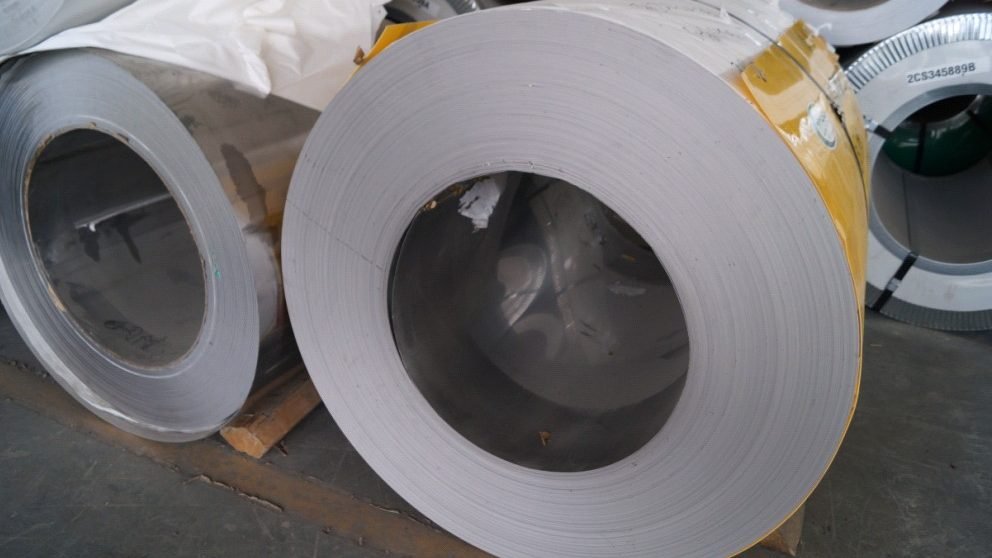
Thickness tolerance follows the usual cold-rolled conventions: ±0.05 mm for 0.30–0.60 mm, ±0.07 mm for 0.60–1.00 mm, ±0.09 mm for 1.00–2.00 mm, and ±0.12 mm above that, with restricted tolerances about 0.02 mm tighter. Width is usually +2/0 mm to 1,000 mm and +3/0 mm above. Coils come with 508 mm or 610 mm inner diameter, and No.4 coils are normally supplied with a PVC film on both surfaces.
6. How the Finish Affects Fabrication
Bending. All mill finishes bend similarly, because the finish is a surface condition and not a coating. The exception is No.4, where bending can open the directional scratches on the outside of the bend and make them more visible. For a visible bent edge, specify a bend line parallel to the polishing direction.
Welding. Welding destroys the finish locally. A TIG weld on a BA surface leaves a heat tint that must be pickled and re-polished, and the re-polished zone will never match the surrounding surface exactly. On a No.4 surface the weld is easier to blend because the satin texture hides small differences, which is one reason No.4 is preferred for welded architectural work.
Laser cutting. The cut edge is oxidized and slightly discoloured on any finish. On BA and mirror surfaces the contrast is obvious and the edge usually needs dressing. On 2B and No.4 the edge is less conspicuous.
Deep drawing. A rougher surface holds lubricant better, so 2B and 2D draw more easily than BA. A BA surface in a deep-drawing operation needs a suitable lubricant and a well-polished tool, or it will pick up and gall.
Cleaning. A smooth surface is easier to clean but shows streaks. A No.4 surface hides fingerprints better than BA but traps fine particles in the scratch pattern, and in a food environment it must be cleaned along the grain, not across it.
7. Selecting a Finish by Application
Kitchen equipment, sinks, worktops. No.4 is the default. It hides scratches, tolerates daily cleaning, and can be blended after welding. BA is used for visible interior panels and for backsplashes where reflectivity is wanted.
Appliances and white goods. 2B for internal parts and structural brackets, BA for visible doors and control panels, and a polymer-coated finish where the surface must resist fingerprints.
Architectural cladding and elevator interiors. No.4, often with a protective film and a specified grain direction. Mirror finishes are used sparingly because they show every handling mark.
Process vessels and piping. 2B internally, with pickling and passivation of welds. Internal surface roughness matters for cleanability in food and pharmaceutical service, where an Ra limit of 0.8 µm or better is often specified.
Hidden structure and supports. 2D or 2B. Paying for BA on a part that will never be seen is waste.
8. Inspection and Common Mistakes
Judging finish by shine. A 2B surface under bright light can look almost as reflective as BA, particularly if it has just been wiped. The distinction shows up in Ra and in the haze: BA reflects a sharp image, 2B reflects a blurred one. Inspect under a defined light at a low angle.
Mixing coil and sheet terminology. A “2B sheet” is cut from a 2B coil; the finish is a property of the coil. Ordering sheet by finish without specifying the base coil grade and temper leaves the mill free to supply something that meets the word but not the intent.
Assuming No.4 is uniform. No.4 depends on the polishing line. Two suppliers can deliver visibly different satin tones from the same base coil, and adjacent batches can differ enough to be seen on a facade. For visible work, request a sample from the actual production batch.
Leaving the PVC film on outdoors. The film is a handling protection, not a weather protection. Sunlight degrades the adhesive, and after a few months the film leaves a residue that is difficult to remove and can stain the surface.
Welding BA and expecting the finish to survive. It will not. Either design the weld out of sight, or plan for pickling and re-polishing, and accept that the repaired area will be slightly different.
Ignoring the grain direction. On a No.4 facade, panels installed with alternating grain directions will look striped in daylight. Mark the direction on the coil and on every cut sheet.
9. Surface Defects and What They Mean
Roll marks and chatter. Faint transverse bands running across the strip come from the cold mill — worn rolls, vibration, or a mill that was run too fast for the reduction. They are cosmetic on a hidden part and unacceptable on a visible one, and they cannot be removed by polishing without changing the thickness.
Scale and pickling stains. Brown or grey patches on a 2B surface indicate that the pickling line left oxide behind, usually because the acid concentration or the line speed was wrong. The stain is not just appearance: the chromium-depleted layer under it is still there, and pitting starts in exactly those patches.
Slivers and edge cracks. Thin flakes of metal along the coil edge, or a fine crack running in from the edge, come from edge trimming that was too light or from a strip that was work-hardened at the edge. Slitting removes most of it; if the slitter is set to take off too little, the defect travels into the finished strip.
Polish lines and comet tails. On a No.4 surface, long scratches or a fan-shaped mark come from a coarse abrasive particle that stayed in the belt or from a belt that was changed without cleaning the line. They are visible only under raking light, which is exactly how a facade will be viewed.
Orange peel. A dimpled, leathery texture that appears after forming, particularly on 430 and on coarse-grained austenitic strip. It comes from grain size, not from the finish, and it cannot be polished out without removing too much material. If a part is to be formed and then polished, specify a fine grain size.
Fingerprint and water stains. These are handling, not mill, defects. On BA they are almost impossible to remove without re-polishing; on 2B they can usually be wiped out with a suitable cleaner. That is the practical argument for supplying BA with a film.
10. Frequently Asked Questions
Is BA more corrosion resistant than 2B? Not in the base metal. Both are the same grade. BA can be marginally better in a clean indoor atmosphere because the surface is smoother and holds less deposits, but in a chloride environment the difference disappears.
Can a 2B coil be polished to No.4 locally? Yes, but the result will not match a mill No.4 coil, because the polishing direction and the abrasive sequence differ. For visible work, buy the finished coil.
What does “skin pass” do? It flattens the strip, sets the roughness, and suppresses yield-point elongation. Without it, formed parts show stretcher strain marks — the flame-like patterns that appear on a bent 2D sheet.
Why does a BA coil come with a film? Because a bright surface marks easily. The film is removed after fabrication, and any adhesive residue is cleaned with a solvent recommended by the film supplier.
Is 430 available in BA? Some mills supply it, but the finish is not as bright as on 304, and availability is limited. Confirm before specifying.
How is Ra measured on a coil? With a portable roughness tester, at several positions across the width and along the length, with the traverse direction stated. A single reading is not a specification.
11. Sourcing Stainless Coil
QIDAMT supplies cold-rolled stainless coil in 304, 304L, 316L and 430, in 2B, BA and No.4 finishes, thickness 0.30–3.00 mm, widths up to 1,500 mm, with 508 mm or 610 mm inner diameter and PVC film on request. Finish, grain direction, temper and surface protection are confirmed on the order, not left to the label.
See the standard 2B coil range here: Stainless Steel Coil 304 2B. For cut sheet and plate, see 304 Stainless Steel Sheet 2B and 316L Stainless Steel Plate.
Need a specific finish, Ra value or grain direction?
Send the grade, thickness, width, finish, temper and tonnage, and we will confirm the production option.
Related reading: Stainless Steel Coil 304 2B · 316L Stainless Plate · 304 Sheet 2B

