 진전
6005 알루미늄 라운드 바: 직경 공차, Straightness and Machining Guide
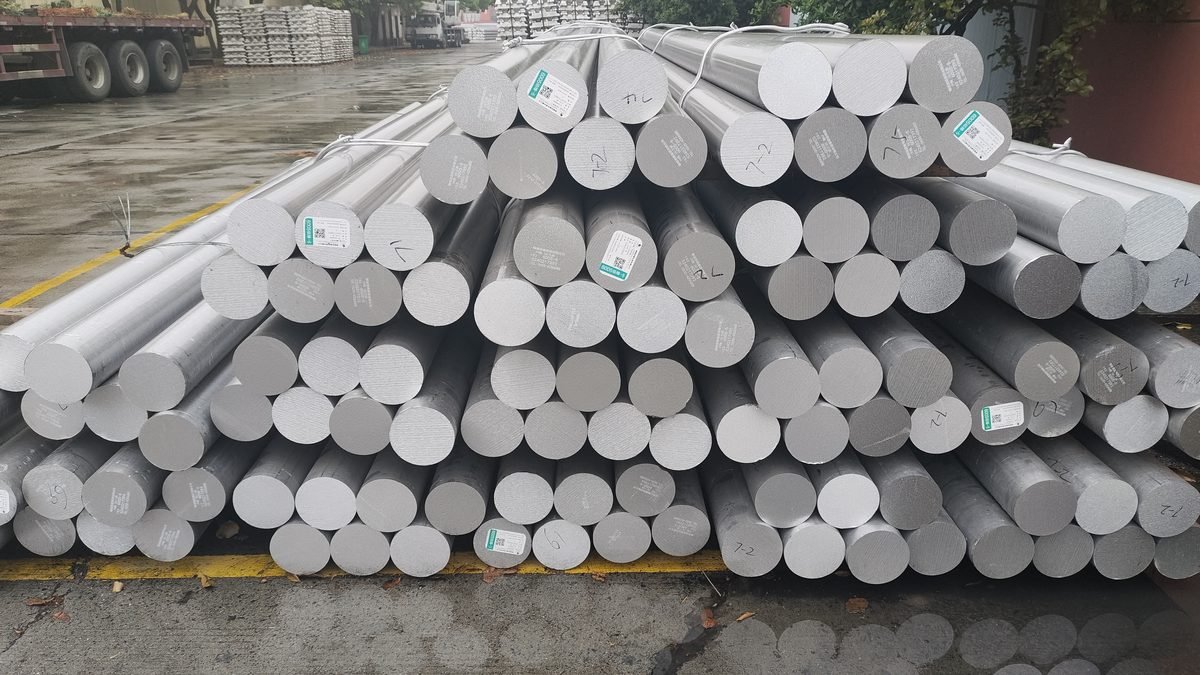
6005 aluminium round bar is an extruded Al-Mg-Si alloy bar supplied in the T5 or T6 temper, with a diameter range from about 6 mm 에 250 mm. It is chosen for structural parts, 기계 프레임, transport equipment, 사다리, guardrails and general fabrication because it offers better strength than 6063 while retaining good extrusion quality and corrosion resistance. The grade is often confused with 6061 그리고 6063, but its chemistry and temper response are different.
무엇 6005 Aluminium Round Bar Is and Where It Is Used
6005 is a medium-strength aluminium alloy in the Al-Mg-Si family. It contains silicon and magnesium in proportions that allow the formation of Mg2Si precipitates during artificial aging. The alloy was developed for extruded structural profiles, and round bar is one of its common product forms. It is stronger than 6063-T5, more formable than 7075, and easier to extrude than 6061 in complex shapes.
Typical uses include machine guards, frame members, 사다리 레일, walkway supports, truck and trailer parts, rail interior structures, scaffolding components, display fixtures, furniture frames and light-duty structural connections. The bar can be machined into brackets, bushings, spacers, 샤프트, rollers and mounting blocks. It can also be anodized, powder coated or laser cut after machining.
The grade is not a marine hull alloy. It has good resistance to rural and urban atmospheres, but it is not the best choice for continuous salt-water immersion or high-chloride chemical service. For a boat hull, 사용 5083 또는 5086 그릇; for a marine superstructure, 6005 may be acceptable with a proper coating and a design that avoids trapped water. The distinction matters because “aluminium” is often treated as one material when it is a family of alloys with very different corrosion behaviour.
등급 지정 및 화학 성분
6005 is standardised in EN 573-3 as EN AW-6005 and in Chinese standards as 6005. It is a heat-treatable Al-Mg-Si alloy with silicon and magnesium as the main alloying elements. The closely related 6005A has wider limits for manganese, copper and chromium and is often used for complex extrusions; a purchase order should state 6005 or 6005A, not just “6005 series”, because the two are not interchangeable for every extrusion or strength calculation.
| 요소 | 전형적인 6005 범위 (%) | 기능 | Purchasing check |
|---|---|---|---|
| 그리고 | 0.50–0.90 | Forms Mg2Si during aging | Low silicon reduces peak strength |
| 마그네슘 | 0.40–0.60 | Forms Mg2Si | Magnesium below range lowers strength |
| 철 | ≤ 0.35 | 불결 | High iron hurts toughness and finish |
| 구리 | ≤ 0.10 | 불결 | Copper raises strength but reduces corrosion resistance |
| 망 | ≤ 0.10 | Impurity and grain control | Higher manganese is a 6005A feature |
| Cr | ≤ 0.10 | 곡물 제어 | Chromium is limited in 6005 |
| 아연 | ≤ 0.10 | 불결 | High zinc can cause staining |
| 의 | ≤ 0.10 | 곡물 정제 | Check casting practice |
| 알 | 균형 | 행렬 | Confirm with mill certificate |
Typical EN AW-6005 window. Confirm the exact standard and the temper on the mill certificate before releasing the order.
The silicon-to-magnesium ratio controls how much Mg2Si can form. A heat with low silicon or low magnesium may still meet the base chemistry but fail to reach the specified T5 or T6 strength after aging. That is why the certificate should include the actual chemistry and the mechanical test result, not only the alloy designation. A spectrograph check on the bar is a useful receiving test for grade verification.
Copper is deliberately kept low in 6005. Copper increases strength but reduces corrosion resistance and can darken the anodic film. A bar with 0.10% copper is not the same as a 6061 bar with 0.4% 구리, even though both are Al-Mg-Si alloys. Do not accept a “6005” bar that has the chemistry of 6061; the strength may be higher, but the corrosion and anodizing behaviour will not match the specification.
Mechanical Properties and Temper
6005 round bar is normally supplied in T5 or T6. T5 is cooled after extrusion, stretched and artificially aged. T6 is solution treated at a higher temperature, water quenched and artificially aged. T6 gives higher strength and lower elongation; T5 gives a better surface, less distortion and enough strength for many structural parts. The temper must be stated on the order because the same diameter can differ by 30–50 MPa in yield strength depending on the temper.
| 재산 | 6005-T5 typical | 6005-T6 typical | 디자인 노트 |
|---|---|---|---|
| 항복 강도, Rp0.2 | ≥ 215 MPa | ≥ 250 MPa | Use the temper-specific minimum |
| 인장강도, Rm | ≥ 260 MPa | ≥ 290 MPa | Actual values depend on diameter |
| 연장, ㅏ | ≥ 8% | ≥ 8% | T6 is less ductile in tight bends |
| 경도 | About 65–75 HB | About 80–95 HB | Useful for a quick temper check |
| 밀도 | 2.70 g/cm3 | 2.70 g/cm3 | About one-third of steel |
| 열전도율 | About 180–200 W/m·K | About 170–190 W/m·K | Good for heat dissipation |
| 녹는 범위 | About 585–650 °C | About 585–650 °C | Do not overheat during welding |
| 내식성 | Good in rural and urban air | 좋은, slightly lower than T5 | Coat for coastal service |
Typical values for extruded 6005 둥근 막대. Thickness-dependent limits and the actual certificate govern for design.
The T5 temper is produced by quenching the extruded bar at the press, stretching it to relieve stress and straighten it, then aging at about 175–185 °C for several hours. The stretch is usually 1–3%. A bar that is not stretched can bow after machining because residual stress is released when metal is removed. A bar that is overstretched can have a coarse grain and a poor surface after anodizing.
T6 requires a solution treatment at about 530–560 °C, a rapid water quench and an artificial aging cycle. The quench creates a supersaturated solid solution, and the aging precipitates Mg2Si. A thick bar quenches more slowly at the centre than at the surface, so the centre may have lower strength. For large diameters, the mill may specify a modified T6 or a T5 temper with a reduced property guarantee. Do not assume that a T6 stamp means uniform strength through a 200 mm 단면.
치수, Tolerances and Supply Forms
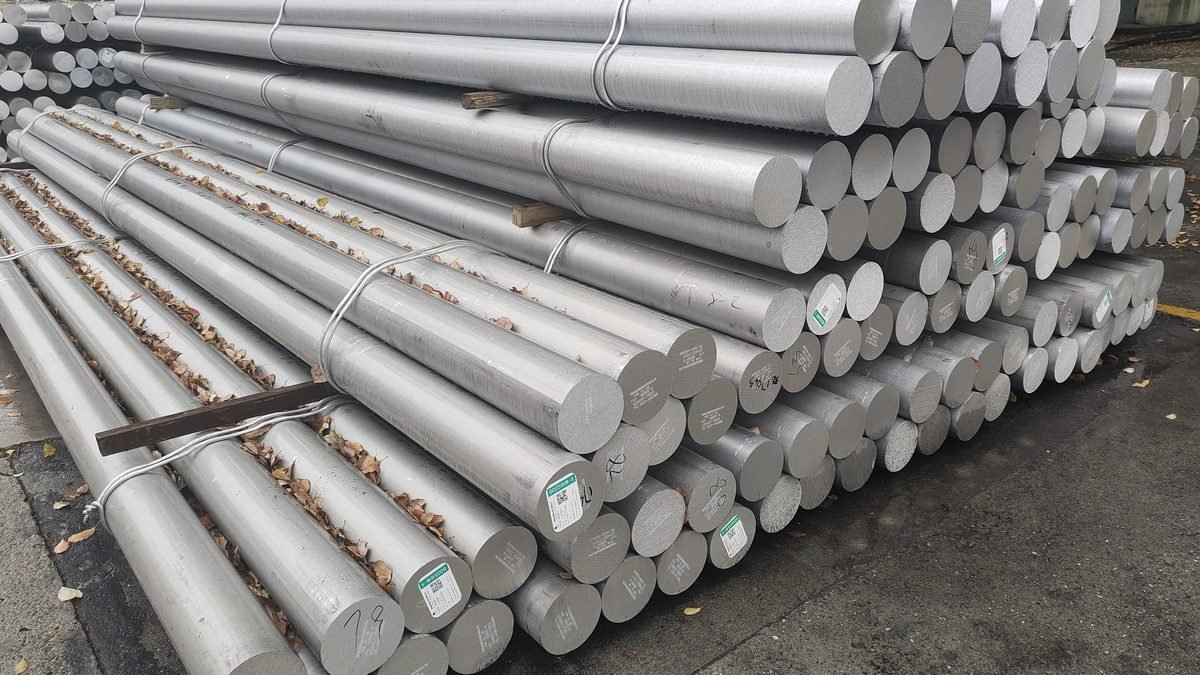
Round bar is ordered by diameter, 길이, temper and tolerance class. The diameter is measured at several points along the bar and at 90 degrees to each other. A bar can be oval within the diameter tolerance and still fail a tight machining setup. For automatic lathes and bar feeders, the diameter tolerance, straightness and end squareness all matter, not just the nominal size.
| 매개변수 | 공통 범위 | 일반적인 공차 | Order description |
|---|---|---|---|
| 지름 | 6–250 mm | ±0.10 to ±0.50 mm depending on size | Nominal diameter and tolerance class |
| 길이 | 3–6 m | +10 / 0 mm | Fixed length or random length |
| 직진도 | — | ≤ 1 미터당 mm | Critical for bar feeders and shafts |
| 타원성 | — | ≤ 50% of diameter tolerance | Check before precision turning |
| 종료 | Saw cut or deburred | — | Squareness and burr limit |
| 표면 | 밀 마무리, anodized or painted | Per order | Finish and protective film |
| 성질 | T5 또는 T6 | — | State the temper and the property standard |
| 포장 | Bundle or crate | — | Export packing and edge protection |
Typical commercial windows for 6005 extruded round bar. Tighter tolerances require a specific drawing and a mill capability check.
Straightness is often the hidden cost in a cheap bar. A bundle that looks straight in the yard can bow after the first cut because the residual stress is released. If the bar will be machined into a long shaft, specify straightness after cut and consider a stress-relief or a T6 temper with a controlled stretch. A bar that is straight but oval will still produce an eccentric turn and a vibration in a bar feeder.
Supply form is a trade-off between handling and cost. ㅏ 6 m bundle is efficient to ship but needs a crane and a long storage bay. ㅏ 3 m length is easier to handle but produces more remnant. For a CNC bar feeder, the bar must be straight, clean and within the feeder’s diameter range. For a manual lathe, a shorter length with a sawn end is often more practical. Specify the length and the end condition on the order, not after the material arrives.
How 6005 Round Bar Is Made
The process starts with a homogenised 6005 billet. The billet is heated to about 450–500 °C and extruded through a round die. The extrusion speed and temperature must be controlled to avoid tearing, die lines and a coarse surface. A billet with a coarse cast structure or a high gas content can produce internal voids and surface blistering after aging.
After extrusion, the bar is quenched, stretched and cut to length. The stretch is the key to straightness and stress relief. The bar is then aged in a batch furnace at a controlled temperature and time. T5 aging is usually around 175–185 °C for 6–10 hours, depending on the diameter and the mill’s procedure. T6 requires a solution treatment and a water quench before aging, which adds cost and distortion risk.
The common defects are die lines, longitudinal streaks, surface blistering, eccentric core, internal voids, bow and hardness variation. Die lines come from a worn or galled die. Streaks can come from impurities or from a billet surface defect. Blistering is often a gas or moisture problem in the billet. Eccentric core comes from die misalignment. Bow comes from poor stretching or from a non-uniform quench. Hardness variation can come from a slow quench at the centre of a thick bar.
A good mill will record the billet heat, extrusion temperature, stretch, aging cycle and mechanical test result. The buyer should ask for the temper and the test direction. For a thick bar, ask whether the test specimen was taken from the surface or the centre; the centre can be weaker. That is not a reason to reject the bar, but it is a reason to design the part with the correct allowable stress.
Machining and Fabrication Rules
6005 machines well but tends to build a built-up edge because it is soft and ductile. 날카로운 것을 사용하라, polished carbide tools with a positive rake, high spindle speed and a generous chip clearance. For turning, a starting surface speed of 300–600 m/min and a feed of 0.1–0.3 mm/rev is reasonable. For drilling, use a parabolic flute and peck deep holes; aluminium chips can pack the flutes and seize the drill.
Coolant is important for dimensional stability. A water-soluble coolant designed for aluminium prevents galling and keeps the part cool. Avoid a coolant with a high chloride content, and clean the part before anodizing. A machined surface that is left with coolant residue can show streaks after anodizing. For thin walls, use light passes and support the part; 6005 is less stiff than steel and will deflect under cutting force.
Welding is possible but not ideal for a T5 or T6 structural part. The heat-affected zone loses strength, 그리고 6005 is more sensitive to hot cracking than 6061. Use a 5356 필러와 자격을 갖춘 시술. If the joint must carry load, design for the heat-affected zone strength, not the parent metal T5 strength. For a highly loaded part, use a mechanical joint or a 5083/6061 alloy selected for welding.
Anodizing gives 6005 a good clear or coloured finish because the copper content is low. The film is uniform and the colour is cleaner than on a high-copper 6061. Powder coating also works well after a proper pretreatment. Do not anodize a bar that has embedded steel or iron particles from a contaminated brush or blasting media; those particles will show as dark spots and can initiate corrosion.
선택 및 주문 규칙
Choose the temper from the loading and the machining. T5 is adequate for most frames, 근위 연대, ladders and general structural parts. T6 is better for high-load brackets, shafts and parts that need higher yield strength. If the part will be bent or flanged, T5 is usually more forgiving; T6 may need a larger bend radius or an annealed temper before forming. Do not specify T6 for a part that will be severely formed without checking the bend radius.
Choose the diameter from the finished part plus the machining allowance. A bar that is 0.5 mm undersize at the low end of the tolerance may not clean up at the finished diameter. For a part that must be turned all over, allow at least 1–2 mm per side, depending on the bar tolerance and the straightness. For a part that is only cut and drilled, the nominal diameter and tolerance may be enough.
표준을 명시하라, 성질, 지름, 용인, 길이, 직진성, surface and packing. A generic “6005 aluminium bar” order leaves the mill free to supply a T5 or T6 temper, a loose diameter and a random length. For export, add the heat number, the certificate and the bundle weight. If the bar will be anodized, state the finish and the film thickness; the anodizer needs to know the alloy and the temper.
| 애플리케이션 | Recommended temper | 이유 |
|---|---|---|
| Machine frame and guard | T5 | Good strength, straightness and cost |
| High-load bracket or shaft | T6 | Higher yield strength |
| Part to be bent or flanged | T5 | Better ductility and formability |
| Anodized architectural part | T5 | Uniform colour and surface |
| Welded structural part | T5 with HAZ design | Strength loss in the weld zone |
| Precision machined part | T6 or stress-relieved T5 | Less distortion after metal removal |
Temper selection is a design decision. Verify the actual mechanical properties for the diameter and the mill’s capability.
일반적인 실수
| Mistake | Consequence | Better practice |
|---|---|---|
| Confusing 6005 ~와 함께 6061 | Different strength, corrosion and anodizing behaviour | Specify the alloy and check the certificate |
| Ordering T5 for a high-load part | Yield strength is lower than expected | Use T6 or increase the section |
| Ignoring straightness | Bar feeder jams and machined parts run out | Specify straightness per metre and per length |
| Using a bar with a loose diameter | Part does not clean up | Allow machining stock or tighten the tolerance |
| Welding a T6 part without HAZ design | Joint fails below parent strength | Design for HAZ or use a different alloy |
| Anodizing without cleaning | Streaks and dark spots | Degrease and rinse before anodizing |
| Storing bars on wet ground | White corrosion and stains | Store dry, covered and off the floor |
| Buying by weight without a length count | Short bundles and production shortages | 길이 지정, pieces and bundle weight |
Most 6005 complaints are grade substitution, temper confusion or handling damage, not a failure of the alloy itself.
Inspection and Acceptance
At receiving, check the alloy, 성질, 열 번호, 지름, length and bundle count. Measure the diameter at several points along the bar and at 90 degrees to each other. Check straightness on a flat table or with a straight edge. Inspect the surface for die lines, streaks, blistering, scratches and white corrosion. A light white powder on the surface is usually aluminium oxide from moisture; it should be cleaned and the storage condition corrected.
For critical parts, require a mechanical test certificate with the temper and the test direction. A hardness check is a quick way to spot a temper mix-up, but hardness is not a substitute for a tensile test. If the bar will be anodized, check the surface for embedded iron and for a uniform grain; a coarse grain can produce a grainy appearance after anodizing.
- Verify the alloy and temper on the certificate and the bundle label.
- Measure diameter, ovality and straightness.
- Inspect the surface for die lines, blistering and corrosion.
- Check the length, piece count and bundle weight.
- Ask for the heat number and the mechanical test direction.
- Keep a cut sample for traceability and anodizing trials.
자주하는 질문
~이다 6005 보다 강하다 6063?
Yes in the same temper. 6005-T5 typically has a higher yield strength than 6063-T5, which is why it is used for structural profiles and bars.
~이다 6005 the same as 6061?
아니요. 6005 has lower copper and manganese limits, lower strength and better anodizing colour. 6061 is stronger and more widely used for machined parts, but it is less suitable for complex extrusion.
할 수 있다 6005 be welded?
It can be welded with a 5356 필러와 자격을 갖춘 시술, but the heat-affected zone loses strength. Design the joint for the HAZ strength, not the parent T5 strength.
What temper should I use for machining?
T5 is easier to machine and more stable for general work. T6 gives higher strength but can distort more after removing metal; a stress-relieved T5 may be better for precision parts.
할 수 있다 6005 be anodized?
예. Its low copper content gives a cleaner, more uniform anodic film than 6061. Proper pretreatment and a chloride-free rinse are essential.
~이다 6005 suitable for outdoor use?
Yes in rural and urban atmospheres. For coastal or chloride-rich service, use a protective coating or a more corrosion-resistant alloy such as 5083 또는 6061 with a suitable finish.
What is the difference between T5 and T6?
T5 is cooled after extrusion, stretched and aged. T6 is solution treated, water quenched and aged. T6 is stronger but less ductile and more prone to distortion.
How is round bar diameter measured?
Measure at several points along the length and at 90 degrees to each other. Check ovality as well as the nominal diameter, especially for bar feeders and precision turning.
필요 6005 aluminium round bar with a stated temper, diameter and straightness?
QIDAMT supplies aluminium plate, bar and coil from Liaocheng. 합금을 보내세요, 성질, 지름, 길이, tolerance and destination for a quotation. Email sales@qidamt.com or call +86 139 6951 8618 during working hours (GMT+8).