 진전
304 Stainless Steel Hot Rolled Coil: No.1 마무리, Edge and Coil Handling Guide
ㅏ 304 stainless steel hot rolled coil is a wide strip of austenitic stainless steel produced by hot rolling a slab, then annealing, pickling and recoiling it into a heavyweight coil. It is the starting material for tanks, process equipment, 건축 패널, kitchen sinks, chimney liners and general fabrication, and it is bought by thickness, 너비, edge condition and coil weight rather than by a single grade name.
정말 304 Hot Rolled Coil Is and Where It Is Used
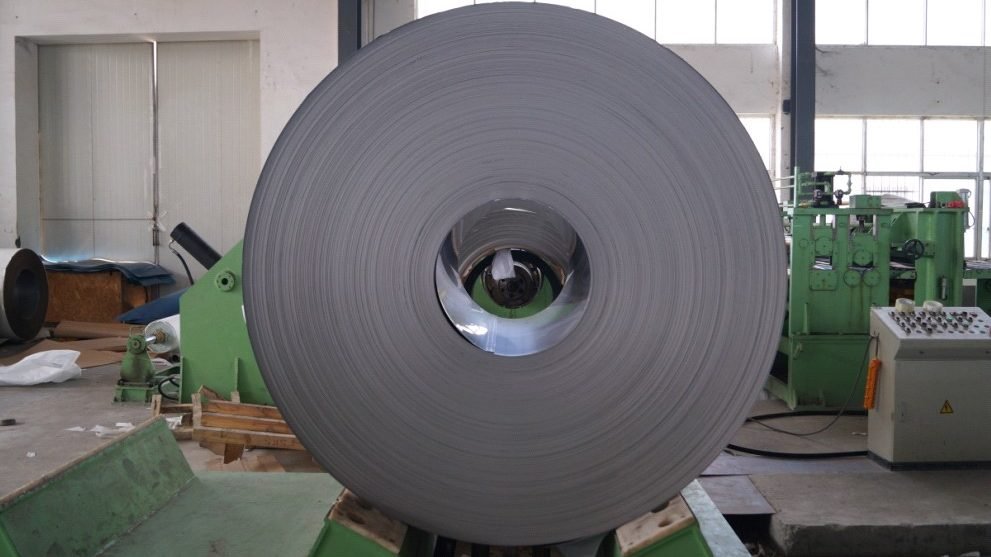
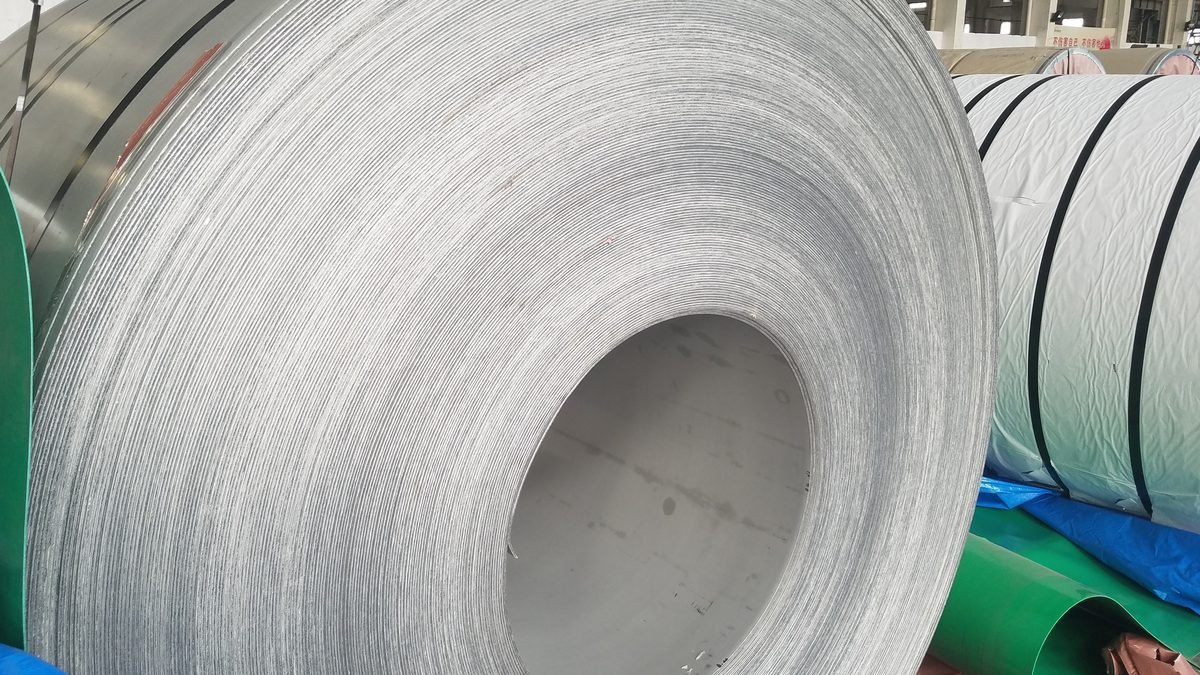
Hot rolled coil begins as a continuously cast slab of 304 스테인레스 스틸. The slab is reheated and passed through a hot rolling train that reduces it to strip in the range of about 3 mm 에 14 mm. The strip is then annealed to restore the austenitic structure, pickled to remove the mill scale, inspected, slit to width and coiled. The result is the familiar No.1 finish: a dull, slightly rough, grey-to-silver surface that still carries the marks of the hot rolling and pickling line.
The product is used wherever a large, continuous length of stainless steel is more efficient than cut plate. 탱크 포탄, silo liners, 덕트, chimney sections, heat exchanger shells, water treatment vessels, 호퍼, 트럭 차체, kitchen equipment and architectural cladding are common examples. A fabricator can slit a coil into strips for roll forming, cut blanks for deep drawing, or shear and weld sections for a vessel. The coil form also reduces handling damage compared with a stack of loose sheets and makes continuous processing possible.
ㅏ 304 hot rolled coil is not the same product as a 304 냉간 압연 시트. Cold rolling produces thinner gauges, tighter thickness tolerance, a smoother 2B or BA surface and better flatness, but it also limits width and increases cost. Hot rolled coil is the economical choice for thicker sections, structural work and applications where the No.1 finish will be hidden, 그린, lined or further processed. The two products can both be 304 and still differ in thickness range, 표면, flatness and the way they behave during cutting and welding.
등급 지정 및 화학 성분
The grade is the standard austenitic 18/8 스테인레스 스틸: ~에 대한 18% 크롬과 8% 니켈, with carbon kept low enough to avoid sensitisation during welding. In Chinese standards it appears as 06Cr19Ni10, in European standards as 1.4301, and in ASTM as 304. The coil certificate should name the standard, the heat number, the thickness and the edge condition, not only the word 304. A generic label without a heat number is difficult to trace if a weld later fails or a surface rust complaint appears.
| 요소 | 전형적인 304 범위 (%) | Role in the alloy | Purchasing check |
|---|---|---|---|
| 기음 | ≤ 0.08 | Austenite stability and weldability | Higher carbon raises sensitisation risk |
| 그리고 | ≤ 0.75 | Deoxidation and scale control | Excess silica can form surface inclusions |
| 망 | ≤ 2.00 | Austenite former and nitrogen carrier | High manganese is not a substitute for nickel |
| 피 | ≤ 0.045 | Residual impurity | High phosphorus hurts hot ductility |
| 에스 | ≤ 0.030 | Residual impurity | Sulphur raises inclusion count and lowers weld quality |
| Cr | 18.0-20.0 | Passive film and corrosion resistance | 아래에 18% weakens pitting resistance |
| ~ 안에 | 8.0-10.5 | Austenite stability and toughness | Low nickel can leave magnetic delta ferrite |
| N | ≤ 0.10 | Austenite former and strength | Too much nitrogen harms deep drawing |
| 철 | 균형 | 행렬 | Check residual elements on the mill certificate |
Typical ASTM A240 / 안에 10028-7 / GB/T 4237 window for 304. Confirm the current edition and any customer-specific restriction before releasing the coil.
Nickel and chromium are the two elements that control both corrosion resistance and phase balance. A coil that is nominally 304 but sits at 8.0% nickel and 18.0% chromium has less pitting margin than one at 10% nickel and 19% 크롬. That difference matters in coastal air, chlorinated water, food processing and architectural cleaning cycles. It is not visible on the surface and cannot be judged by a magnet test, because cold work can make 304 slightly magnetic even when the chemistry is correct.
기계적 성질
열간압연 304 coil is normally supplied in the annealed and pickled condition. Annealing dissolves carbides, removes work hardening from rolling and restores elongation. If the coil is sold without a proper anneal, or if the anneal is too cold or too fast, the material can be strong but brittle, and subsequent bending or flanging may crack. The table below gives typical annealed values; they are design guidance, not a substitute for the mill test certificate.
| 재산 | Typical annealed value | Test standard | 디자인 노트 |
|---|---|---|---|
| 항복 강도, Rp0.2 | ≥ 205 MPa | ASTM A370 / 안에 10002 | 사용 205 MPa as the minimum for structural calculation |
| 인장강도, Rm | ≥ 515 MPa | ASTM A370 / 안에 10002 | Actual values often run 550–650 MPa |
| 연장, A50 | ≥ 40% | ASTM A370 | Lower elongation signals incomplete anneal |
| 경도 | ≤ 201 HB | ASTM E10 | Hardness above 92 HRB suggests work hardening |
| 밀도 | 7.93 g/cm3 | — | Useful for coil weight and freight estimates |
| 열전도율 | 15–16 W/m·K at 20 ℃ | — | Low compared with carbon steel |
| Coefficient of expansion | 17–18 × 10-6 /케이 | — | Allow for thermal movement in long runs |
| Maximum service temperature | 에 대한 800 °C in oxidising air | — | Strength and scaling limit continuous use |
Typical room-temperature values for annealed 304. For pressure vessels or safety-critical work, use the minimum values in the applicable design code and the actual certificate.
The annealed condition is soft and highly ductile, 그렇기 때문에 304 hot rolled coil can be sheared, plasma cut, roll formed and welded without the cracking problems of martensitic or ferritic grades. Cold work raises strength and introduces magnetism, but it also reduces corrosion resistance at the same chromium level. A coil that has been heavily slit or straightened may show higher hardness at the edges than in the centre. That is normal, but it should be accounted for when the edge is subsequently rolled or welded.
치수, Tolerances and Coil Data
Hot rolled coil is ordered by nominal thickness, 너비, 가장자리 상태 및 코일 무게. Thickness is the most disputed dimension because the hot rolling process has a wider tolerance than cold rolling. ㅏ 6 mm nominal coil may be supplied at 5.7 mm 또는 6.3 mm depending on the standard and the mill’s capability. If the finished part has a minimum wall requirement, the purchase order should state the minimum after tolerances, not only the nominal gauge.
| 매개변수 | 공통 범위 | 일반적인 공차 | What to write on the order |
|---|---|---|---|
| 두께 | 3.0–14.0 mm | ±0.25 to ±0.75 mm depending on gauge | 명사 같은, 기준, and minimum actual thickness |
| 너비 | 1000–2000 mm | 0 / +20 mm or ±10 mm | Finished width after slitting, not slab width |
| 코일 내경 | 508 mm 또는 610 mm | ±5 mm | Mandrel size at the customer’s decoiler |
| Coil outer diameter | 1000–2200 mm | Mill-dependent | Crane and coil car capacity |
| 코일 무게 | 5–25 t | ±10% typical | Maximum lift and storage bay load |
| 가장자리 조건 | 밀 가장자리 또는 슬릿 가장자리 | Slit width tolerance ±1–3 mm | Slit edge for exposed or welded edges |
| 캠버 | — | ≤ 5 mm 이상 5 m typical | Critical for long roll forming lines |
| 표면 | 1호 절임 | No pits, scale or residual oxide | Pickled and oiled only if specified |
| Coil wrap | Cardboard, plastic or both | — | Export packing and moisture protection |
Typical commercial data for 304 열간압연 코일. Tolerances vary by standard and mill; state the governing standard and the measured acceptance limits.
Edge condition deserves more attention than it usually gets. A mill edge is the natural edge produced during hot rolling. It can be slightly irregular, may carry a narrow zone of decarburised or oxidised metal, and is not suitable for a visible edge or a longitudinal weld without trimming. A slit edge is produced by rotary slitting and is straighter and cleaner, but it can still have a small burr or a work-hardened rim. 탱크용, ducts and architectural work, specify slit edge with a defined burr limit. For a coil that will be cut into blanks, mill edge may be acceptable if the edge is trimmed after cutting.
Coil weight is a logistics decision as much as a technical one. ㅏ 25 t coil needs a crane, a decoiler and a coil car rated for it. ㅏ 5 t coil is easier to handle but creates more setup time and more leftover ends. For export, the coil should be edge-wrapped, eye-protected and strapped, with a moisture barrier that does not trap condensation. A coil that arrives with a broken wrap often has rust spots at the edges, and the buyer may mistake that for a grade problem.
How 304 Hot Rolled Coil Is Made
The process starts with a 304 slab that has been continuously cast and surface-ground. The slab is reheated to about 1200–1250 °C, then rolled through roughing and finishing stands. The finishing temperature and coiling temperature control grain size and scale. If the coiling temperature is too high, the scale becomes thick and difficult to pickle; if it is too low, the strip can be hard and the coil may not flatten properly.
롤링 후, the coil is annealed in a continuous furnace or a batch furnace. Continuous annealing is faster and gives more uniform properties; batch annealing is slower but can suit heavy gauges. The annealed coil is pickled in nitric-hydrofluoric acid to remove scale and the chromium-depleted layer. Pickling is followed by passivation or a rinse, then edge slitting, inspection and recoiling. The No.1 finish is the direct result of this hot route and is not polished afterward.
The most common manufacturing defects are residual scale, pickle streaks, 가장자리 균열, 캠버, thickness variation and coil telescoping. Residual scale appears as dark patches that do not respond to picking and can hide corrosion; it usually comes from incomplete pickling or from a scale that was rolled into the surface. Pickle streaks are grey bands caused by uneven acid flow. Edge cracks come from slab defects or from poor edge trimming. Camber is a sideways bow that makes the coil track poorly on a decoiler. Telescoping is a coil whose wraps have shifted sideways, which can damage the edge during handling.
A good mill will record the slab heat number, the rolling temperatures, the annealing line speed, the pickle bath chemistry and the final inspection result. The buyer does not need every parameter, but the certificate should connect the coil to a heat number and to the mechanical test results. Without that link, a failure investigation has no starting point.
Selection and Coil Handling Rules
The first selection decision is thickness. Use the finished design thickness plus a corrosion allowance plus a rolling or grinding allowance. A tank shell that is designed at 4 mm may need a 5 mm coil if the surface will be ground after welding. A duct that is designed at 1.2 mm cannot be made from a 3 mm hot rolled coil without cold rolling; choose a cold rolled sheet instead. Do not force a hot rolled product into a thin-gauge application just because the grade is correct.
The second decision is width. Slitting a wide coil into narrower strips is efficient, but each slit adds a small edge loss and a burr. If the finished width is close to the coil width, the edge trim may not be enough to remove the mill edge. Calculate the finished width plus edge trim plus slitting kerf before choosing the coil width. For roll forming, a few millimetres of width error can change the formed profile and cause cracking at the corners.
The third decision is surface. No.1 is not a decorative finish. If the coil will be visible, plan to grind, 브러시, polish or coat it. If it will be welded and pickled, specify the pickling procedure and the final surface requirement. A No.1 coil that is stored wet can develop surface rust in the wrap; that rust is usually shallow and can be removed, but it should be inspected before cutting rather than after fabrication.
- Store coils horizontally on a saddle or on timber, never directly on a wet concrete floor.
- Keep the eye covered and the wrap intact until the coil is loaded on the decoiler.
- Use a coil car or crane with a proper C-hook; do not lift by the wrap straps.
- Allow the coil to reach room temperature before precision cutting if it was stored in freezing conditions.
- Record the heat number and coil number on the cutting plan so finished parts remain traceable.
Common Mistakes Buyers Make
| Mistake | Why it goes wrong | Better practice |
|---|---|---|
| Ordering only 304 without a standard | Chemistry and tolerance can drift between mills | State ASTM A240, 안에 10028-7 or GB/T 4237 plus thickness tolerance |
| Treating No.1 as a finished surface | It is matte, pickled and may show rolling texture | Specify grinding, polishing or coating if appearance matters |
| 사용 304 in a chlorinated or coastal splash zone | Pitting and crevice corrosion start at chlorides | Use 316L or a higher-molybdenum grade where chlorides persist |
| Ignoring edge condition | Mill edge can crack or show oxide during welding | Specify slit edge and burr limit for exposed or welded edges |
| Choosing a coil heavier than the crane | Handling becomes unsafe and the coil may be damaged | Match coil weight to crane, decoiler and storage capacity |
| Assuming thickness is exact | Hot rolling tolerance is wider than cold rolling | State minimum actual thickness and check with a micrometer |
| Leaving the coil wrapped in a humid yard | Condensation causes edge rust and white spots | Store dry, ventilated, with a moisture barrier and periodic inspection |
| 용접 304 without controlling heat input | Sensitisation and heat tint reduce corrosion resistance | Use low heat input, proper shielding gas and post-weld cleaning |
These are commercial and fabrication errors, not grade failures. Most can be avoided by a complete purchase description and a receiving inspection.
Inspection and Acceptance
Receiving inspection should start with the certificate and the coil label. Check the grade, 열 번호, 두께, 너비, 무게, standard and edge condition against the purchase order. Then measure thickness at several points along the coil width and at the head and tail. A coil that is within tolerance at the head can drift at the tail if the mill had a thickness control problem. Measure width at the same points and check for camber by laying a straight edge along the edge.
Surface inspection should be done after the wrap is opened and under good light. Look for residual scale, pickle streaks, 긁힌 자국, 가장자리 균열, rust spots and roll marks. A light rust that wipes off may be handling damage; dark pitting that does not wipe off is a material or storage problem. If the coil is for a pressure vessel or a safety-related part, require PMI on the first piece and a positive material identification report. A magnet test is not a substitute for PMI because 304 can be weakly magnetic after cold work.
- Check the heat number on the coil and on the certificate; they must match.
- Measure thickness at the head, middle and tail, and at three positions across the width.
- 너비 확인, 가장자리 버, camber and coil inner diameter.
- Inspect both faces for scale, streaks, rust and mechanical damage.
- Confirm the coil weight and the number of wraps before signing the delivery note.
- Keep a cut sample and the certificate for traceability.
자주하는 질문
Is a 304 hot rolled coil magnetic?
It can be weakly magnetic at sheared edges or after cold work because deformation transforms some austenite to martensite. A strong magnet response across the whole coil is not normal for annealed 304 and should be checked with PMI.
Can I use a 304 hot rolled coil for a water tank?
예, for potable water and many process waters. For chlorinated water, seawater or high-chloride service, use 316L or a duplex grade, and specify the internal surface finish and passivation.
What is the difference between No.1 and 2B?
No.1 is the hot rolled, 단련 및 절인 표면. 2B는 냉간 압연된다, 단련하고 절인, then skin passed to a smoother, brighter finish. No.1 is normally thicker and less flat.
How much thickness tolerance should I allow?
Allow the full tolerance of the chosen standard plus any grinding or corrosion allowance. If the design has a minimum wall, put that minimum on the order and require the mill to certify the actual thickness.
Can the coil be supplied with a slit edge?
예. Slit edge is common for coil that will be welded or exposed. State the width tolerance, burr limit and whether the edge needs to be deburred.
Why does the coil rust in storage?
Condensation under the wrap, coastal air or contact with carbon steel can start surface rust. Store the coil dry, keep the wrap intact and avoid stacking it against untreated steel.
What coil weight can be shipped in a container?
Coil weight is limited by the crane, the container payload and the coil dimensions. A 20-foot container may take coils in the 5–10 t range, while a 40-foot container can take heavier coils if the load is properly secured.
Do I need a mill certificate?
Yes for any structural, 압력, food or export application. The certificate should show the heat number, 화학 분석, mechanical properties and the standard used.
Need a 304 stainless steel coil with a stated thickness, width and edge condition?
QIDAMT 용품 304 스테인레스 시트, coil and plate from Liaocheng. 두께를 보내다, 너비, 코일 무게, edge condition and destination for a quotation. Email sales@qidamt.com or call +86 139 6951 8618 during working hours (GMT+8).