 진전
316L Stainless Steel Plate: 두께 공차, Finish and Cutting Practice
316L Stainless Steel Plate: 두께 공차, Finish and Cutting Practice
316L stainless steel plate is the low carbon variant of the standard 316 molybdenum-bearing austenitic grade. The L stands for low carbon, and the maximum carbon content drops from 0.08 percent in 316 에게 0.03 percent in 316L. That single change is what makes the grade suitable for welded construction without post-weld solution annealing in most thicknesses.
The grade is chosen for three reasons: resistance to chlorides, resistance to reducing acids, and reliable performance after welding. It is not the strongest stainless steel, it is not the cheapest, and it is not immune to every corrosive environment. Most specification errors come from treating 316L as a universal upgrade rather than as a specific answer to a specific corrosion problem.
This guide covers the chemistry, the mechanical values, the thickness and flatness tolerances, the surface finishes, the cutting and welding practice, and the points where buyers and fabricators most often create problems for themselves.
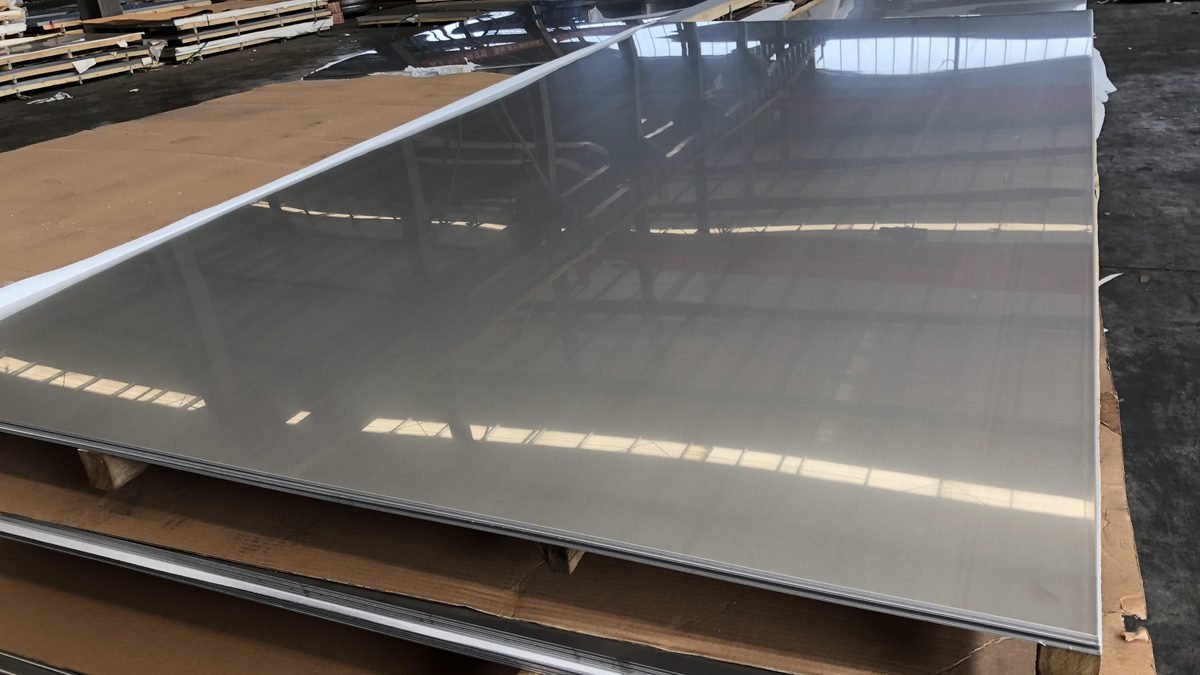
What 316L Plate Is and Where It Is Used
316L is an austenitic stainless steel with molybdenum added to improve resistance to pitting and crevice corrosion, particularly in chloride-bearing environments. It is supplied as hot rolled plate, cold rolled sheet and strip, and as bar and tube. This article deals with plate, meaning material from roughly 3 mm upward, although the same grade in thinner sections is usually called sheet.
The molybdenum content is the defining alloying addition. It raises the pitting resistance equivalent number, which is a calculated value used to rank grades for chloride service. A typical 316L heat with 17 크롬 퍼센트, 12 percent nickel and 2.5 percent molybdenum gives a PREN near 26, compared with about 18 ~을 위한 304. That difference is what allows 316L to survive in coastal atmospheres, chemical process streams and medical cleaning cycles where 304 would pit.
Typical applications include chemical reactor shells, storage tanks for mild acids, pharmaceutical process equipment, food processing vessels, marine fittings above the waterline, 펄프 및 제지 장비, heat exchanger plates, and architectural plate in coastal locations. It is also common in medical device housings and in laboratory furniture where repeated disinfection is expected.
It is not the right grade for strong hydrochloric acid, for hot concentrated chlorides, or for service where chloride stress corrosion cracking is likely. Those environments need duplex stainless steel, higher nickel alloys, or a non-metallic lining. Using 316L there produces a failure that is blamed on the material rather than on the selection.
Chemical Composition and Grade Equivalents
The grade is defined in ASTM A240, 안에 10028-7, JIS G4304 and GB/T 4237. The designation differs by system but the chemistry window is essentially the same. The table below gives the ASTM A240 limits, which are the values most often quoted on mill certificates.
| 요소 | Range or maximum | Role in the alloy |
|---|---|---|
| 탄소 | 0.030 최대 | Low carbon prevents carbide precipitation at weld seams |
| 크롬 | 16.0 에게 18.0 | Forms the passive oxide layer |
| 니켈 | 10.0 에게 14.0 | Stabilises the austenitic structure and improves toughness |
| 몰리브덴 | 2.00 에게 3.00 | Improves pitting and crevice corrosion resistance |
| 망간 | 2.00 최대 | Deoxidation, partial austenite stabilisation |
| 규소 | 0.75 최대 | Deoxidation |
| 인 | 0.045 최대 | Residual element, kept low for toughness |
| Sulphur | 0.030 최대 | Residual element, affects weldability |
| 질소 | 0.10 최대 | Austenite stabiliser, raises strength |
The equivalent designations are UNS S31603 in the United States, 1.4404 in the European system, SUS316L in Japan, and 022Cr17Ni12Mo2 in China. A purchaser who accepts a certificate marked 1.4404 should check that it also meets the 0.03 percent carbon limit, because the older 1.4404 specification and some mill practices can drift toward the higher carbon end of the window.
Titanium-stabilised 316Ti is a different grade. It is used for elevated temperature service where the titanium prevents sensitisation, but it is not a substitute for 316L in ambient temperature corrosion service, and the two should not be mixed in a welded assembly without checking the filler metal.
기계적 성질
Austenitic stainless steel does not respond to heat treatment in the way carbon steel does. It cannot be hardened by quenching, and it is strengthened only by cold work. The values below are the minimums for annealed plate under ASTM A240.
| 재산 | Minimum value | Comment |
|---|---|---|
| 인장강도 | 485 MPa | Annealed condition |
| 항복 강도, 0.2 percent offset | 170 MPa | Low compared with carbon steel |
| 신장률 50 mm | 40 퍼센트 | High ductility, good for forming |
| 경도 | 217 HBW max | Approximate, depends on product form |
| 탄성 계수 | 에 대한 193 평점 | Used for deflection calculations |
| 열팽창 | 에 대한 0.000017 per degree Celsius | Higher than carbon steel, allow for movement |
The low yield strength surprises designers who are used to carbon steel. A 316L tank wall designed on the same basis as a carbon steel wall will be thinner in calculation but may deflect more in service, and the stiffness of a large flat panel is usually governed by deflection rather than by stress. Stiffeners, tie rods and plate thickness selection should follow a deflection check, not only a stress check.
The high elongation is an advantage for forming and for tolerance to minor damage. A plate that is accidentally overloaded will bend rather than fracture, which is one reason austenitic stainless steel is used in equipment that must fail safely. The same ductility means the material work hardens quickly during cold forming, and a heavily formed part may need an intermediate anneal.
Thickness and Flatness Tolerances
Plate thickness is the most disputed dimension in stainless steel purchasing. The tolerance depends on the product form, the width and the standard. Hot rolled plate is generally supplied to a nominal thickness with a permitted minus tolerance, and cold rolled sheet is supplied to a tighter tolerance. The table below shows values that are widely used in commercial practice; the purchase order standard always governs.
| Nominal thickness | Typical tolerance, 냉간 압연 | Typical tolerance, 열간압연 |
|---|---|---|
| 0.30 에게 0.50 mm | plus or minus 0.05 mm | Not applicable |
| 0.50 에게 1.00 mm | plus or minus 0.07 mm | Not applicable |
| 1.00 에게 1.50 mm | plus or minus 0.09 mm | Not applicable |
| 1.50 에게 2.50 mm | plus or minus 0.11 mm | plus or minus 0.20 mm |
| 2.50 에게 3.00 mm | plus or minus 0.13 mm | plus or minus 0.25 mm |
| 3.00 에게 5.00 mm | plus or minus 0.15 mm | plus or minus 0.30 mm |
| 5.00 에게 10.0 mm | plus or minus 0.25 mm | plus or minus 0.40 mm |
| 10.0 에게 20.0 mm | Not typical | plus or minus 0.60 mm |
| 20.0 에게 40.0 mm | Not typical | plus or minus 0.80 mm |
Width and length tolerances are usually plus only, in the range of 0 에게 5 mm for width and 0 에게 10 mm for length on sheared plate. Flatness is the tolerance that matters most for visible surfaces and for gasket joints. A cold rolled 2B sheet is typically flat within 3 mm per metre, while a hot rolled plate may be 5 mm per metre or more. A tank flange that is not flat will leak regardless of how well the weld is made.
Buyers who need a guaranteed minimum thickness should order to a minimum, not to a nominal. This is especially important for pressure vessels and for machined components where the finished surface must clean up at the design thickness.
표면 마감
The finish designation describes how the surface was produced, and it determines both appearance and corrosion behaviour. The common finishes are listed below.
| 마치다 | 설명 | 일반적인 사용 |
|---|---|---|
| No.1 | 열간압연, 단련하고 절인 | Industrial tanks, structural plate |
| 2디 | Cold rolled, 단련하고 절인, matte | Deep drawn parts, painted substrates |
| 2비 | Cold rolled, 어닐링 및 피부 통과, smooth | 일반제작, 식품 장비 |
| 학사 | Bright annealed in a controlled atmosphere | Reflective surfaces, 가전 제품 |
| 4호 | Polished with a coarse abrasive, direction visible | Kitchen equipment, architectural plate |
| 8호 | Mirror polished with fine abrasive | Decorative panels, 반사경 |
| 헤어라인 | Long directional scratches from a belt | Elevator doors, column cladding |
A No.1 finish is the economical choice for equipment that will be painted or insulated. A 2B finish is the default for general fabrication because it is smooth, easy to clean and widely available. A polished finish improves cleanability but also removes the passive layer at the surface, which must then be restored by passivation. A mirror finish shows every fingerprint and every scratch, and it is rarely the right choice for a working surface.
Finish direction matters on architectural work. Two panels with a No.4 finish installed at different orientations will reflect light differently and will look like different colours. The fabrication drawing should state the polishing direction relative to the panel edge, and the installer should keep the direction consistent across the facade.
절단, 성형 및 가공
Laser cutting is the standard process for thin and medium plate. Nitrogen assist gas is used for stainless steel to avoid oxidation at the cut edge; oxygen assist is faster but leaves a dark, oxidised edge that must be cleaned before welding. Fiber lasers cut 316L up to about 20 mm efficiently, and thicker plate is usually cut by plasma or waterjet.
Plasma cutting with nitrogen or an argon-hydrogen mixture produces a clean edge on stainless steel. Waterjet cutting produces no heat affected zone and is preferred where the metallurgy at the edge must not change, for example on parts that will be welded and then exposed to a corrosive process stream.
Shearing is practical for thin sheet and for straight cuts in plate up to about 6 mm, depending on the machine. The shear blade clearance must be set for stainless steel, which is stronger and work hardens more than carbon steel. A blade set for mild steel will produce a burr and a distorted edge on 316L.
Machining 316L is more difficult than machining 304 because the molybdenum addition increases the tendency to work harden and to built-up edge. Sharp tools, positive rake angles, adequate coolant and a steady feed are the essentials. A tool that rubs rather than cuts will harden the surface and shorten tool life dramatically. Free-machining grades such as 316F exist but they are not the same alloy and should not be substituted without approval.
Cold forming is limited by the work hardening rate. A bend radius of twice the thickness is a reasonable minimum for annealed plate in normal fabrication; tighter radii require a larger bend allowance, more springback compensation, and sometimes an intermediate anneal. The bend line should run across the rolling direction where possible, because ductility is lower along the rolling direction.
Welding and Post-Weld Treatment
316L is welded with matching filler metal, typically ER316L for gas tungsten arc and gas metal arc welding, or E316L covered electrodes for shielded metal arc welding. The low carbon content of the filler and the base metal together limit carbide precipitation in the heat affected zone.
Heat input should be controlled. A common practice is to keep the interpass temperature below 150 degrees Celsius and to use stringer beads rather than wide weaving. Excessive heat input promotes delta ferrite formation, sigma phase in extreme cases, and distortion. The joint should be dry and free from oil, paint and marking fluid, because sulphur and chlorine compounds in marking fluids can cause cracking.
용접 후, the heat tint and the oxide layer must be removed. This is not cosmetic. The heat tint is a chromium-depleted film that has lost its corrosion resistance, and leaving it in place is the most common cause of premature rusting on a 316L fabrication. Cleaning is done by pickling with a nitric-hydrofluoric acid gel or paste, followed by passivation with nitric acid, and then thorough rinsing.
Mechanical cleaning with a stainless brush is acceptable for light tint, but the brush must be dedicated to stainless steel and must never have touched carbon steel. A carbon steel wire brush deposits iron particles that rust and initiate pitting. The same rule applies to grinding discs, files and work tables.
Post-weld heat treatment is generally not required for 316L, because the low carbon content prevents sensitisation. Stress relief may be required for dimensional stability or for service in certain corrosive environments, and the heat treatment temperature and cooling rate should follow the design code.
Selecting 316L Correctly
The first question is the chloride level. 316L is a reasonable choice for atmospheric coastal exposure and for process streams with moderate chloride content at ambient temperature. It is not a reasonable choice for hot brines, for hypochlorite solutions, or for chloride concentrations above roughly 200 mg per litre at elevated temperature. Those cases need a higher grade or a different material family.
The second question is the welding extent. A fabrication with extensive welding benefits from the low carbon content of 316L. A fabrication with no welding might use 316 or even 304 if the corrosion environment allows it, but the price difference is usually too small to justify the extra inventory item.
The third question is the surface finish and the cleaning regime. A pharmaceutical vessel needs a smooth, passive surface that can be cleaned in place. A structural support in a coastal plant needs a plate that can be inspected and repainted if necessary. The finish specification should follow from the cleaning method, not from a generic preference.
The fourth question is the design life and the inspection access. A tank that can be inspected and repaired every year is a different design problem from a tank that must run for twenty years without access. Corrosion allowance is not normally applied to stainless steel, so the design must rely on the material’s actual corrosion rate, which in turn depends on the chemistry, the temperature and the oxygen level.
Common Mistakes and Misunderstandings
Treating 316L as stainless in the sense of never corroding is the first mistake. It stains, it pits in the wrong environment, and it rusts if iron contamination is left on the surface. The grade is resistant, not immune.
The second mistake is using carbon steel tools and brushes on stainless steel. The contamination is invisible until the first rain, and then the surface shows brown rust spots that are wrongly attributed to bad material.
The third mistake is skipping pickling after welding. A welded joint with heat tint will corrode at the tint line long before the parent plate shows any sign of attack. The cost of pickling is small compared with the cost of a repair.
The fourth mistake is ordering by nominal thickness and machining the surface. A plate that is 0.3 mm under nominal may not clean up to the finished dimension, and the part is scrap before it is cut.
The fifth mistake is mixing 304 and 316L in one welded assembly without recording which is which. The two grades look identical, and a later inspection cannot tell them apart without a chemical test. Mark the grade on every cut piece.
The sixth mistake is assuming that a polished finish is more corrosion resistant. A polished surface is easier to clean, but polishing can smear embedded iron into the surface. Polished parts still need passivation, and the finish alone does not guarantee performance.
자주 묻는 질문
What is the difference between 316 and 316L? The carbon limit. 316 allows up to 0.08 percent carbon, 316L allows up to 0.03 퍼센트. The lower carbon content reduces carbide precipitation during welding and improves intergranular corrosion resistance.
Is 316L food safe? 예, it is widely used in food processing equipment. The surface finish and the cleaning regime matter as much as the grade.
Can 316L be used in seawater? It can be used for some seawater applications, but it is not the best choice for immersed service. Chloride pitting and crevice corrosion are real risks, and duplex or higher alloys are usually preferred for permanent immersion.
Is 316L magnetic? Annealed 316L is essentially non-magnetic. Cold working can induce slight magnetism, and welds may show a small magnetic response due to delta ferrite.
Why does 316L rust after welding? The heat tint left by welding is chromium depleted and loses its passive layer. Pickling and passivation restore the surface and remove the tint.
Can 316L be heat treated to increase strength? 아니요. Austenitic stainless steel cannot be hardened by heat treatment. Strength is increased only by cold working.
What thickness tolerance should I specify? Specify a minimum thickness if the design depends on it, and state the governing standard and the acceptable minus tolerance. Nominal thickness alone is not a specification.
What is the PREN of 316L? Roughly 25 에게 27, depending on the exact chromium and molybdenum content. It is a ranking tool, not a guarantee of performance in a specific environment.
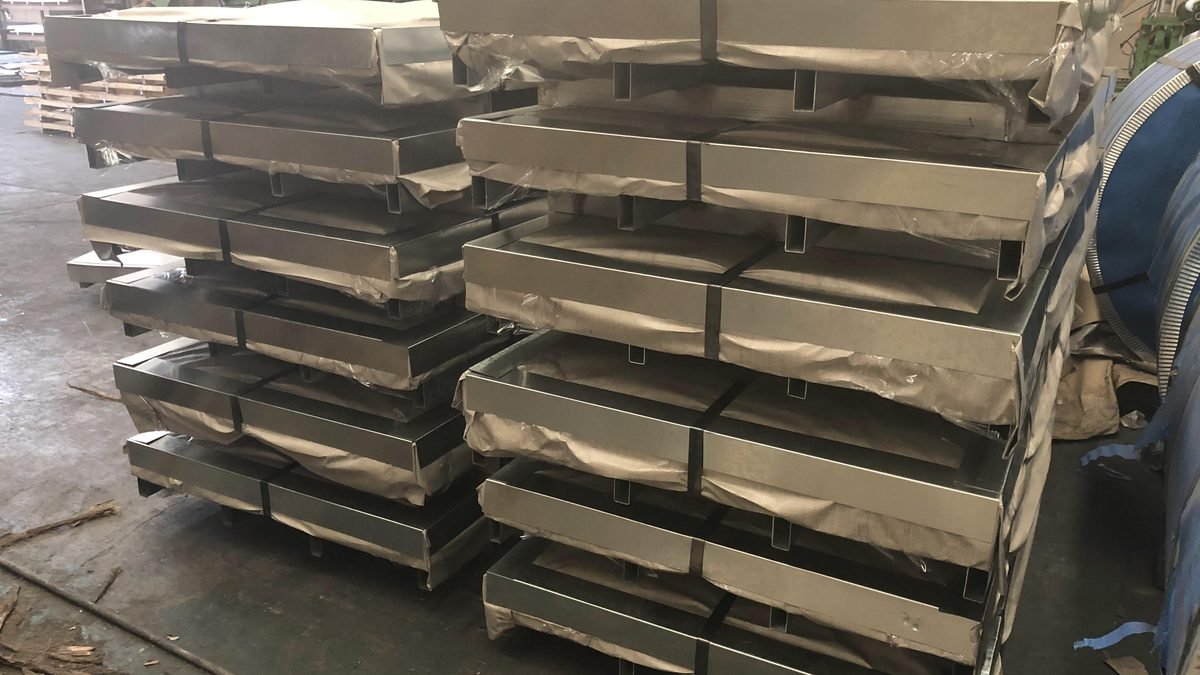
How should 316L plate be stored? Indoors, 마른, on timber skids, with the plates separated by paper or plastic. Avoid contact with carbon steel and with chlorinated water.
Can 316L be laser cut? 예, with nitrogen assist gas to keep the edge clean. Oxygen assist leaves an oxidised edge that must be removed before welding.
Need 316L plate in a specific thickness, width or finish? Send the dimensions and the surface requirement for a quotation.
관련 상품
Related pages on this site: 316L 스테인리스 강판, 304 stainless steel sheet with 2B finish, 그리고 304 stainless steel coil 2B.

