 진전
알루미늄 라운드 바 6063: Diameter Tolerance, Straightness and Machining
Aluminium round bar 6063 is an extruded, heat-treatable aluminium rod supplied in straight lengths, used wherever a light, corrosion-resistant shaft, spacer, handle or machined part has to be produced quickly and repeatably. This guide covers the metallurgy behind the grade, the temper states normally stocked, the diameter and straightness tolerances that decide whether a bar will run true in a lathe, the extrusion and ageing practice that produces a stable bar, and the selection rules that separate a bar suitable for anodising from one suitable for structural machining.
What an Aluminium Round Bar Is and Where It Is Used
An aluminium round bar is a solid circular section produced by direct extrusion: a heated billet is pushed through a circular die, 담금질된, stretched, straightened and sawn to length. Unlike a drawn wire or a rolled bar, the extruded round bar keeps a clearly defined as-extruded surface, and the diameter is controlled by the die plus the finishing pass rather than by grinding. The section is solid, so it can be drilled, tapped, turned, milled and anodised across its full section without the wall-thinning problems that govern tube.
그만큼 6063 alloy sits in the 6xxx family, with magnesium and silicon as the main alloying elements. It is the standard extrusion alloy: soft enough to extrude at high speed, strong enough after artificial ageing for most non-structural parts, and clean enough in surface finish that anodising produces an even, bright film. 실제로, 6063 round bar appears as:
- 샤프트, axles and rollers in conveyors, packaging machines and light automation, where weight saving matters more than ultimate strength.
- Spacers, standoffs, threaded studs and mounting pillars in electrical and electronic assemblies, often anodised black or natural.
- Handles, grab rails, trim rings and furniture components where the bar is bent, polished or anodised after machining.
- Rivets, pins and clevis parts in marine and architectural hardware, where the natural oxide film replaces plating.
- Jigs, fixture blocks and machine guards in workshops that need fast, low-cost stock removal without rust staining.
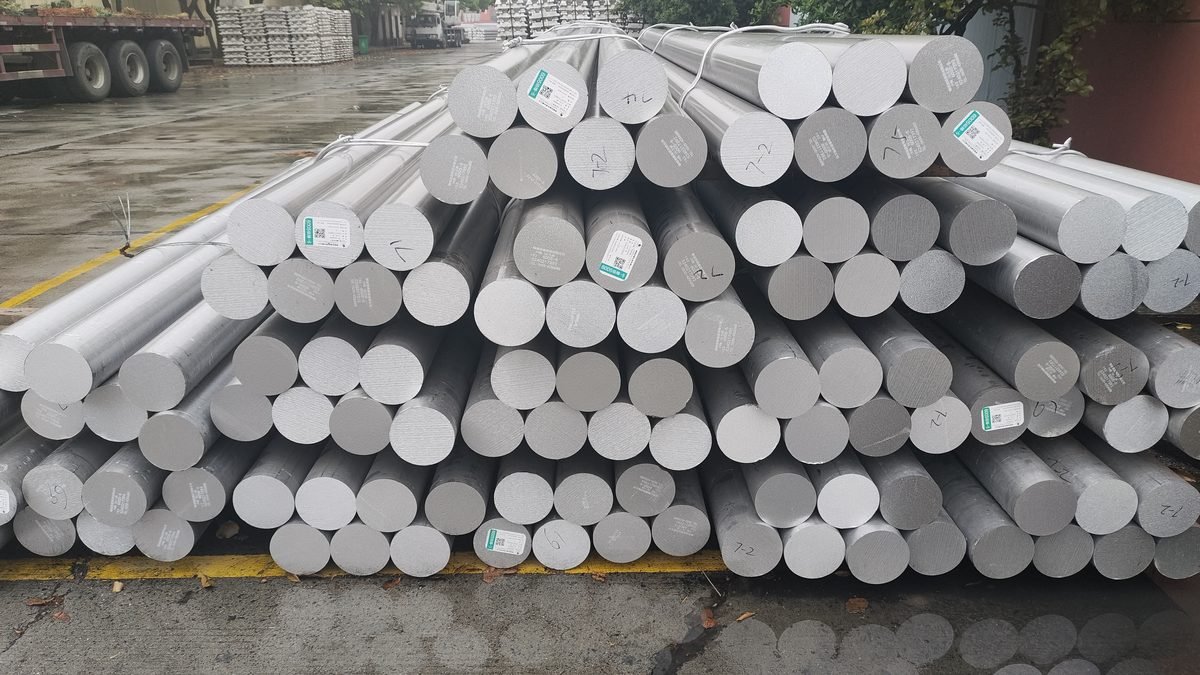
The distinction from 6061 matters. 6061 contains about 1 % magnesium and 0.6 % silicon with a copper addition, and it is the alloy chosen when the part needs real strength or heavy machining. 6063 has lower magnesium, no deliberate copper, and a much softer temper response; it machines easily but galls more readily and deforms more under clamping. Choosing 6063 for a part drawn as 6061 is one of the most common specification mistakes in light fabrication, and it usually shows up as a part that bends in service rather than one that fails in the machine shop.
Grade and Chemical Composition
6063 is a wrought Al-Mg-Si alloy with a nominal magnesium content of about 0.7 % and silicon of about 0.4 %. The compositional window is deliberately tight because the Mg2Si phase that provides age hardening is formed from exactly these two elements. Too little magnesium leaves the alloy under-aged; too much silicon makes the extrusion surface rough and reduces anodising uniformity. Iron and copper are controlled as impurities, because both reduce corrosion resistance and darken the anodised film.
| 요소 | Typical range (%) | 기능 | Effect if out of range |
|---|---|---|---|
| 알 | 균형 | Matrix | — |
| 마그네슘 | 0.45 – 0.90 | Forms Mg2Si with Si; drives ageing | 낮은: under-aged, 부드러운; 높은: hot cracking |
| 그리고 | 0.20 – 0.60 | Partners with Mg | 높은: coarse eutectic, dull anodised surface |
| 철 | ≤ 0.35 | 불결 | 높은: brittle intermetallics, poor finish |
| 구리 | ≤ 0.10 | 불결 | 높은: pitting corrosion, dark anodising |
| 망 | ≤ 0.10 | 불결 / grain control | 높은: reduces extrudability |
| 아연 | ≤ 0.10 | 불결 | 높은: stress corrosion risk |
| 의 | ≤ 0.10 | 곡물 정제 | 높은: coarse recrystallisation |
| Cr | ≤ 0.10 | 불결 | Minor |
| 기타 | ≤ 0.15 총 | Impurity ceiling | Affects anodising colour consistency |
Typical chemical composition for 6063 extrusion alloy; confirm against the mill certificate and the governing standard before release.
Two practical points follow from this table. 첫 번째, the certificate matters: a bar sold as 6063 but sitting at the top of the iron and copper windows will anodise to a slightly grey, patchy colour that cannot be corrected at the finishing line. 두번째, the alloy is not hardenable by cold work in the way that 1xxx or 3xxx alloys are; strength comes from the Mg2Si precipitate formed during ageing, so the temper designation on the delivery note is part of the product, not a secondary detail.
Mechanical Properties by Temper
Round bar 6063 is normally supplied in T5, T6 or, for bending-intensive work, T4 or O. The differences are not cosmetic: T5 is the workhorse for architectural and light mechanical parts, T6 is used where a higher yield strength is needed, and the softer tempers are reserved for forming, bending or heavy machining where tool pressure would otherwise distort the part.
| 성질 | Tensile strength Rm (MPa, 분) | Yield strength Rp0.2 (MPa, 분) | 신장 A (%) | Typical hardness | 일반적인 사용 |
|---|---|---|---|---|---|
| 영형 (단련된) | ≒ 95 | ≒ 55 | ≥ 18 | ≒ 25 HB | Severe forming, 굽힘, spinning |
| T4 (natural aged) | ≒ 140 | ≒ 90 | ≥ 12 | ≒ 45 HB | Bent parts, cold flaring |
| T5 (artificial aged) | ≥ 160 | ≥ 110 | ≥ 8 | ≒ 60 HB | General machining, 프레임, handles |
| T6 (full artificial aged) | ≥ 205 | ≥ 170 | ≥ 8 | ≒ 73 HB | Structural brackets, stressed shafts |
| T66 (고강도) | ≥ 215 | ≥ 180 | ≥ 8 | ≒ 78 HB | Thin sections, high-load fittings |
Indicative minimum values for extruded 6063 술집; exact acceptance values follow the order standard and the mill certificate.
The elongation figures explain a frequent field problem. A T6 bar will hold a thread and take a light press fit, but it has almost no reserve for cold bending; a fabricator who orders T6 because “stronger is better” and then bends the bar over a former will see cracking on the outside radius. Conversely, a T5 bar used as a structural pin in a vibrating machine may yield at the thread relief. Matching temper to the process, not to the word “stronger”, is the whole point of the table.
Hardness is included because it predicts machining behaviour more reliably than tensile data for small parts. ㅏ 60 HB bar turns with clean chips and holds a polished face; 에이 73 HB bar needs sharper tools and more coolant, but produces a better surface on long shafts because it deflects less between centres.
지름, Length and Straightness Tolerances
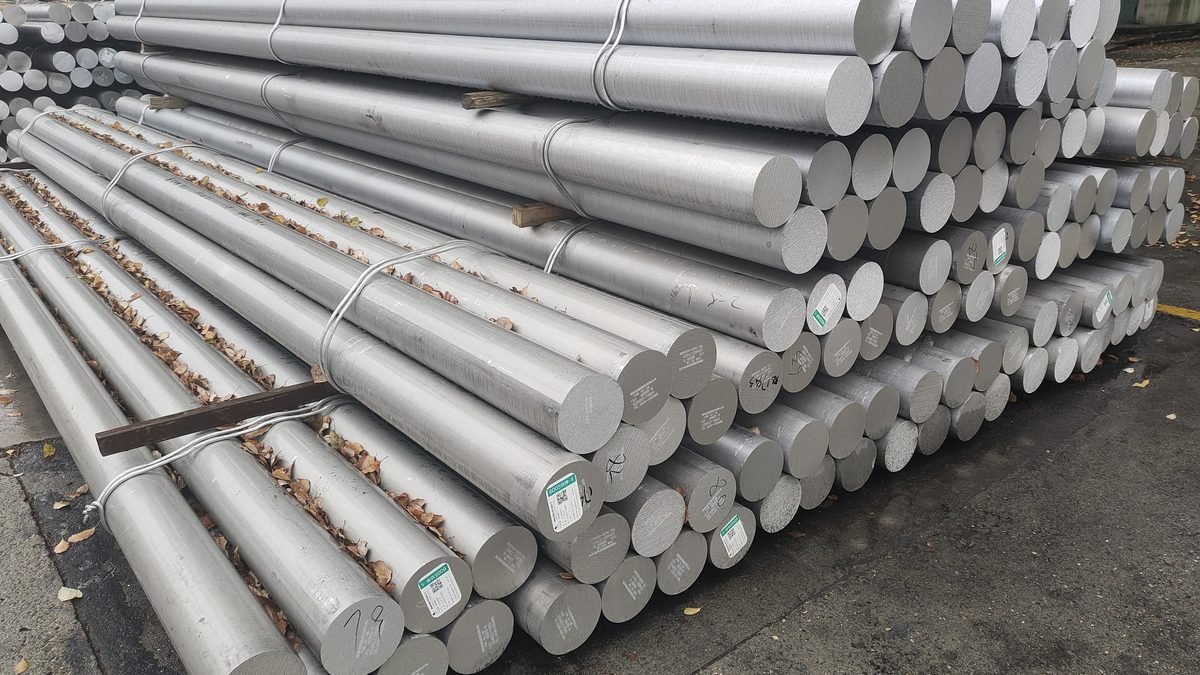
Extruded round bar is a mill product, not a ground shaft. The diameter tolerance is stated as a band around nominal size, and the band widens as the diameter grows. Buyers who need a bearing fit should order oversize bar and machine to size, or specify a drawn and ground bar, rather than expect an as-extruded bar to hold a press fit.
| Nominal diameter (mm) | Typical diameter tolerance (mm) | Ovality (mm, 최대) | 직진도 (mm/m, 최대) | Standard length |
|---|---|---|---|---|
| 5 – 10 | ± 0.25 | 0.20 | 1.0 | 3 – 6 중 |
| over 10 – 25 | ± 0.35 | 0.25 | 1.0 | 3 – 6 중 |
| over 25 – 50 | ± 0.45 | 0.30 | 1.0 | 3 – 6 중 |
| over 50 – 80 | ± 0.60 | 0.40 | 1.2 | 3 – 6 중 |
| over 80 – 120 | ± 0.80 | 0.50 | 1.5 | 3 – 6 중 |
Typical extruded-bar tolerances; the governing standard and the purchase order take precedence. Cut lengths are normally ± 2 mm on sawn ends.
Straightness is quoted per metre but is measured over the full length in practice, and a bar that passes a 1 mm/m check can still show a visible bow at 6 m if the total deviation accumulates in one direction. For long shafts that will be turned between centres, specify total deviation over the ordered length, not only per metre. For bars that will be cut into short pieces, per-metre straightness is sufficient because the local bow is removed with the cut.
Length tolerance looks trivial until a bar is fed into an automatic saw. ㅏ 6 m bar ordered as 6000 mm with a ± 2 mm sawn tolerance may not fit a magazine set for 5998 mm. State whether the length is a minimum, a nominal with a band, or a maximum, and state whether the ends are square sawn, chamfered or deburred.
Extrusion and Ageing Practice
The quality of a 6063 bar is decided before it reaches the straightener. Billet casting controls the iron and silicon morphology; homogenisation at about 560–580 °C removes segregation and makes the extrusion surface uniform; the billet is then preheated to 450–500 °C and extruded through a die at a speed matched to the section. A round section is the easiest shape to extrude, which is exactly why a cheap bar can look acceptable while hiding a poor billet: the defect appears later as a rough anodised finish or as a bar that bends in one direction after machining.
Quenching follows the die. 을 위한 6063 the quench rate after extrusion controls how much Mg2Si remains in solution; a slow quench leaves coarse precipitates that never fully dissolve during ageing, and the bar ends up under strength even though the certificate says T6. In-line water spray or forced air is used depending on section thickness, and the bar is then stretched to straighten and to relieve extrusion stresses.
Ageing is the final step. T5 is produced by cooling in air and then holding the bar at roughly 170–180 °C for several hours; T6 uses a higher solution treatment and a longer hold at about 175–185 °C. The difference in strength between the two tempers comes from how much of the Mg2Si has been precipitated as fine particles. A mill that shortens the hold to raise throughput produces a bar that passes a tensile test at the end of the coil but creeps in service, so ageing records are worth asking for on any load-bearing part.
Stress relief matters for machined parts. Extrusion and straightening leave a residual stress pattern across the section; when a skin is removed asymmetrically, the bar bows. For long, slender parts, specify stress-relieved bar, rough-machine with equal stock removal on both sides, or machine between centres and finish in two passes. For short parts the effect is negligible.
가공, Anodising and Finishing Rules
6063 is soft and gummy compared with steel. It cuts best with high rake angles, sharp uncoated carbide, generous coolant and a firm, wide clamping area. Thin bars deflect under tool pressure, so support with a collet or a follower rest rather than over-tightening the chuck, which ovalises the section and leaves a spring-back error after release.
- Turning: surface speed 300–600 m/min for carbide, feed 0.1–0.25 mm/rev; use a positive rake insert and avoid dwelling, which builds a built-up edge.
- 갈기: two-flute or three-flute cutters for chip clearance; climb milling for finish; air blast or minimum quantity lubrication helps avoid chip welding.
- Drilling and tapping: split-point drills, form taps where possible; thread flutes fill quickly in 6063, so peck or use spiral-flute taps.
- Deburring: a light abrasive brush pass prevents burrs from being anodised into a hard, sharp edge that fails handling checks.
Anodising is where 6063 earns its place. 합금은 명확한 생산, even film in sulphuric acid anodising, and the natural colour is close to neutral. Contamination from steel tooling — swarf, wire brush bristles, steel clamps — embeds iron in the surface and shows up as dark specks or pits after anodising, so the finishing line should be kept strictly aluminium-only. For dyed work, the dye uptake depends on film thickness and sealing; a bar with a rough as-extruded surface takes dye unevenly and looks streaked no matter how good the anodising line is.
If the part will be anodised after machining, leave a machining allowance on the diameter, because anodising consumes about half the film thickness from each side. ㅏ 20 µm film removes roughly 10 µm of aluminium per surface; on a 10 mm bar this changes the finished diameter by 0.02 mm, which matters on a press fit but not on a decorative handle.
Selection Rules for Buyers
A round bar specification is short, but it has to answer five questions. Leaving them to the supplier is how projects end up with a bar that machines well but will not anodise, or one that is dimensionally correct but too soft for the application.
- 등급: 6063 for extrusion, anodising and light machining; 6061 when the part needs strength, tight threads or heavy stock removal.
- 성질: T5 is the default for machined fittings; T6 for stressed or structural parts; O or T4 only when the part is formed after delivery.
- Diameter and tolerance class: state nominal diameter and whether it is a machining allowance or a finished size; for bearing fits, order oversize and machine.
- Straightness and length: specify total deviation for long shafts and a minimum/maximum length for automatic feeding.
- Surface and finish: as-extruded, 우아한, anodised clear or anodised dyed; state the film thickness and whether the bar or the finished part is anodised.
For projects that also need plate or sheet in the same alloy family, the mill can often ship bar and flat product on one certificate. QIDAMT 용품 6063 bar alongside 스테인레스 시트 그리고 1060 aluminium plate for mixed assemblies, which keeps the incoming inspection batch consistent. If the drawing calls for a shaft that must not rust in a wet room, the alternative is a 316L stainless plate machined part rather than a coated aluminium bar.
일반적인 실수
The same failures repeat across fabricators, and almost all of them are specification failures rather than supplier failures.
- Ordering 6063-T6 for a part that will be bent. The temper that improves machinability removes the ductility needed for cold forming; specify T4 or O for bending and age after forming if strength is needed.
- Treating the as-extruded diameter as a finished bore fit. The tolerance band is typically ± 0.35 mm ~에 20 mm; a bearing needs a machined, ground or drawn bar.
- Ignoring straightness over the full length. A bar that passes 1 mm/m can still bow 6 mm 이상 6 중; long shafts must be specified on total deviation.
- Anodising a bar that was brushed with a steel wire wheel. Embedded iron shows as black pits and cannot be removed by re-polishing after anodising.
- Storing bars on the ground or on a single support. 6063 is light and creeps under its own weight over months; rack storage with full-length support preserves straightness.
- 혼입 6063 그리고 6061 in the same anodising load without separating them. The two alloys take dye and film thickness differently, producing a two-tone batch.
One more subtle error: buying a “6063” bar on price without checking the certificate. The alloy window allows a range of iron and copper, and a cheap bar at the top of the window will anodise grey and pit in coastal service. 부분이 보이는 경우, the certificate is part of the product.
자주 묻는 질문
~이다 6063 round bar strong enough for a shaft?
For light shafts, rollers and spacers, 예. 6063-T6 reaches about 205 MPa tensile and 170 MPa 수율, which is adequate for low-torque drives and static loads. For a shaft that carries bending load, runs in a bearing at speed, or sees shock, 6061-T6 or a steel shaft is the correct choice. The limit is stiffness as much as strength: aluminium’s modulus is about one third of steel, so deflection, 양보하지 않는다, usually decides the design.
What is the difference between T5 and T6 in the same bar?
Both are artificially aged, but T6 is aged further to precipitate more of the Mg2Si. T6 is stronger and harder, machines to a better finish on long shafts, and is less ductile. T5 is softer, bends better and is the usual stock temper for architectural and general machining work.
할 수 있다 6063 bar be welded?
예, ~와 함께 4043 또는 5356 filler and care with heat input. Welding over-ages the heat-affected zone and drops its strength; parts that need full strength after welding should be re-aged or designed with a mechanical fastener instead. For a round bar, welding is usually a bracket detail, not a structural joint.
How do I specify straightness for a 3 m shaft?
State the total deviation over the ordered length, for example “maximum 3 mm bow over 3 중, measured on a surface plate”, rather than only per-metre. Also state the support condition, because a bar measured on two end supports reads differently from one measured on a full-length table.
Does anodising change the diameter?
예. The film grows outward and inward; roughly half the thickness consumes the substrate. ㅏ 20 µm film reduces the aluminium section by about 10 면당 µm, 그래서 10 mm bar finishes about 0.02 mm smaller. For press fits, anodise before final sizing or allow for the film in the drawing.
Why do some 6063 bars turn with a rough, torn surface?
Usually a combination of a dull tool, insufficient rake, and a built-up edge from low cutting speed. 6063 galls easily; sharp positive-rake carbide, higher speed, and flood coolant normally fix it. If the surface is rough along the full length from the mill, suspect a worn die or a cold billet.
필요 6063 round bar cut to length, anodised or machined?
Send the diameter, 성질, length and finish; we will confirm stock, tolerance and lead time within one working day.

