 진전
탄소강 앵글 바 Q235B: Leg Sizes, Weight and Welding
탄소강 앵글 바 Q235B: Leg Sizes, Weight and Welding
A carbon steel angle bar is an L-shaped hot rolled section with two legs at 90 도. It is the oldest and most widely used structural shape in general fabrication: cheap, 자르기 쉽다, easy to weld, and available in a size for almost any light structural job. Q235B is the Chinese standard grade that corresponds, in practice, to a mild steel with a minimum yield strength of 235 MPa, and it is the default angle grade for frames, braces, supports and general steelwork in China and in export markets that buy to GB/T 700.
The angle bar is used for transmission tower bracing, workshop roof purlins, racking uprights, 기계 베이스, 계단 자국, 게이트 프레임, sign supports, and temporary works. It is also the section that fabricators reach for when a detail needs a stiff corner with a flat face on each side, which is a job that a flat bar cannot do and a hollow section makes awkward.
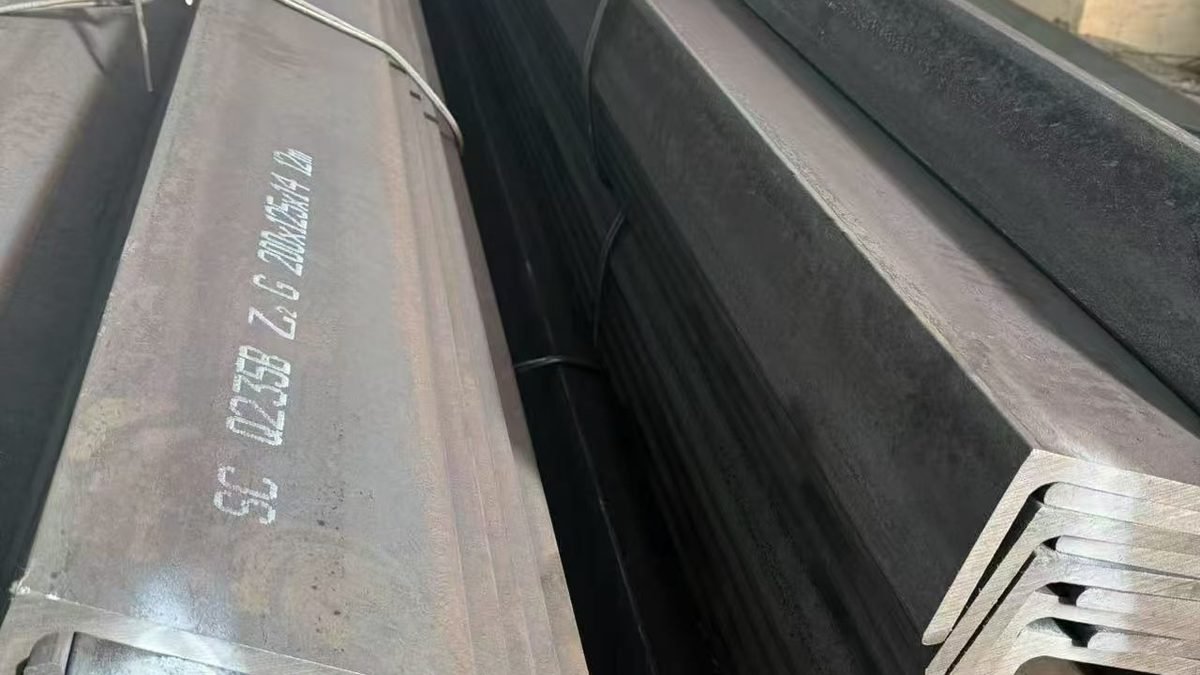
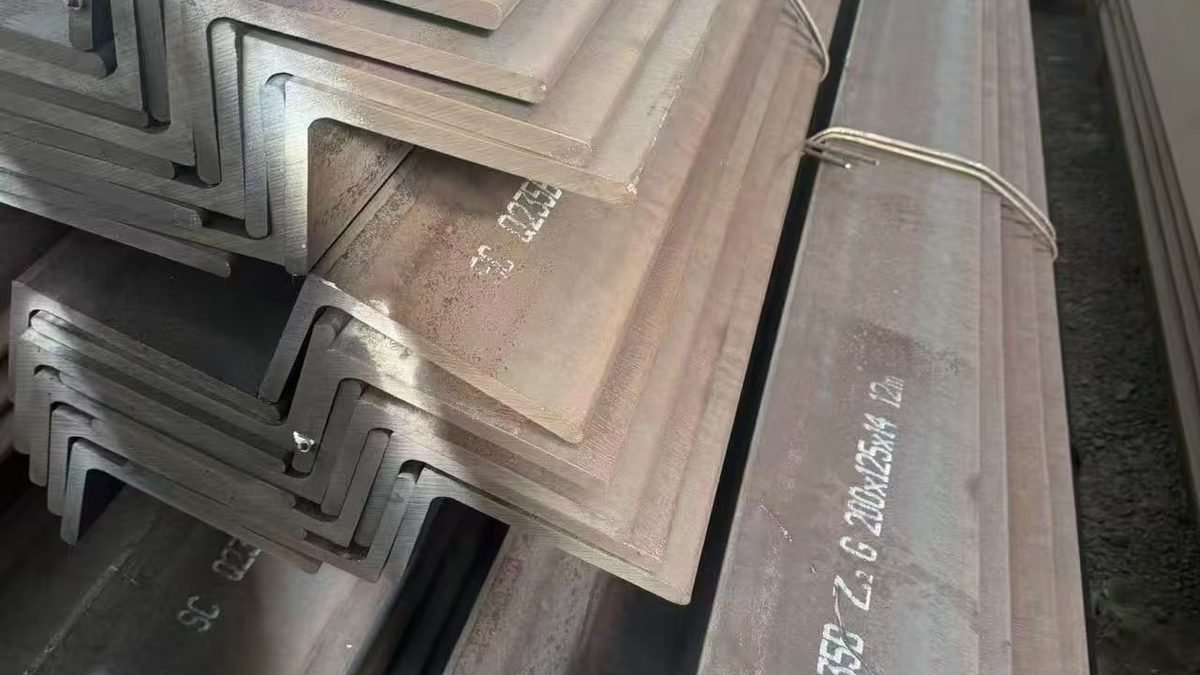
The photographs in this article show a Q235B angle bar with the heat number and size stencilled on the leg, and a bundle of angles strapped for shipment. The stencil is worth reading: it tells the buyer the grade, the size and the mill mark, and it is the first thing to check when a delivery is disputed.
1. The Section and How It Carries Load
An angle has two principal axes that are not aligned with the legs. The strong axis runs through the centroid at 45 degrees to the legs for an equal angle, and the weak axis is perpendicular to it. Bending about the strong axis is efficient; bending about the weak axis is not, and torsion is very poor because the section is open and the shear centre is offset from the centroid.
This asymmetry is the reason angles are usually used as axially loaded struts, as bracing, or as members bending about the strong axis with the load applied through the shear centre or restrained by connected members. A single angle used as a beam with load applied at the leg tip will twist as well as bend, and the twist can govern the design at a load far below the bending capacity.
For an equal angle, the two legs are the same width and thickness. For an unequal angle, one leg is longer, which is useful where the connection needs more edge distance on one face. Both are hot rolled from a single billet through a series of passes, and both carry residual stresses from the rolling and cooling process.
2. Grade Q235B and Its Composition
Q235 is the Chinese carbon structural steel designation: Q for the yield point, 235 for the minimum yield strength in megapascals. The letter B is a quality class that controls the impact test and the sulphur and phosphorus limits. Q235B is impact tested at plus 20 degrees Celsius and is the grade used for general welded structures. Q235A is not impact tested and is used for non-critical work; Q235C and Q235D are tested at 0 and minus 20 degrees Celsius and are used for cold climates.
| 요소 | Q235B (%) | Q355B (%) | Comment |
|---|---|---|---|
| 탄소 | 0.12 에게 0.20 | 0.24 최대 | Higher carbon raises strength and hurts weldability |
| 규소 | 0.30 최대 | 0.55 최대 | Deoxidation residual |
| 망간 | 0.30 에게 0.70 | 1.60 최대 | Manganese adds toughness |
| 인 | 0.045 최대 | 0.045 최대 | 불결; embrittles the weld |
| Sulphur | 0.045 최대 | 0.045 최대 | 불결; causes hot cracking |
| 크롬, 니켈, 구리 | 0.30 max each | 0.30 max each | Residual elements from scrap |
| Carbon equivalent | ~에 대한 0.30 | ~에 대한 0.42 | Below 0.40 is generally weldable without preheat |
| 재산 | Q235B | Q355B |
|---|---|---|
| 항복 강도, 두께 16 mm or less | 235 MPa min | 355 MPa min |
| 인장강도 | 370 에게 500 MPa | 470 에게 630 MPa |
| Elongation after fracture | 26 percent min | 22 percent min |
| Impact test | 27 J at plus 20 기음 | 27 J at plus 20 기음 |
| 밀도 | 7.85 g/cm3 | 7.85 g/cm3 |
| Typical hardness | 120 에게 160 HB | 150 에게 190 HB |
Q235B is not a high strength grade, and it should not be treated as interchangeable with Q355B. A fabricator who substitutes Q355B for Q235B because it is what is in stock is usually safe, because the stronger grade can carry the same load; the reverse substitution is not safe, because a member designed for 355 MPa will be overstressed at 235 MPa. Substitution in the stronger direction still needs a check on weldability, because the higher carbon equivalent of Q355B requires more care in thick sections.
3. Leg Sizes and Weight
Angle weight is calculated from the nominal cross-sectional area and the density. For an equal angle with leg a and thickness t, the area is (2a minus t) multiplied by t. For an unequal angle with legs a and b and thickness t, the area is (a plus b minus t) multiplied by t. The weight per metre is the area in square millimetres multiplied by 7.85 and divided by 1000.
| 크기 (mm) | Area (mm2) | 무게 (kg/m2) | 일반적인 사용 |
|---|---|---|---|
| 30 × 30 × 3 | 171 | 1.34 | Sign frames, light guards |
| 40 × 40 × 4 | 304 | 2.39 | Racking, small frames |
| 50 × 50 × 5 | 475 | 3.73 | Purlins, bracing, 게이트 |
| 63 × 63 × 6 | 720 | 5.65 | Roof bracing, tower legs |
| 75 × 75 × 8 | 1136 | 8.92 | Workshop frames, 컨베이어 지지대 |
| 90 × 90 × 8 | 1376 | 10.80 | Heavy bracing, 기계 베이스 |
| 100 × 100 × 10 | 1900 | 14.92 | Columns, heavy frames |
| 125 × 125 × 12 | 2856 | 22.42 | Heavy structural work |
| 200 × 125 × 12 (같지 않은) | 3756 | 29.48 | Long span bracing, crane supports |
The table is a theoretical weight on nominal dimensions. Hot rolled angle has a small leg tolerance and a thickness tolerance, so the actual bundle weight can differ by about five percent. When a project is priced by weight, the difference is real money, and the purchase order should state whether the price is based on theoretical weight or on actual weighbridge weight.
4. Dimensions and Tolerances
| 매개변수 | 용인 | Comment |
|---|---|---|
| 다리 폭, 최대 50 mm | plus or minus 1.0 mm | Measured at the end, away from the shear cut |
| 다리 폭, 50 에게 100 mm | plus or minus 1.5 mm | Rolling wear shows as a tapered leg |
| 다리 폭, over 100 mm | plus or minus 2.0 mm | Check both legs; unequal wear is common |
| 두께 | plus or minus 0.3 에게 0.5 mm | Thin leg is the most common complaint |
| 길이 | 6 m or 9 m or 12 중, plus 50 / minus 0 | Confirm metric or imperial length before cutting |
| Squareness of the leg angle | 1.5 degrees max deviation | Affects fit-up of welded frames |
| 직진도 | 4 mm per metre | Bow in the leg plane is the usual defect |
| 트위스트 | 1 mm per metre | Reject twisted bundle for precision frames |
| End cut | Saw cut or shear cut | Shear cut is acceptable for non-welded work |
| 표면 | As rolled, 절인, 아연 도금 | Mill scale must be removed before painting |
Mill scale is a factor that buyers underestimate. Hot rolled angle carries a blue-grey oxide layer that is tightly bonded and must be removed by blasting or pickling before a protective coating will adhere. A painted angle that was only wire brushed will lose its coating at the scale boundary within a year, and the corrosion will look like a paint failure when it is a surface preparation failure.
5. How Angle Bar Is Made
Angle is hot rolled from a square billet. The billet is reheated to around 1200 degrees Celsius and passed through a series of grooved rolls that progressively form the L shape. The finished section leaves the last stand at about 850 에게 900 degrees Celsius, is cut to length by a flying shear, and then cools on a cooling bed. Straightening is done by roller straighteners while the section is still warm, and the residual stress pattern left by this process is what causes the angle to bow when one leg is welded.
Cooling rate affects the final properties. A heavy unequal angle cools more slowly in the thick leg, and the difference in contraction between the legs produces a built-in bow. This is not a defect; it is a normal consequence of the process, and it is why a fabricated frame should be checked for squareness after welding rather than before.
For galvanized angle, the section is hot dip galvanized after fabrication or before. Galvanizing before fabrication gives a uniform coating but leaves bare steel at every cut and weld, which must be repaired with a zinc-rich paint. Galvanizing after fabrication gives complete coverage but requires vent and drain holes so that molten zinc can flow in and out, and it requires that the fabrication be designed for the coating thickness, because galvanizing adds about 50 에게 80 micrometres and can change a fit-up.
6. Welding and Fabrication
Q235B welds easily. The carbon equivalent is around 0.30, well below the 0.40 threshold where preheat becomes necessary, so sections up to about 20 mm thickness can be welded without preheat at normal shop temperatures. Thicker sections, low ambient temperature, or high restraint should be preheated to 100 에게 150 degrees Celsius to avoid hydrogen cracking.
The filler for shielded metal arc welding is an E43 series electrode, commonly J422, which matches the strength of Q235B without overmatching. For gas shielded welding, ER70S-6 wire with carbon dioxide or a mixed gas is standard. Overmatching with a higher strength electrode is not necessary and can reduce toughness in the heat-affected zone.
Fit-up matters more than current setting. An angle frame welded without a jig will pull out of square, because each weld shrinks and the open section has little resistance to that shrinkage. The standard practice is to tack the frame in a jig, check the diagonals, weld the joints in a balanced sequence, and let the frame cool before releasing the clamps. Welding the two legs of a corner at the same time, with one pass on each side, balances the shrinkage and keeps the angle square.
For a T-joint between two angles, the fillet weld size should be calculated, not guessed. A common shop rule is a leg size equal to the thinner part thickness, but that rule is a minimum for static lightly loaded joints, not a design rule. For fatigue or dynamic loading, the weld toe should be smooth and the throat thickness should follow the drawing.
Cutting is usually by saw, shear or plasma. Saw cutting gives a square end for welding; shear cutting is faster but leaves a distorted edge on thick legs. Plasma cutting is convenient on site but leaves a dross edge that must be ground before welding. Thermal cutting also hardens the cut edge slightly, and on a thick angle that edge should be ground back to clean metal before the root pass.
7. 선택 규칙
Design to the actual grade. Q235B carries 235 MPa minimum yield. A member designed for Q355B cannot be built from Q235B, and the substitution is a structural change, not a purchasing convenience.
Check the weak axis. An angle bending about its weak axis is much less efficient than the same weight in a channel or a hollow section. If the member must resist load in two directions, a hollow section is usually the better choice.
Provide edge distance for bolts. The minimum edge distance from a bolt hole centre to the leg edge is about 1.5 bolt diameters for a rolled edge and 2 diameters for a sheared edge. ㅏ 50 × 50 angle with M16 bolts at the leg centre leaves only 25 mm to the edge, which is marginal; the connection should be detailed with the bolts staggered or the angle increased.
Think about corrosion before choosing the coating. Q235B in a dry interior can be painted with a zinc phosphate primer and a topcoat. 옥외, hot dip galvanizing is the standard, with a minimum coating of 70 micrometres for a rural atmosphere and 85 micrometres for coastal or industrial service. A galvanized angle must be designed with vent holes and drain holes, or the coating will be incomplete at the joints.
Consider the temperature. Q235B is impact tested at plus 20 degrees Celsius. For a structure that will operate below zero, Q235C or Q235D is the correct grade, and the Charpy test temperature should be stated on the order. Using Q235B in a cold store or a winter-exposed outdoor structure is a brittle fracture risk, not a cost saving.
Specify the surface condition. 밀 스케일, pickled and oiled, or galvanized are three different products at three different prices. A pickled and oiled angle is the right input for painting and for precision fabrication, because the scale is already removed and the surface is uniformly clean.
8. 일반적인 실수
Substituting Q235B for Q355B. This is the most serious mistake in the list. The member is understrength, the weld may be overmatched, and the failure mode changes from yielding to buckling.
Assuming the bundle weight is exact. Theoretical weight and actual weight differ by up to five percent. State the basis in the purchase order.
Welding without a jig. Angle frames pull out of square. Use a jig, balance the welds and check diagonals.
Welding over mill scale or paint. Scale and paint contaminate the weld and produce porosity. Grind to clean metal at least 25 mm each side of the joint.
Galvanizing without vent holes. Molten zinc cannot enter a sealed corner, and the joint will rust from the inside. Design the vent and drain holes before fabrication.
Using a sheared edge as a bolt edge. A sheared edge is already work hardened and can crack under load. For a bolted connection, use a rolled edge or increase the edge distance.
Ignoring the leg squareness. A leg that is 1.5 degrees out of square will not fit a jig, and the welder will compensate with a gap that fails inspection.
Painting over a damp surface. Moisture trapped under a coating blisters and lifts. The surface must be dry and above the dew point before painting.
9. 자주 묻는 질문
What does Q235B mean? Q is the yield strength designation, 235 is the minimum yield in megapascals, and B is the quality class with a 27 joule impact test at plus 20 degrees Celsius.
Is Q235B the same as S235JR? They are close but not identical. S235JR is the European grade with a minimum yield of 235 MPa and a 27 joule impact test at plus 20 Celsius; the chemistry limits differ slightly. For most general fabrication they are treated as equivalent, but a certified design should check the specific standard.
Can Q235B be galvanized? 예, and it is one of the most common galvanized sections. The silicon content is low, which gives a smooth, well bonded coating without the grey, thick coating that high-silicon steels produce.
What is the standard length? Six metres is the most common, with nine and twelve metres available. Longer lengths are usually fabricated by welding two pieces with a full penetration butt weld.
A는 얼마입니까? 50 × 50 × 5 angle weigh? 에 대한 3.73 kilograms per metre on nominal dimensions, which means about 22.4 kilograms for a six metre length.
Can angle be bent? 예, by cold bending or by hot bending. Cold bending an equal angle about the strong axis is practical up to a moderate radius; tight bends cause the leg to distort and the section to twist, and hot bending is used for tight radii.
What is the difference between equal and unequal angle? Equal angle has two legs of the same width; unequal angle has one leg longer, which gives more edge distance on the longer leg. Unequal angle is common in transmission towers and in connections where one face carries more bolts.
Does Q235B rust? 예. It is a carbon steel with no alloying element for corrosion resistance. It must be painted or galvanized for outdoor service, and it will rust in storage if it is not kept dry.
Can I weld Q235B to stainless steel? It is possible with a nickel-based or 309L filler, but the joint is a dissimilar metal joint with a galvanic couple and a carbon migration zone. It is not a standard detail, and it should be engineered rather than improvised.
What is the minimum edge distance for a bolt? 에 대한 1.5 bolt diameters from the hole centre to a rolled edge, 그리고 2 diameters to a sheared edge. 에 대한 16 mm bolt in a sheared angle, that means 32 mm of edge distance, which a 50 mm leg can provide only if the bolt is placed close to the corner.
Why does my angle bow after welding one leg? The weld shrinks and pulls the leg toward the joint. The open section has little resistance to this. Balance the weld, clamp in a jig, or weld both legs in alternation.
Need Q235B angle bar to a specific size and length?
Send the leg sizes, 두께, 길이, surface condition and quantity. We will confirm the rolling programme, theoretical and actual weight, and the mill certificate, and quote against the grade you actually need rather than a substituted one.
Related reading: Q235B 탄소강 플랫 바 · Hot dip galvanized round tube Q235B · Q345D 이음매 없는 강관