 پیشرفت
Hot-Dip Galvanized Round Steel Tube Q235B: پوشش, Sizes and Installation
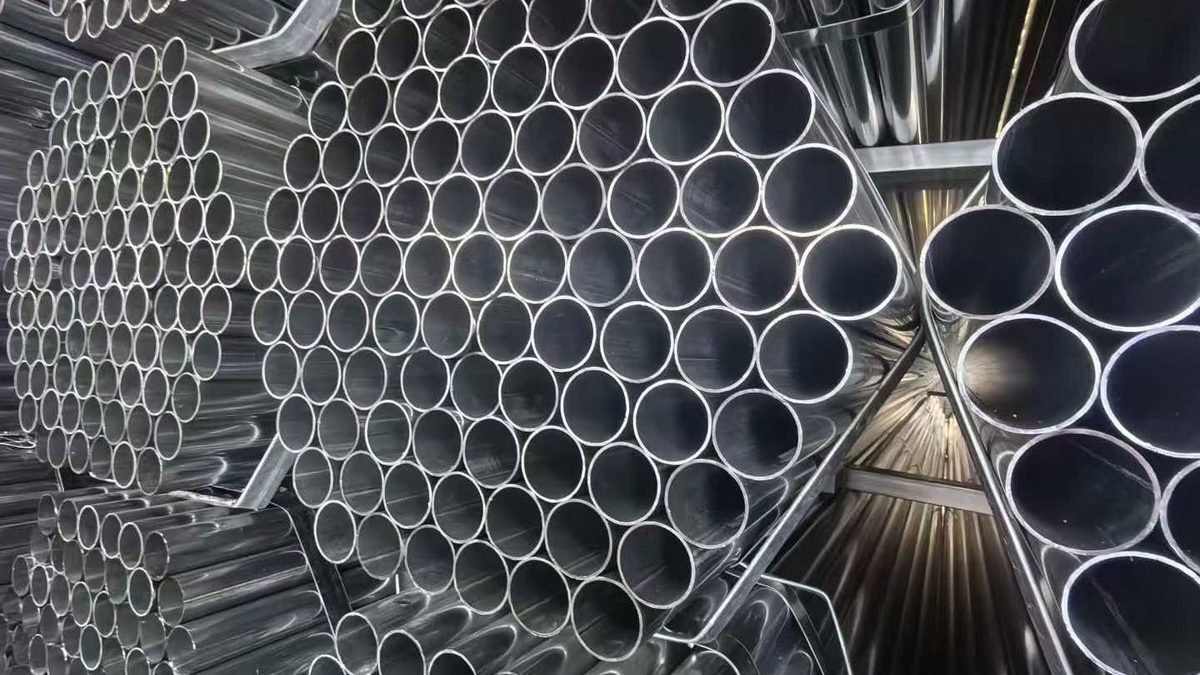
A hot-dip galvanized round steel tube made from Q235B strip is a welded carbon steel tube that has been fully immersed in molten zinc after fabrication. The zinc layer covers the outside, the inside and the cut ends in one operation, which is why it is the default choice for greenhouse frames, fence systems, نرده ها, shade structures and light structural work that must survive weather for a decade or more.
What the Product Is and Where It Fits
The product starts as Q235B hot-rolled or cold-rolled strip, is formed into a round section and electric-resistance welded along the seam, then hot-dip galvanized as a finished tube. It is not the same as pre-galvanized tube made from zinc-coated strip: pre-galvanized tube has bare weld seams and bare cut ends, while true hot-dip tube has zinc on every surface that the bath could reach. That difference decides which product belongs on an outdoor structure.
Typical applications are agricultural and horticultural frames, livestock penning, industrial fencing, temporary and permanent handrails, playground equipment, sign posts, shade frame work, carport frames, drying racks and light conveyor guards. It is also used for low-pressure water lines in irrigation and for cable-support frames where the tube is not required to be pressure-rated. It is not a boiler tube, not a hydraulic line and not a substitute for a seamless pressure pipe.
فلز پایه: Q235B Chemistry
Q235B is a Chinese structural carbon steel grade with a minimum yield strength of 235 MPa. The “B” suffix means the steel is impact-tested at +20 °C and has tighter phosphorus and sulphur limits than the A grade. It is a general-purpose structural steel: weldable with ordinary consumables, formable, and cheap. It is not a weathering steel, not a low-temperature steel and not intended for wet hydrogen sulphide service.
| عنصر | Q235B limit (%) | معمولی (%) | Comment |
|---|---|---|---|
| سی | ≤ 0.20 | 0.14–0.18 | Higher carbon raises strength and hurts weldability |
| و | ≤ 0.35 | 0.15–0.25 | Deoxidation; excess raises strength |
| منگنز | ≤ 1.40 | 0.40–0.70 | Strengthens; improves toughness |
| پ | ≤ 0.045 | 0.020–0.035 | B grade limit; lower is better for bending |
| اس | ≤ 0.045 | 0.015–0.030 | Controls weld hot cracking |
| Ceq | - | 0.25–0.35 | Keep below 0.40 for unrestrained welding |
Typical Q235B limits. Confirm the mill certificate because some suppliers ship Q235A or a re-rolled strip that meets strength but not the B impact requirement.
For tube making, the strip must have consistent thickness and a clean surface. A strip with a heavy scale or a torn edge will produce a weld seam that is hard to galvanize cleanly, and a strip with a high carbon equivalent will crack when the tube is bent after galvanizing. Buyers who bend or roll the tube after coating should ask for a base metal with a carbon equivalent below 0.35 and a controlled silicon level, because high silicon produces a thick, grey, less adherent zinc layer.
Mechanical Properties of the Tube
The welded tube is normally supplied in the as-welded, normalized or stress-relieved condition. Q235B tube in the as-welded condition meets the base metal yield strength in the body but can show a harder weld zone. For structures that will be bent or forming-rolled, a normalized or stress-relieved tube is easier to work and less prone to seam cracking.
| اموال | Requirement or typical value | Test basis |
|---|---|---|
| قدرت تسلیم, ReH | ≥ 235 MPa | Base metal, transverse |
| استحکام کششی, Rm | 370-500 مگاپاسکال | Full section or flattened strap |
| ازدیاد طول, الف | ≥ 26% | 50 میلی متر سنج, base metal |
| Weld tensile strength | ≥ 370 MPa | Full-section tensile |
| سختی, weld zone | ≤ 180 HV typical | Cross-section |
| تاثیر, Q235B | ≥ 27 جی در +20 درجه سانتی گراد | چارپی, base metal |
Typical values for Q235B ERW tube. The weld seam is the critical location for bending and for fatigue; ask for a weld-integrity test if the tube will be cyclically loaded.
The weld seam deserves separate attention. ERW tube is made by high-frequency welding of the strip edges, and the seam is then scarfed and annealed in better mills. A seam that is not annealed can crack when the tube is expanded, swaged or bent sharply. A seam that is not scarfed can leave a ridge that catches on a die or a clamp. For handrail and greenhouse work the seam is usually hidden or acceptable; for bending into arches, specify that the seam be annealed and that the bend radius be large enough to keep strain below the weld’s capacity.
پوشش روی: Mass, Thickness and Class
Hot-dip galvanizing for tube is usually specified by coating mass per unit area, not by a single thickness number. The mass is measured on both surfaces together, بنابراین یک 300 g/m² coating is roughly 21 µm on each side, و الف 500 g/m² coating is roughly 35 µm on each side. The exact relationship depends on the zinc density and the measurement method, but the order of magnitude is what matters when comparing offers.
| کلاس پوشش | Total mass (گرم بر متر مربع) | Approx. per side (میکرومتر) | Typical service |
|---|---|---|---|
| نور | 180–250 | 13–18 | Indoor or sheltered, short life |
| استاندارد | 300 | 21 | General outdoor, rural and urban |
| سنگین | 400–500 | 28–35 | ساحلی, کشاورزی, abrasive contact |
| Extra heavy | 600+ | 42+ | Severe coastal or chemical exposure |
Approximate conversion using zinc density 7.14 g/cm³. Coating mass is normally measured by the gravimetric method on a cut sample; magnetic gauges are a fast shop check but can read high on curved surfaces.
Coating appearance is not a reliable measure of coating mass. A bright, spangled surface can be thin, and a uniform grey surface can be thick. The grey colour often comes from a high silicon base metal or from a thicker zinc-iron alloy layer; it does not mean the coating is defective, but it does mean the layer may be less ductile. If the tube will be bent after galvanizing, a thick all-alloy layer can crack and flake at the outside of the bend.
Cut ends and weld seams are the places where coating is thinnest or absent. Hot-dip galvanizing covers the inside of a tube only if the tube is open at both ends and the bath can drain; a sealed tube will trap air and will not coat internally. Field cuts expose bare steel, and field welds destroy the zinc locally. Both need a repair coating of zinc-rich paint, applied after the weld has cooled and been cleaned.
Dimensions and Tolerances
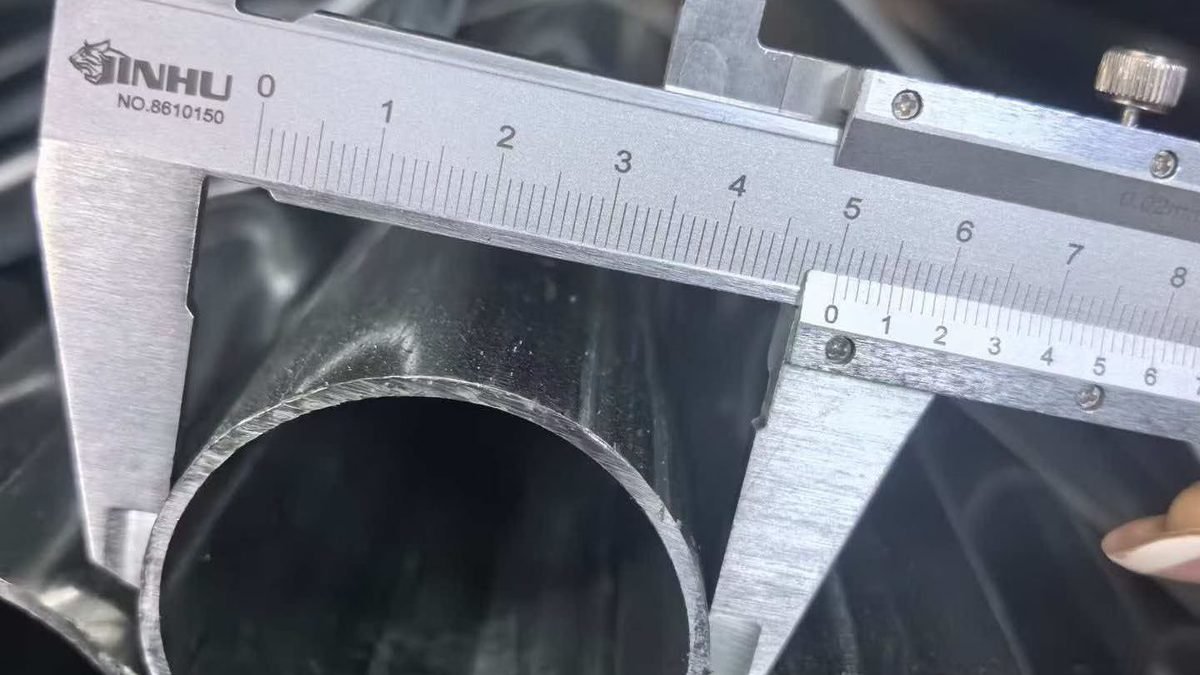
The common stock range runs from 21.3 میلی متر به 114.3 mm outside diameter, with wall thickness from 1.5 میلی متر به 4.0 میلی متر. Lengths are usually 6 متر, با 5.8 m and custom cut lengths available. The table gives commercial windows; a project that needs a tight ovality or a precise inside diameter should state it, because standard tube tolerances are written for structural and fencing use, not for machined fittings.
| ویژگی | Common range | Typical tolerance | Notes |
|---|---|---|---|
| قطر بیرونی | 21.3–114.3 mm | ±0.5 mm or ±1% | Larger sizes often ±1% |
| ضخامت دیوار | 1.2–4.0 mm | ± 10% | Check at the weld and opposite |
| طول | 5.8–6.0 m | +10 / 0 میلی متر | Cut lengths to order |
| Ovality | - | ≤ 1% of OD | Critical for sleeved joints |
| صراط مستقیم | - | ≤ 2 میلی متر بر متر | Better for exposed handrail |
| پوشش روی | 300–500 g/m² | Per agreed class | State the class, not “galvanized” |
| Unit weight | - | Calculated from OD and wall | Use nominal, not coated, ابعاد |
Typical commercial windows for Q235B galvanized round tube. For structural design, use the nominal wall and the minimum yield strength, not the average measured values.
Weight calculation is worth doing before ordering. The nominal weight per metre is π × (OD − wall) × wall × density, with density taken as 7.85 g/cm³ for carbon steel. الف 48.3 × 3.0 mm tube weighs about 3.39 kg/m before galvanizing and roughly 3.5 kg/m after a 300 g/m² coating. Quotations that omit the coating mass or quote a weight without stating whether it is theoretical or actual should be checked.
How Hot-Dip Galvanized Tube Is Made
Tube making begins with slitting the strip to the developed width, forming it through a series of rolls and welding the seam by high-frequency resistance welding. The weld is scarfed to remove the upset metal, then the tube is sized, straightened and cut. In-line annealing may be used to normalize the weld zone; without it, the weld remains a hard, brittle band that limits bending.
Galvanizing is a separate batch process. The tube is degreased, pickled in acid to remove scale and rust, rinsed, fluxed, dried and then immersed in molten zinc at 445–465 °C. The zinc reacts with the steel to form a zinc-iron alloy layer and a top layer of nearly pure zinc. The tube is withdrawn, drained, wiped or centrifuged where appropriate, then passivated or oiled. The thickness of the alloy layer depends on the steel chemistry, the bath temperature and the immersion time; high-silicon steel can produce an excessively thick, dark layer.
After galvanizing, the tube is straightened and inspected. Straightening a coated tube can crack the coating at the outside of a bend, so the straightener rolls must be clean and the pressure controlled. The finished tube is bundled, strapped and usually tagged with size, coating class and heat number. A tube that is stacked on the ground without dunnage will drain poorly and can develop white rust in storage.
قوانین انتخاب
- Use hot-dip tube, not pre-galvanized tube, for outdoor structures with cut ends, drilled holes or field welds.
- Choose the coating class by environment: 300 g/m² for rural and urban, 400–500 g/m² for coastal, fertilizer sheds and livestock areas.
- Size by span and load, not by appearance. الف 33.4 mm tube that looks right can be too flexible for a 2 m cantilever; check deflection, not only stress.
- Specify wall thickness with tolerance and minimum, because a 10% wall reduction cuts bending stiffness by roughly 30%.
- For bending after coating, choose a lighter coating and a larger bend radius; thick alloy layers crack at the outside of tight bends.
- For welding, use a procedure qualified for galvanized steel, remove zinc from the weld zone, and repair the coating afterwards.
A common specification error is to write “hot-dip galvanized” and nothing else. That leaves the supplier free to deliver 180 گرم بر متر مربع, which may look fine on delivery and fail in two years. Write the coating class, the measurement method, the base metal grade and the cut-end treatment. If the tube will be exposed to animal waste or fertilizer, add a note that the coating must be free of uncoated highspots and that field cuts must be repaired with zinc-rich paint.
Another error is to compare tubes by outside diameter only. Two 48 mm tubes can have 2.0 mm and 3.0 mm walls, and their load capacity differs by more than 50%. Ask for the wall thickness and the minimum wall, and calculate the section properties from those values. For a greenhouse arch, the bend radius and the seam condition matter as much as the coating.
Installation and Jointing
Cut the tube with a saw or a cold-cut wheel, not with an abrasive disc that overheats the coating. After cutting, remove burrs and repair the cut face with a zinc-rich paint. If the tube is to be drilled, drill from the outside in, clear the chips and repair the hole edges. Do not leave bare steel exposed at a joint, because the coating around the bare area will corrode faster than a uniformly coated surface.
Field welding destroys the zinc in the heat-affected zone and produces zinc fume. Remove the coating 25–50 mm either side of the weld, weld with a procedure suitable for the steel, clean the slag and apply a zinc-rich repair coat. Provide ventilation or respiratory protection; zinc fume exposure is a recognized occupational hazard. Never weld a sealed tube without venting it, because expanding air can blow through the weld.
For fencing and greenhouse frames, the usual joints are sleeved, bolted or clamped. Sleeves should be a loose fit and should not trap water; if a joint can fill with rainwater, provide a drain hole at the low point. Bolted joints should use galvanized or stainless bolts and washers, and the bolt material should be compatible with the tube to avoid galvanic attack. Where the tube meets concrete, keep the tube end above the slab or seal it, because standing water at the base is the usual start of a rust stain.
Common Misconceptions
- “Galvanized tube is rust-proof.” It is corrosion-resistant, not rust-proof. Coating mass, cut-end repair and drainage decide the service life.
- “Pre-galvanized and hot-dip are the same.” Pre-galvanized strip leaves bare welds and bare cut ends; hot-dip coats the finished tube.
- “Thicker zinc is always better.” A very thick, brittle alloy layer cracks when the tube is bent. Match the coating to the forming operation.
- “A grey coating is defective.” Grey usually means a thicker zinc-iron alloy from the steel chemistry; it is not necessarily a failure.
- “The tube can be sealed and galvanized.” A sealed tube traps air and will not coat internally. Vent both ends.
Inspection and Acceptance
Receiving inspection should check coating mass on a sample, outside diameter, ضخامت دیوار, صراط مستقیم, weld seam condition and cut-end repair. A magnetic thickness gauge gives a fast check but must be calibrated on the same curvature; a gravimetric strip test is the referee method. Check the wall at four points around the circumference and at both ends, because eccentricity is common in welded tube. Inspect the weld seam for a continuous scarfed bead and for cracks after a sample bend.
For a project that will be inspected by a third party, prepare a coating class statement, mill certificates for the strip, a galvanizing batch record and a repair procedure for field cuts. These four documents answer most of the questions that arise in a delivery inspection, and they are much easier to assemble before shipment than after the tube is on site.
سوالات متداول
Is hot-dip galvanized round tube suitable for drinking water?
Not without a specific approval. The zinc layer and the Q235B base metal are not certified for potable water, and the internal coating may not be continuous. Use a lined or stainless tube for potable water.
How long will a 300 g/m² coating last outdoors?
In a rural or urban environment, 15–25 years is a reasonable planning figure for a sound coating with repaired cuts. In coastal or fertilizer exposure, expect less and specify 400–500 g/m².
Can I bend the tube after galvanizing?
بله, but the bend radius must be generous and the coating class moderate. Thick alloy layers crack at the outside of a tight bend. Bend before galvanizing when the geometry is tight.
Why does the inside of the tube rust?
The bath cannot coat a tube that is sealed, poorly vented or too long for the bath. Specify internal coating if it matters, and confirm the supplier’s venting and draining practice.
What is the difference between Q235B and Q195 for tube?
Q195 has lower strength and better formability; Q235B has higher strength and is impact-tested at +20 درجه سانتی گراد. For structural frames, Q235B is the normal choice; for light forming, Q195 may be easier to work.
Can galvanized tube touch aluminum or stainless steel?
It can, but in wet conditions the zinc becomes the anode and will corrode faster. Insulate dissimilar joints or keep them dry and inspect them periodically.
Order hot-dip galvanized round tube Q235B with a stated coating class
QIDAMT supplies welded round tube from 21.3 به 114.3 میلی متر, with coating mass, wall tolerance and cut lengths agreed on the order.