 پیشرفت
Perforated C Steel Purlin Q235B: بخش, Hole Pattern and Span
A perforated C steel purlin is a cold-formed channel with a lipped C section and a regular pattern of holes punched through the web or flange. The holes are not decorative. They let self-drilling screws locate quickly, allow services to pass, and reduce weight in the parts of the section that carry little stress. Get the hole pattern wrong, however, and the purlin that looked adequate on paper loses a meaningful share of its net section exactly where the roof load is highest. This guide explains the section geometry, the Q235B substrate, the tolerance that matters on site, and the rules for spacing, hole layout and fixing.
What a Perforated C Purlin Is and Where It Is Used
The product is a cold-rolled steel section, normally formed from 1.5 میلی متر به 3.0 mm strip into a C shape with short inward lips at the flange edges. The lips stiffen the flanges against local buckling and give the screws a second plane of contact. After forming, the section is punched with round or slotted holes at a fixed pitch, سپس به طول برش دهید. In export trade the item is often called C purlin, کانال سی, lip channel or roof purlin; in Chinese mill catalogues it is C型钢.
Purlins sit between the roof cladding and the main frame. They carry snow, wind uplift, cladding weight and the weight of anyone standing on the roof during installation. The perforated variant is common in pre-engineered buildings, warehouses, agricultural sheds, طبقات نیم طبقه, solar mounting rails and light wall girts. It is also used for racking uprights and for temporary structures where fast location of screws speeds up assembly.
The perforated C purlin is not a substitute for a hot-rolled channel. It is a light, thin-walled section that derives its strength from shape rather than mass. That is why the connection detail, the hole pattern, and the restraint provided by the cladding matter as much as the steel grade.
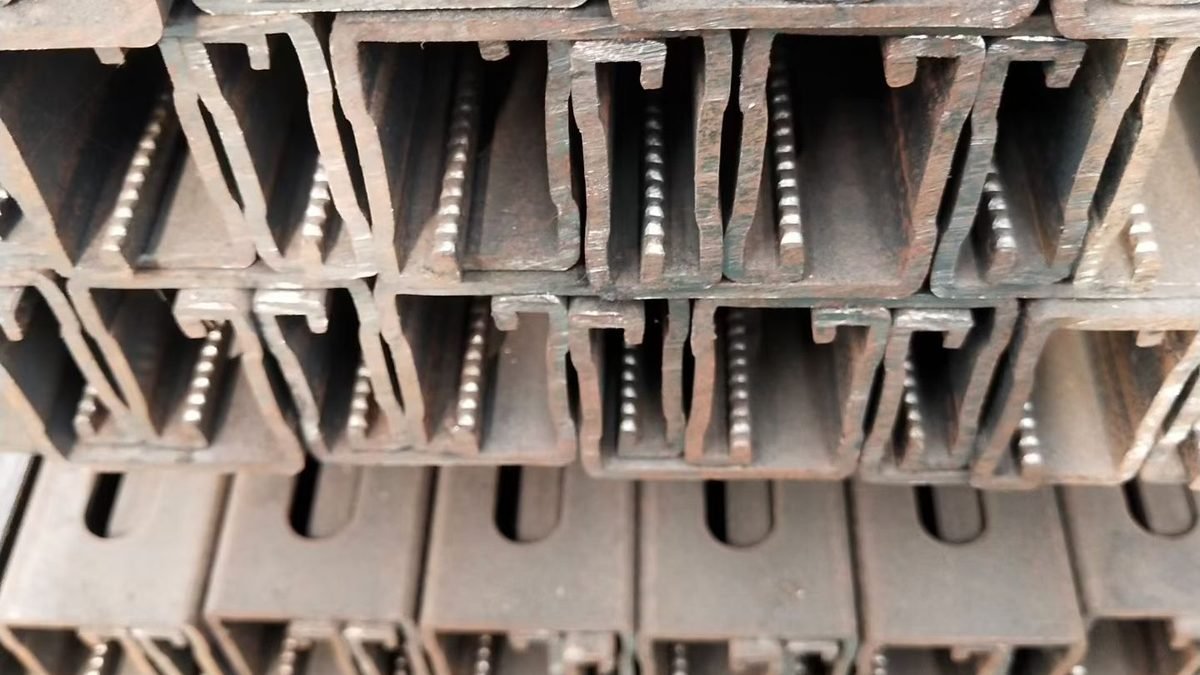
Grade and Chemical Composition
The default substrate is Q235B to GB/T 700, the Chinese structural carbon steel equivalent to ASTM A36 in strength class but with its own chemistry limits. Q235B is a rimmed or killed steel with a carbon range that keeps weldability reasonable and a manganese level that provides strength without excessive hardness. For galvanized purlins the strip may be DX51D+Z to EN 10346, which is a forming grade rather than a structural grade; the designer must confirm that the zinc-coated substrate has the required yield strength.
| عنصر | Q235B (%) | DX51D+Z (%) | Comment |
|---|---|---|---|
| کربن (سی) | 0.12–0.20 | ≤ 0.18 | Higher carbon raises strength and reduces weld ductility |
| سیلیکون (و) | ≤ 0.30 | ≤ 0.50 | Deoxidation; excess can affect coating |
| منگنز (منگنز) | 0.30–0.70 | ≤ 0.50 | Solid-solution strengthening |
| فسفر (پ) | ≤ 0.045 | ≤ 0.100 | Keep low for brittle fracture control |
| Sulphur (اس) | ≤ 0.045 | ≤ 0.045 | Inclusions reduce fatigue life at holes |
| آلومینیوم (ال) | — | ≥ 0.020 | Killing and coating adhesion |
| آهن (Fe) | تعادل | تعادل | Matrix |
Q235B limits to GB/T 700-2006; DX51D+Z to EN 10346. Request the mill certificate for each heat.
Two practical points follow from the chemistry. اول, Q235B is not a low-alloy weathering steel; it needs a coating in any exposed service. دوم, the zinc coating on a DX51D strip is usually Z120 to Z275, which is adequate for interior and sheltered exterior use but not for coastal or chemical atmospheres without an additional coating.
خواص مکانیکی
Cold forming raises the yield strength of the corners and the flanges through work hardening. Design codes usually ignore this benefit and use the nominal yield of the strip, which is conservative and avoids relying on a property that varies along the section. The values below are the minimums for the substrate, not the formed section.
| اموال | Q235B | DX51D+Z | Design note |
|---|---|---|---|
| قدرت تسلیم (ReH) | ≥ 235 MPa | 140–260 MPa | Use the lower bound for thin-walled buckling checks |
| استحکام کششی (Rm) | 370–500 MPa | 270–420 MPa | Screw pull-through depends on local bearing |
| ازدیاد طول (الف) | ≥ 26% | ≥ 22% | Needed for roll forming and bending at corners |
| تراکم | 7.85 g/cm³ | 7.85 g/cm³ | Mass per metre from developed width |
| مدول (E) | 206 GPa | 206 GPa | Deflection governs long spans |
| Coefficient of expansion | 12 × 10⁻⁶ /ک | 12 × 10⁻⁶ /ک | Thermal movement over 12 m roofs |
Minimum specified values. Formed corners are stronger but shall not be used to justify a lower safety factor.
Thin-walled sections fail in ways that thick sections do not: local buckling of the compression flange, web crippling at the support, and screw pull-out at the connection. None of these is captured by a simple bending stress check. A purlin calculation should include wind uplift (which reverses the load direction and puts the unrestrained bottom flange into compression), the restraint from the cladding, and the reaction at each support.
Section Dimensions and Tolerances
C purlins are designated by height, flange width, lip length and thickness, in that order: C100×50×20×2.0 means 100 mm web, 50 mm flange, 20 mm lip, 2.0 mm steel. The table gives indicative masses for common sizes; the exact mass depends on corner radii and the actual strip thickness.
| تعیین | Web h (میلی متر) | Flange b (میلی متر) | Lip c (میلی متر) | Thickness t (میلی متر) | Mass (کیلوگرم بر متر, تقریبا) |
|---|---|---|---|---|---|
| C80×40×20×2.0 | 80 | 40 | 20 | 2.0 | 3.0 |
| C100×50×20×2.0 | 100 | 50 | 20 | 2.0 | 3.8 |
| C120×50×20×2.5 | 120 | 50 | 20 | 2.5 | 5.1 |
| C140×60×20×3.0 | 140 | 60 | 20 | 3.0 | 7.1 |
| C160×60×20×3.0 | 160 | 60 | 20 | 3.0 | 7.5 |
| C200×70×20×3.0 | 200 | 70 | 20 | 3.0 | 8.9 |
Indicative theoretical mass from developed width at 7.85 g/cm³. Confirm against the mill’s section property table before ordering.
Dimensional tolerance is where cheap purlins reveal themselves. A web that is 3 mm under nominal reduces the section modulus by roughly 3%, and a flange that is short reduces the screw edge distance. The tolerances below are typical for good cold-forming practice; tighter values can be agreed for curtain-wall or solar work.
| بعد | Typical tolerance | Why the buyer should check |
|---|---|---|
| Web height h | ±2.0 میلی متر | Affects section modulus and fit into the frame |
| Flange width b | ±2.0 میلی متر | Affects screw edge distance and cladding bearing |
| Lip length c | ±1.5 میلی متر | Affects local buckling and nesting |
| Thickness t | ±0.05 میلی متر | Thinner strip is the most common hidden substitution |
| طول | ±5 میلی متر | Cumulative error shows at the last bay |
| مربعی بودن برش | ≤ 1.5° | Open gaps at the end connection |
| کمبر | ≤ 2 میلی متر روی 1 متر | Visible sag between purlins |
| پیچ و تاب | ≤ 1°/متر | Prevents cladding from seating flat |
Measure thickness with a micrometer at the web, not with a tape at the edge burr.
How the Purlin Is Made
Strip preparation
The process begins with slit strip of the specified width and thickness. For pre-galvanized purlins the strip is DX51D+Z with a zinc coating; for painted purlins it may be pre-coated. The strip width is calculated from the developed length of the section: web plus two flanges plus two lips, minus the corner allowances. A strip that is 2 mm too narrow produces a section that is visually correct but dimensionally undersized.
Roll forming
The strip passes through a series of roll stands, each making a small bend, until the C shape is complete. Roll forming is a cold process; the corners work-harden and the strip must be ductile enough to bend without cracking. Lubrication and roll alignment determine whether the section comes out straight or with a twist. A worn roll leaves a wave in the flange that is difficult to correct later.
مشت زدن
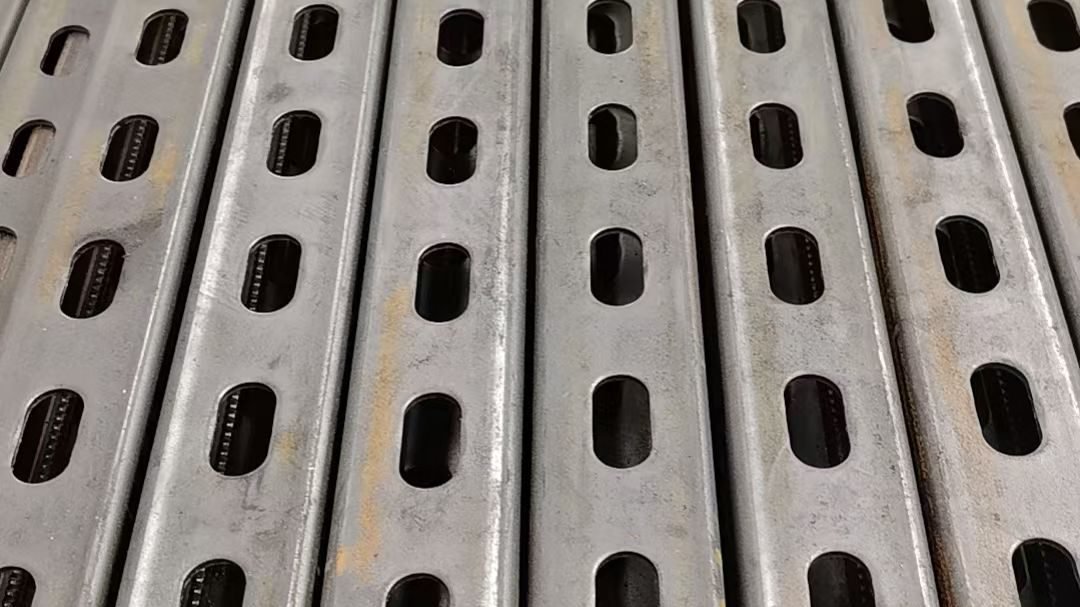
Holes are punched in a press or a flying punch unit synchronized with the line speed. The punch die determines hole shape: round holes for bolts, slots for adjustment, and grouped patterns for specific bracket spacing. Punching after forming is normal; punching before forming can distort the hole when the strip bends. Burrs on the inner face should be removed or controlled, because a burr under a screw head prevents proper seating and reduces pull-through capacity.
Cutting and stacking
The line cuts to length with a flying saw or shear. Cut ends should be square and free of heavy burrs. Purlins are stacked in bundles with timber bearers, and the bundle should be lifted with a spreader to avoid bending the top sections. Galvanized sections stored outdoors need ventilation between layers; condensation between tightly stacked sheets is the classic cause of white rust.
قوانین انتخاب
A purlin is selected by span, load, restraint and connection, not by a single “strongest” اندازه. The following rules cover the decisions that most often go wrong.
- Start from the roof load case, not the wall. Snow, dead load and wind uplift act in different directions. Uplift can put the bottom flange into compression, so a purlin that is adequate for downward load may fail in a wind event.
- Check net section at the holes. الف 14 mm hole at 100 mm pitch in a 100 mm web removes about 14% of the web area at that station. If the holes are concentrated near mid-span, the bending capacity drops more than the average suggests.
- Keep holes away from supports. Web crippling is highest at the reaction point. A hole within 50 mm of the bearing plate is a stress raiser; move the pattern or add a solid section at the support.
- Match thickness to the screw. الف 1.5 mm purlin is not suitable for heavy cladding screws or for standing seams that generate point loads. استفاده کنید 2.0 mm or more where the screw pattern is dense.
- Specify the zinc coating explicitly. Z275 pre-galvanized is normal for sheltered roofs; coastal or ammonia-rich livestock buildings need a heavier coating or a painted system.
- Confirm the section property table, not just the designation. Two suppliers can offer a “C100” with different flange widths, lip lengths and thickness. Compare section modulus and mass per metre.
Installation Rules
Most purlin failures reported on site are connection failures, not steel failures. Follow the sequence below.
- Set out from the ridge and check cumulative spacing. Purlin spacing is usually 600–1200 mm for cladding; الف 20 mm drift over ten bays is enough to misalign the last panel.
- Seat the purlin square to the rafter. A twisted purlin bears on one flange corner, which reduces the effective restraint and can crack the cladding at the fixing.
- Screw through the flange, not the lip, unless the design says otherwise. Screws in the lip have less edge distance and are prone to pull-out under uplift.
- Use the correct screw length. The screw must penetrate the purlin by at least three thread pitches; too short a screw is a common cause of roof sheets lifting in wind.
- Respect the hole pattern. Do not add holes on site without checking the net section. Field-drilled holes near mid-span are a frequent source of local buckling.
- Provide bridging or sag rods where the span exceeds the restraint assumption. A purlin restrained only by cladding behaves differently once the cladding is removed for maintenance.
- Do not walk on the purlins before the cladding is fixed. Point loads from boots on a thin web can permanently deform the section.
Common Misconceptions
“The holes barely affect strength”
They affect it in exactly the place where bending stress is highest. الف 12 mm hole in a 100 mm web removes 12% of the web at that section, and a row of holes at 50 mm pitch removes more than a row at 150 mm pitch. The correct check is net section at the critical station, not an average over the member.
“Thicker is always safer”
A thicker purlin of the same designation is stronger, but if the extra thickness comes with a narrower flange or a shorter lip, the buckling behaviour can be worse. Section shape and restraint matter more than thickness alone. A well-restrained 2.0 mm purlin can outperform a poorly detailed 2.5 mm one.
“Galvanized means maintenance-free”
Z275 gives a long service life in a dry, ventilated roof, but it is not a marine coating. Cut edges, field-drilled holes and scratched surfaces are unprotected steel and will rust first. In coastal or fertilizer environments, specify a heavier coating or a painted system and inspect cut edges.
“C purlins can be used as beams”
A C purlin is a light, thin-walled section designed for distributed roof load with cladding restraint. Used as a beam with concentrated loads and no lateral restraint, it can fail by lateral-torsional buckling at a load far below its bending capacity.
Inspection and Receiving Checks
در بدو ورود, check the bundle label against the packing list, then measure web, flange, lip and thickness on three sections per bundle. Look for twist by sighting along the length, and for camber by laying the purlin on a flat floor. Inspect the hole pattern: pitch, hole diameter, burr height, and whether any holes are deformed or missing. Check the zinc coating with a magnetic gauge at several points and confirm the coating mass on the mill certificate. در نهایت, check that the cut ends are square and that the bundle has not been deformed by lifting.
Store bundles on timber bearers, clear of the ground, with ventilation between layers. Do not stack heavy plates on top of purlins. If the material will sit on site for months, cover it but allow air movement; a tarpaulin that traps condensation does more harm than rain.
سوالات متداول
What is the difference between a C purlin and a Z purlin?
A C purlin has a symmetrical lipped channel section and is used where simple nesting and straight installation are wanted. A Z purlin has a point-symmetric section that nests for lapped spans and is more efficient in long roof runs. The connection details differ, so they are not interchangeable without redesign.
Can the holes be omitted?
بله. Solid C sections are available and carry more capacity for the same thickness. Perforated sections are chosen for assembly speed and service routing, not for maximum strength.
What hole size is standard?
Round holes of 10–14 mm and slots of 14×30 mm are common, در 50 میلی متر یا 100 mm pitch. The correct size depends on the screw or bolt and on the net-section check.
Is Q235B suitable for galvanized purlins?
Q235B can be hot-dip galvanized after forming. Pre-galvanized purlins are usually made from DX51D+Z strip, which is a forming grade with a wider strength range. Confirm the yield strength on the certificate.
How much does a purlin weigh?
Use the developed width: mass per metre is approximately developed width (میلی متر) × ضخامت (میلی متر) × 7.85 / 1000 کیلوگرم بر متر. For C100×50×20×2.0 the developed width is about 240 میلی متر, giving roughly 3.8 کیلوگرم بر متر.
Can purlins be spliced?
Splicing is possible with a designed lap and a matched screw pattern, but a field splice in a thin-walled section is a weak point. Prefer mill lengths that span the bay, and if a splice is unavoidable, place it near a support and design it for the full moment and shear.
Need perforated C purlins in Q235B or galvanized strip?
Send the section designation, hole pattern, length schedule and zinc requirement to sales@qidamt.com. مرتبط: میله تخت فولاد کربن Q235B for solid sections, یا request a quotation.
QIDAMT supplies cold-formed C and Z sections, perforated purlins and galvanized strip from Shandong. Send the roof plan and the screw schedule with the enquiry; the hole pattern is the part that most often delays production.

