 QIDAMT
Embossed Stainless Steel Decorative Sheet: Pattern Depth, Finish and Fabrication
An embossed stainless steel decorative sheet is a 304 stainless sheet whose surface has been pressed with a repeating pattern by a pair of engraved rolls. The pattern is part of the metal, not a printed coating, so it survives cleaning, light abrasion and outdoor exposure. It is used for wall cladding, elevator interiors, appliance fronts, column wraps, signage and furniture, where a flat 2B or No.4 sheet would look too plain.
What Embossed Stainless Sheet Is, and What It Is Not
Embossing is a cold forming process. A patterned roll presses the sheet against a matching roll or a compliant backing, and the metal flows into the pattern. The result is a three-dimensional surface with raised and recessed areas, a measurable pattern depth and a repeat distance or pitch. The base sheet remains 304 stainless steel; the pattern changes the appearance and the stiffness, not the grade.
This product is different from a checker plate. A checker plate has a raised slip-resistant pattern intended for floors, running boards and stair treads, and it is usually supplied in a thicker gauge with a coarse diamond or lentil pattern. An embossed decorative sheet has a finer, often geometric or floral pattern, a thinner gauge and a surface intended to be seen rather than walked on. A buyer who orders a checker plate for a wall panel will get a surface that is too coarse, too heavy and visually wrong for the application.
It is also different from a perforated sheet, a PVD-coated sheet and a printed sheet. Perforation removes metal and creates holes. PVD adds a thin coloured film on top of the metal. Printing applies ink or a film. Embossing changes the topography of the sheet itself. The four products can be combined, for example an embossed sheet with a PVD finish, but the base product and its fabrication rules are different.
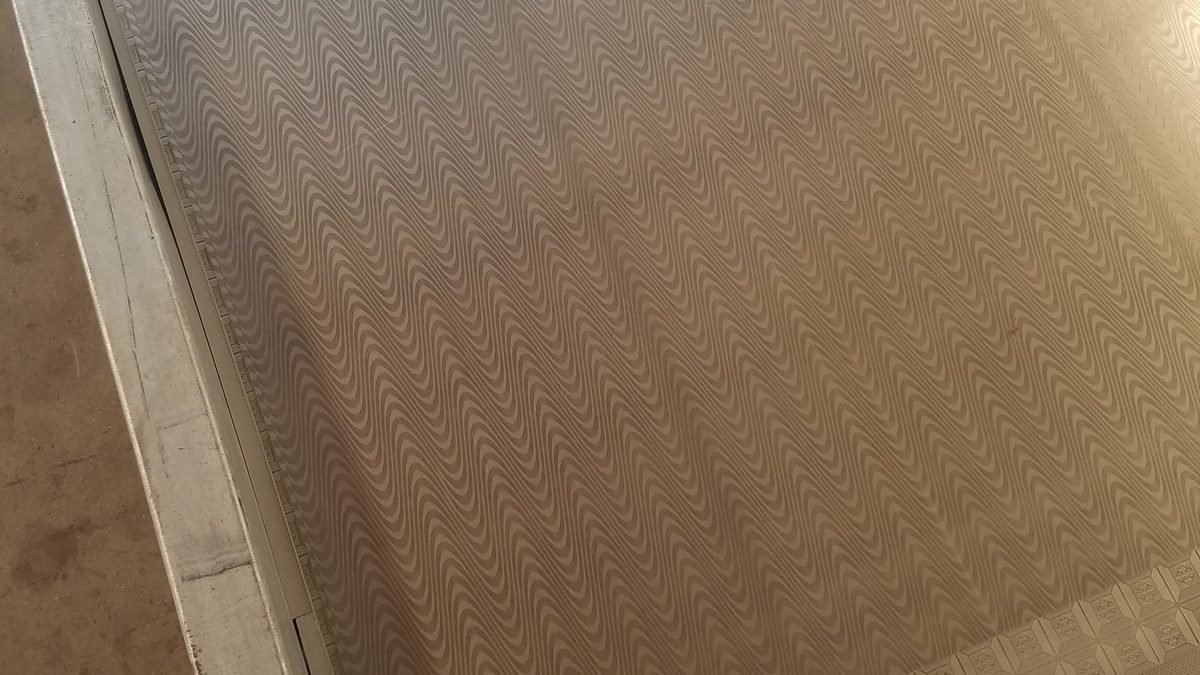
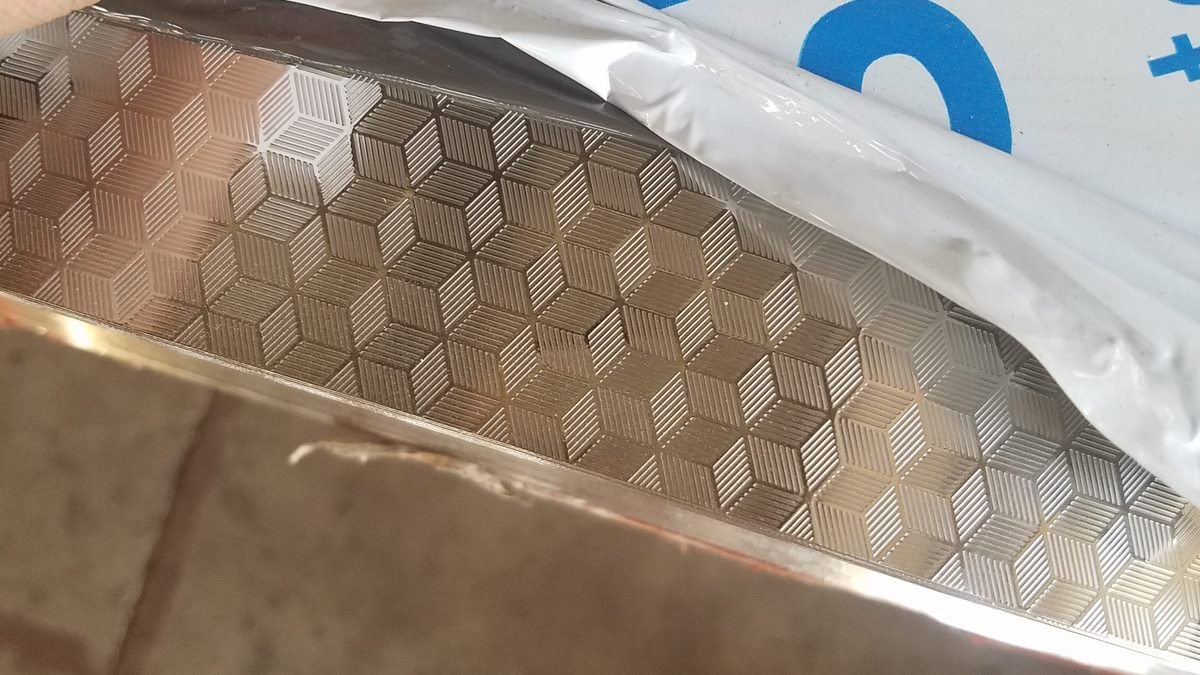
Typical uses include lift car ceilings and door panels, hotel lobby wall cladding, retail display backs, appliance doors, range hoods, column cladding, reception desks, signage backgrounds and decorative screens. The pattern can be a small diamond, a woven texture, a wave, a floral motif, a hexagon or a custom logo repeat. The choice depends on viewing distance, lighting, cleaning method and the size of the panel.
Grade and Chemical Composition
The standard grade for embossed decorative sheet is 304, the 18% chromium and 8% nickel austenitic stainless steel. It has enough ductility to accept the embossing pattern without cracking, enough corrosion resistance for indoor and many outdoor architectural uses, and a stable colour after brushing or polishing. 430 ferritic stainless is sometimes used for indoor appliance panels because it is cheaper, but it is less formable and more prone to rust in wet or coastal service. This article covers 304 only.
| Element | Typical 304 range (%) | Why it matters for embossing | Purchasing check |
|---|---|---|---|
| C | ≤ 0.08 | Weldability and anneal response | High carbon raises sensitisation risk |
| Si | ≤ 0.75 | Surface quality | High silicon can cause scale defects |
| Mn | ≤ 2.00 | Austenite stability | Not a substitute for nickel |
| P | ≤ 0.045 | Formability | High phosphorus reduces ductility |
| S | ≤ 0.030 | Surface cleanliness | Sulphur inclusions can crack during embossing |
| Cr | 18.0–20.0 | Corrosion resistance | Below 18% weakens the passive film |
| Ni | 8.0–10.5 | Austenite and toughness | Low nickel can leave magnetic phase |
| N | ≤ 0.10 | Strength | Excess nitrogen reduces formability |
| Fe | Balance | Matrix | Confirm with mill certificate |
Typical 304 window under ASTM A240 / EN 10088-2 / GB/T 3280. The embossing mill should confirm the annealed temper before running a new heat.
The starting sheet is usually 2B finish, because a smooth, uniform surface takes the pattern more evenly than a rough No.1 surface. Some products start from a No.4 brushed sheet and emboss over the brush lines, which creates a directional texture. The surface condition of the base sheet is therefore part of the product definition, not an afterthought. A 2B base with a scratch will show the scratch through the pattern, and the embossing will not hide it.
Mechanical Properties
Embossing work-hardens the sheet locally. The raised areas receive more deformation than the recessed areas, so the sheet can show a small increase in hardness and a small loss of elongation after patterning. The base sheet should be annealed before embossing and, if the pattern is deep or the panel will be severely bent, annealed again after embossing. A sheet that is already hard from cold rolling may crack at the pattern edge or delaminate the surface.
| Property | Typical annealed 304 value | After light embossing | Design note |
|---|---|---|---|
| Yield strength, Rp0.2 | ≥ 205 MPa | 205–260 MPa | Pattern adds stiffness but not uniform strength |
| Tensile strength, Rm | ≥ 515 MPa | 515–600 MPa | Use base values for structural calculation |
| Elongation, A50 | ≥ 40% | 30–40% | Deep patterns reduce reserve ductility |
| Hardness | ≤ 201 HB | 200–230 HB | Hard surface may need slower bending |
| Pattern depth | — | 0.2–0.8 mm | Deeper patterns need thicker base sheet |
| Surface roughness | 2B or No.4 base | Pattern-dependent | Measure Ra across the pattern, not along one line |
| Density | 7.93 g/cm3 | 7.93 g/cm3 | Useful for panel weight |
| Thermal expansion | 17–18 × 10-6 /K | Same | Allow movement on long facades |
Typical values for 304 sheet before and after embossing. The actual mechanical result depends on pattern depth, roll pressure and post-embossing anneal.
The pattern also changes the stiffness of the panel. A shallow pattern adds little rigidity, while a deep, close-pitched pattern can increase the apparent stiffness and reduce oil-canning. That can be an advantage for large wall panels, but it can also make the panel harder to flatten after cutting. Do not use the pattern as a substitute for a proper substructure or stiffener; the sheet still needs a frame, a carrier board or a continuous adhesive bond.
Dimensions, Pattern and Tolerance
Embossed sheet is ordered by base thickness, width, length, pattern name or drawing, pattern depth, pitch, surface finish and protective film. The base thickness is the thickness before embossing. The final thickness at a raised area is slightly less than the base because the metal is stretched, while the recessed area remains close to the base. If the panel has a minimum stiffness or a fire rating, the base thickness must be specified, not the average after embossing.
| Parameter | Common range | Typical tolerance | What to state |
|---|---|---|---|
| Base thickness | 0.3–1.5 mm | ±0.03 to ±0.10 mm | Base gauge and minimum after embossing |
| Width | 1000, 1219, 1500 mm | 0 / +5 mm | Finished panel width and trim allowance |
| Length | Coil or 2–4 m sheet | +10 / 0 mm | Fixed length or coil |
| Pattern depth | 0.2–0.8 mm | ±0.05 mm | Measured with a depth gauge or profilometer |
| Pitch | 1–20 mm | Pattern-dependent | Repeat distance and direction |
| Flatness | — | ≤ 5 mm per metre | Critical for large wall panels |
| Surface | 2B, No.4 or hairline | Per sample | Base finish and pattern orientation |
| Protective film | PVC or laser film | — | Film type and removal timing |
Typical commercial windows for embossed 304 decorative sheet. Custom patterns should be approved from a physical sample, not from a screen image.
Pattern depth is the number that most often causes a dispute. A buyer sees a photograph and expects a deep, shadow-rich texture; the mill supplies a shallow pattern that looks flat under diffuse light. Depth must be measured and agreed. The viewing angle also matters: a pattern with 0.3 mm depth can look strong under grazing light and almost invisible under flat office lighting. Approve the sample under the lighting conditions of the final installation.
Pattern direction is a second source of error. A roll has a machine direction and a transverse direction, and a pattern that is symmetrical on the sample may be directional on the coil. If the panels are installed vertically, the pattern must be oriented so that the repeat runs in the intended direction. For a book-matched wall, the panels must be cut from the same position in the pattern; otherwise the joint will show a mismatch.
How Embossed Sheet Is Made
The base coil is first slit to width and annealed. It is then cleaned and, if required, brushed or polished to the specified base finish. The sheet passes through an embossing stand with a patterned upper roll and a matching lower roll or a rubber-covered back-up roll. The roll gap, the tension and the roll temperature control the pattern depth and the amount of springback. A shallow pattern may be run in one pass; a deeper pattern needs multiple passes or a post-embossing anneal.
After embossing, the sheet is tension leveled to remove longitudinal bow and crossbow, then cut to length or recoiled. A protective film is applied to the visible face to prevent scratches during packing, transport and installation. The film must be removable without leaving adhesive. A cheap film that bakes onto the surface in the sun can be harder to remove than the scratches it was meant to prevent.
The common defects are pattern roll marks, incomplete pattern at the edges, oil-canning, crossbow, scratches under the film and “orange peel” texture. Roll marks come from dirt or a damaged roll. Incomplete pattern at the edge comes from insufficient roll pressure or a sheet that is too wide for the stand. Oil-canning is a local buckle caused by uneven tension. Orange peel is a rough, dimpled surface caused by too coarse a grain or too much deformation. Each defect should be defined in the inspection standard before the order is placed.
A custom pattern requires an engraved roll, which is a significant setup cost. The buyer should expect to approve a sample and to pay for the roll if the pattern is exclusive. For a small order, it is usually cheaper to choose an existing pattern from the mill’s catalogue than to commission a new roll. The catalogue pattern should still be approved as a physical sample, because the same pattern name can be interpreted differently by different mills.
Selection and Installation Rules
Select the base thickness from the panel size and the support spacing. A 0.5 mm sheet with a deep pattern can look stiff in a small sample but will oil-can on a 1.2 m wide panel with a light frame. A 1.0 mm sheet with the same pattern will hold flatter and resist handling damage. For lift ceilings and cabinet doors, 0.6–1.0 mm is common. For large facade panels, 1.0–1.5 mm is common, with a carrier board or a stiffening frame.
Select the pattern from the viewing distance. A fine pattern that looks elegant at 300 mm can disappear at 3 m. A coarse pattern that looks bold at 3 m can look heavy in a small lift car. Ask for a sample at the actual size and view it from the intended distance under the intended light. Do not approve a pattern from a small swatch held at reading distance.
Plan the joint layout before cutting. Embossed sheet cannot be welded and ground flat like a 2B sheet; a weld will disturb the pattern and leave a heat tint that is difficult to remove without local polishing. For wall cladding, use a dry joint, a trim strip or a shadow gap. For a seamless look, use a carrier board and a concealed fixing rather than a welded joint. If a weld is unavoidable, place it in a concealed location and specify the post-weld cleaning.
- Use a carrier board or a continuous frame; do not rely on the pattern for stiffness.
- Allow for thermal movement at each panel edge; stainless expands about 1.7 mm per metre over a 100 K rise.
- Cut with a guillotine, laser or waterjet; avoid shearing that leaves a distorted edge.
- Bend across the pattern with a radius of at least 3–4 times the thickness, and use a mandrel if the pattern is deep.
- Keep the protective film on until the panel is fixed, then remove it promptly.
- Clean with a neutral detergent and a soft cloth; avoid chloride cleaners and steel wool.
Common Mistakes
| Mistake | Why it fails | Better approach |
|---|---|---|
| Confusing embossed sheet with checker plate | Wrong pattern, thickness and slip resistance | Specify decorative embossed sheet and the pattern sample |
| Approving a pattern from a photo | Depth and scale are not visible | Approve a physical sample at final size |
| Using too thin a base for a large panel | Oil-canning and handling damage | Increase base thickness or reduce panel size |
| Welding visible panel joints | Pattern disturbance and heat tint | Use dry joints, trim strips or concealed fixings |
| Leaving protective film in the sun | Adhesive bakes and leaves residue | Remove film promptly after installation |
| Cleaning with chloride detergent | Pitting and crevice corrosion | Use neutral cleaner and rinse with fresh water |
| Cutting with a dull shear | Distorted edge and pattern damage | Use guillotine, laser or waterjet with a clean edge |
| Mixing pattern positions at a joint | Visible mismatch in the repeat | Cut panels from the same pattern position |
Embossed sheet is a visual product. Most complaints are about pattern scale, depth and joint appearance rather than corrosion.
Inspection and Acceptance
Inspect the first panel under the final lighting. Check the pattern depth with a depth gauge at several points, the pitch and the orientation, the base thickness, the flatness and the surface for scratches, roll marks and orange peel. Compare the panel to the approved sample, not to a photograph. If the panel is part of a set, lay several panels out in the intended order and check that the pattern lines up across the joints.
Check the protective film for adhesion and for any sign of adhesive transfer. A film that peels cleanly at the factory may become difficult to remove after a week in the sun. Ask for the film type and the recommended removal window. For outdoor work, confirm the stainless grade and the cleaning procedure, because a 304 panel in a coastal environment can develop tea staining even if the pattern is correct.
- Compare the pattern depth, pitch and orientation with the approved sample.
- Measure base thickness and final thickness at a raised area.
- Check flatness on a surface table or with a straight edge.
- Inspect both faces for scratches, roll marks and orange peel.
- Confirm the protective film type and removal instructions.
- Keep one approved sample and one production panel for reference.
FAQ
Is embossed stainless sheet suitable for outdoor use?
Yes in 304 for many urban and inland facades, provided the surface is cleaned regularly. For coastal or chloride-rich environments, use 316L or a higher-alloy grade and specify a suitable finish.
Can the pattern be customised?
Yes, but a custom pattern requires an engraved roll and a sample approval. For small quantities, an existing catalogue pattern is usually more economical.
Does embossing reduce corrosion resistance?
The base alloy is unchanged, but a deep pattern creates recesses that can trap dirt and moisture. Clean the pattern regularly and avoid chloride cleaners.
Can embossed sheet be bent?
Yes, with a radius that depends on thickness and pattern depth. Deep patterns need a larger radius or a mandrel, and bending across the pattern is easier than bending along it.
Can I weld embossed panels?
It is possible but difficult to make invisible. The weld disturbs the pattern and leaves heat tint. Use dry joints or concealed fixings for visible work.
What is the difference between 2B and No.4 base?
2B is a smooth, bright cold rolled finish. No.4 is a brushed finish with visible directional lines. The base finish changes how the pattern reflects light.
How should the sheet be cleaned?
Use a neutral detergent, a soft cloth or sponge, and a clean water rinse. Avoid chloride cleaners, bleach, steel wool and abrasive pads.
What is the minimum order for a custom pattern?
It depends on the mill’s roll cost and the run length. Ask for the roll charge and the minimum tonnage before committing to a custom design.
Need 304 embossed decorative sheet with an approved pattern and base thickness?
QIDAMT supplies 304 stainless sheet and coil from Liaocheng. Send the pattern sample, base thickness, panel size, finish and destination for a quotation. Email sales@qidamt.com or call +86 139 6951 8618 during working hours (GMT+8).