 FRAMSTEG
3003 Aluminiumplåt: Manganese Alloy, Temper and Tank Fabrication Guide
A 3003 aluminium plate is a manganese-alloyed, non-heat-treatable sheet product with moderate strength, excellent formability and good resistance to atmospheric and fresh-water corrosion. It is the standard choice for fuel tanks, köksredskap, takläggning, skyltning, HVAC parts and chemical equipment where 1060 is too soft and 5052 is more corrosion resistance than the budget allows.
Vad 3003 Plate Is and Where It Is Used
3003 is an aluminium-manganese alloy, standardised as AA3003, EN AW-3003 and GB/T 3190 3003. The manganese addition, usually around 1.2%, raises strength above commercially pure 1060 without destroying the ductility that makes aluminium easy to form. Det är inte värmebehandlingsbart, so the strength comes from strain hardening, annealing and the temper selected at the mill, not from a solution-and-age cycle.
The plate is used for fuel tanks, oil tanks, hydraulic reservoirs, cooking pots and pans, domestic appliance panels, roofing and wall cladding, vägmärken, HVAC ductwork, heat exchanger parts, chemical storage and food processing equipment. It is also common in architectural trim, luggage, storage boxes and marine topside parts that do not see continuous salt immersion. In each case, the buyer is trading some strength for formability, svetsbarhet och kostnad.
3003 is often confused with 3004 och 3104, which contain magnesium in addition to manganese and are used for beverage cans. It is also compared with 5052, which contains magnesium and has better marine corrosion resistance and higher strength. A 3003 plate is not a marine-grade plate, and it is not a structural alloy. It is a general-purpose fabricated sheet that performs well when the environment is moderate and the forming is demanding.
Betygsbeteckning och kemisk sammansättning
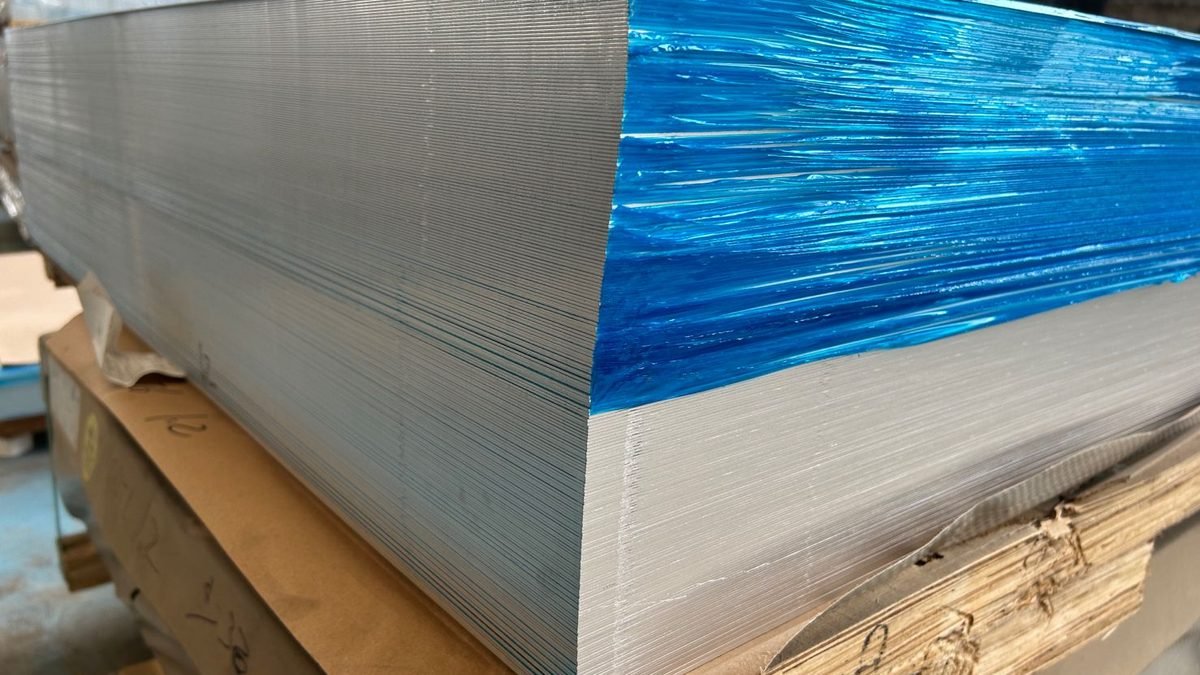
The certificate should name the alloy, the temper and the heat number. A delivery note that says aluminium plate is not enough, därför att 1100, 3003 och 5052 can look identical under a blue protective film. The manganese range is the clearest way to separate 3003 from 1060, and the copper range separates it from some 3000-series variants.
| Element | 3003 räckvidd (%) | Role | Purchasing check |
|---|---|---|---|
| Och | 0.6 max | Förorening; affects casting and anodising | High silicon can dull the anodised finish |
| Fe | 0.7 max | Impurity and grain control | High iron reduces ductility |
| Cu | 0.05-0.20 | Strength and corrosion | Too much copper hurts corrosion |
| Mn | 1.0-1.5 | Main alloying element; styrka | Nedan 1.0 is not 3003 |
| Mg | 0.05 max | Förorening | Magnesium shifts behaviour toward 3004 |
| Zn | 0.10 max | Förorening | High zinc lowers corrosion resistance |
| Av | 0.20 max | Grain refinement | Excess titanium can affect casting |
| Andra | 0.15 max vardera, 0.05 max total | Rester | Check the certificate for unusual residuals |
| Al | Balans | Matris | Purity affects conductivity and finish |
Typical AA3003 / EN AW-3003 window. Confirm the exact standard and temper on the mill certificate.
Manganese is what gives 3003 its working character. It forms fine precipitates that strengthen the aluminium and refine the grain, but it does not make the alloy heat-treatable. The manganese content also affects recrystallisation during annealing, so a mill that runs the anneal too hot or too long can produce a coarse grain and a surface that orange-peels during forming. That is a process issue, not a chemistry failure, but it shows up as a forming problem at the press.
Copper is a small but important addition. It raises strength slightly and improves some corrosion behaviour, but excessive copper can reduce resistance in certain waters. De 0.05 till 0.20% window is narrow enough that a certificate should be checked rather than assumed. For food equipment, the copper level and the surface finish both matter, because the plate may be in contact with acidic foods.
Mechanical Properties and Temper Selection
3003 levereras i O (glödgat), H14, H32, H24 and other strain-hardened tempers. The temper is not a cosmetic label; it controls yield strength, förlängning, bend radius and springback. A fabricator who orders H14 because it is in stock and then tries to form a tight radius may find that the plate cracks, while the same design in O temper forms easily but lacks the stiffness the part needs.
| Humör | Draghållfasthet, Rm | Sträckstyrka, Rp0,2 | Förlängning | Typisk användning |
|---|---|---|---|---|
| O | 110-140 MPa | 40-55 MPa | 25-30% | Djupteckning, complex forming |
| H14 | 140-180 MPa | 125 MPa minimum | 4-8% | Allmän tillverkning, panels, tankar |
| H24 | 150-190 MPa | 130 MPa minimum | 5-8% | Stiffer panels with moderate forming |
| H32 | 150-200 MPa | 130 MPa minimum | 6-10% | Structural covers, VVS, skyltning |
| H18 | 185 MPa and above | 150 MPa minimum | 2-4% | Hard sheet, limited forming |
Typical room-temperature ranges for 3003. Actual values depend on thickness, temper and mill; use the certificate and the applicable design code.
For a fuel tank, H14 is common because it has enough strength to resist handling and sloshing while still allowing rolling and bending. For a deep-drawn cooking pot, O temper is usually better because it stretches before it tears. For a flat sign panel, H32 gives a stiffer sheet that stays flat. The right temper is a function of the forming operation, not a default.
Bend radius follows the temper. A rule of thumb for 3003 H14 is a minimum inside radius of about 1.5 till 2 times the thickness for a 90-degree bend across the rolling direction, and somewhat less along the rolling direction. För O humör, the radius can be smaller. These are starting points, not guarantees: the actual limit depends on thickness, kornstorlek, edge condition and tooling. A trial bend on a sample from the actual coil is the only reliable check.
Springback is another temper effect. Aluminium has a lower elastic modulus than steel, so it springs back more after bending. H14 springs back more than O temper and more than 5052 H32 in some geometries. The die angle has to be corrected, and the operator should not try to compensate by overbending the part after it is formed. Design the tool for the temper, or specify a softer temper and accept the lower strength.
Mått, Tolerances and Plate Data
3003 plate is ordered by thickness, bredd, längd, temperament och yta. Thickness tolerance is the most common dispute because aluminium sheet is often sold by theoretical weight, and a mill that rolls to the plus side can deliver a heavier plate than the nominal. If the design has a minimum thickness, state the minimum actual and require it on the certificate.
| Parameter | Gemensamt utbud | Typisk tolerans | What to write on the order |
|---|---|---|---|
| Tjocklek | 0.5-6.0 mm | ±0.03 to ±0.15 mm | Nominal, standard and minimum actual |
| Bredd | 1000-1500 mm | 0 till +5 mm or ±2 mm | Finished width after trimming |
| Längd | 2000-4000 mm | ±5 mm | Cut-to-length or mill length |
| Flathet | — | Om 3-5 mm per meter | Critical for panels and signs |
| Camber | — | Om 3 mm över 3 m | Check before shearing |
| Kant | Sheared or sawed | Burr limit to agree | Deburr for visible or welded edges |
| Yta | Bruksfinish, stucco, film | No scratches or roll marks | Protective film type and thickness |
| Humör | O, H14, H24, H32 | Per standard | State the temper, not only the alloy |
| Förpackning | Timber crate or pallet | Export seaworthy | Protect edges and faces |
Typical commercial data for 3003 tallrik. Tolerances vary by standard, width and thickness; the purchase order should name the standard and the measured acceptance limits.
Flatness is a serious issue for signage and architectural panels. A plate that is flat on the pallet can bow after it is cut, because the residual stress pattern changes when the edges are removed. If the panel is visible, specify a flatness limit and ask for tension-leveled sheet. A plate that is within thickness tolerance but waves under a straight edge will show a shadow line on a facade.
Protective film is a practical detail. A blue PVC film protects the surface during transport and fabrication, but it can leave adhesive residue if it is left on a plate that is heated or stored in the sun. For a plate that will be anodised, the film must be removed before the anodising line and the surface must be free of adhesive. For a plate that will be welded, the film should be removed from the weld zone before welding, because some films release chloride and cause porosity.
Hur 3003 Plate Is Made
The process starts with a direct-chill cast ingot or a continuously cast slab. The ingot is homogenised at about 580 till 620 degrees C to dissolve the manganese-bearing phases and reduce segregation. It is then hot rolled at about 480 till 520 degrees C to a transfer gauge, cold rolled to the final thickness and annealed or strain hardened to the ordered temper.
Cold rolling controls thickness and surface. Annealing controls grain size and ductility. A tension-level line can improve flatness and reduce residual stress. The final temper is set by a combination of cold reduction and annealing, so the mill must know the forming operation to choose the right schedule. A plate that is simply called H14 may have different forming behaviour from another mill’s H14 if the grain size and residual stress are different.
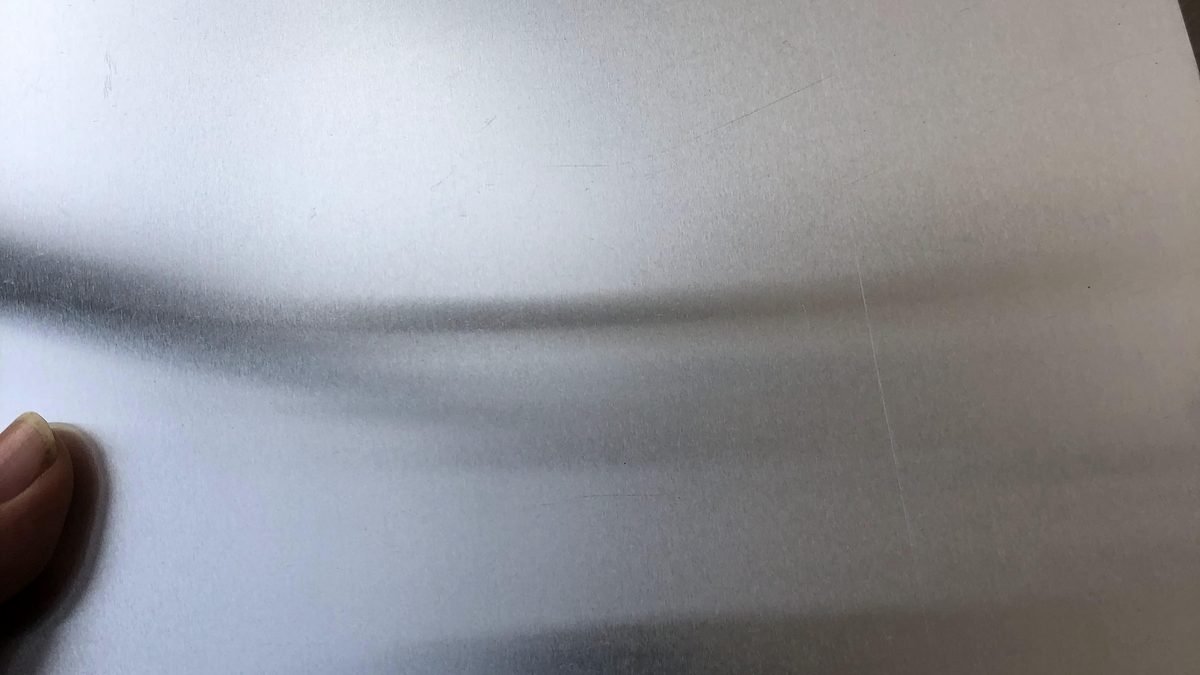
The most common defects are scratches under the film, rullmärken, edge burr, wave, oil stains and adhesive residue. A scratch that is visible after the film is removed is difficult to polish out without leaving a depression. Roll marks are periodic bands that show under low-angle light. Edge burr is a shearing issue, not a rolling issue, but it becomes the buyer’s problem at the press. Oil stains can be cleaned, but they may indicate a mill that did not rinse properly.
For a tank or a food contact part, the surface should be clean and free of embedded iron. Aluminium är mjukt, and a stainless or carbon steel brush can transfer particles that later rust or initiate corrosion. Use dedicated aluminium tools, clean gloves and a separate work area. This is especially important after the plate has been anodised, because the oxide layer is thin and easily contaminated.
Selection and Fabrication Rules
The first selection question is the environment. 3003 performs well in rural and industrial atmospheres, fresh water and many food applications. It is not the best choice for continuous seawater immersion, heavy salt spray or strongly alkaline solutions. For a marine tank or a coastal facade, 5052 eller 5083 is usually a better starting point, even at a higher cost.
The second question is the strength requirement. 3003 is a moderate-strength alloy. If the part is a pressure vessel, a structural bracket or a load-bearing panel, the design should be checked against the allowable stress at the service temperature. Do not assume that a thicker 3003 plate will match a 5052 or steel design; the stiffness is lower, and the failure mode may be buckling rather than yielding.
The third question is the joining method. 3003 is weldable with 4043 eller 1100 fyllmedel, and TIG or MIG processes work well. The heat-affected zone softens in H-tempers, so a welded H14 tank will have a soft zone beside the weld. If the design depends on the H14 strength, either accept the softened zone in the calculation or use a post-weld treatment that is appropriate for the alloy. Do not assume that the weld is as strong as the parent metal.
- Select the temper from the forming operation, not from stock availability.
- Use a bend radius of at least 1.5-2 times thickness for H14, and trial a sample.
- Remove the protective film from weld zones before welding.
- Använda 4043 eller 1100 filler for 3003; do not use a high-strength dissimilar filler without checking.
- Keep aluminium tools separate from steel tools to avoid embedded iron.
- Tillåt termisk expansion; aluminium expands more than steel.
- Protect the surface from scratches during shearing, forming and transport.
- Do not anodise a plate that has been contaminated with adhesive or iron.
Common Mistakes Buyers Make
| Mistake | Why it goes wrong | Better practice |
|---|---|---|
| Ordering 3003 for a marine tank | Pitting in salt water and crevices | Använda 5052 eller 5083 for marine service |
| Using H14 for a deep draw | Cracks at the radius or tears in the wall | Use O temper for severe forming |
| Expecting a bright anodised finish | 3003 anodises to a dull, grey appearance | Använda 1060 or a dedicated anodising alloy for bright work |
| Ignoring temper in the purchase order | The mill supplies a different hardness | State alloy and temper, and check the certificate |
| Welding through the protective film | Porosity and contamination | Remove film and clean the weld zone |
| Assuming weld strength equals parent strength | Soft heat-affected zone in H-temper | Design for the softened zone or re-temper |
| Using a steel brush on aluminium | Embedded iron and rust spots | Use stainless or dedicated aluminium tools |
| Buying by theoretical weight only | Thickness may be at the low side | Check actual thickness and weight |
Most 3003 failures are selection or fabrication errors. The alloy is capable; the specification has to be complete.
A common commercial mistake is to compare 3003 och 5052 on price per kilogram without comparing the required thickness. 5052 is stronger and more corrosion resistant, so a thinner 5052 plate may do the same job as a thicker 3003 tallrik. The cheaper alloy is not always the cheaper finished part. Run the design with both and compare the formed assembly, not only the raw material invoice.
Inspection and Acceptance
Receiving inspection should start with the certificate and the plate label. Check the alloy, humör, värmenummer, tjocklek, bredd och längd. Measure thickness at several points and check flatness on a flat bed. Inspect the surface under the film for scratches, rullmärken, dents and stains. If the plate is for anodising or food contact, check for adhesive residue and embedded particles.
For a formed or welded part, inspect the first piece before running the batch. Check the bend radius, återfjädring, weld appearance and fit-up. A plate that forms well in a sample may behave differently at the edge of a coil or at a different grain orientation. The first-piece inspection is cheaper than scrapping a tank.
- Match the alloy and temper on the label to the certificate.
- Measure thickness at head, middle and tail, and at three widths.
- Check flatness and camber on a flat surface.
- Inspect both faces for scratches, roll marks and stains.
- Check the protective film for adhesive residue before anodising.
- Verify the bend radius and springback on a sample.
- Keep the certificate and a sample for traceability.
- Record any deviation before cutting; efter formning, the evidence is gone.
FAQ
är 3003 aluminium strong enough for a fuel tank?
Ja, in the correct thickness and temper. H14 is common for road and off-road fuel tanks. The design should account for vibration, sloshing and the softened zone at welds.
Vad är skillnaden mellan 3003 och 5052?
5052 contains magnesium, has higher strength and much better marine corrosion resistance. 3003 is cheaper, more formable in some operations and adequate for fresh water and moderate environments.
Burk 3003 värmebehandlas?
Inga. It is a non-heat-treatable alloy. Strength comes from strain hardening and temper, not from solution treatment and aging.
What filler should I use for 3003?
4043 is common for general welding, och 1100 can be used for ductile joints. The filler choice depends on strength, colour match after anodising and cracking risk.
Why does 3003 look dull after anodising?
The manganese and impurity content produces a grey, diffuse oxide. If a bright, clear anodised finish is required, använda 1060 or another high-purity alloy.
Burk 3003 be used outdoors?
Ja, for roofing, signage and general outdoor fabrication in moderate atmospheres. It is not the best choice for coastal salt spray or continuous seawater.
What temper should I order for bending?
O temper for tight radii and deep draws, H14 or H32 for general fabrication where strength and flatness matter. Trial a sample before releasing the batch.
Hur mycket kostar a 3003 plate weigh?
The density is about 2.73 g/cm3. A 1 m x 2 m plate at 2 mm weighs about 10.9 kg. Use the actual thickness for freight estimates.
Burk 3003 svetsas till 5052?
It can be welded with a suitable filler, but the joint may not match the corrosion resistance of 5052. For marine service, använda 5052 throughout.
är 3003 livsmedelssäker?
3003 is used in cookware and food equipment, but the surface finish, cleaning regime and applicable food-contact standard must be checked. Anodised or coated surfaces may be required.
What is the lead time?
Stock sizes may ship in days; custom width, temper or finish may take several weeks. Send the full specification for a firm date.
Need a 3003 aluminium plate with a stated temper, thickness and surface?
QIDAMT-tillbehör 3003 aluminium plate from Liaocheng. Skicka tjockleken, bredd, längd, humör, surface and destination for a quotation. Email sales@qidamt.com or call +86 139 6951 8618 during working hours (GMT+8).