 FRAMSTEG
C11000 Copper Coil: ETP Conductivity, Temper and Coil Handling Guide
A C11000 copper coil is a continuous length of electrolytic tough pitch copper strip, supplied in coil form for slitting, stämpling, transformer winding, busbar fabrication and architectural work. It is selected for electrical conductivity and formability rather than strength, och det köps av humör, tjocklek, bredd, spolens vikt, edge condition and oxygen content rather than by the word copper.
What C11000 Copper Coil Is and Where It Is Used
C11000 is the standard electrolytic tough pitch copper, often written ETP copper. It contains at least 99.90% copper and a controlled amount of oxygen, vanligtvis 0.02 till 0.04%, which combines with residual impurities and improves conductivity. It is the most common electrical copper in the world, and it is supplied as wire, remsa, ark, tallrik, bar and coil. The coil form is used when a continuous feed is needed for slitting, stämpling, roll forming or winding.
Typical applications include transformer windings, inductor coils, samlingsskenor, elektriska kontakter, terminal strips, motor windings, printed circuit board grounding, roofing and gutters, värmeväxlarens fenor, köksredskap, sculpture and architectural cladding. In electrical work, the grade is chosen for conductivity; in architectural work, it is chosen for appearance and patina. The same C11000 coil can serve both, but the temper and surface requirements are different.
C11000 is not the same as C10100 or C10200 oxygen-free copper. The oxygen in ETP copper improves conductivity and machinability, but it can react with hydrogen at high temperature and cause embrittlement. For vacuum devices, hydrogen-brazed assemblies or high-temperature reducing atmospheres, an oxygen-free grade such as C10100 is usually required. A buyer who specifies C11000 for a vacuum furnace because it is cheaper may create a leak path that no leak detector can fix.
Betygsbeteckning och kemisk sammansättning
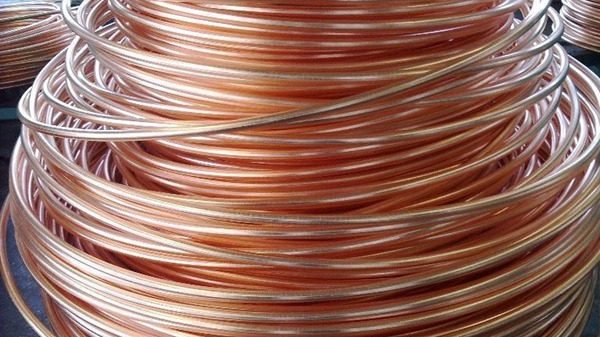
The certificate should report the copper content, the oxygen range, the temper and the heat number. A label that says copper coil is not enough, because C11000, C12200 and C26000 brass can look similar in a photograph and behave very differently in service. C12200 contains phosphorus as a deoxidiser and is a plumbing grade; C11000 is an electrical grade with oxygen. Mixing them up can cause conductivity or welding problems.
| Element | C11000 range (%) | Role | Purchasing check |
|---|---|---|---|
| Cu | 99.90 minimum | Conductivity and ductility | Nedan 99.90 is not C11000 |
| O | 0.02-0.04 | Controlled oxygen; improves conductivity | Too high causes embrittlement |
| Ag | 0.05 max | Residual impurity | Silver raises conductivity slightly |
| Bi | 0.0005 max | Förorening | Bismuth embrittles at grain boundaries |
| Pb | 0.005 max | Förorening | Lead hurts weldability and conductivity |
| Sb | 0.002 max | Förorening | Antimony lowers conductivity |
| Som | 0.002 max | Förorening | Arsenic lowers conductivity |
| Fe | 0.005 max | Förorening | Iron lowers conductivity |
| Andra | 0.03 max total | Rester | Kontrollera certifikatet |
Typical ASTM B152 / I 13601 / GB/T 5231 window for C11000. Confirm the exact standard and temper on the mill certificate.
Oxygen is the element that separates C11000 from oxygen-free copper. In the right range, it reacts with residual impurities and improves conductivity. Above the range, it forms copper oxide inclusions that can crack during rolling or embrittle in hydrogen. A certificate that reports only 99.9% copper without the oxygen value is incomplete for an electrical grade.
Silver is a permitted residual and can raise conductivity slightly, but it is not a reason to pay a premium unless the specification calls for it. Vismut, lead and antimony are the elements to watch. Even a few parts per million of bismuth can make the copper brittle at grain boundaries, and the failure may not appear until the wire is drawn or the strip is bent.
Mechanical Properties and Electrical Conductivity
C11000 is a soft, ductile metal in the annealed condition. It is not a structural material, and its strength is low compared with steel or brass. The design value is conductivity, formability and thermal transfer, not yield strength. If a part needs both conductivity and strength, a copper alloy such as C19400 or a precipitation-hardened grade may be a better choice.
| Egendom | Annealed C11000 | Half-hard C11000 | Design note |
|---|---|---|---|
| Draghållfasthet, Rm | 220-260 MPa | 260-310 MPa | Strength rises with cold work |
| Sträckstyrka, Rp0,2 | 50-80 MPa | 180-220 MPa | Low in annealed temper |
| Förlängning, A50 | 35-45% | 10-20% | Good formability in annealed temper |
| Hårdhet | 40-60 HV | 80-110 HV | Soft compared with brass |
| Elektrisk ledningsförmåga | 101% IACS | Om 100-101% IACS | Conductivity falls slightly with cold work |
| Värmeledningsförmåga | Om 390 W/m.K | Om 385 W/m.K | Excellent heat transfer |
| Densitet | 8.96 g/cm3 | 8.96 g/cm3 | Heavy for its strength |
| Smältpunkt | 1083 degrees C | 1083 degrees C | Softens well below melting |
| Softening temperature | Om 200-250 degrees C | Depends on temper | Do not use in high-temperature springs |
Typical room-temperature values for C11000. Actual values depend on temper, thickness and mill; use the certificate and the applicable standard.
Conductivity is usually specified as a percentage of the International Annealed Copper Standard, or IACS. C11000 is the reference material at 100% IACS, and a good electrical grade can reach 101% or slightly above. Cold work reduces conductivity a little, and annealing restores it. A coil that has been heavily slit or straightened may have a slightly lower conductivity at the edge than in the centre.
Softening is a practical limit. Copper that is annealed at 200 till 250 degrees C begins to lose the strength gained from cold work. A half-hard busbar that runs hot can soften and lose its shape. If the part must carry current and remain rigid at elevated temperature, a dispersion-strengthened copper or a different alloy may be needed. Do not use C11000 for a spring or a structural member that operates hot.
Mått, Tolerances and Coil Data
Copper coil is ordered by thickness, bredd, humör, coil weight and inner diameter. Thickness tolerance is tighter than for steel because copper strip is often used in electrical windings where the number of turns and the fill factor matter. A strip that is 0.02 mm thick at the low side can change the resistance of a winding and the fit inside a core.
| Parameter | Gemensamt utbud | Typisk tolerans | What to write on the order |
|---|---|---|---|
| Tjocklek | 0.10-6.0 mm | ±0.01 to ±0.05 mm | Nominal, standard and minimum actual |
| Bredd | 10-1000 mm | ±0.5 to ±2 mm | Finished width after slitting |
| Spole innerdiameter | 300-600 mm | ±5 mm | Winder or decoiler mandrel |
| Coil outer diameter | 500-1500 mm | Mill-dependent | Crane and coil car capacity |
| Spolens vikt | 100 kg-5 t | ±10% typical | Maximum lift and line capacity |
| Kant | Slit or rolled | Burr limit to agree | Slit edge for winding and stamping |
| Humör | O, kvart hårt, halvt hårt, hård | Per standard | State the temper, not only the alloy |
| Yta | Ljus, tinned, överdragen | No oxide or scratches | Specify the surface and protection |
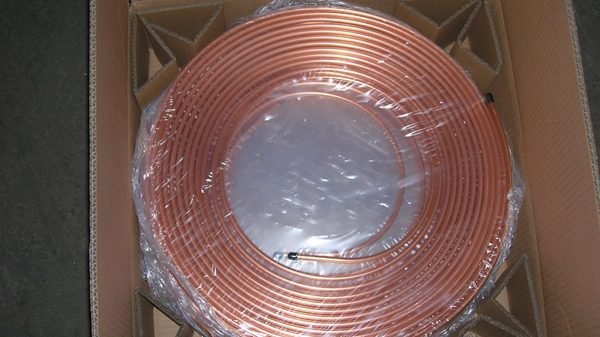
| Förpackning | Låda, pallet or wooden case | Seaworthy | Protect from moisture and tarnish |
Typical commercial data for C11000 coil. Tolerances vary by width, thickness and mill; state the governing standard and the measured acceptance limits.
Coil weight is a handling decision. A 5 t copper coil is heavy for its size, and a crane or decoiler that is rated for a steel coil of the same diameter may not be rated for the copper weight. Check the actual weight, not the volume. A copper coil that is dropped or lifted by the wrap can be deformed, and the wraps may telescope, making it impossible to feed.
Edge quality is critical for winding. A burr on a copper strip can cut through insulation, create a short circuit or damage the wire guide. A slit edge should have a controlled burr direction and a limit that is agreed before production. For a transformer winding, the burr is often specified to face outward or to be removed by a deburring pass. A cheap slit edge can cost more in scrap than a good one.
Surface protection is another detail. Copper tarnishes in air, and a humid container can produce a brown or green film that is difficult to remove. For a bright architectural finish, specify a protective film or a paper interleave, and pack with a desiccant. For an electrical winding, a clean, dry surface is enough, but oil or dust can affect insulation.
How C11000 Coil Is Made
The process starts with cathode copper of high purity. The cathode is melted in a shaft furnace or an induction furnace, and the oxygen content is controlled during casting. The melt is cast into wire bars or continuously cast into strip. The cast material is hot rolled, cold rolled to the final thickness, annealed and pickled or bright cleaned. The coil is then slit to width and packed.
Oxygen control is the key metallurgical step. If the oxygen is too low, the copper may contain residual impurities that lower conductivity. If it is too high, copper oxide inclusions form and the strip can crack during rolling or embrittle in hydrogen. A good mill measures the oxygen at the cast stage and confirms it on the finished strip.
The most common defects are surface oxide, rullmärken, edge cracks, thickness variation, coil telescoping and tarnish. Surface oxide appears as a dark or discoloured film that does not clean off; it usually comes from poor pickling or from a wet pack. Roll marks are periodic bands from the rolling mill. Edge cracks come from casting or rolling defects. Telescoping is a coil whose wraps have shifted sideways, which damages the edge during unwinding.
For electrical use, the strip should be free of inclusions and surface defects that can cause a break in a winding. A small sliver or a rolled-in oxide can reduce the effective cross-section and create a hot spot. The buyer should inspect the first metres of the coil before running a long winding line, because a defect that appears after 200 metres can scrap the whole batch.
Selection and Coil Handling Rules
The first selection question is the conductivity requirement. C11000 is the default for general electrical work. If the specification calls for oxygen-free copper, use C10100 or C10200. If it calls for phosphorus-deoxidised copper for plumbing or brazing, use C12200. Do not substitute C11000 for C12200 in a brazed plumbing assembly without checking the hydrogen embrittlement risk.
The second question is the temper. Annealed copper is soft and formable, lämplig för djupteckning, bending and winding. Half-hard copper has enough strength to hold shape in a busbar or a connector but less elongation. Hard temper is used where strength and spring are needed, but it is less forgiving in tight bends. The temper should be chosen from the forming operation and the service load, not from what is in stock.
The third question is the surface. Bright copper is chosen for architecture and decorative work; tinned or coated copper is chosen for soldering, corrosion protection or appearance. A bare copper coil that is stored in a humid warehouse can tarnish, and the tarnish may not be acceptable for a visible finish. Specify the surface and the packing, and inspect the coil before it goes to the line.
- Store coils on a dry pallet or saddle, never on wet concrete.
- Keep the wrap intact and the coil eye protected until unwinding.
- Lift with a proper coil hook or coil car; do not lift by the straps.
- Check the coil weight against the crane and decoiler capacity.
- Inspect the first metres for edge burr, oxide and slivers.
- Use clean gloves; copper stains easily and fingerprints can etch.
- Keep copper away from steel tools that can embed iron and cause corrosion.
- Protect the coil from moisture during export; use a desiccant and a sealed wrap.
Common Mistakes Buyers Make
| Mistake | Why it goes wrong | Better practice |
|---|---|---|
| Using C11000 in a hydrogen furnace | Oxygen reacts with hydrogen and the copper embrittles | Use C10100 oxygen-free copper |
| Expecting high strength | C11000 is soft and creeps at moderate temperature | Use a copper alloy or a stronger grade |
| Ordering without a temper | The mill supplies a different hardness | State temper, thickness and conductivity |
| Ignoring edge burr | Burr cuts insulation or damages the winding | Specify burr limit and direction |
| Storing coils in a humid yard | Tarnish and oxide spots | Store dry, wrapped and inspected |
| Using C11000 for a brazed plumbing joint | Phosphorus is needed for deoxidation | Use C12200 for plumbing brazing |
| Buying by weight only | Thickness may be at the low side | Check actual thickness and conductivity |
| Mixing copper and steel tools | Embedded iron causes corrosion spots | Use dedicated copper tools and clean gloves |
Most C11000 complaints are selection or handling errors. The grade is capable; the specification has to be complete.
A common commercial mistake is to buy C11000 on price per kilogram without checking the conductivity and temper. A coil that is 99.9% copper but has the wrong oxygen content or a hard temper may not meet the electrical or forming requirement. The cost of a failed winding or a rejected architectural panel is much higher than the few percent saved on the coil.
Inspection and Acceptance
Receiving inspection should start with the certificate and the coil label. Check the copper content, oxygen range, humör, tjocklek, width and weight. Measure thickness at several points and check the edge for burr and cracks. Inspect the surface for oxide, tarnish, scratches and roll marks. If the coil is for a visible architectural finish, compare it with the approved sample under the same lighting.
For electrical use, check the conductivity on a sample if the application is critical. A conductivity meter can confirm the grade, but it does not replace the certificate. For a winding, run a short length through the line before committing the whole coil. A defect that appears early is a receiving issue; a defect that appears after 200 metres is a production loss.
- Match the copper content and oxygen range to the certificate.
- Measure thickness at head, middle and tail, and at three widths.
- Check width, edge burr and coil inner diameter.
- Inspect both faces for oxide, tarnish and mechanical damage.
- Verify the temper by hardness or a bend test if critical.
- Check conductivity on a sample for electrical applications.
- Record the heat number and coil number for traceability.
- Keep a sample and the certificate for failure analysis.
FAQ
What is C11000 copper?
C11000 is electrolytic tough pitch copper with at least 99.90% copper and a controlled oxygen content of about 0.02-0.04%. It is the standard electrical copper.
What is the conductivity of C11000?
Om 101% IACS in the annealed condition. Cold work can reduce it slightly, and annealing restores it.
Can C11000 be used for plumbing?
It can carry water, but C12200 phosphorus-deoxidised copper is the usual plumbing grade because it is resistant to hydrogen embrittlement during brazing.
Why does C11000 embrittle in hydrogen?
The oxygen in the copper reacts with hydrogen at high temperature to form steam at grain boundaries, which causes cracks. Use oxygen-free copper for hydrogen or vacuum service.
What temper should I order for bending?
Annealed or quarter hard for tight bends; half hard for busbars and connectors that need strength. Trial the bend before releasing the batch.
Can C11000 be welded?
It can be welded, but the high thermal conductivity makes heat control difficult. Brazing and soldering are more common for electrical joints.
How much does a C11000 coil weigh?
The density is 8.96 g/cm3. A coil can run from 100 kg to 5 t depending on thickness, bredd och längd. Check the crane capacity.
Why does copper tarnish?
Copper reacts with oxygen, moisture and sulphur compounds in air. A protective wrap, dry storage and a coating or tinning can prevent it.
What is the difference between C11000 and C12200?
C11000 is ETP copper with oxygen; C12200 is phosphorus-deoxidised copper with about 0.02-0.04% phosphorus. C12200 is used for plumbing and brazing; C11000 is used for electrical conductivity.
Can C11000 be used outdoors?
Ja, for roofing and architectural work, where it develops a stable patina. För elektriska delar, protect it from moisture and contamination.
What is the lead time for a C11000 coil?
Stock sizes may ship in days; custom width, temper or surface may take several weeks. Send the full specification for a firm date.
Need a C11000 copper coil with a stated temper, width and conductivity?
QIDAMT supplies C11000 copper coil from Liaocheng. Skicka tjockleken, bredd, humör, ledningsförmåga, coil weight and destination for a quotation. Email sales@qidamt.com or call +86 139 6951 8618 during working hours (GMT+8).