 FRAMSTEG
Galvanized Scaffolding Tube: 48.3 mm Wall, Zinc Coating and Inspection
Galvanized Scaffolding Tube: 48.3 mm Wall, Zinc Coating and Inspection
A galvanized scaffolding tube is a hot-dip galvanized steel tube of 48.3 mm nominal outside diameter, supplied in standard lengths of 6 m, for tube-and-coupler scaffolding, falsework and edge protection. De 48.3 mm diameter is not an arbitrary figure: it is the size that the international scaffolding standards settled on, and it is the size that the great majority of couplers, beslag, base plates and accessories are designed to grip.
The tube itself is a simple product, but the three things that decide whether it is safe on site are not simple: the wall thickness, because it sets the load capacity; the zinc coating, because it sets the corrosion life and the inspection interval; and the inspection regime, because a tube that has been dropped, böjd, or welded in a previous life is no longer the tube that was certified. This article deals with hot-dip galvanized scaffolding tube only, and with the practical rules for buying it, checking it and retiring it.
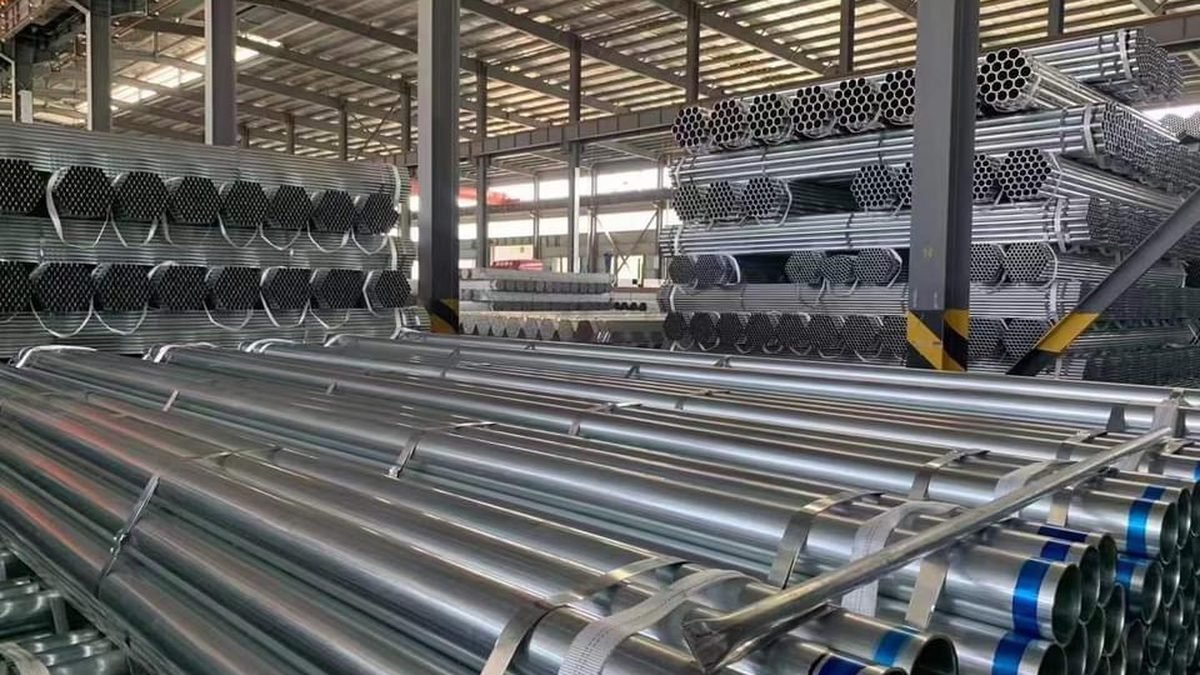
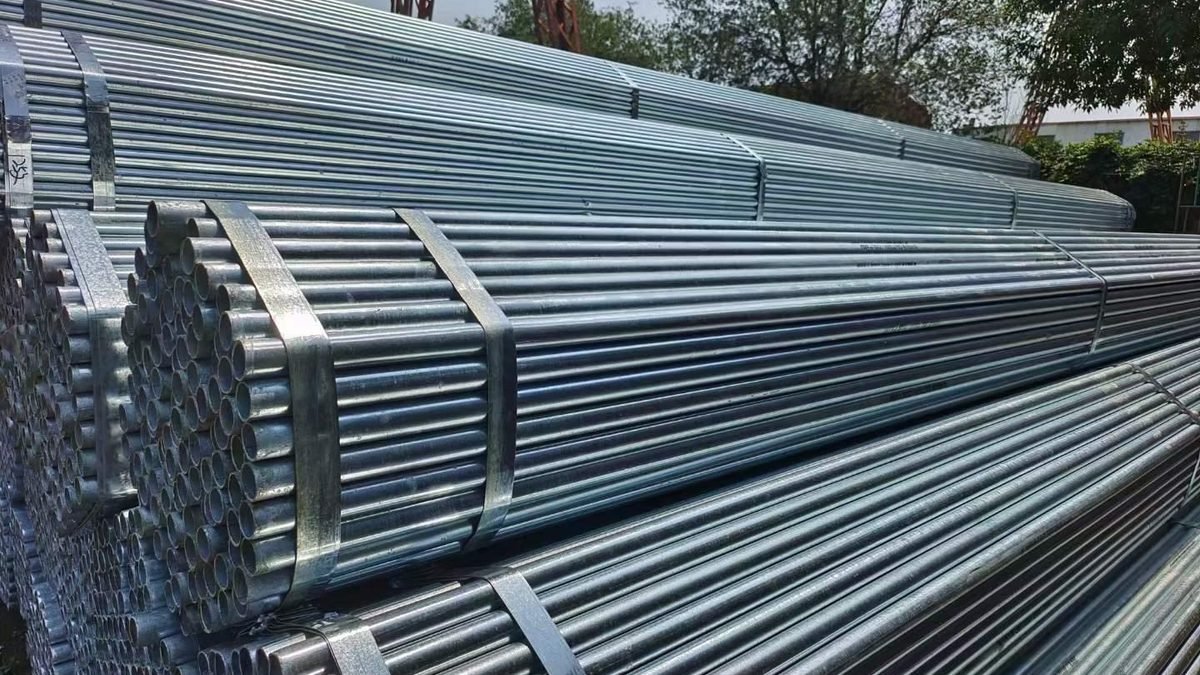
The photographs show bundles of galvanized tube stacked and strapped in the yard, and a storage bay where galvanized tubes are stacked in layers under a factory canopy. The zinc surface is bright and uniform, and the tube ends are cut square; both are what an inspector looks at first.
1. What the Product Is and Where It Is Used
Scaffolding tube is a welded steel tube, usually electric resistance welded from hot rolled coil, then cut to length and hot-dip galvanized. It is used with couplers, which are the fittings that clamp two tubes together at any angle, and with base plates, adjustable jacks, diagonal braces, toe boards and decking. The system is called tube-and-coupler scaffolding, and it remains the most flexible scaffold system in the world because any geometry can be built from straight tubes and couplers.
The applications are broader than scaffolding alone. The same tube is used for falsework under bridge decks and formwork, for temporary edge protection and guardrails, for event staging and seating structures, for racking frames, for temporary roofs and weather shelters, and for site hoarding frames. In each case the tube is chosen because it is strong, light enough to handle by two people, standardized so that fittings are interchangeable, and galvanized so that it can be reused outdoors for years.
The galvanized finish is the reason the product is bought galvanized rather than painted. A painted tube loses its coating at every cut, every dropped end and every coupler clamp, and the exposed steel rusts at those points. A hot-dip galvanized tube carries a metallurgically bonded zinc layer over the whole surface, inside and outside, including the cut ends, and the zinc protects the steel both as a barrier and as a sacrificial anode at scratches. For a product that is handled roughly, stored outdoors and reused for a decade, that is the difference between an asset and a consumable.
2. Steel Grade and Chemical Composition
The steel grade is normally a structural carbon steel such as S235JR to EN 10025-2, Q235B to the Chinese standard, or STK400 to JIS G3444 for the Japanese market. The grade matters because it sets the minimum yield strength that the scaffold design assumes, and because the chemistry affects both the weld and the galvanizing response.
| Element, % | S235JR | Q235B | Comment |
|---|---|---|---|
| Kol, max | 0.17 | 0.20 | higher carbon raises strength and lowers weldability |
| Mangan, max | 1.40 | 1.40 | strength and deoxidation |
| Kisel, max | 0.55 | 0.35 | too high silicon gives a thick, grey zinc layer |
| Fosfor, max | 0.035 | 0.045 | impurity, kept low for toughness |
| Sulphur, max | 0.035 | 0.045 | impurity |
| Koppar, max | 0.55 | inte specificerat | copper improves atmospheric corrosion resistance |
| Kväve, max | 0.012 | inte specificerat | excess nitrogen causes strain ageing |
Silicon deserves a note because it is the element that most often surprises a galvanizing customer. A steel with silicon above about 0.25 procent, or with a silicon plus phosphorus combination in a certain range, reacts with the zinc bath to form an abnormally thick, dark and sometimes brittle coating. The coating looks different from the bright, uniform surface of a normal galvanized tube, and it can be more prone to flaking. A tube mill that supplies scaffolding tube regularly knows this and controls the silicon; a mill that sells whatever coil is available does not.
The mechanical properties that the design relies on are the yield strength and the tensile strength. S235JR has a minimum yield of 235 MPa and a tensile range of 360 till 510 MPa, with a minimum elongation of 24 procent. Q235B has a minimum yield of 235 MPa and a tensile range of 370 till 500 MPa. STK400 has a minimum yield of 245 MPa and a tensile minimum of 400 MPa. The scaffold design standards use these values, and a tube made from a lower grade steel, or from a steel with a thinner wall than specified, invalidates the design.
3. Wall Thickness and the Sizes That Matter
The nominal outside diameter is 48.3 mm, and the wall thickness is where the market varies most. The European standard for loose scaffold tubes specifies 48.3 mm outside diameter with a 4.0 mm wall. The Asian market commonly supplies 48.3 × 3.2 mm, 48.3 × 3.6 mm och 48 × 3.0 mm, och den 3.2 mm tube is the volume product for export scaffolding. The difference in capacity is not small: a 4.0 mm tube has about 23 percent more steel than a 3.2 mm tube of the same diameter, and the section modulus and the buckling resistance follow.
| Storlek, mm | Vägg, mm | Massa, kg/m | Mass of 6 m tube | Typical market |
|---|---|---|---|---|
| 48.3 | 4.0 | 4.37 | 26.2 kg | European standard scaffold tube |
| 48.3 | 3.6 | 3.97 | 23.8 kg | heavy-duty Asian export |
| 48.3 | 3.2 | 3.56 | 21.4 kg | standard export scaffolding tube |
| 48.0 | 3.0 | 3.33 | 20.0 kg | light market tube, check coupler fit |
The mass figures are calculated from the nominal dimensions and a density of 7.85 g/cm³. The real mass of a galvanized tube is slightly higher because of the zinc, by about 0.5 till 1 kg per metre of surface, which is negligible for handling but should be allowed for when calculating scaffold loads.
Tolerance on the wall is the parameter that hides the most risk. A wall tolerance of plus or minus 10 percent is normal for welded tube, så a 3.2 mm nominal tube can be 2.88 mm at the thin point. On a 48.3 mm tube, that is a 10 percent loss of steel and a significantly lower buckling load. A buyer who specifies “3.2 mm” without specifying the minimum wall, and who does not measure the wall on receipt, is buying a tube that may not match the scaffold design. The practical rule is to specify the minimum wall and to check it with an ultrasonic gauge at several points around the circumference, because a welded tube is often thinner at the weld and at the opposite side.
Length is normally 6 m, med 3 m och 4 m available. The length tolerance is usually plus 20, minus 0 mm, and the ends are cut square and deburred. A tube cut at an angle will not sit properly in a coupler, and a burr will cut the galvanized coating and the hand of the erector.
4. The Zinc Coating: Tjocklek, Mass and Appearance
Hot-dip galvanizing is a batch process. The finished tube is degreased, pickled in acid to remove scale and rust, fluxed, dipped in molten zinc at about 450 °C, withdrawn, and then cleared of excess zinc by air blowing or draining. The zinc reacts with the steel to form a series of zinc-iron alloy layers, topped by a layer of nearly pure zinc. The coating is metallurgically bonded, not painted on, and it cannot peel in the way a paint film can.
Coating thickness is specified in micrometres or in grams per square metre, and the two are related by the density of zinc: 1 µm of zinc is about 7.14 g/m², så a 70 µm coating is about 500 g/m². For steel between 3 och 6 mm tjock, the general hot-dip galvanizing standard requires an average coating of about 70 µm with a local minimum of about 55 µm. Scaffolding tube specifications often ask for more, because the tube is handled roughly and reused; 80 till 100 µm is a common export requirement for a long service life.
| Coating parameter | Typical requirement | Test method |
|---|---|---|
| Average coating thickness | 70 µm minimum, 80 till 100 µm for long-life export | magnetic gauge, microscopical method |
| Local minimum | 55 µm minimum | magnetic gauge at the thinnest point |
| Coating mass | om 500 g/m² average | weigh-strip method |
| Adhesion | no flaking on bending or impact | bend test, hammer test |
| Utseende | uniform, free of dross, ash and uncoated patches | visual, both surfaces |
| Inner surface | coated along the full length | visual with a light, endoscope if required |
The weigh-strip method is the referee test. A measured length of tube is weighed, the zinc is stripped in a inhibited acid, the tube is weighed again, and the coating mass is calculated from the difference and the surface area. It is destructive, so it is done on a sample, not on every tube. A magnetic thickness gauge is the shop method: it is fast and non-destructive, but it reads the total coating on one spot and can be fooled by a thick alloy layer. For a dispute, the weigh-strip result is the one that counts.
Appearance is a legitimate acceptance criterion, but it has to be applied with knowledge. A hot-dip galvanized tube can be bright and shiny, or it can be matte grey, depending on the steel chemistry, the bath and the cooling. Both can be sound. What is not acceptable is a dark, lumpy coating with visible dross, an uncoated patch, a black spot where the tube touched a jig, or a white powdery deposit, which is wet storage stain from moisture trapped between tubes in a bundle. Wet storage stain is a corrosion product of zinc, and while it is usually superficial, it consumes coating and it signals that the packing was wet.
Passivation is sometimes applied after galvanizing to reduce the risk of wet storage stain during sea freight. A chromate or a chrome-free passivation leaves a very thin film that is not part of the coating thickness. It should be declared on the certificate, because some food and drinking water applications restrict chromate.
5. How the Tube Is Made
The tube is made from hot rolled coil, slit to width, formed into a cylinder through a series of rolls and welded along the seam by high-frequency resistance welding. The weld is then normalized or annealed in line, the tube is sized and straightened, skär till längden, and end faced. This is the electric resistance welded, or ERW, behandla, and it is the standard process for scaffolding tube worldwide.
The weld seam is the part of the tube that needs the most attention. A high-frequency weld made with the correct power and speed is a sound, narrow seam with a small internal and external flash. A seam made with too little power is incomplete; a seam made with too much power is brittle and can crack when the tube is bent or flattened. The standard test for the seam is the flattening test: a length of tube is flattened between platens until the distance between the platens is a specified fraction of the diameter, and the weld must not open. A tube that fails the flattening test is not fit for scaffold use, whatever the certificate says.
Galvanizing comes after cutting and end facing, so the zinc covers the cut ends as well. That is the advantage of hot-dip over pre-galvanized strip: a pre-galvanized tube has bare steel at every cut, and those bare ends rust first. A hot-dip tube has no bare steel anywhere, which is exactly what a reusable scaffold needs.
The galvanizing process also relieves some of the residual stress from forming and welding, because the tube passes through a 450 °C bath. It does not normalize the weld, and it does not restore the mechanical properties of the seam, so the flattening test and the tensile test remain necessary.
6. Inspection: What to Check and When
Inspection happens at three points: on receipt, before each erection, and after each dismantling. Each has a different purpose.
On receipt. Check the certificate against the order: kvalitet, storlek, vägg, längd, coating specification and heat number. Measure the outside diameter at several points, the wall with an ultrasonic gauge at four points around the circumference and at both ends, the length, and the straightness. Check the coating with a magnetic gauge on at least ten points per bundle, look at both the outside and the inside of the tube, and look for wet storage stain between the tubes. Check the ends for squareness and burr. Take one tube per lot and flatten it, or ask for the mill’s flattening test record.
Before each erection. Inspect every tube that will carry load. Reject a tube that is bent by more than the scaffold standard allows, that has a dent deeper than about 5 percent of the diameter, that has a crack at the weld, that has lost its coating over a significant area with red rust showing, or that has been welded, drilled or cut in a previous life without a proper assessment. A tube with a flattened or ovalized end will not grip in a coupler properly, and a coupler that does not grip is a slip waiting to happen.
After dismantling. Sort the tubes. Tubes that are straight and sound go back to stock; tubes that are bent go to a straightening bench or to scrap; tubes with red rust, cracks or repairs go out of service. The sorting is the step that keeps a scaffold fleet safe, and it is the step that is most often skipped when a job is running late.
| Defect | Acceptance guide | Action |
|---|---|---|
| Bend | more than about 1/500 of the length | straighten or retire |
| Dent | deeper than 5 % of diameter | retire, the section is locally weakened |
| Wall loss | more than 10 % of nominal | retire or downgrade after assessment |
| Coating loss with red rust | any area larger than a hand | inspect, derate or re-galvanize |
| Weld crack | any visible crack | retire immediately |
| Ovalized or flattened end | end that will not seat in a coupler | cut back or retire |
| Unauthorized weld or hole | any | retire unless assessed by an engineer |
| Wet storage stain | white deposit, no red rust | clean and dry, monitor |
The acceptance figures above are practical guides, not substitutes for the governing scaffold standard or the designer’s instructions. Where a project has a specific inspection regime, that regime governs.
7. Selection and Use Rules
Match the tube to the couplers. Couplers are made for a specific outside diameter and a specific wall range. A 48.0 mm tube in a 48.3 mm coupler may grip, or may not, depending on the coupler’s tolerance; a 48.3 mm tube is the safe choice for international couplers.
Specify the minimum wall and the grade. The scaffold design assumes a wall and a yield strength. A 3.2 mm nominal tube that measures 2.88 mm at the thin point, made from a steel with a lower yield, is outside the design assumption even though it looks the same.
Specify the coating by mass or thickness, not by the word galvanized. “Galvaniserad” can mean 40 µm or 100 µm. For a fleet that will be reused outdoors for ten years, specificera 80 µm or more and check it on receipt.
Do not mix galvanized and aluminum fittings without isolation. Zinc and aluminum form a galvanic couple in wet conditions, and the aluminum will corrode. Where aluminum couplers or planks are used with galvanized tube, the detail should be dry and the contact should be isolated where possible.
Do not weld galvanized tube on site. Welding burns the zinc and produces zinc oxide fume, which causes metal fume fever. If a tube must be welded, the coating is removed locally first, the weld is made with the appropriate procedure, and the coating is restored with a zinc-rich repair compound.
Do not cut galvanized tube with a torch. The same fume problem applies, and the cut edge is left bare. Cut with a saw or a wheel and repair the cut end with a zinc-rich compound, or buy the tube cut and galvanized to length.
Inspect the fleet on a schedule. A tube that passed inspection when it was new may not pass after two years of site handling. A documented inspection at each project start and a formal retirement rule are cheaper than an accident.
Stack and store properly. Tubes stored on the ground, in bundles that trap water, develop wet storage stain and bend under their own weight. Store on timber bearers, clear of the ground, with the bundles opened for air circulation after rain.
8. Vanliga misstag
Buying 48 × 3.0 mm as a “standard” scaffold tube. The international standard diameter is 48.3 mm, and the common export wall is 3.2 mm. A 48.0 × 3.0 tube is a lighter product and may not fit standard couplers or meet the design.
Accepting a certificate without a wall measurement. The wall is the load path. A certificate that states a nominal wall without a measured minimum is not a verification.
Treating coating colour as quality. A bright tube and a matte grey tube can both be sound. What matters is the measured thickness and the absence of bare patches.
Ignoring the inside of the tube. A tube can be coated outside and bare inside, and the inside corrodes first. Check with a light at both ends.
Assuming galvanizing is a paint. It is a metallurgical coating and it can be damaged by welding, torch cutting and aggressive acid cleaning. Damage should be repaired with a zinc-rich compound, not with ordinary paint.
Using a bent tube because it is “only a brace”. A bent tube is a load eccentricity, and braces carry load. Retire it or straighten it properly.
Welding a tube that was drilled in a previous life. A hole in the wall is a stress raiser and a corrosion site. Retire it unless an engineer has assessed it.
Storing bundles in the rain. Water between tubes produces wet storage stain and white corrosion. Store under cover, on bearers, and open the bundles to dry.
Mixing tube from different suppliers in one scaffold. Different walls and grades have different capacities, and the design assumes one section. Keep the batches identifiable.
Forgetting the base. A galvanized tube standing on a base plate on soft ground will settle. The base plate, the sole board and the ground bearing capacity are part of the scaffold design, not an accessory.
9. Vanliga frågor
What is the standard scaffold tube size? 48.3 mm outside diameter. The wall varies by market: 4.0 mm in the European loose tube standard, 3.2 mm for the common export product, och 3.0 till 3.6 mm in other markets.
Hur mycket kostar a 6 m scaffold tube weigh? Om 21.4 kg at 48.3 × 3.2 mm, om 26.2 kg at 48.3 × 4.0 mm, plus a small allowance for the zinc coating.
How thick is the zinc coating? The general hot-dip standard requires about 70 µm average for this wall thickness, and long-life export specifications ask for 80 till 100 µm. One micrometre of zinc is about 7.14 g/m².
Can galvanized tube be painted? Ja, with a suitable primer after the surface is cleaned and, where required, etsat. Painting over a sound zinc coating is usually unnecessary and adds a maintenance liability.
Can galvanized tube be welded? It can, but the zinc must be removed from the weld zone and the fume extracted, and the coating restored afterwards. På plats, welding is usually the wrong answer; use couplers or fittings.
Why does my galvanized tube have white patches? That is wet storage stain, a zinc corrosion product from moisture trapped between tubes. It is usually superficial; clean, dry and separate the tubes, and check the coating thickness if the stain is heavy.
How often should scaffolding tube be inspected? At each project start, after any event that could have damaged it, and at a defined interval in a fleet regime. The governing standard for the site sets the formal requirement.
What is the flattening test? A sample of tube is flattened between platens until the gap reaches a specified fraction of the diameter, and the weld must not open. It is the standard check on the weld seam quality.
Can I use scaffold tube as a structural member? Only within a designed structure. Tube-and-coupler scaffolds are designed as a system, and a single tube used as a beam or a column outside that system needs its own check.
What is the difference between hot-dip and pre-galvanized tube? Hot-dip galvanizing is applied after the tube is formed and cut, so the ends and the weld are coated. Pre-galvanized strip is coated before forming, so the weld and the cut ends are bare unless they are repaired.
Need galvanized scaffolding tube to a coating specification?
Send the diameter, vägg, längd, stålkvalitet, coating mass and quantity. We will confirm the mill programme, the flattening test record, the coating certificate and the packing, and quote against the measured wall and coating rather than a nominal size.
Relaterad läsning: varmförzinkat runt stålrör · DX51D galvanized steel strip · Q345D seamless steel pipe

