 PROGRÈS
Z275 Galvanized Steel Coil: Coating Mass, Spangle and Fabrication Guide
Z275 galvanized steel coil is a hot-dip zinc-coated coil with a total coating mass of 275 g/m² across both surfaces. It is one of the heavier standard coatings, intended for roofing, walling, conduit, racking and structural profiles that will be exposed to weather or handled for a long period before painting. The designation describes the zinc, not the steel: the substrate grade, surface condition and spangle must be specified separately.
What Z275 Galvanized Steel Coil Is and Where It Is Used
Z275 is a coating class in the EN 10346 system. The “Z” denotes zinc, et 275 is the total mass of zinc applied to both surfaces in grams per square metre. Because the coating is applied on both sides, 275 g/m² total corresponds to about 137.5 g/m² par face, or roughly 19 µm of zinc per surface. That is substantially heavier than a Z120 or Z40 coating and is intended for longer service or more aggressive exposure.
The substrate is usually DX51D, a low-carbon, fully killed steel intended for bending and profiling rather than for structural load. Z275 coil is used for roofing and wall cladding, gouttières, downpipes, ventilation ducting, chemins de câbles, racking, rayonnage, dos d'appareil, automotive underbody parts and general sheet-metal fabrication. It is also used as a base for painted products, although a dedicated PPGI line is normally preferred for a consistent paint finish.
The coating works in two ways. The zinc is sacrificial: if the steel is exposed at a cut edge or a scratch, the zinc around it corrodes first and protects the steel. The zinc also forms a barrier layer of zinc oxide and zinc carbonate that slows further attack. That combination is why galvanized sheet performs well in rural and urban atmospheres, but it is not unlimited: chlorure, acid rain and standing water consume the coating.
Z275 should not be confused with a zinc-aluminium coating or with a thicker “Z” class used for severe marine exposure. It is a conventional hot-dip zinc coating. For a coastal roof or a heavily polluted industrial site, a zinc-aluminium-magnesium coating or a heavier coating plus a suitable paint system may be needed. The grade name alone does not guarantee a service life.
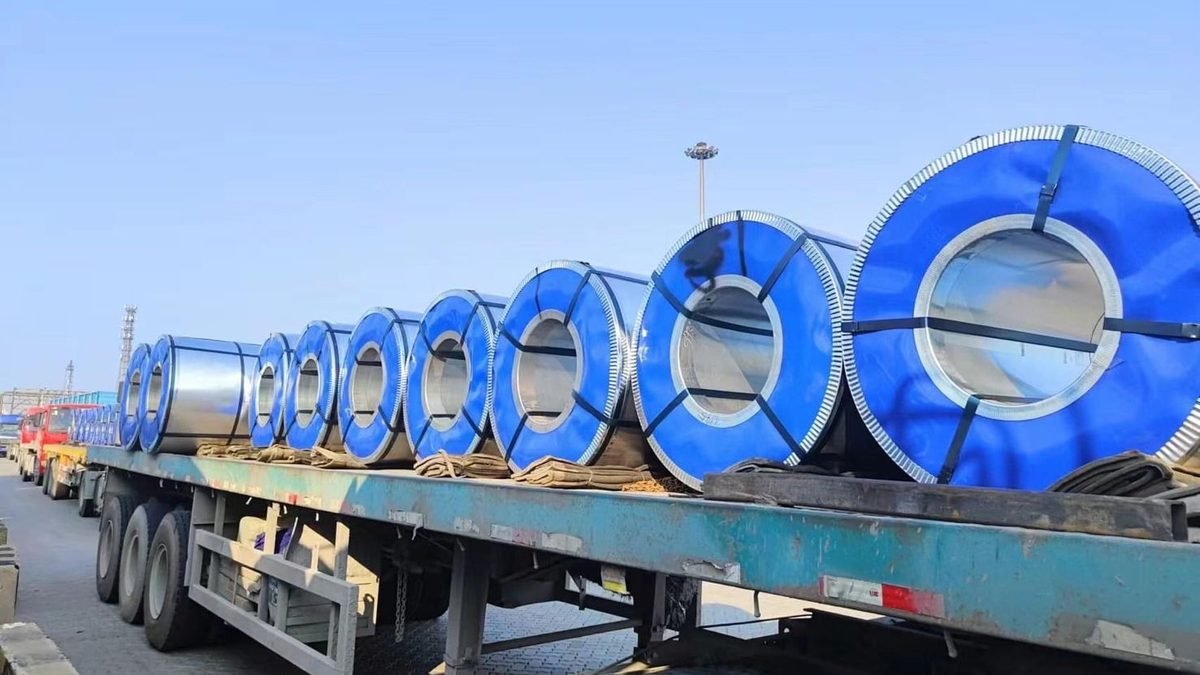
Désignation de qualité et composition chimique
Z275 is a coating designation, and the steel beneath it is usually DX51D. The substrate chemistry is controlled to give consistent formability and a sound zinc adhesion. The table shows a typical DX51D window under EN 10346. The zinc bath chemistry is also controlled: aluminium is added to suppress a brittle iron-zinc alloy layer, and lead or antimony may be used to control spangle. Modern lines increasingly use lead-free spangle control.
| Élément | Typical DX51D range (%) | Rôle | Purchasing note |
|---|---|---|---|
| C | ≤ 0.18 | Strength and hardness | Higher carbon reduces formability |
| Mn | ≤ 1.20 | Force | Residual; keep within the standard |
| Et | ≤ 0.50 | Désoxydation | High silicon can impair coating adhesion |
| P. | ≤ 0.12 | Force | Segregation hurts ductility |
| S | ≤ 0.045 | Impureté | Keep low for weldability |
| Al | ≥ 0.020 | Killing and grain control | Also controls the zinc bath reaction |
| De | ≤ 0.30 | Affinage des grains | Facultatif; check the mill’s practice |
| Fe | Équilibre | Matrix | — |
| Zn coating | 275 g/m² total | Sacrificial protection | À propos 137.5 g/m² per surface |
Typical DX51D substrate limits and Z275 coating mass. Confirm the exact grade and coating class on the mill certificate.
The coating mass is the number that must be verified, not assumed. A coil marked Z275 should have a certificate showing the triple-spot or single-spot coating test result. The standard allows a tolerance band, and a coil at the low end of the band has less zinc than a coil at the high end. For a long-life roofing project, specify the minimum individual test value, not only the nominal class.
The substrate grade also matters. DX51D is a bending grade, not a structural grade. If the coil will be roll-formed into a load-bearing purlin or a structural deck, the designer may need a grade with a guaranteed yield strength, such as S250GD or S280GD, in the same Z275 coating. Using DX51D for a structural section because “it is Z275” is a common and expensive mistake.
Propriétés mécaniques
The mechanical properties of Z275 coil are dominated by the steel substrate, not by the coating. DX51D is supplied in the annealed and skin-passed condition, with a low yield strength and good elongation for profiling. The zinc coating adds negligible strength but can affect bendability at tight radii, because the coating must stretch with the steel without cracking.
| Propriété | Typical DX51D + Z275 | Test basis | Fabrication implication |
|---|---|---|---|
| Limite d'élasticité, ReH (MPa) | 140–260 | Transverse, DANS 10346 | Low yield suits roll forming |
| Résistance à la traction, Chambre (MPa) | 270–390 | Transverse | Moderate strength; not structural |
| Élongation, A80 (%) | ≥ 22 | Transverse | Good for bending and profiling |
| Coating mass, total (g/m²) | 275 nominal | Triple-spot | À propos 19 µm par côté |
| Coating adhesion | No flaking at specified bend | Essai de pliage | Check at the tightest radius |
| Surface | Oiled, passivated or dry | Visuel | Oil affects painting and handling |
| Paillette | Normal or minimised | Visuel | Appearance and paint texture |
Typical values for DX51D substrate with Z275 coating. Structural grades and high-strength grades have different mechanical tables.
The coating adhesion test is the one that catches problems before roll forming. A coil can pass the coating mass test and still flake at a tight bend if the zinc-iron layer is too thick or the skin-pass is inadequate. Ask for a bend test at the radius the part will actually use, not a generic 180-degree fold. A roof panel formed at a 5 mm radius is a different case from a duct corner formed at 2 mm.
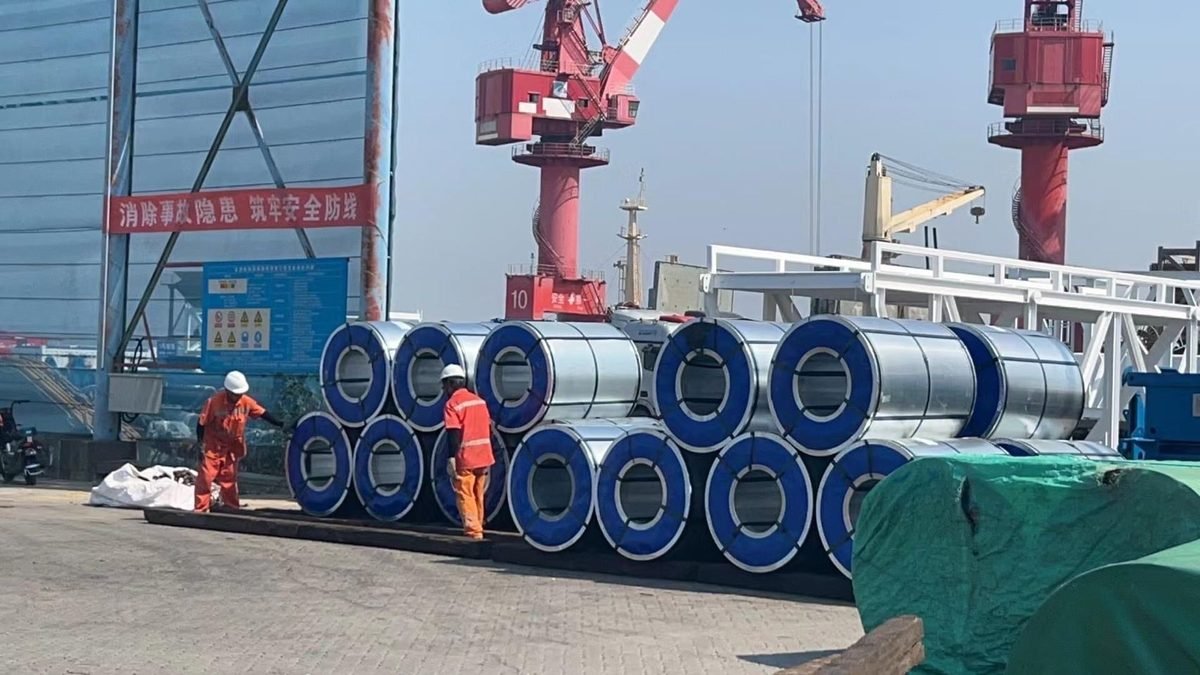
Dimensions, Tolerances and Supply Forms
Z275 coil is ordered by thickness, largeur, classe de revêtement, surface treatment, spangle and coil weight. Thickness is usually 0.25–2.0 mm; width 600–1500 mm. The coil inner diameter is normally 508 mm ou 610 mm, and the coil weight is typically 2–10 tonnes. The tolerances follow EN 10143 or the equivalent standard, and the thickness tolerance applies to the steel base, not to the coating.
| Fonctionnalité | Gamme commune | Tolérance typique | Ordering note |
|---|---|---|---|
| Épaisseur | 0.25–2.0 mm | ±0.03–0.10 mm | State whether the gauge includes coating |
| Largeur | 600–1500mm | ±2 mm | Slit width may carry a burr allowance |
| ID de bobine | 508 ou 610 mm | — | Match the uncoiler mandrel |
| Poids de la bobine | 2–10 t | ±10% | Check crane and uncoiler capacity |
| Coating mass | 275 g/m² | Standard tolerance band | State minimum individual value if critical |
| Paillette | Normal / minimised | Visual standard | Minimised spangle is preferred for painting |
| Surface | Oiled / passivé / sec | — | Oil must be removed before painting |
| Bord | Mill edge or slit | — | Slit edge needs a clean burr |
Typical commercial windows for Z275 coil. Confirm the applicable tolerance standard and the coating test method on the order.
Coil weight and inner diameter are logistics decisions that become production problems if they are ignored. A 10-tonne coil may exceed the uncoiler capacity of a small roll-forming line; un 508 mm inner diameter will not fit a 610 mandrin mm sans adaptateur. A coil that is too light causes frequent line stops; a coil that is too heavy needs a crane and a coil car that the factory may not have. Specify the range, not only the nominal.
The surface treatment should also be explicit. Oiled coil is the default for export and long storage, but the oil must be removed before painting or adhesive bonding. Passivated coil has a thin chemical film that slows white rust, but the film can interfere with some paint pretreatments. Dry coil without oil or passivation is suitable for immediate processing in a dry factory, not for a long sea voyage.
How Z275 Coil Is Made
The substrate coil is pickled and cold rolled to the required thickness, then annealed to recrystallise the steel and to develop the formability needed for profiling. The annealed strip is cooled and passed through a continuous hot-dip galvanizing line. In the zinc pot, the strip enters a molten zinc bath at about 450–460 °C; the coating weight is controlled by air knives that wipe excess zinc from the surface.
The zinc bath contains aluminium, typically 0.15–0.25%, to suppress the formation of a thick brittle iron-zinc alloy layer. That layer is what gives adhesion, but if it grows too thick the coating flakes during bending. Line speed, bath temperature, strip temperature and aluminium content all affect the layer thickness. A coil that is made at the wrong combination can pass the coating mass test and still fail the bend test.
After the zinc pot, the strip is cooled, skin-passed and tension-levelled. The skin pass improves flatness, controls surface texture and adjusts mechanical properties slightly. Tension levelling removes shape defects from rolling and coating. The strip is then passivated, oiled or left dry, and wound into coils. The spangle is controlled by the cooling rate and by the addition of lead, antimony or other elements; minimised spangle is produced by rapid cooling or by a special bath chemistry.
The defects that most often cause complaints are white rust, zinc flaking, uneven coating mass, spangle variation and edge damage. White rust comes from moisture trapped between coil wraps; it is a storage and transport problem, not a coating defect. Flaking comes from excessive zinc-iron layer growth or from a tight bend. Uneven coating mass comes from air-knife set-up. Spangle variation comes from cooling or bath chemistry. Edge damage comes from handling and from inadequate edge protection.
Fabrication and Welding Rules
Z275 coil is sheared, fente, roll-formed, bent and stamped with conventional steel tooling. The zinc coating is softer than the steel and tends to smear on the tooling; use sharp dies, adequate clearance and a lubricant that is compatible with the subsequent paint or adhesive process. For a tight bend, the coating is the limiting factor, not the steel. A bend radius that is acceptable for uncoated DX51D may crack the zinc at the outside fibre.
Welding requires the zinc to be removed from the weld zone. Zinc boils at about 907 °C, below the steel melting point, and the vapour causes porosity, spatter and a health hazard. Grind or strip the coating back from the joint, weld with a process suitable for thin sheet, and restore the coating on the finished weld with a zinc-rich repair paint. Do not weld through the coating in a confined space without fume extraction.
Cut edges are the weak point of any galvanized part. The zinc protects a narrow cut edge by sacrificial action, but a wide edge or a sheared edge with a rough burr consumes the zinc faster. For a long-life roof or duct, specify a edge treatment or a paint system that covers the cut. Do not assume that the Z275 coating protects an exposed edge indefinitely.
Painting and adhesive bonding require a clean surface. Oil, passivation film, dust and zinc salts all reduce adhesion. Use a pretreatment appropriate to the coating: alkaline cleaning, rinsing, a conversion coating and a primer that is compatible with zinc. A paint system designed for carbon steel may not adhere to galvanized zinc, especially if the surface is passivated. Test the full system on a sample before production.
Selection Rules for Buyers
- Choose Z275 for exposed roofing, walling and ducting with moderate corrosivity. It gives a longer coating life than Z120 or Z40.
- Choose Z120 or Z40 for indoor parts and short-life applications. Heavier coating adds cost without benefit in a dry interior.
- Choose a structural grade if the part carries load. DX51D is a bending grade, not a structural grade.
- Choose minimised spangle for painted surfaces. A normal spangle shows through thin paint and can affect appearance.
- Choose zinc-aluminium or a paint system for coastal or severe service. Z275 alone is not a marine coating.
- Specify the coating test and the minimum individual value. The nominal class is not a guarantee of uniform coverage.
The service environment should be classified before the coating is chosen. A rural roof, an urban wall, an industrial plant and a coastal facade are four different corrosion categories. Z275 is a reasonable choice for the first two and a marginal choice for the third; for the fourth, a heavier coating or a different alloy system is usually needed. The cost difference between Z275 and a premium coating is small compared with the cost of replacing a roof.
Formability and coating weight interact. A heavy coating on a tight bend is more likely to flake than a lighter coating on the same bend. If the part is a complex profile with small radii, a Z275 coating may need a more ductile substrate or a post-form coating repair. Do not solve a forming problem by increasing the coating weight; that usually makes it worse.
Stockage, Handling and Installation
Store coils indoors, sur un sol sec, with ventilation around the coil. Condensation between wraps is the main cause of white rust. If a coil must be stored outdoors, keep it on a raised platform, cover it with a breathable cover and allow air to circulate; a sealed plastic sheet traps moisture and makes the problem worse. Do not stack coils directly on wet concrete.
Handle coils with edge protectors and a spreader beam. A fork lift that contacts the coil body can damage the zinc and create a corrosion site. When the coil is unwound, keep the strip clean and avoid dragging it over a dirty floor. For cut sheets, stack them with a slight tilt so that water runs off, and do not leave them in the rain before installation.
Pendant l'installation, avoid trapping water behind the panel. Use a ventilated cavity, a proper flashing detail and a drainage path. Cut edges should face downward or be covered by a flashing where possible. Fasteners should be galvanized or stainless and should not be a dissimilar metal that accelerates zinc consumption. Do not use copper or lead flashing in direct contact with galvanized sheet in a wet location.
Inspection after installation should look for scratches, cut edges, trapped moisture and dissimilar-metal contacts. A scratch that exposes the steel will start to red-rust if the surrounding zinc cannot protect it. Repair a deep scratch with a zinc-rich repair coating after cleaning. A small white-rust patch on a cut edge is normal; a heavy white deposit across the surface means water has been trapped and the coil should be investigated before the part is installed.
Idées fausses courantes
- “Z275 means 275 µm of zinc.” Non. C'est 275 g/m² total coating mass, à propos 19 µm par côté.
- “Big spangle means more zinc.” Spangle is a crystal appearance, not a coating mass measurement.
- “Galvanized steel never rusts.” The zinc is consumed over time; cut edges, scratches and trapped water will eventually rust.
- “Thicker zinc is always better.” A heavier coating can flake on tight bends and adds cost without benefit in a dry interior.
- “You can weld galvanized sheet without removing the zinc.” Zinc vapour causes porosity and is a health hazard; strip the coating first.
- “Any paint will stick to galvanized steel.” Zinc needs a compatible pretreatment and primer; a carbon-steel paint system may peel.
Inspection and Acceptance
Receiving inspection for Z275 coil should cover grade and coating class, épaisseur, largeur, coil ID and weight, surface treatment, spangle and coating test results. Check the certificate for the substrate grade and the coating mass; a coil marked Z275 without a test value is not enough for a long-life project. Measure thickness at several points across the width and check the coil edges for damage.
Inspect the surface under good light for white rust, dark patches, rayures, roll marks and uneven spangle. A light oil film is normal; a heavy, sticky oil film may be a storage problem. Check the coil wrap for condensation and for water stains. If the coil has been in transit for a long time, unwrap a few wraps and inspect before accepting; white rust can develop inside a coil that looks perfect from the outside.
For a formed part, check the coating at the bend and at the cut edge. A bend test on a sample from the coil is the best early warning of flaking. A tape test or a visual check after bending will show whether the coating has detached. Si la pièce sera peinte, run a full pretreatment and paint sample before releasing the coil; adhesion failures often appear only after a cure and a bend.
Foire aux questions
What does Z275 mean on a galvanized coil?
It means a total zinc coating mass of 275 g/m² across both surfaces, à propos 137.5 g/m² or 19 µm par côté.
What steel grade is under Z275?
Usually DX51D, a low-carbon bending grade. Structural applications need a grade with a guaranteed yield strength, such as S250GD or S280GD.
Can Z275 be used outdoors?
Oui, for roofing, walling and ducting in moderate atmospheres. It is not a marine coating and needs a paint system for coastal or severe service.
Can Z275 be welded?
Oui, but the zinc must be removed from the weld zone first. Zinc vapour causes porosity and is a health hazard.
What causes white rust on galvanized coils?
Moisture trapped between wraps during storage or transport. It is a storage problem, not a coating defect.
Is minimised spangle better than normal spangle?
For painted surfaces, Oui. Minimised spangle gives a smoother, more uniform paint appearance. For unpainted roofing, normal spangle is acceptable.
Need Z275 galvanized steel coil with a coating test certificate and export packing?
QIDAMT supplies galvanized coil, strip and tube from Liaocheng, with coating mass verification, slit-width service and export packing. Envoyer l'épaisseur, largeur, classe de revêtement, surface treatment and quantity for a quotation.