 PROGRÈS
Galvanized Steel Strip: Largeur, Coating and Applications Guide
Galvanized Steel Strip: Largeur, Coating and Applications Guide
Galvanized steel strip is the quiet workhorse of the metal industry. Most buyers never see it — it is inside cable trays, strapping bands, furniture channels, hose clamps and light-gauge framing. But when you need it, the specification is easy to get wrong: largeur, thickness and coating class all interact, and a mistake means a coil that cannot run on your line. This guide covers how strip is made, what the key parameters mean, and how to order it correctly.
How Galvanized Strip Is Produced
Galvanized strip starts as a wide hot-dip galvanized coil, usually DX51D+Z, produced on a continuous galvanizing line. The wide coil is then slit into narrow widths on a slitting line — from 10 mm up to about 600 mm — and rewound into compact coils for delivery. Because the strip is coated before slitting, the process is fast and economical, and the coating is perfectly uniform across the original width. Notre galvanized steel strip follows exactly this route, with the same DX51D+Z chemistry and Z-class options as full-width galvanized coil.
Reading a Strip Specification
A complete strip specification has four parts: width × thickness, coating class, edge condition, and coil weight. “50 × 1.2 mm, Z120, slit edge, 3 t coils” means a 50 mm wide strip, 1.2 mm thick, with a Z120 zinc coating, square cut edges, delivered in coils of about 3 tonnes. The two edges to watch are the coating class (see our separate galvanized sheet guide on Z classes) and the edge condition — slit edges are standard, but edge trimming removes burrs when the strip feeds a stamping or roll-forming press.
Width and Thickness Limits
| Parameter | Standard range | Note |
|---|---|---|
| Largeur | 10 – 600 mm | Slit to exact width |
| Épaisseur | 0.20 – 4.0 mm | Thinner = tighter tolerance |
| enrobage | Z40 – Z275 | Indoor to coastal duty |
| Coil ID / DEPUIS | IDENTIFIANT 508 mm / OD ≤ 1250 mm | Fits standard uncoilers |
| Poids de la bobine | ≤ 12 t | Split on request |
Typical Applications
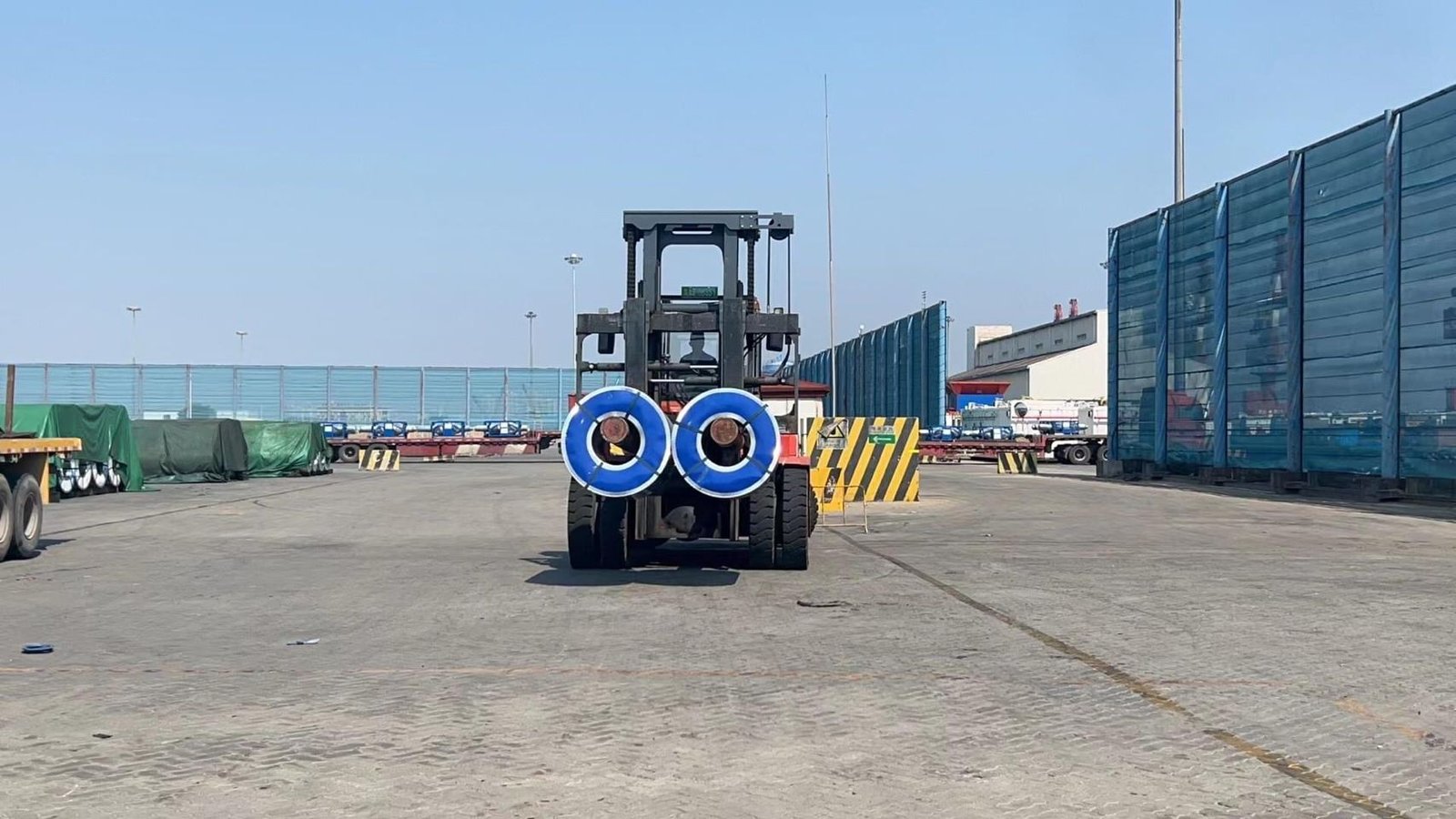
Galvanized strip is consumed by five big industries. Cable tray and raceway makers roll strip into side rails and rungs; strapping producers slit it into banding for packing and bundling; roll-formers turn it into purlins, studs and light-gauge sections; the furniture industry draws it into desk and shelf channels; and fastener companies punch it into hose clamps, clips and ties. In all of these, the two properties that matter most are dimensional consistency — the line cannot tolerate width wandering — and coating adhesion, because tight bends and punches will expose the steel if the zinc does not hold.
Ordering Checklist
Before you send an inquiry, decide the five points: exact width and thickness in millimetres; coating class (Z120 is the most common export choice; Z275 for outdoor service); edge condition (slit vs trimmed); coil weight and inner diameter to match your uncoiler; and quantity in tonnes. If the strip will be painted or formed into tight bends, say so — we can supply skin-passed or zero-spangle surface for a smoother paint finish. For full-width flat products the same chemistry applies to galvanized sheet.
Every strip coil ships with a mill test certificate confirming chemistry, coating weight and dimensions, so your incoming inspection can verify the delivery in minutes.