 QIDAMT
2205 Duplex Stainless Steel Coil: PREN, Yield Strength and Welding
2205 is a duplex stainless steel: roughly half austenite and half ferrite, with about 22% chromium, 5% nickel, 3% molybdenum and 0.15% nitrogen. The duplex structure gives it roughly twice the yield strength of 316L and much better resistance to chloride stress corrosion cracking, which is why it is used for tanks, pipelines, marine structures and chemical equipment. This guide covers the UNS S32205 / EN 1.4462 composition, PREN calculation, mechanical limits, coil dimensions, annealing, welding and the temperature range where 2205 should not be used.
What 2205 Duplex Coil Is
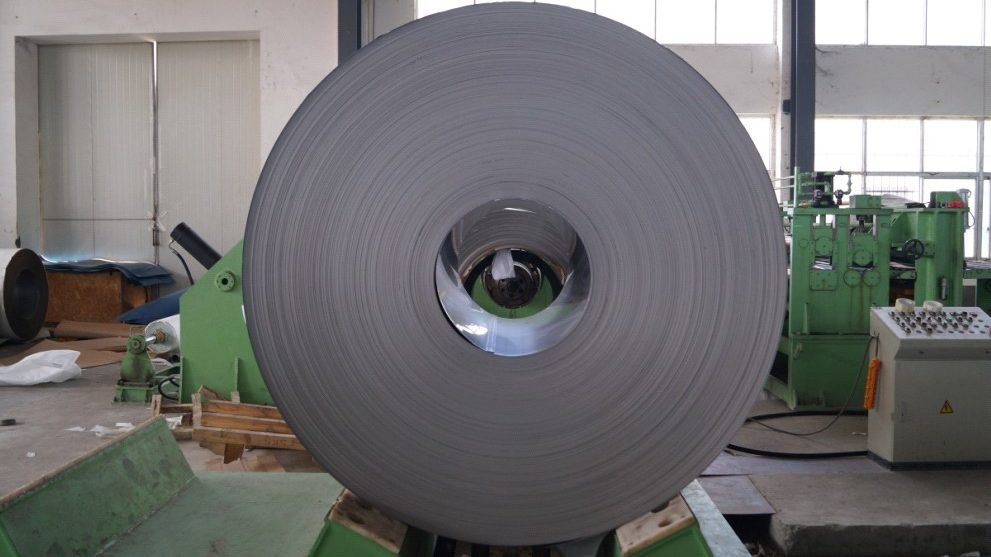
2205 is the most widely used duplex grade. It is supplied as hot-rolled or cold-rolled coil, plate, bar and tube. In coil form it is used for slit strip, welded tube, tank shells, heat exchanger shells, structural profiles and clad components.
The two-phase microstructure is the point. Austenite gives toughness and weldability; ferrite gives strength and resistance to chloride stress corrosion cracking. A correct 2205 has roughly equal phase balance, typically 40 – 60% ferrite, checked by metallography or by magnetic response.
- Chemical and petrochemical tanks, reactors and pipework
- Desalination and seawater cooling systems
- Flue gas desulphurisation scrubbers and ducting
- Marine structures, mooring equipment and shipboard piping
- Pulp and paper digesters, bleach plant equipment
- High-strength structural components where 316L is too weak
Chemical Composition and PREN
| Element | UNS S32205 (%) | EN 1.4462 (%) | Role |
|---|---|---|---|
| Chromium (Cr) | 22.0 – 23.0 | 21.0 – 23.0 | Passive film; pitting resistance |
| Nickel (Ni) | 4.5 – 6.5 | 4.5 – 6.5 | Austenite balance; toughness |
| Molybdenum (Mo) | 3.0 – 3.5 | 2.5 – 3.5 | Chloride pitting resistance |
| Nitrogen (N) | 0.14 – 0.20 | 0.10 – 0.22 | Austenite balance; strength; PREN |
| Carbon (C) | ≤ 0.030 | ≤ 0.030 | Low carbon for weldability |
| Manganese (Mn) | ≤ 2.00 | ≤ 2.00 | Austenite former |
| Silicon (Si) | ≤ 1.00 | ≤ 1.00 | Deoxidation |
| Phosphorus (P) | ≤ 0.030 | ≤ 0.030 | Impurity |
| Sulphur (S) | ≤ 0.020 | ≤ 0.020 | Impurity; control for weldability |
The pitting resistance equivalent number (PREN) is calculated as PREN = %Cr + 3.3 × %Mo + 16 × %N. For 2205 the result is normally 34 – 36, compared with about 26 – 28 for 316L and 40+ for 904L or super duplex grades. PREN is the first filter when comparing stainless grades for chloride service, but it is not a service-life guarantee: temperature, crevices, deposits and weld quality all matter.
A 2205 heat with chromium and molybdenum at the bottom of the range and nitrogen below 0.14 can fall under PREN 34, which narrows the gap to 316L. Ask for the PREN on the certificate when the application is seawater or chloride-rich.
Mechanical Properties
| Property | Minimum (solution annealed) | Comment |
|---|---|---|
| Yield strength Rp0.2 | ≥ 450 MPa | About twice 316L |
| Tensile strength Rm | ≥ 620 MPa | Design advantage in thin sections |
| Elongation A5 | ≥ 25% | Adequate for forming, less than austenitic grades |
| Hardness | ≤ 293 HBW (≈ 31 HRC) | Higher readings suggest poor annealing |
| Impact energy (20 °C) | ≥ 40 J typical | Drops sharply below −40 °C |
| Ferrite content | 40 – 60% | Check on the coil, not only the heat certificate |
The high yield strength lets a 2205 tank shell be thinner than a 316L shell for the same design pressure, which partly offsets the higher price per kilogram. The lower elongation means forming limits are tighter: 2205 bends well but does not deep draw like 304.
Coil Dimensions and Tolerances
| Item | Range | Notes |
|---|---|---|
| Thickness | 0.3 – 6.0 mm (cold rolled); 3 – 20 mm (hot rolled) | Confirm route for the gauge |
| Width | 600 – 1,500 mm | Slit to width on request |
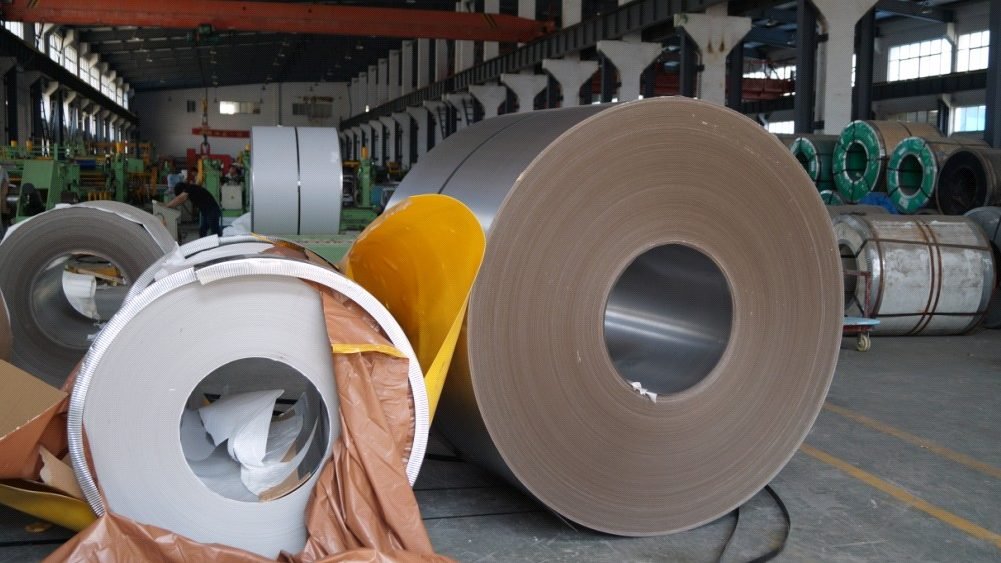
| Coil ID | 508 / 610 mm | State uncoiler mandrel |
| Coil weight | 3 – 10 t | Limited by crane and container |
| Thickness tolerance | ±0.05 mm typical (cold rolled) | Tighter by agreement |
| Edge | Slit or mill edge | Slit edge deburred for welding |
| Surface | 2B, No.1, BA | Pickled and passivated after annealing |
Mill Processing: Annealing Is the Grade
2205 is solution annealed at 1,020 – 1,100 °C and then water quenched. The quench is not optional: slow cooling through 600 – 900 °C precipitates sigma phase, a brittle intermetallic that destroys toughness and corrosion resistance. A coil that has been annealed at the low end of the range, or cooled in air, can pass a chemistry check and still fail a bend test.
- Ask for the annealing temperature and quenching method on the mill certificate.
- Avoid buying 2205 that has been re-annealed in a local furnace without a controlled quench.
- Sigma phase is not visible to the eye; it shows up as low impact energy, high hardness and poor corrosion resistance.
- 475 °C embrittlement occurs after long exposure around 300 – 500 °C; the grade is not for continuous service above about 300 °C.
Welding 2205
Welding is where most 2205 failures start. The weld and heat-affected zone must retain roughly balanced ferrite and austenite, without sigma or excessive ferrite. That requires the right consumable, heat input and shielding gas.
| Variable | Recommended practice | Why |
|---|---|---|
| Filler | ER2209 (matching), or 22Cr duplex consumable | Balances weld metal chemistry |
| Heat input | 0.5 – 1.5 kJ/mm | Too high promotes sigma; too low promotes ferrite |
| Interpass temperature | ≤ 150 °C | Controls cooling rate |
| Preheat | None | Preheating is not needed and can hurt |
| Shielding gas | Ar + 2 – 3% N2 for root; Ar for cap | Nitrogen restores austenite in the root |
| Root purge | Argon or forming gas | Prevents oxidation and nitride loss |
| Post-weld | Pickle and passivate; brush only with stainless tools | Restores passive film |
Avoid multipass welds with heavy weaving. Use stringer beads, keep the joint design open enough for access, and do not weld 2205 to carbon steel without a qualified transition. After welding, the heat tint must be removed: it is not a cosmetic issue, it is a corrosion initiation site.
Forming, Cutting and Machining
- 2205 work-hardens faster than 304; allow larger bend radii and more springback.
- Cold rolling to thin gauges requires intermediate annealing; a coil rolled too far without annealing will crack.
- Cut with plasma, waterjet or mechanical shear; grind the cut edge before welding.
- Machining is feasible but generates heat; use sharp tools, generous feed and coolant, and avoid dwelling.
- Do not pick with carbon steel tools or brushes; iron contamination rusts on the surface.
Selection Rules
2205 or 316L?
Choose 2205 when chloride stress corrosion cracking is the governing risk, when the design needs higher yield strength in a thin wall, or when the chloride concentration and temperature exceed what 316L tolerates. Stay with 316L for mild indoor chemical service, food equipment and applications where the lower cost and easier welding outweigh the corrosion margin.
2205 or super duplex?
Super duplex (2507, PREN 40+) is for hotter, more concentrated chloride service and for higher pressure. It costs more and is harder to weld. 2205 covers most ambient seawater and chemical tank duties; 2507 is for the cases where 2205 shows pitting or crevice corrosion in service.
Temperature limits
Do not use 2205 for continuous service above about 300 °C. Above that, 475 °C embrittlement and sigma formation reduce toughness, and the corrosion advantage is no longer the design driver. For high-temperature sulphidation or oxidation, austenitic 310S or nickel alloys are the correct family.
Corrosion Performance in Chloride Service
The reason 2205 exists is chloride stress corrosion cracking. Austenitic grades such as 304 and 316L crack under tensile stress in warm chloride environments — swimming pool ceilings, seawater heat exchangers, coastal soffits — often at chloride levels well below what causes visible pitting. Duplex resists SCC because the ferrite phase interrupts the crack path and because the higher chromium, molybdenum and nitrogen content raises the pitting resistance.
| Property | 2205 typical | 316L typical | Practical meaning |
|---|---|---|---|
| PREN | 34 – 36 | 26 – 28 | Chloride pitting resistance |
| Critical pitting temperature (ASTM G48) | ≈ 50 – 60 °C | ≈ 20 – 25 °C | Above this, pitting is likely |
| Critical crevice temperature | ≈ 25 – 35 °C | ≈ 10 – 15 °C | Crevices are the weak point |
| SCC threshold in chloride | Much higher than 316L | Low in warm chloride | Why duplex is chosen |
Typical test values for solution-annealed material with a balanced microstructure; welded and creviced conditions are worse.
PREN and CPT are screening tools, not guarantees. A 2205 tank that holds seawater at 60 °C with a sediment layer on the bottom can still pit under the deposit, because the deposit creates a crevice and a local chemistry that the bulk analysis does not describe. Design for drainage and cleaning, not only for alloy selection.
Quality Tests: ASTM A923 and Phase Balance
A 2205 certificate that lists only chemistry and tensile results is incomplete. The properties that make duplex work are microstructural, and they are verified by three tests grouped in ASTM A923:
- Method A — sodium hydroxide etch test to detect sigma phase and other intermetallic precipitation.
- Method B — Charpy impact test to confirm toughness after the specified heat treatment.
- Method C — ferric chloride corrosion test to confirm pitting resistance of the finished product.
- Phase balance — 40 – 60% ferrite by point count or magnetic measurement; a large imbalance suggests wrong annealing or welding.
For a coil order, ask for the annealing temperature, the quench method and at least one of these test results. For welded pipe or tanks, ask for a procedure qualification with a cross-weld microstructure check, not just a bend test.
Typical Design Details That Decide Service Life
- Drain every low point; standing chloride water is the most common cause of pitting in duplex tanks.
- Avoid crevices at support pads, gasket faces and weld toes; crevice corrosion starts where the environment stagnates.
- Use compatible gaskets — PTFE or graphite — and avoid chlorinated rubber or graphite-free compounds that degrade.
- Do not over-insulate a hot line and then let it cool with condensate trapped inside the cladding.
- Keep the surface clean; grinding dust and iron particles from carbon steel work cause rust spots that look like base-metal failure.
Case: Seawater Cooling and Desalination
A seawater cooling loop is the classic 2205 application. Carbon steel corrodes rapidly, 316L suffers crevice corrosion under deposits and SCC in warm sections, and super duplex or titanium costs far more. 2205 handles ambient seawater in a properly designed loop, provided the velocity stays above about 1 m/s to prevent sediment and biological deposits, and below about 3 – 4 m/s to avoid erosion of the passive film.
The design details matter more than the alloy: drain the loop when idle, avoid dead legs where seawater can stagnate, keep gasket faces narrow and clean, and do not hydrotest with chlorinated water and leave it standing for weeks. A 2205 tube that fails in service is usually a tube that sat wet and stagnant, not a tube that was the wrong grade.
Fabrication Sequence for Tanks and Shells
- Cut and form the shell, allowing for springback and for the lower elongation of duplex.
- Fit-up with minimal gap; a wide gap needs more weld metal and more heat.
- Weld with ER2209, controlled heat input and nitrogen-bearing root shielding.
- Cool between passes; do not quench a hot weld with water.
- Pickle the weld and heat tint with a duplex-safe acid, then passivate.
- Hydrotest with clean water and drain immediately; do not leave chlorinated test water in the tank.
Ordering Checklist
- UNS S32205 or EN 1.4462, with the standard stated on the order
- Thickness, width and coil ID, plus metres or tonnes
- PREN minimum and ferrite balance requirement
- Annealing temperature and quench method on the certificate
- ASTM A923 Method A/B/C results as applicable
- Surface finish: 2B, No.1, pickled and passivated
- Welding consumable and procedure if fabrication is included
Common Mistakes
- Buying on PREN alone and ignoring the annealing and quench record.
- Welding with 308L or 316L filler, which gives a ferrite-poor or unbalanced weld.
- Leaving heat tint on the weld and expecting the parent metal corrosion resistance.
- Using carbon steel wire brushes and grinding discs, then finding rust spots.
- Designing a 316L-thickness shell in 2205 without re-checking stiffness and buckling.
- Storing the coil wet with carbon steel straps in contact.
Availability and Price Drivers
2205 coil is priced off the nickel, molybdenum and chromium content, so the alloy surcharge moves more than the base conversion cost. Molybdenum is the volatile element: a rise in the molybdenum price can add more to the tonne price than a change in the mill’s rolling margin. That is why a 2205 quotation is usually valid for a shorter period than a carbon steel quotation.
- Ask for the alloy surcharge to be shown separately from the conversion cost.
- Confirm whether the price is based on actual heat chemistry or on the standard minimum.
- For repeat orders, fix the surcharge mechanism rather than the total price.
- Thin cold-rolled coil has a different conversion cost from hot-rolled plate; do not compare them per tonne.
One more cost factor is the test package. A 2205 order with ASTM A923, ferrite count and third-party inspection adds cost, but it protects the buyer: the failure mode of duplex is often invisible on a chemistry certificate, and the tests are the only practical way to catch a bad anneal before fabrication. For a first order or a new mill source, include them; for a repeat source with a stable record, a reduced package is reasonable.
Frequently Asked Questions
Is 2205 magnetic?
Yes, noticeably. The ferrite phase is magnetic, so a magnet sticks. This is normal and is not a sign of the wrong grade.
Can 2205 replace 316L in seawater?
For many ambient seawater duties, yes, because it resists chloride stress corrosion cracking far better. It is not immune to crevice corrosion, so gasket and support details still matter.
What filler should be used for 2205?
ER2209 matching filler, with controlled heat input and interpass temperature. Using austenitic 316L filler is a common and costly mistake.
Does 2205 need post-weld heat treatment?
No. Solution annealing after welding is impractical on site and would distort the part. The correct approach is controlled heat input, balanced filler and pickling/passivation.
What is the maximum service temperature?
About 300 °C for continuous service. Above that, 475 °C embrittlement and sigma formation become significant.
Do you supply 2205 coil slit to width?
Yes. Send thickness, width, coil ID, surface finish and quantity; we slit and pack with interleaving for export.
Related Products on QIDAMT
Need 2205 duplex coil with a PREN and annealing record?
Send thickness, width, PREN requirement and service environment. We confirm mill source, certificate and delivery within 24 hours.