 进步
定制滚压成型不锈钢型材: 带材宽度, 回弹和公差
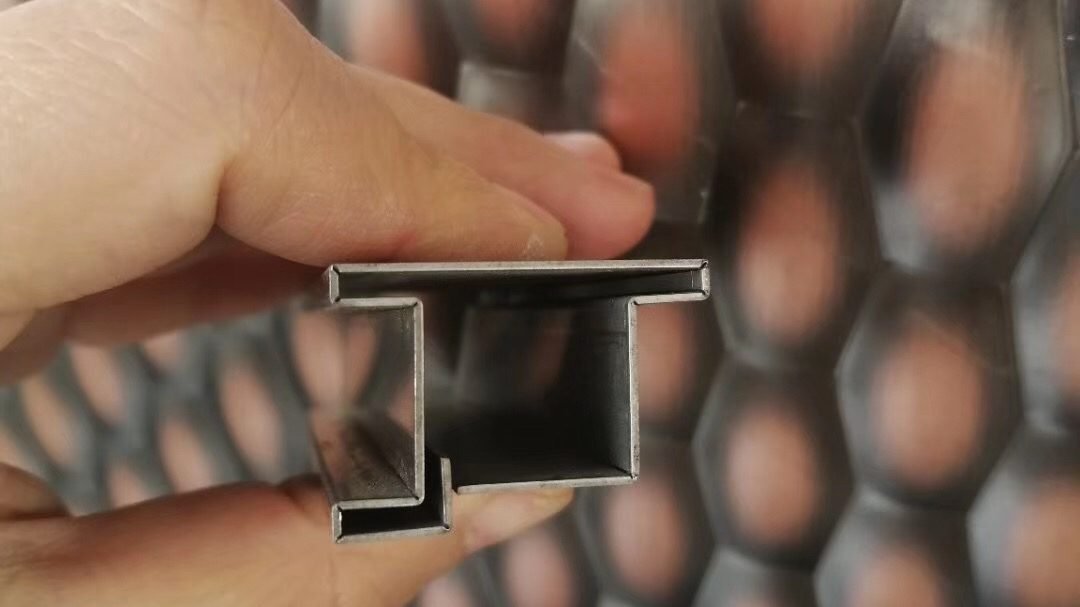
A custom roll-formed stainless profile is a 304 section produced by feeding stainless strip through a series of rotating rolls that bend it progressively into a U, C, hat, Z or bespoke shape. It is a cold-forming process, so the section is uniform over the whole coil length, the surface is unmarked by heat, and the cost per metre falls sharply as the run length rises. The engineering difficulty sits in three places: the developed strip width, the springback that decides whether the angles come out right, and the tolerances that a roll-formed section can realistically hold.
What a Roll-Formed Stainless Profile Is
The process starts with a coil of 304 条, slit to the developed width of the finished section. The strip passes through a set of roll stands, 通常 8 到 20 pairs, each of which bends the strip a little further toward the final shape. Between stands the strip is supported by side guides and, for complex sections, by a mandrel or a shaping insert. At the end of the line a flying shear or a cut-off die cuts the profile to length.
The product is distinct from a press-braked section in four ways. 第一的, length is limited only by the coil, 所以 6 米, 12 m or coil-fed lengths are normal. 第二, the section is identical along the whole length because every metre passes the same rolls. 第三, the strip surface is not touched by a punch or a die face, so a 2B or a No. 4 finish survives the process largely intact. 第四, the tooling is dedicated: a set of rolls for one section costs far more than a press-brake setup, which is why roll forming becomes economic only above a certain quantity.
Typical uses include:
- C and U sections for stainless framing, cladding supports and cable tray rails.
- Hat and Z sections for roof and facade substructure, where the profile carries wind load and provides a fixing plane.
- Bespoke edge trims, capping and corner profiles for architectural metalwork.
- Roll-formed sections for equipment frames, conveyor rails and clean-room partitions.
Grade and Strip Properties
年级 304 is the standard choice for roll-formed stainless profiles. Its elongation of about 40 % in the annealed condition allows the strip to be bent to a tight radius without cracking, and its work-hardening rate is moderate, so the section does not become brittle after a dozen forming stands. Grades with lower nickel, 例如 201, are cheaper but work-harden faster and are more prone to edge cracking in tight bends; 316L is used where chlorides are present.
| 元素 | 304 范围 (%) | Relevance to roll forming |
|---|---|---|
| C | ≤ 0.08 | Higher carbon raises strength and lowers bendability; edge cracking in tight radius |
| 铬 | 18.0 – 20.0 | 耐腐蚀; low Cr shows as staining on stored profiles |
| 在 | 8.0 – 10.5 | 奥氏体稳定性; low Ni increases martensite and springback scatter |
| 锰 | ≤ 2.00 | 奥氏体前体; balances sulphur |
| 和 | ≤ 1.00 | Too high causes scale and roll marking |
| 磷 | ≤ 0.045 | 隔离; cracking at sheared edges |
| S | ≤ 0.030 | Inclusions act as crack initiators in bending |
| 铁 | 平衡 | 矩阵 |
Composition to EN 10088-2 / ASTM A240; the strip certificate should be checked against the coil number.
Two strip properties matter more than the certificate: 脾气和边缘状况. Roll forming is done from annealed, skin-passed strip in the 2B or 2D finish, not from full-hard strip, because the bend radius required would be too large. The slit edges must be burr-free; a burr on the outside edge becomes a crack initiator at the first forming stand, and a burr on the inside edge marks the roll. Specify deburred, square-cut edges and check the coil ends before loading.
Mechanical Properties and Bend Radius
退火 304 strip at 0.5–3 mm has a tensile strength of 515–700 MPa, A 0.2 % proof stress of about 205 MPa and elongation of 40 % or more. The minimum bend radius depends on thickness and temper, and it is the first thing to check when a designer draws a sharp corner.
| 厚度 (毫米) | Minimum inside bend radius, 退火的 (t) | Minimum inside radius, 半硬 (t) | 笔记 |
|---|---|---|---|
| 0.5 – 0.8 | 0.5 – 1.0 | 1.5 – 2.0 | Tight radii need a shaped insert, not a simple roll |
| 0.8 – 1.5 | 1.0 – 1.5 | 2.0 – 2.5 | Standard for framing sections |
| 1.5 – 2.5 | 1.5 – 2.0 | 2.5 – 3.0 | Flange height should be ≥ 3 × thickness |
| 2.5 – 3.0 | 2.0 – 2.5 | 3.0 – 4.0 | Check roll load and motor capacity |
Indicative minimum bend radii for 304 条; tight radii and high-strength tempers require trial forming.
A bend radius below about half the thickness is not a roll-forming operation at all; it is a coining or a wiping operation, and it will mark the surface and thin the bend. If the design calls for a sharp corner, the honest options are to increase the radius, to use a thinner strip, or to accept a press-braked section instead. Stretching the bend also matters: the outside surface of a 90° bend at a 1 t radius elongates by roughly 30 %, which is well within 304’s elongation but reduces the remaining ductility for any subsequent forming.
Developed Strip Width and Section Geometry
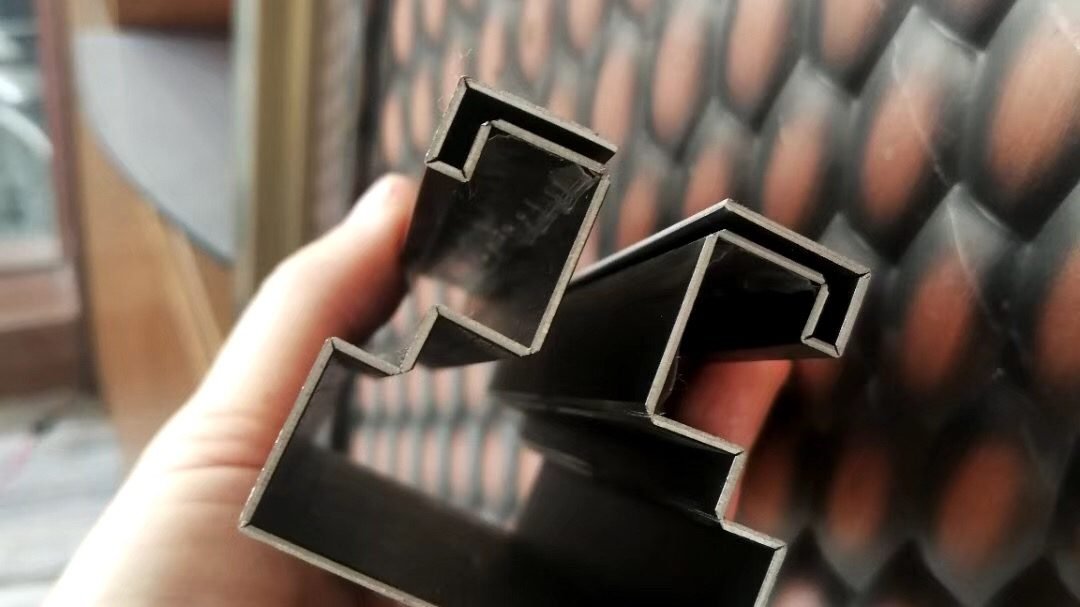
The strip width is the sum of the developed lengths of every leg, calculated on the neutral axis, plus allowance for the bend arcs. For a simple U section with a web w, two flanges f and two 90° bends of inside radius r at thickness t, the developed width is approximately:
W = w + 2f − 4(r + t) + 2 × (π/2)(r + 0.5t) — which simplifies in practice to the sum of the flat lengths plus the arc lengths at the neutral line. The exact value is calculated by the tool designer and then corrected on the first trial run, because the neutral axis shifts with the bend radius and the actual material.
| 部分 | Key dimensions | Typical strip width | 笔记 |
|---|---|---|---|
| U / C | 网络 50, flange 25, t 1.2, r 1.5 | ≈ 96 毫米 | 添加 2 mm for edge trim if the flange height is critical |
| Hat | 网络 60, flange 30, return 15, t 1.0, r 1.2 | ≈ 145 毫米 | Return legs need a shaped roll pass |
| Z | 网络 80, flange 40, t 1.5, r 2.0 | ≈ 155 毫米 | Check twist after forming; Z sections are prone to it |
| Custom capping | As drawing | Calculated per bend | Trial coil of 100 m is normal before production |
Illustrative widths only; the tool designer’s calculation governs and must be confirmed by a trial length.
Springback and Angle Control
Every bend springs back when the forming force is released, because the outer fibres have been stretched elastically and want to recover. 为了 304 在 1 毫米, a 90° bend formed over a 1.5 mm radius typically springs back 2–4°; 在 2.5 mm and a 2 mm radius the springback can reach 5–7°. The tool designer compensates by over-bending: the roll is set to form 94° so that the strip relaxes to 90°.
Springback is not constant. It varies with yield strength, 厚度, radius and the amount of cold work already in the strip, so a coil at the top of the tensile range will produce angles 1–2° tighter than a soft coil. This is why a roll-formed profile is specified with an angle tolerance rather than a nominal angle, and why changing coil suppliers mid-run requires a roll adjustment.
Thickness variation is the largest single cause of angle drift. A strip that runs 0.05 mm over nominal on a 1.0 mm section is 5 % 较厚, and the springback changes accordingly. If the finished profile is angle-critical, specify a thickness tolerance of ± 0.03 mm and check it at the coil head, middle and tail. The second cause is the strip edge: a burr or a cambered edge pulls the section to one side and produces a twist that no roll adjustment can remove.
Tolerances Achievable in Roll Forming
Roll-formed tolerances are governed by EN 10162 for cold-rolled steel sections; stainless profiles are usually specified by agreement on the same pattern. The table below gives values that a competent tool can hold without special measures.
| 特征 | 典型公差 | 评论 |
|---|---|---|
| Web width | ± 0.5 毫米 ≤ 100 毫米; ± 1.0 上方毫米 | Measured across the flat, away from bends |
| Flange height | ± 1.0 毫米 | Affected by strip width and edge trim |
| Bend angle | ± 1.5° for 90° bends | Springback scatter; tighter needs in-line gauging |
| 厚度 | As strip tolerance, typically ± 0.05 毫米 | Not changed by forming |
| 长度 | ± 2 mm cut length; ± 5 mm for long lengths | Flying shear accuracy |
| 直线度 (bow) | ≤ 1.5 毫米/米 | Corrected by roll alignment and straightener |
| 捻 | ≤ 1° per metre | Worst on Z and asymmetric sections |
| 切割垂直度 | ≤ 1 毫米每 100 mm of web | Cut-off die condition |
Indicative capabilities for 304 profiles at 0.5–3 mm; confirm with the tool shop for the specific section.
工装, Run Length and Cost
Roll tooling for a stainless profile is a real investment: 8–20 stands, each with a pair of hardened rolls, plus side guides, a straightener and a cut-off. The cost is recovered over the run, so the economics are simple: below a few hundred metres, press braking is cheaper; above a few thousand metres, roll forming wins because the cycle time per metre is short and the labour per metre is almost nil.
Stainless is harder on tooling than carbon steel. It work-hardens, it galls, and it wears a roll edge quickly if lubrication is poor. Tool steel with a hard chrome or PVD coating, generous lubricant flow and a roll gap that is checked every few thousand metres are the practical countermeasures. A tool that runs carbon steel without trouble will mark 304 within a few hundred metres unless the lubricant and the roll finish are upgraded.
For a first run, ask for a trial length of 100–200 m and inspect it before the rest of the coil is processed. The trial shows the actual springback, the twist, the surface condition and the cut quality, and it is far cheaper to adjust a roll stand than to scrap a full coil.
Selection and Purchase Checklist
- 年级: 304 for general and food service; 316L for chloride exposure; 201 only where corrosion demand is low and cost dominates.
- 脾气: annealed and skin-passed for forming; never full hard unless the section is almost flat.
- Thickness and tolerance: fix both, and state the measuring position; thickness drift is the main cause of angle drift.
- Developed width: let the tool shop calculate it and confirm with a trial length; do not derive it from a CAD flatten without bend allowance.
- 弯曲半径: keep inside radius ≥ 1 t for 90° bends; below 0.5 t the process changes and the surface suffers.
- 宽容: quote web, flange, 角度, straightness and twist separately, because they fail independently.
- Length and cut: state the cut tolerance and whether the ends must be deburred or square.
- 表面: state the finish (2乙, 不. 4, 学士) and whether roll marks are acceptable on the visible face.
- 包装: nested bundles with edge protection, because a roll-formed section dents easily at the flange tip.
Where the profile becomes part of a larger stainless assembly, ordering the strip and the flat product from the same source simplifies traceability. 启达美特用品 304 2B cold-rolled sheet for the flat components and 316L板 where the environment demands it.
常见错误
- Flattening the section in CAD and calling that the strip width. Without bend allowance the blank is short and the flanges come out undersize.
- Designing a sharp 90° corner at 0.5 t radius. The bend will mark, thin and possibly crack; increase the radius or change the process.
- Specifying a nominal angle with no tolerance. Springback scatter guarantees that some lengths will be outside a nominal-only callout.
- Changing coil supplier mid-run without a roll adjustment. A harder coil forms tighter angles and the section drifts out of tolerance.
- Ignoring twist on Z and hat sections. Twist is not visible on a short sample and only shows when the profiles are stacked or installed.
- Running stainless on tooling set up for carbon steel without upgrading lubrication. Galling and roll marking appear within a few hundred metres.
常见问题解答
What is the minimum quantity for a custom roll-formed profile?
It depends on the tool cost. As a rule of thumb, a simple U or C section becomes economic at a few hundred metres and clearly cheaper than press braking above 2–3 km. Complex hat or Z sections with several stands need a longer run to justify the tooling.
Can roll forming produce a sharp corner?
不. Roll forming needs a bend radius of roughly one thickness or more for 90° bends in 304. A sharper corner requires coining or wiping, which marks the surface and thins the bend; a press-braked section is usually the better route.
How much springback should I expect?
为了 1 毫米 304 在一个 1.5 毫米半径, about 2–4° on a 90° bend; 为了 2.5 mm at a 2 毫米半径, 5–7°. The tool over-bends to compensate, and the residual scatter is covered by the angle tolerance.
Why does the profile twist?
Asymmetric sections, cambered strip, burrs on one edge and uneven roll gaps all produce twist. A straightener and balanced roll gaps correct most of it, but a Z section will always need more attention than a U section.
Is the 2B finish preserved through roll forming?
Largely, 是的, because the rolls contact the strip over a small area and do not slide. Roll marks can appear at the bend lines if the roll surface is worn or the lubricant is insufficient; specify whether the visible face must be mark-free.
How long can a roll-formed profile be supplied?
Length is limited by handling and transport, not by the process. 6 m is standard, 12 m is common for structural sections, and coil-fed lengths are possible if the customer can handle them.
Have a custom stainless section to develop?
Send the drawing, 厚度, grade and annual quantity; we will review the strip width and tooling feasibility.

