 PROGRESSO
Copper Plate C11000 vs C12200: Electrical vs Plumbing Grade
Copper Plate C11000 vs C12200: Electrical vs Plumbing Grade
Two copper plate grades dominate general engineering supply: C11000 electrolytic tough pitch (ETP) and C12200 deoxidized high phosphorus (DHP). They look identical in the warehouse, share the same density and the same reddish colour, and are frequently quoted interchangeably by suppliers who should know better. The difference is 0.02–0.04 % phosphorus — and that difference decides whether the plate is a good conductor or a good brazing substrate.
This guide sets out what each grade is, how the chemistry changes conductivity, strength and fabrication behaviour, which thicknesses and tolerances are normal for plate, and the failure modes that follow from specifying the wrong one. It is written for buyers and engineers working on busbar, switchgear, trocadores de calor, roofing and process equipment.
1. What Each Grade Is
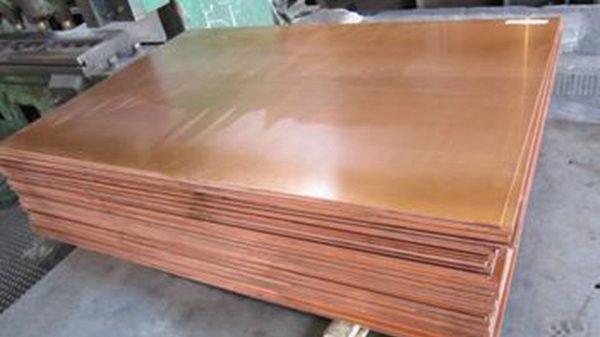
C11000 is electrolytic tough pitch copper: cathode copper melted and cast, with oxygen deliberately left in the metal at around 0.02–0.05 %. The oxygen combines with residual impurities and improves fluidity in casting, but it also means the metal contains copper oxide particles at the grain boundaries. That structure is harmless in the annealed condition and dangerous when the plate is welded or brazed in a hydrogen-bearing atmosphere, because hydrogen diffuses in and reacts with the oxide to form steam, which opens voids along the grain boundaries. The result is hydrogen embrittlement — a joint that looks sound and cracks when it cools or when it is bent.
C12200 is deoxidized high phosphorus copper. Phosphorus is added to the melt, it removes the oxygen, and 0.015–0.040 % remains in the solid metal. There is essentially no copper oxide in the structure, so the alloy can be brazed, welded and annealed in reducing atmospheres without embrittlement. The price is conductivity: the residual phosphorus scatters electrons, and conductivity drops to roughly 85 % SIGC.
Both are covered by ASTM B152 for plate, sheet and strip, by EN 1652 for general copper plate, and by GB/T 2040 in China. UNS numbers are C11000 and C12200 respectively; older trade names are ETP copper and DHP copper, or in some markets “phosphorized copper” for the second.
2. Chemistry and Its Consequences
| Elemento | C11000 ETP | C12200 DHP | Effect |
|---|---|---|---|
| Cu | 99.90 % min | 99.90 % min (Cu + P) | Base metal |
| Ó | 0.02–0.05 % typical | Not present | Oxygen decides weldability |
| P | Não especificado | 0.015–0.040 % | Deoxidation; lowers conductivity |
| Ag, Como, Bi, Sb | Trace limits | Trace limits | Conductivity scatter |
| Total impurities | 0.1 % máx. | 0.1 % máx. | Predictable properties |
A useful rule of thumb: todo 0.01 % of phosphorus costs roughly 1 % of conductivity. At the 0.03 % mid-point of the C12200 range, that accounts for most of the gap between 101 % e 85 % SIGC.
3. Electrical and Thermal Properties
| Propriedade | C11000 | C12200 |
|---|---|---|
| Condutividade | 100–101.5 % SIGC | 85 % IACS typical |
| Resistivity at 20 °C | 0.01724 Ω·milímetros²/eu | 0.0203 Ω·milímetros²/eu |
| Condutividade térmica | 385–395 C/(eu·K) | 335–345 C/(eu·K) |
| Densidade | 8.90 g/cm³ | 8.89 g/cm³ |
| Melting range | 1065–1083 °C | 1065–1083 °C |
| Thermal expansion | 17 × 10⁻⁶ /K | 17 × 10⁻⁶ /K |
The conductivity gap looks small in percentage terms and is large in busbar design. UM 100 milímetros × 10 mm C11000 bar carries about 19 % more current than the same bar in C12200 at the same temperature rise, or the same current at a lower rise. In a switchgear enclosure where heat is the limiting factor, that difference decides whether a design needs a larger bar or forced ventilation.
For heat transfer the gap is less important. In a brazed plate heat exchanger the wall resistance is a small part of the total, and the corrosion behaviour and brazing quality of C12200 are worth more than 15 % of conductivity.
4. Propriedades Mecânicas
| Temperamento | Nota | Tração | Colheita | Alongamento | Dureza |
|---|---|---|---|---|---|
| Annealed O60 | C11000 | 220–260 MPa | 70–90 MPa | 35–45 % | 40–50 Alta tensão |
| Half hard H02 | C11000 | 260–310 MPa | 180–240 MPa | 15–25 % | 65–80 Alta tensão |
| Hard H04 | C11000 | 310–380 MPa | 260–330 MPa | 3–10 % | 90–110 Alta tensão |
| Annealed O60 | C12200 | 220–250 MPa | 60–80 MPa | 38–48 % | 40–50 Alta tensão |
| Hard H04 | C12200 | 300–360 MPa | 240–310 MPa | 4–12 % | 85–105 Alta tensão |
Mechanically the two are close enough that a design based on strength will not fail because of a grade swap. The swap shows up in conductivity, soldabilidade e custo, in that order. Where a plate is used purely as a structural or decorative element — a copper roof panel, a façade sheet, a salt-and-pepper partition — either grade will perform, and C12200 is often the better buy because it tolerates site brazing.
5. Plate Sizes and Tolerances
Copper plate is normally supplied in thickness from 0.5 mm para 100 milímetros, with the range 0.5–20 mm being the stock range and heavier sections mill-rolled to order. Widths run from 200 mm para 1000 mm for standard stock, and 1000–1500 mm for mill orders; lengths are typically 1000 milímetros, 2000 mm and 2440 milímetros.
| Grossura | Tolerância | Tolerância de largura | Weight per m² |
|---|---|---|---|
| 0.5–1.0 milímetros | ±0.05 milímetros | ±2 milímetros | 4.45–8.90 kg |
| 1.0–3.0 milímetros | ±0.08 milímetros | ±3 milímetros | 8.90–26.7 kg |
| 3.0–6.0 milímetros | ±0.15 milímetros | ±4 milímetros | 26.7–53.4 kg |
| 6.0–12.0 milímetros | ±0.25 milímetros | ±5 milímetros | 53.4–106.8 kg |
| 12.0–25.0 milímetros | ±0.5 milímetros | ±6 milímetros | 106.8–222.5 kg |
| 25.0–100 milímetros | ±1.0 milímetros ou 1 % | ±8 milímetros | 222.5–890 kg |
Weight is a useful check on delivery: a 1 eu × 2 m sheet of 3 mm plate should weigh about 53 kg. A sheet that weighs 45 kg is 2.5 milímetros, whatever the label says. Weigh it, or measure it at four points with a micrometer, before accepting it into a job where the thickness matters.
6. Fabrication Behaviour
Shearing and machining. Both grades cut and machine similarly. C11000 is slightly gummier because of the oxide inclusions, and a sharp tool with positive rake gives a better finish than a dull one. Use a lubricant; copper work-hardens quickly, so take light passes on a mill rather than a heavy cut.
Dobrando. Annealed plate bends to a tight radius without cracking; hard temper plate requires a radius of at least 1.5–2 times the thickness and will spring back more. Bend lines should run across the rolling direction where possible, because the plate is weaker and more prone to orange peeling along the transverse direction.
Soldagem. This is where the grades diverge. C11000 must not be welded with a hydrogen-containing shielding gas, and it should not be preheated in a reducing atmosphere. Use a deoxidized filler and, where possible, specify C12200 for any joint that will be welded. GTAW on C12200 is straightforward with ERCu filler and argon; the weld pool is fluid and the joint needs a backing or a chill to control it.
Brazing and soldering. C12200 brazes with phosphorus-bearing filler without flux, which is one reason it dominates plumbing and heat exchanger work. C11000 requires flux with a phos-copper filler, or a silver filler with flux, and the flux residue must be removed because it is corrosive.
Forming and annealing. Copper work-hardens; after about 30–40 % cold reduction the plate needs annealing at 400–600 °C. C11000 can be annealed in air; C12200 tolerates reducing atmospheres.
7. Corrosion Behaviour in Service
Copper does not rust, and that sentence has cost a great many owners a great deal of money. Copper oxidizes, and in the presence of chloride, ammonia or sulphide it corrodes in ways that are not always visible from the outside.
Atmosphere. Indoors, dry copper is stable for decades. Outdoors, a patina forms within a few years in urban air: first brown cuprite, then green brochantite or antlerite. The patina is protective, but it is also a colour change, and architectural projects that specify “bright copper” must expect it. In marine air the chloride load accelerates the process and can produce pitting rather than an even patina.
Água. Both grades handle neutral fresh water well. Aggressive water — low pH, high free carbon dioxide, high chloride-to-sulphate ratio — attacks copper and can produce pitting, particularly in hot water above 60 °C where a protective film is harder to maintain. C12200 is the grade specified for potable water because it is the one with a long service record in that application; it is not more corrosion-resistant in a chemical sense.
Ammonia and amines. Copper is attacked by ammonia solutions and by amine-based corrosion inhibitors and cleaning chemicals. A heat exchanger cleaned with an ammoniacal compound and left damp will develop stress corrosion cracks at the tube-to-header joint. Rinse thoroughly, and dry.
Galvanic contact. Copper is cathodic to steel, zinc and aluminium, so a copper plate bolted to a galvanized frame will corrode the frame. The copper itself survives; the fastener and the adjacent steel do not. Use insulating washers or a transition plate, and never let copper runoff drip onto galvanized steel below.
Stress corrosion. Cold-worked copper under residual stress, exposed to ammonia or nitrite, can crack. Annealed plate is far less susceptible, which is another argument for buying the temper that matches the forming operation rather than the hardest available sheet.
8. Custo, Availability and Substitution
Copper price is set on the London Metal Exchange and moves the plate price more than any mill factor does. On top of the metal, the buyer pays a conversion premium that depends on thickness, largura, temper and quantity, and a premium for certificates and special packing. Thin plate and wide sheet carry higher premiums per kilogram than thick plate, because the rolling and handling cost is spread over less metal.
C11000 and C12200 trade within a few percent of each other, with C12200 usually at a small premium because of the phosphorus addition and the extra deoxidation step. The premium is not enough to justify substituting one for the other on price alone; the grade should follow the function.
Substitution is common and often unwise. Latão (C26000, C28000) is cheaper and stronger but conducts at 25–30 % SIGC, which is useless for busbar. Phosphor bronze is stronger and more wear-resistant but a poor conductor. Copper-nickel is the answer for seawater, at three to four times the price. Aluminium busbar is lighter and cheaper per amp in some designs, but it needs larger cross-sections and a different joint technique, and it cannot be mixed with copper joints without bimetallic transition plates.
Availability is the practical constraint on large projects. C11000 plate up to 20 mm is normally a stock item in 1000 milímetros × 2000 milímetros; wider or thicker plate is a mill order with a lead time of four to eight weeks. C12200 is stocked in the thinner gauges used by the tube and heat exchanger trade, and thicker sections are mill-rolled. Order the mill certificate with the plate, not afterwards.
9. Selection Rules
- Busbar, switchgear, electrical contacts, eletrodos: C11000. Conductivity is the design driver and the oxygen content is irrelevant because the part is not welded.
- Brazed plate heat exchangers, hot water tanks, acessórios de encanamento: C12200. It brazes without flux and does not embrittle.
- Welded process vessels and pipework: C12200, or a deoxidized grade such as C12000. Never C11000.
- Architectural roofing and flashings: C11000 is traditional and acceptable; C12200 also works. Consider lead-coated or pre-patinated sheet where appearance is controlled.
- Marine and salt-water service: neither. Use copper-nickel 90/10 (C70600) or a suitable bronze.
- Food and drinking water contact: C12200, with a certificate for the applicable drinking-water standard.
- Cost-sensitive decorative work: C12200 is usually the cheaper buy at equal thickness, because the mill runs it in volume for the tube market.
10. Common Mistakes
Quoting “copper plate” without a UNS number. The supplier ships whichever grade is in stock, and the buyer finds out at the conductivity test or at the first weld.
Welding C11000 in a hydrogen atmosphere. The joint passes a visual inspection and cracks along the grain boundaries days later. There is no repair that makes it reliable; the part must be replaced.
Using C12200 for a busbar because it is cheaper. The bar needs to be about 19 % larger for the same temperature rise, which usually costs more than the material saving, and the design may not have the space.
Assuming a mill certificate covers the delivered plate. Certificates are per heat. Check that the heat number on the plate matches the certificate.
Stacking plate on wet concrete. Copper stains and, in chloride environments, poços. Use dry timber or plastic bearers.
Ignoring the temper. A hard-temper plate specified for a bending job will crack at the bend, and the supplier will point out that the temper was not on the order.
11. Perguntas frequentes
Can C11000 and C12200 be joined to each other? Sim, with brazing or welding using a suitable filler. There is no galvanic couple worth worrying about, because both are essentially copper.
Does C12200 corrode faster? Not in normal service. Phosphorus does not degrade corrosion resistance in fresh water; the alloy is the standard for domestic water tube.
Which grade is better for a copper sink or counter? C12200 is common for fabricated work because it brazes easily; C11000 is used for stamped and deep-drawn parts. Both need a clear lacquer or regular cleaning to keep the finish.
Can copper plate be laser cut? Sim, with a fibre laser and oxygen or nitrogen assist. The cut edge is clean but oxidized; a light pickle restores the colour.
What thickness for a 1000 A busbar? Depends on the bar width and the allowable rise. UM 10 milímetros × 100 mm C11000 bar is a reasonable starting point at natural convection; verify with the switchgear standard and the enclosure thermal test.
Is C11000 magnetic? Não. Copper is non-magnetic in both grades.
What does “ETP” mean on a certificate? Passo resistente eletrolítico — cathode copper, cast with controlled oxygen. It is the standard electrical grade, not a quality grade.
12. Sourcing Copper Plate
QIDAMT supplies C11000 ETP and C12200 DHP copper plate from 0.5 mm para 100 milímetros, in standard 1000 milímetros × 2000 mm and 1220 milímetros × 2440 mm sheets, with mill certificates stating chemistry, conductivity and mechanical properties. Plate is packed on timber, edge-protected, and marked with grade, número de calor, thickness and dimensions.
Send the grade, grossura, largura e comprimento, the temper, and the conductivity or brazing requirement. We will confirm the stock range and the certificate data before shipment.
Need C11000 or C12200 copper plate?
Send the grade, thickness and temper for a quotation with conductivity data on the certificate.
Related specifications: C11000 ETP copper plate, Tubo de cobre C12200, e Bobina de cobre C11000.