 PROGRESSO
Aluminium Tube: 6063 Extruded Tube for Framing and Fabrication
Aluminium Tube: 6063 Extruded Tube for Framing and Fabrication
Aluminium tube is the hollow extruded section that carries most of the world’s lightweight framing: protetores de máquinas, workbenches, conveyor frames, signage structures, window and door profiles, grades, roof supports and exhibition stands. The grade behind nearly all of it is 6063, in temper T5 or T6. It is not the strongest aluminium alloy and it is not the most corrosion resistant, but it extrudes fast, finishes beautifully and welds well enough for structural framing — which is exactly the combination that fabrication shops need.
This guide explains what 6063 tube is, how T5 and T6 differ, what the chemistry and mechanical data actually say, how wall thickness and tolerance affect load capacity, and where the section fails in real fabrication work.
1. O que 6063 Tube Is
6063 is an Al-Mg-Si alloy designed for extrusion. Its magnesium and silicon are balanced so that almost all of both elements combine as magnesium silicide during ageing, leaving very little free silicon or magnesium in solid solution. That balance is why 6063 extrudes at high speed with a clean, bright surface and why it anodises to a uniform colour — two properties that matter more in tube than strength does.
Tube is produced by pushing a heated billet through a die with a mandrel or a bridge port, forming a hollow section in one pass. Redondo, square and rectangular sections are the commodity shapes; custom profiles with ribs, slots and integrated flanges are made to drawing. Wall thickness typically runs from 0.8 mm para 5 mm for framing sections, and from 5 mm para 12 mm for structural or pressure applications.
Seamless tube and bridge-port tube differ in one respect that matters for pressure and appearance. A bridge-port die leaves a longitudinal weld line where the metal flows around the mandrel support; it is fully bonded and structurally sound, but it can show as a faint line after anodising. Seamless tube has no such line and is specified where the tube will be pressure tested, polido, or anodised in a dark colour that would highlight the seam.
2. Chemistry
The composition below is the standard range for 6063. The tight limits on copper, iron and zinc are what separate extrusion-grade 6063 from a generic Al-Mg-Si melt.
| Elemento (%) | 6063 faixa | Effect on tube |
|---|---|---|
| Magnésio | 0.45–0.90 | Forms Mg2Si with silicon; too much slows extrusion |
| Silício | 0.20–0.60 | Balanced against Mg; excess darkens anodising |
| Ferro | ≤ 0.35 | High iron gives a dull, streaked extrusion surface |
| Cobre | ≤ 0.10 | Kept low for corrosion and anodising colour |
| Manganês | ≤ 0.10 | Impurity; raises strength slightly but hurts finish |
| Cromo | ≤ 0.10 | Grain control |
| Zinco | ≤ 0.10 | Impurity; can cause pitting if high |
| Titânio | ≤ 0.10 | Grain refiner in the billet cast |
| Alumínio | equilíbrio | — |
Copper is the element to watch in recycled billet. Secondary aluminium often carries 0.15–0.25 % copper, which pushes strength up by a few megapascals and turns a bright anodised finish grey or yellowish. If the tube is going to be anodised and colour matched, ask for the copper content on the mill certificate rather than assuming the grade name guarantees the appearance.
3. T5 versus T6
Both tempers start with a solution treatment at the extrusion press exit, where the section is quenched with air or water. T5 is then aged at about 175–185 °C for several hours without any prior cold work. T6 is the same, but the quench is faster and the ageing cycle is controlled more tightly to reach a higher strength level. Na prática, T5 is the commodity temper for architectural and framing tube, and T6 is specified when strength or machining stability matters.
The strength difference is real but not dramatic. T6 is roughly 25–30 % stronger at proof load. The cost difference is usually small; the availability difference is not, because many mills stock T5 sections and treat T6 as a special order.
A third option, T66, appears in some European standards for tube that has been additionally worked after extrusion. It sits between T5 and T6 and is worth specifying only if the mill can certify it.
4. Propriedades Mecânicas
Typical minimums for extruded tube to EN 755-2 are shown below. Values are for the longitudinal direction, which is the orientation that governs most framing calculations.
| Propriedade | 6063-T5 | 6063-T6 |
|---|---|---|
| 0.2 % proof stress | ≥ 145 MPa | ≥ 205 MPa |
| Resistência à tracção | ≥ 185 MPa | ≥ 245 MPa |
| Alongamento, 50 milímetros | ≥ 12 % | ≥ 8 % |
| Dureza | 60 HB | 73 HB |
| Young’s modulus | 69 GPa | 69 GPa |
| Densidade | 2.68 g/cm³ | 2.68 g/cm³ |
| Condutividade térmica | 200 W/m·K | 190 W/m·K |
| Thermal expansion | 23 × 10-6/K | 23 × 10-6/K |
The modulus is the number that decides most framing designs. At 69 GPa, aluminium is about one third as stiff as steel per unit area, and because it is also about one third the density, a well-designed aluminium section can match a steel section’s stiffness at roughly the same weight — but only if the section is deep enough. Increasing wall thickness raises strength and weight together; increasing the section depth raises stiffness far faster than it raises weight.
5. Espessura da Parede, Tolerances and Load Capacity
Extruded tube tolerances are defined by the standard, not by the supplier’s goodwill. For EN 755-9 the wall thickness tolerance on a 2 mm wall is typically ± 10 % for the same-wall class, and the tolerance widens on thin walls and on large circumferences. UM 2 mm wall delivered at 1.8 mm loses 10 % of its section area and, more importantly, a disproportionate share of its local buckling resistance.
| Recurso | Typical value | Remark |
|---|---|---|
| Wall thickness 1.5–3 milímetros | ± 10 % | Tighter by agreement on request |
| Wall thickness 3–6 milímetros | ± 8 % | Check both wall and web on custom dies |
| Outer dimension 25–60 milímetros | ± 0.5 milímetros | Square and rectangular sections |
| Outer dimension 60–120 milímetros | ± 0.8 milímetros | — |
| Retidão | 1.5 mm/m | Até 3 mm/m on thin walls |
| Twist, per metre | 1–2° | Worse on large flat sections |
| Squareness of corner | 1° | Affects mitre joints |
| Cut length | ± 1 milímetros | Saw cut, rebarbado |
For load capacity, three checks govern a framing member. Primeiro, bending stress at the section’s weakest point, usually a bolt hole or a welded joint. Second, deflection at service load, which for machine frames and exhibition structures is usually the limiting criterion rather than stress. Third, local buckling of the wall or the compression flange, which is where thin-wall tube fails well below its calculated bending capacity.
A simple way to compare: for a square tube, moment of inertia rises with the cube of the outside dimension and falls with the cube of the inside dimension. Doubling wall thickness increases stiffness only marginally; increasing the outside dimension by 20 % increases stiffness by about 70 % for a similar weight. Fabricators who solve a deflection problem by moving to a thicker wall usually pay for weight and get little stiffness.
6. Fabrication Practice
Corte. A carbide-tipped chop saw or a band saw with a coarse-to-medium blade both work. The enemy is heat: a dull blade smears aluminium across the cut face, and that smeared layer will not anodise consistently. Cut dry with a dedicated aluminium blade or use a lubricant that is removed before finishing. Deburr both ends; a burr left inside a tube becomes a chip source in service and a crack initiation point under vibration.
Soldagem. 6063 welds with 4043 ou 5356 enchimento. 5356 gives better strength and colour match after anodising; 4043 gives better crack resistance and feeds more smoothly. The heat-affected zone drops to near-annealed strength, so a welded 6063-T6 frame should be designed at roughly T5 or lower values in the joint area. For structural frames under vibration, bolt or rivet rather than weld where possible, or add a gusset so the weld is not the primary load path.
Dobrando. Tube bends on a rotary draw bender with a mandrel inside to prevent collapse. Minimum centreline radius is roughly 2.5 times the outside diameter for a 2 mm wall in T5, e 3 times for T6 because of lower elongation. Thin walls and large sections need a mandrel and possibly a wiper die. Bend before anodising; bending after anodising cracks the coating at the outer radius and leaves a visible white line.
Bolting and clamping. Hollow sections crush under bolt tension. Use a crush sleeve, a spacer block, or a corner connector designed for the section. Tighten to the connector manufacturer’s torque, not to the bolt’s capacity; over-tightening collapses the wall and the joint loosens in service.
Mitre joints. A 45° mitre on square tube needs a square cut in both planes. If the saw is out by 0.5°, the joint shows a gap on the inside face that no amount of welding fills cleanly. Check the saw setting on a test piece before cutting production parts.
Frame squareness. A fabricated frame is only as square as its assembly sequence. Build it on a flat table with a diagonal check before any weld is applied, clamp the diagonals to within 1 milímetros, and weld in a balanced sequence — alternate opposite corners rather than running one side to completion. Aluminium conducts heat five times faster than steel and expands about twice as much for the same temperature rise, so an unbalanced weld sequence pulls a 1.5 m frame out of square by 3–5 milímetros. Once the frame is welded, correcting it means cutting a joint, not adjusting a clamp.
Drainage and trapped water. Hollow sections that face upwards collect water. On outdoor frames, either seal the ends with a plug or cap, or drill a 6 mm drain hole at the lowest point of each closed member. Tube that fills with rainwater in a coastal environment will corrode from the inside out, and the failure is invisible until the wall perforates. The same applies to condensation in cold-storage frames and to washdown areas in food plants.
7. Finishing
Mill finish is acceptable for internal frames, machine guards and structures that will be painted. It carries a thin natural oxide and a faint die line, and it stains if handled with bare hands and left wet.
Anodising is the standard architectural finish. Clear anodising at 10–15 µm preserves the metal look and gives moderate abrasion resistance. Dark anodising, particularly black, needs a thicker coating and a well-controlled alloy; 6063 with high silicon or copper anodises to a muddy tone rather than a true black. Hard anodising at 25–50 µm suits sliding surfaces and wear parts but reduces fatigue strength and must be allowed for in thread and bore dimensions.
Powder coating gives the widest colour range and better UV stability than anodising, at the cost of a thicker build (60–100 µeu) that can bridge joints and hide the section’s edge detail. The pretreatment matters more than the powder: a chrome-free conversion coat on a properly etched surface will outperform a premium powder on a poorly cleaned one.
Whatever the finish, specify that cutting, drilling and welding are completed first. Any mechanical operation after coating leaves an exposed edge that becomes the starting point for filiform corrosion.
8. Selection Rules
- Architectural and visible frames: 6063-T5 with 15 µm anodising, copper checked on the certificate.
- Machine frames and load-bearing guards: 6063-T6, or step to 6005A-T6 if the loads are high or the section is welded.
- Pressure or leak-tight tube: tubo sem costura, not bridge-port, and a pressure test certificate.
- Bent frames: 6063-T5 for the higher elongation, bend radius at least 2.5 times OD.
- Coastal or humid service: 6063 with anodising plus a sealed joint detail; if chloride is heavy, considerar 6061 ou 5083.
- Long spans where deflection governs: increase the section depth before increasing wall thickness.
9. Common Mistakes
Comparing tube by wall thickness instead of by section depth. UM 40 × 40 × 3 tube is not stiffer than a 60 × 60 × 2 tube of similar weight, and the deeper section usually wins.
Welding a T6 frame and designing to T6 strength. The heat-affected zone is effectively annealed. Design the joint at T5 values or lower.
Anodising after bending. The coating cracks at the outer radius. Bend first, then anodise.
Ignoring wall eccentricity. A tube with a 1.4 mm wall on one side and 2.0 mm on the other will bend toward the thin side under load and will not clean up in a lathe.
Using a generic “aluminium tube” specification. Nota, temperamento, wall tolerance and finish all change the price and the performance. A purchase order that says only “aluminium tube 40×40” invites the cheapest interpretation.
Bolting hollow sections without a crush sleeve. The wall collapses and the joint loses preload within weeks.
10. Perguntas frequentes
What is the difference between aluminium tube and aluminium pipe? Tube is specified by outside dimension and wall thickness for structural or mechanical use; pipe is specified by nominal bore and schedule for fluid conveyance. They are not interchangeable in pressure service.
Is 6063 strong enough for a machine frame? For most guards, benches and light frames, sim, in T6, provided deflection is checked. For high-load or high-vibration frames, 6005A-T6 or steel may be more appropriate.
Can 6063 tube be welded to 6061? Sim, com 5356 enchimento. The joint takes the lower strength of the two heat-affected zones.
Why does my anodised tube look grey? Usually copper or silicon above the specification range, or a finish applied over a smeared cut face. Check the mill certificate and the pretreatment.
What wall thickness should I use for a railing? For a typical 40 × 40 mm post at 1 m spacing, 2 mm in T6 is common; verify with a deflection calculation for your span and load, and confirm the local building code.
How much does aluminium tube weigh? Weight per metre = (outer area − inner area) in mm² × 2.68 / 1000 kg. UM 50 × 50 × 2 mm square tube weighs about 1.02 kg/m.
11. Sourcing 6063 Tubo
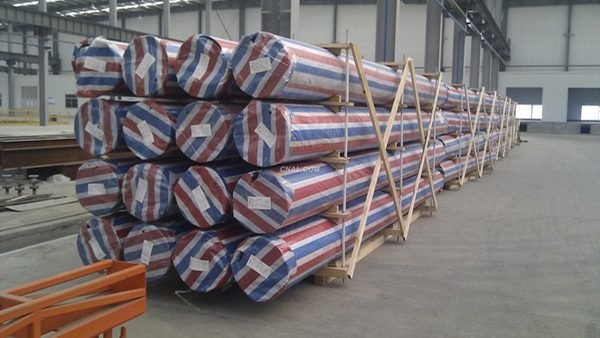
QIDAMT supplies 6063-T5 and 6063-T6 extruded tube in round, square and rectangular sections from 10 × 10 mm para 150 × 150 milímetros, with wall thickness from 0.8 mm para 6 milímetros. Custom profiles can be quoted against a section drawing, including die cost and lead time. Tube is supplied cut to length, rebarbado, and bundled for export.
Send the section drawing, temperamento, finish and quantity. We will confirm wall tolerance, mill certificate and the anodising or powder coating option that matches your project.
Precisar 6063 tube cut to length?
Send the section, temper and quantity for a quotation with wall tolerance and finish options.
Related specifications: 6061-T6 aluminium plate, 5052-H32 aluminium sheet, e 1060 pure aluminium sheet.

