 PROGRÈS
Galvanized Rectangular Steel Tube: Revêtement de zinc, Wall Tolerance and Racking Use
Hot-dip galvanized rectangular tube is a cold-formed hollow section, welded from strip and then dipped in molten zinc. It is the default section for pallet racking, escrime, cadres de serre, sign structures and light mezzanine floors. This guide covers the base grade, the coating classes that decide service life, the wall-thickness tolerance that decides strength, and the fabrication rules that keep the coating intact.
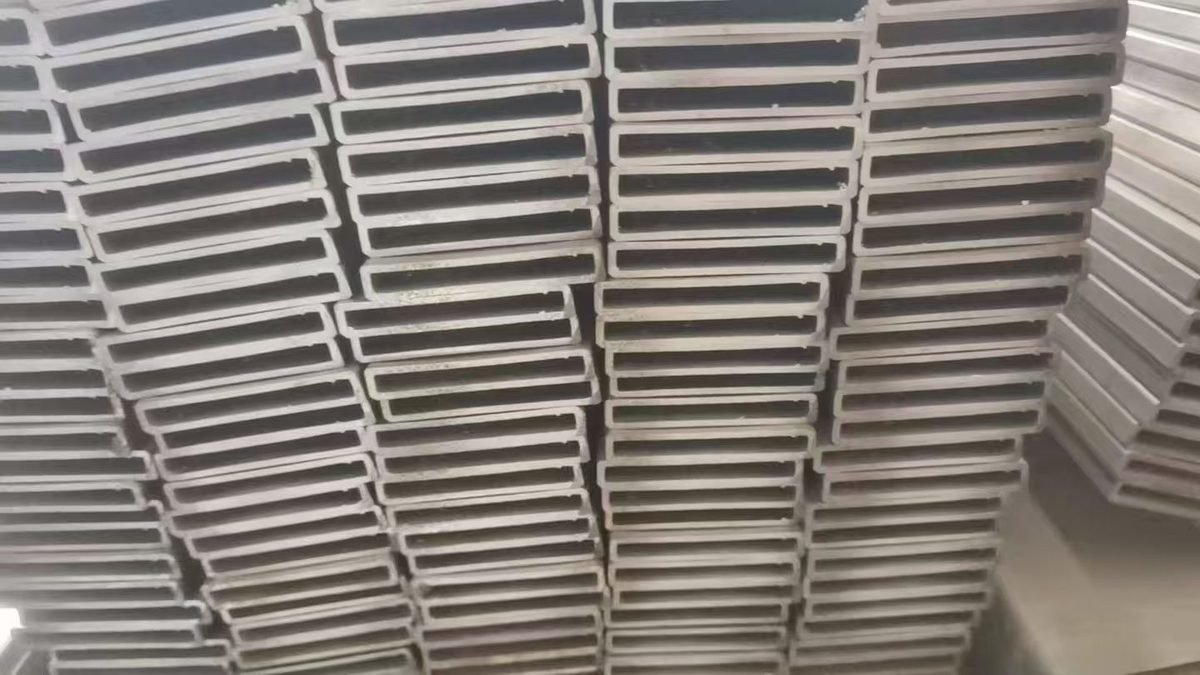
What Galvanized Rectangular Tube Is
Tube rectangulaire — also called rectangular hollow section, RHS, or box section — is produced from galvanized steel strip, formed into a tube and welded along one edge, then hot-dip galvanized. The result is a closed section with a smooth, uniform zinc coating inside and out, and a dimensional accuracy that is better than a welded built-up box.
The alternative product is pre-galvanized tube: strip that is already zinc-coated before forming, so the weld seam and the cut ends are bare steel. Pre-galvanized is cheaper and perfectly adequate indoors or in dry service, but it is not the same product as hot-dip galvanized, and the two are frequently confused in quotations.
Where it is used
- Pallet racking and shelving — uprights and beams in 80×40, 100×50 and 120×60 sections.
- Fencing and gates — frames for welded mesh panels, sliding gate rails and posts.
- Greenhouse and agricultural frames — 40×20 and 50×30 sections with a coating that survives condensation and fertilizer.
- Sign posts and street furniture — where a clean square section is wanted and maintenance access is limited.
- Light mezzanine and stair stringers — secondary structure where the section is calculated, pas deviné.
Base Grade and Chemical Composition
Most galvanized rectangular tube in the Chinese market is made from Q235B strip, which is weldable, formable and cheap. For structural racking some buyers specify Q355B or S355 to reduce wall thickness, but the higher strength grades are less common in stock sizes.
| Grade | C | Et | Mn | P. | S | Rendement, MPa | Traction, MPa |
|---|---|---|---|---|---|---|---|
| Q235B | 0.12–0.20 | ≤0.30 | 0.30–0.70 | ≤0.035 | ≤0.035 | ≥235 | 370–500 |
| Q355B | ≤0.20 | ≤0.55 | 0.90–1.60 | ≤0.035 | ≤0.035 | ≥355 | 470–630 |
| S235JR | ≤0.17 | ≤0.35* | ≤1.40 | ≤0.035 | ≤0.035 | ≥235 | 360–510 |
Typical ladle limits to GB/T 700 and GB/T 1591. *S235JR silicon limit depends on deoxidation method; confirm on the mill certificate.
The silicon content matters more than it looks. Silicon above about 0.03% affects the reaction between steel and molten zinc and can produce a thick, grey, brittle coating at the high end of the dipping temperature, or a very thin coating at the low end. That is why galvanizers ask for the silicon and phosphorus levels on the mill certificate before quoting, and why a change of strip supplier can change the appearance of a whole batch.
Zinc Coating Classes
Coating is specified as mass per unit area, not as a thickness, and the two units are routinely mixed up in purchase orders. The conversion is simple: 1 µm of zinc is about 7.14 g/m², and the mass figure in standards counts both faces, so a 275 g/m² coating is about 19 µm per face.
| Classe de revêtement | Total mass, g/m² | Approx thickness per face, µm | Typical service |
|---|---|---|---|
| Z120 | 120 | 8–9 | Intérieur, sec, C1 environment |
| Z180 | 180 | 12–13 | Sheltered outdoor, C2 |
| Z275 | 275 | 19–20 | General outdoor, C3 |
| Z350 | 350 | 24–25 | Industrial or coastal, C4 |
| Z450 | 450 | 31–32 | Severe coastal or chemical, C4–C5 |
Zinc coating classes follow EN 10346 and the equivalent GB/T 2518 designations. Service categories refer to ISO 9223 atmospheric corrosivity.
For hot-dip galvanized tube the coating is normally 45–85 µm per face after dipping, which corresponds to 320–600 g/m² total and comfortably exceeds the Z275 class. That is one reason hot-dip tube is preferred outdoors: the coating is thick enough to survive a scratch and still protect the steel, whereas a 20µm pre-galvanized coating is gone once it is damaged.
Coating appearance is not a quality criterion by itself. A bright, spangled surface and a matt grey surface can both be correct; the difference comes from the steel chemistry, the cooling rate and whether the tube was passivated after dipping. What matters is the measured coating mass and the adhesion, checked by a bend or hammer test on a sample.
Section Properties and Wall Thickness
Rectangular tube is sold by outside dimension, épaisseur et longueur du mur. The wall thickness is the variable that carries the load, and it is also the variable that is most often at the tolerance limit.
| Taille, mm | Mur, mm | Masse, kg/m | Section area, mm² | Ix, cm&sup4; (environ) |
|---|---|---|---|---|
| 40×20 | 1.5 | 1.34 | 171 | 2.9 |
| 50×30 | 1.5 | 1.81 | 231 | 6.9 |
| 60×40 | 2.0 | 3.01 | 384 | 19.7 |
| 80×40 | 2.0 | 3.64 | 464 | 42.0 |
| 100×50 | 2.0 | 4.58 | 584 | 82.0 |
| 100×60 | 2.5 | 6.08 | 775 | 128.0 |
| 120×60 | 3.0 | 8.20 | 1,044 | 232.0 |
Mass calculated as 0.00785× t× (2(a+b) − 4t). Moments of inertia are nominal and exclude corner radii; use the manufacturer’s section table for design.
Wall thickness tolerance for cold-formed hollow sections is typically ±10%, and the standard permits the thickness to be measured at any point around the section, not just the flat faces. A 2.5 mm specification can therefore deliver 2.25 mm at the corner radius, qui est un 10% loss of area and a larger loss of stiffness. For racking uprights, where the section is thin and the load is repeated, specify the negative tolerance explicitly or order to a minimum wall rather than a nominal one.
| Paramètre | Tolérance typique | Standard reference |
|---|---|---|
| Outside dimension | ±1.0%, minimum ±0.5 mm | GB/T 6728 / EN 10219 |
| Épaisseur de paroi | ±10% | GB/T 6728 |
| Longueur | +10 / −0 mm on a fixed length | Order-specific |
| Squareness of corner | 90° ±1° | GB/T 6728 |
| Rectitude | ≤0.15% of length, maximum 10 mm | GB/T 6728 |
| Torsion | ≤1° per metre | GB/T 6728 |
| Coating mass | ≥ declared class, measured per batch | GB/T 2518 / EN 10346 |
| Weld seam | Continuous, no open lap, no burn-through | Visual and dye penetrant |
How the Tube Is Made
Forming and welding
Strip is slit to width, roll-formed through a series of stands into a rectangular profile, and the longitudinal seam is welded by high-frequency induction or resistance welding. The seam sits on one face, usually the narrower one, and is then scarfed or shaved flush. A raised weld bead is not acceptable on a tube that will be handled or coated, because the zinc builds up on the bead and the section no longer sits flat.
Après soudage, the tube is sized through Turks heads to bring the outside dimensions within tolerance, then cut to length and deburred. Squareness is checked at the cut end; a tube cut on a saw that is out of square by 2° will not close a frame properly on site.
Galvanisation à chaud
The tube is degreased, pickled in acid, fluxed, dried and dipped in zinc at about 445–460 °C. Coating thickness is governed by the steel chemistry and the immersion time rather than by the operator’s preference, which is why a change of heat can change the coating. After dipping, the tube is quenched or air-cooled, inspecté, and optionally passivated to reduce the risk of wet-storage staining.
Two practical points for buyers: the tube must have drain and vent paths so that molten zinc and acid can escape, and the inside of a closed section will coat, but unevenly if the section is long and narrow. For a 120×60 mm tube at 6 m, the inside coating is usually present but thinner at the middle of the length; if internal corrosion protection is critical, the design should allow drainage and inspection.
Selection and Installation Rules
- Match coating to environment. Z275 is the minimum for general outdoor work; coastal or industrial sites need Z350 or hot-dip. À l'intérieur, Z120 or pre-galvanized is adequate.
- Check the wall against the load, not the catalogue. Racking uprights are calculated for the actual beam loads and the actual measured wall, including the negative tolerance.
- Do not weld without repairing the coating. Welding burns the zinc back 10–20 mm from the bead; that zone must be cleaned and coated with a zinc-rich repair paint, or it will rust first.
- Assurer le drainage. Any tube that is open at the top and closed at the bottom will collect water. Drill a weep hole, or cap the end with a vented cap.
- Isolate dissimilar metals. Galvanized tube against copper, brass or stainless in a wet environment creates a galvanic couple; use isolating washers or a barrier tape.
- Handle with slings, not forks. A forklift tine through the open end of a rectangular tube deforms the section and cracks the coating at the corner.
- Store under cover, off the ground. White rust (zinc hydroxide) forms on newly galvanized surfaces that are stored wet and without air circulation. Dunnage and ventilation prevent it.
Field Cutting and Coating Repair
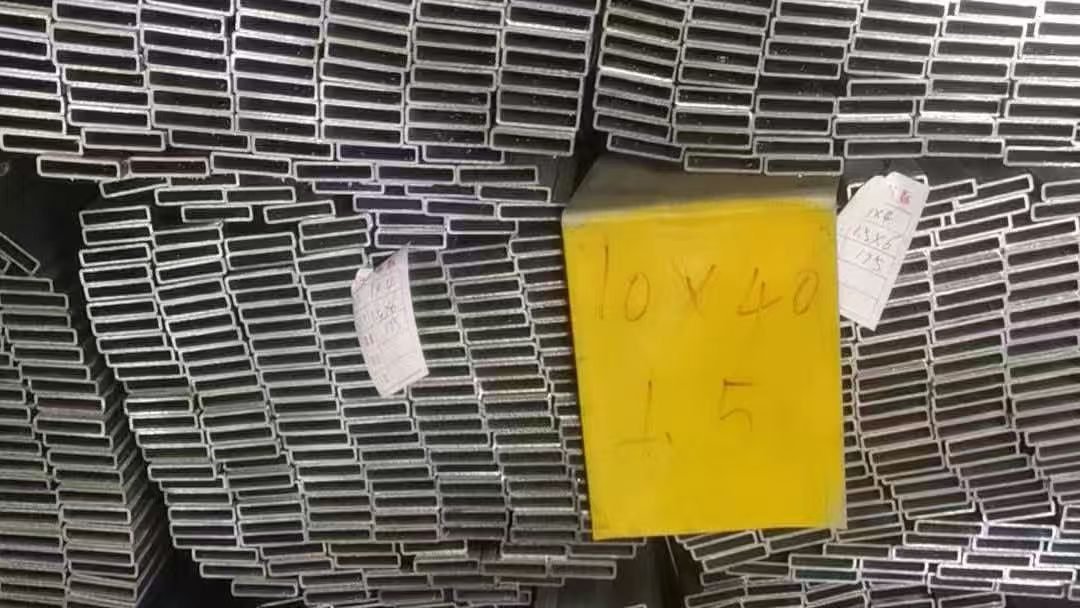
Almost every galvanized tube frame is cut or drilled on site, and every cut exposes bare steel. The edge of a saw cut through a 20µm coating is a 2 mm band of unprotected metal, which is small but is also exactly where water sits. The practical repair is a zinc-rich primer applied to the cut end and to any weld zone, before the frame is assembled, not after it is installed.
Two repair products are commonly used: a zinc-rich cold galvanizing compound, which contains 90%+ zinc in the dry film and is the closest match to the original coating, and a zinc-aluminium epoxy, which is more robust but changes the appearance. Either way, the surface must be cleaned to bare steel, degreased and dry before application, and the repair should be measured with a coating gauge if the client requires a documented coating mass.
Drilling is the other field operation that damages coating. A hole drilled with a worn bit tears the zinc around the edge and leaves a burr; deburring and touching up the hole takes a few seconds per hole and prevents the ring of rust that otherwise appears at every bolt after the first wet season.
Liste de contrôle de commande
Galvanized rectangular tube is a commodity, and the differences between suppliers sit almost entirely in the tolerances and the documentation. A purchase order that states only “100×60 galvanized tube” leaves every one of those differences open.
- Section and wall — nominal size, nominal wall, and whether the wall is a minimum or a nominal value.
- Grade and standard — Q235B to GB/T 700, or the structural grade required by the calculation.
- enrobage — class in g/m² total, method (hot-dip or pre-galvanized), and whether passivation is required.
- Longueur — fixed length with the cut tolerance, or random length with the allowable range.
- End condition — sawn and deburred, plafonné, or open; and whether drain holes are to be drilled by the supplier.
- Straightness and twist — the standard tolerance, or a tighter figure for racking and automated handling.
- Documentation — mill certificate for the strip, coating mass test report, and a packing list that matches the bundle marks.
- Emballage — banded bundles with timber dunnage, or crates for export, with the bundle weight marked for crane handling.
Erreurs courantes
- Confusing pre-galvanized with hot-dip. The weld seam and cut ends of pre-galvanized tube are bare steel; outdoors they rust first and the quotation was cheaper for a reason.
- Reading coating in µm when the order is in g/m². A “20 µm” requirement is roughly double a Z120 order, and the two are not interchangeable.
- Accepting nominal wall without the minus tolerance. A 2.5 mm tube at 2.25 mm is a different structural member.
- Welding the frame after galvanizing without repair. The weld zone is the first place to rust, and it is always visible.
- No drain holes in closed frames. Water inside the section, freezing, splitting the corner weld.
- Assuming the inside is coated as well as the outside. It usually is, but not uniformly on long narrow sections.
- Using rectangular tube as a structural column without checking the weld seam position. The seam face is the weak face in compression buckling.
FAQ
Is hot-dip galvanized rectangular tube better than pre-galvanized?
For outdoor or wet service, Oui. Hot-dip coats the whole section including the weld seam and the cut ends, with a coating of 45–85 µm per face. Pre-galvanized leaves the seam and the ends bare, which is acceptable indoors but is the first point of rust outdoors.
How long will the coating last?
In a rural or urban atmosphere, a Z275 coating typically gives 15–25 years to first red rust; hot-dip tube usually longer. In a coastal or industrial atmosphere the life falls sharply, and Z350 or Z450 should be specified. The number is a maintenance-planning figure, not a warranty.
Can I weld galvanized tube?
Oui, but the zinc must be removed from the weld zone before welding and the weld repaired afterwards with a zinc-rich coating. Welding over zinc produces fumes and a porous weld, and the burnt zone is unprotected.
What wall thickness do I need for a racking upright?
That is a calculation, not a rule of thumb. It depends on the upright height, the beam loads, the number of levels and the measured wall after tolerance. A 100×60 mm upright at 2.0 mm and one at 2.5 mm look identical on site and behave very differently.
Why does the tube have a visible seam?
It is a welded hollow section; the strip is formed and welded along one edge. The seam is scarfed flush during production, but a faint line usually remains and is normal. A raised bead or an open lap is not normal and should be rejected.
Can rectangular tube be bent?
Cold bending is possible for large radii, but the coating cracks on the outside of the bend and the section ovalises. For structural curves, a welded built-up section or a purpose-made bend is more reliable than bending galvanized tube.
Produits connexes
Round galvanized tube for handrail, scaffold and conduit is described on the tube en acier rond galvanisé à chaud Q235B page, and the strip used to make both products is covered on the bande d'acier galvanisée DX51D page with coating classes and width options.
Need a galvanized rectangular tube quotation?
Send the section sizes, épaisseur de paroi, total length, coating class and whether the frames are welded or bolted. We will quote against the measured wall and the declared zinc mass.

