 进步
Aluminium Round Bar: 6061-T6 vs 6082-T6 for Machining
Aluminium Round Bar: 6061-T6 vs 6082-T6 for Machining
Aluminium round bar is the default stock for turned parts: 轴, 垫片, 衬套, 阀体, jig pins, 滚筒, flanges and adaptors. It is sold by diameter and temper, cut from extruded or rolled rod, and priced per kilogram. The two grades that dominate machining stock in Europe and Asia are 6061-T6 and 6082-T6, and buyers routinely treat them as interchangeable. They are not interchangeable in machining behaviour, anodising response, weld strength or availability.
This guide compares the two grades as machining stock, with the chemistry, temper definitions, mechanical data, tolerance ranges, shop-floor cutting parameters and selection rules that decide which bar belongs on which job.
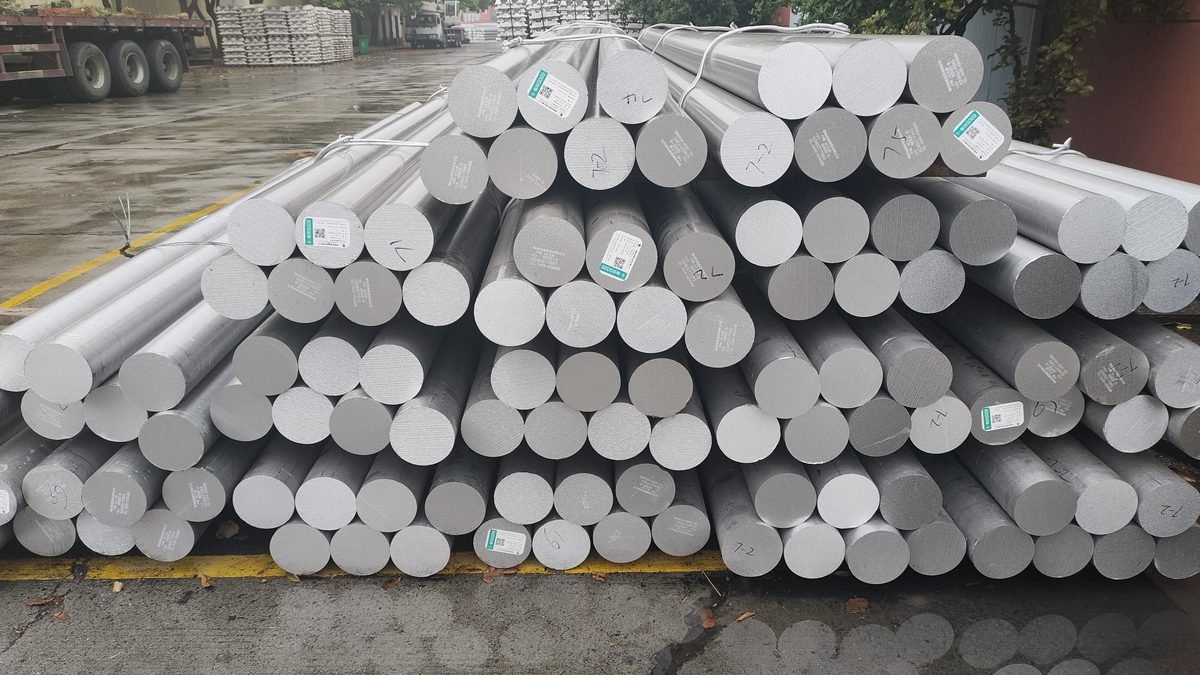
1. What Round Bar Is and How It Is Made
Round bar is solid aluminium rod in diameters from about 6 毫米至 300 毫米. Three production routes matter commercially. Extruded rod is pushed through a die at 450–500 °C, giving good surface finish in long lengths and the widest size range. Rolled rod is hot rolled from cast billet, used mostly for larger diameters and where extrusion press capacity runs out. Cast or continuously cast bar appears in large diameters and in remelt stock, with a coarser structure that shows up as banding after anodising.
The temper suffix is as important as the alloy number. T6 means solution heat treated and then artificially aged, with no cold work after ageing. T651 means the same treatment plus a controlled stretch after quenching to relieve residual stress; T6511 is the same for bar and rod. For machined parts with tight concentricity or flatness, T651 or T6511 is the correct purchase description. Plain T6 bar can move 0.2–0.5 mm over a 300 mm length when a large amount of material is removed from one side.
Diameter selection drives cost more than grade. Cutting a 120 mm bar down to a 40 mm part wastes three quarters of the purchased weight in chips. If the part envelope is close to a standard diameter, buy the standard diameter and machine the features; stepping up to the next size to gain a shoulder usually costs less than buying oversized stock.
2. Chemistry: The Real Difference
Both alloys are Al-Mg-Si heat-treatable grades hardenable by the formation of magnesium silicide precipitates. The differences are the silicon-to-magnesium ratio, the manganese level and the copper limit.
| 元素 (%) | 6061 | 6082 | Effect |
|---|---|---|---|
| 镁 | 0.8–1.2 | 0.6–1.2 | Forms Mg2Si precipitate with silicon |
| 硅 | 0.40–0.80 | 0.70–1.30 | Higher in 6082, more free silicon after ageing |
| 铜 | 0.15–0.40 | ≤ 0.10 | 6061’s copper raises strength and lowers corrosion resistance slightly |
| 锰 | ≤ 0.15 | 0.40–1.00 | 6082’s manganese controls grain structure and chip form |
| 铁 | ≤ 0.70 | ≤ 0.50 | Impurity; higher iron coarsens intermetallics |
| 铬 | 0.04–0.35 | ≤ 0.25 | Refines precipitate, improves corrosion |
| 锌 | ≤ 0.25 | ≤ 0.20 | Impurity; affects anodising colour |
| 钛 | ≤ 0.15 | ≤ 0.10 | Grain refiner during casting |
The copper difference is the most consequential for service performance. 6061 carries up to 0.40 % copper, which raises strength but reduces resistance to chloride pitting and makes the alloy slightly less suitable for architectural anodising in coastal atmospheres. 6082 caps copper at 0.10 %, which is one reason European structural specifications favour it.
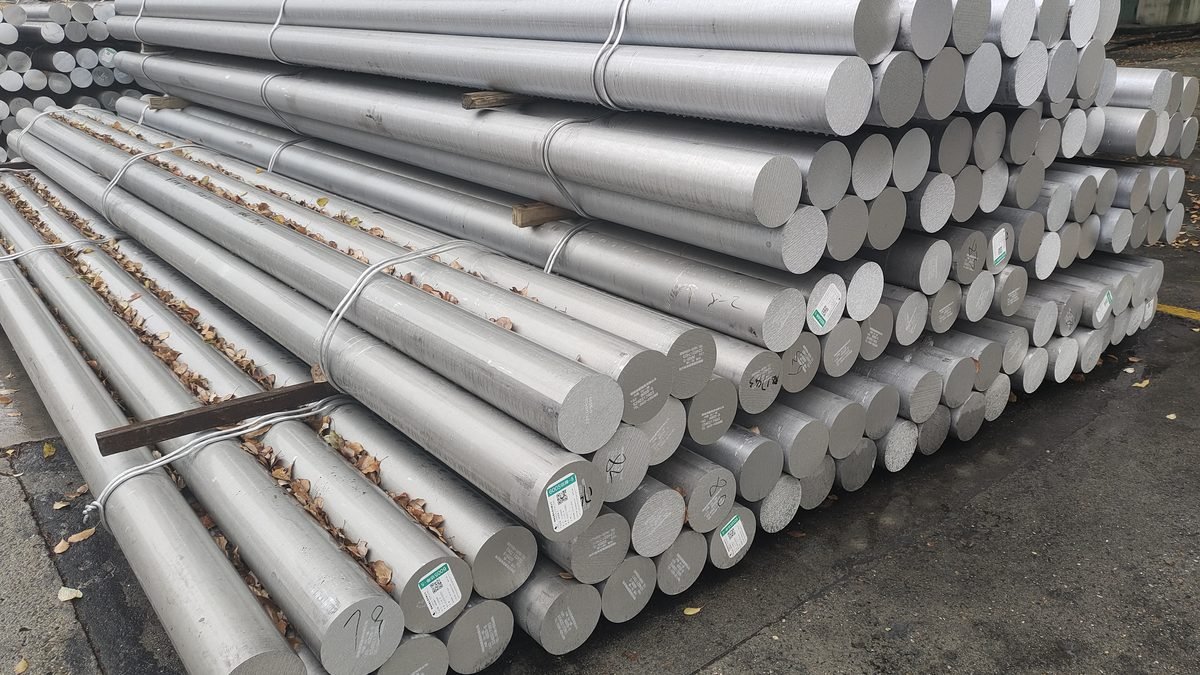
3. Mechanical Properties in T6
Values below are typical minimums for extruded bar in the T6 temper. Actual mill results usually sit 5–10 % higher.
| 财产 | 6061-T6 | 6082-T6 |
|---|---|---|
| 0.2 % proof stress | ≥ 240 兆帕 | ≥ 260 兆帕 |
| 抗拉强度 | ≥ 290 兆帕 | ≥ 310 兆帕 |
| 伸长, 50 毫米 | ≥ 8 % | ≥ 6 % |
| 硬度 | 95 HB | 100 HB |
| Young’s modulus | 68.3 GPa | 71 GPa |
| 密度 | 2.70 克/厘米³ | 2.71 克/厘米³ |
| 导热系数 | 167 W/m·K | 172 W/m·K |
| 电导率 | 43 % 国际化学学会 | 45 % 国际化学学会 |
6082 is roughly 10 % stronger and correspondingly less ductile. For a machined pin under transverse load, that difference can allow a smaller diameter. For a part that will be staked, crimped or bent after machining, 6061’s extra elongation usually wins.
Both grades lose strength rapidly above 100 °C and should not be used in T6 above about 150 °C for sustained service. If the part sits against a hot surface, consider T6 with an insulative washer or move to 5083 for a non-heat-treated alternative.
4. 加工: 为什么 6082 Cuts Cleaner
On a lathe or mill, 6082-T6 has a clear advantage. The manganese addition changes the chip from a long continuous coil that wraps the tool to a shorter, more segmented chip that breaks against the insert. Operators describe it as “less gummy”. The practical consequences are fewer bird nests in the chip tray, less downtime clearing the conveyor, and a more stable tool load in deep cuts.
6061-T6 machines well by aluminium standards but produces a built-up edge on uncoated carbide at low speed, and it smears on sharp tools with small rake angles. Recommended practice: polished or DLC-coated carbide inserts, cutting speed 300–500 m/min in turning, 0.2–0.4 mm/rev feed, high-pressure coolant or air blast to clear chips from blind bores. For drilling, use 130–140 ° point angle, high helix, and peck if depth exceeds three diameters.
6082-T6 runs 10–20 % faster in many shops with equivalent tool life. It also holds a better surface finish on the bore because it does not smear. Where the part is a hydraulic manifold with a 0.4 µm Ra bore requirement, that difference shortens the honing step.
Temper matters more than grade for dimensional stability. T6 bar released from the quench without stretching can move after heavy material removal. T651/T6511 bar is stretched 1–3 % after quenching, which converts residual stress into plastic flow before machining. Parts machined from T6511 hold concentricity within 0.05 mm over 500 mm in most cases; the same part from plain T6 can drift 0.2 mm or more.
Clamping is the other source of movement. Aluminium is soft enough that a standard vice with serrated jaws will imprint and distort a thin-walled part. Use soft jaws bored to the bar diameter, moderate clamping pressure, and take a light finishing pass after releasing and re-clamping if concentricity is critical.
5. Anodising and Surface Finish Response
Both alloys anodise to a clear, hard coating, but the appearance differs. 6061 generally produces a clean silver-grey with good colour consistency between heats. 6082’s higher silicon content leaves fine silicon particles that do not anodise, so the coating can look slightly darker or greyer at the same thickness, and batch-to-batch colour variation is harder to control in dyed work.
For natural or black anodising on visible consumer parts, 6061 is the safer choice when colour match across batches matters. For structural or internal parts where appearance is irrelevant, 6082 anodises well and its lower copper content gives slightly better corrosion performance in salt exposure.
Hard anodising, Type III, works on both grades. Coating thickness up to 50 µm is achievable, but the coating grows both inward and outward, so a 25 µm nominal build adds roughly 12 µm to the diameter. Threads and bores must be masked or allowed for. Sharp edges on either alloy produce the friable “burnt” edge that chips in service; specify a 0.3–0.5 mm radius on all anodised edges.
Machined surfaces show the alloy’s structure. A coarse cast bar will display banding or streaking after anodising even when the surface finish is good. If the part is decorative, specify extruded bar with a fine-grain structure and verify on a sample before committing to a production run.
6. 尺寸, 公差和直线度
Round bar is normally supplied in mill lengths of 3 m or 6 米, 或切成一定长度. Diameter tolerance follows the ISO limits selected by the mill, usually h9 or h11 for extruded bar and tighter for ground or drawn bar.
| 特征 | Commercial extruded | Precision / 地面 |
|---|---|---|
| Diameter 10–25 毫米 | 小时11 | h9 or better |
| Diameter 25–80 毫米 | 小时11 | h9 |
| Diameter 80–200 毫米 | h12 | h10 |
| Roundness | within diameter tolerance | 0.02 毫米 |
| 直线度 | 2 毫米/米 | 0.5 毫米/米 |
| Cut length | ± 2 毫米 | ± 0.5 毫米 |
| Twist | not specified | 1 毫米/米 |
Remember that diameter tolerance is not the same as machinability allowance. A h11 bar at the top of its tolerance may clean up at nominal size with almost no stock left, and any straightness deviation then shows as an eccentric part. For parts where the finished surface must be fully cleaned, order 0.5–1 mm above nominal and machine down.
切割, Storage and Handling
Aluminium bar is soft enough that a dull saw blade work-hardens the cut face and leaves a burr that will not seat in a collet. Use a carbide-tipped saw with a high tooth count, a feed rate matched to the diameter, and a coolant or air blast to stop the chips welding to the blade. A horizontal band saw with a 3–4 mm kerf is normal for cut-to-length service; a circular saw is faster but leaves a rougher face on large diameters.
Storage is a corrosion issue as much as a handling issue. Aluminium does not rust like steel, but it stains. White or grey powdery corrosion appears where water sits between stacked bars, and finger marks become permanent on freshly machined surfaces within days if the part is left unprotected. Keep bar on timber dunnage rather than on bare concrete, allow air to move between bundles, and never store bar in the same rack as steel offcuts — embedded iron particles from the steel will seed pitting on the aluminium.
For long-term storage or export, wrap the bundles in VCI film rather than plain stretch wrap. Plain wrap traps condensation against the metal and produces exactly the wet-storage staining it was meant to prevent. Interleaved paper at 1–2 mm thickness also helps, provided it stays dry.
One more handling rule for machining stock: do not let the bar sit on the shop floor next to grinding operations. Aluminium picks up airborne grinding dust, and that dust becomes a corrosion cell in service, particularly on anodised parts. Cover the stock or keep it in a closed rack.
7. Welding and Assembly
6061 welds readily with 4043 或者 5356 填料. The heat-affected zone loses roughly 40 % of its T6 strength and cannot be recovered by re-ageing alone; a full solution treatment and re-age is required, which is impractical for most assemblies. Design welded 6061 joints for the annealed strength, 或使用 5083/5754 where welding dominates.
6082 is also weldable with 4043 或者 5356, and its lower copper content reduces hot-cracking sensitivity slightly. 然而 6082 is more sensitive to heat input in thin sections and can develop a soft zone extending 15–25 mm from the weld. Structural codes in some markets restrict 6082 in welded load-bearing applications for this reason.
For a machined part welded into a frame, the practical sequence is: machine the part in T6511, 焊接, then re-machine critical features if tolerance matters. Trying to hold a 0.05 mm bore after welding is a specification error regardless of grade.
Threaded joints in aluminium need care. A steel bolt threaded directly into aluminium will gall and strip on repeated assembly. Use stainless or zinc-plated inserts, or specify a thread insert such as a helical coil, and limit thread depth to 1.5 times diameter. Lubricate with a corrosion-inhibiting compound that is compatible with anodising.
8. Selection Rules
- Colour-critical anodised parts: 6061-T6511. Better batch consistency and a cleaner silver tone.
- High-volume turned parts with chip control problems: 6082-T6 or T651. Shorter chips, faster cycles.
- Structural parts designed to European codes: 6082-T6, which is the standard EN structural alloy and is listed in EN 1999-1-1.
- Parts needing post-machining bends or staking: 6061-T6 for the extra elongation.
- Coastal or salt-exposed anodised parts: 6082 for the lower copper content, with a sealed anodised finish.
- Tight concentricity over long lengths: either grade, but specify T651/T6511 and check stress relief, not just alloy.
- Mixed inventory: if you already stock one grade, the cost of adding the second usually exceeds the machining benefit unless volumes are high.
9. 常见错误
Buying T6 for a precision part and blaming the machine. The bar moves because it was never stress relieved. Order T651/T6511.
Assuming 6082 is a drop-in replacement for 6061 in an existing weld procedure. The heat-affected zone behaves differently and the qualified WPS may not cover it.
Specifying 6061 for a dyed anodised product across multiple batches. Colour drift between heats is visible to customers even when the coating thickness is correct.
Using uncoated carbide at low speed on 6061. Built-up edge smears the surface and the operator compensates by increasing feed, which overloads small-diameter tools.
Ordering bar at nominal diameter. With h11 tolerance and 2 mm/m straightness, there may be no clean-up allowance. Order oversize.
Ignoring the saw cut. A dull blade work-hardens the bar end and leaves a burr that will not seat in a collet. Specify a square cut and deburr, or face the end in the first operation.
10. 常见问题解答
Is 6082 stronger than 6061? 是的, by roughly 10 % in T6. It is also slightly less ductile and shows lower elongation in the mill certificate.
Can 6061 和 6082 be welded together? 是的, 和 5356 填料. The joint takes the properties of the lower-strength side in the heat-affected zone, and the WPS should be qualified for the combination.
Which grade is better for anodising? 6061 for colour consistency and appearance; 6082 for corrosion resistance where copper content matters. Both accept clear, black and hard anodising.
What does T6511 mean? Solution heat treated, stress relieved by stretching, then artificially aged, in bar or rod form. It is the standard temper for precision-machined bar.
Can aluminium bar be used outdoors? 是的, with an anodised or painted finish. Untreated 6061 will oxidise to a dull grey and stain in coastal air; 6082 performs slightly better because of its lower copper.
How do I calculate bar weight? Weight per metre = π / 4 × 直径² (毫米) × density (克/厘米³) / 1000. A 50 毫米 6061 bar weighs about 5.30 公斤/米.
11. Sourcing Machining Bar
QIDAMT supplies 6061-T6/T6511 and 6082-T6/T651 aluminium round bar from 6 毫米至 300 毫米, 切成一定长度, with mill certificates and temper verification. Bar can be supplied saw-cut, chamfered or ground, and bundled for export with edge protection.
Send the part drawing with the finished diameter, temper and anodising requirement, and we will confirm the stock size, the clean-up allowance and the most economical grade for the run.
需要 6061 或者 6082 bar cut to length?
Tell us the diameter, temper and quantity and we will quote against the current mill price.
Related specifications: 6061-T6 aluminium plate, 1060 pure aluminium sheet, 和 5052-H32 aluminium sheet.

