 FRAMSTEG
Vinkelstång i rostfritt stål: Betyg, Storlekar, Vikt- och svetsguide
A stainless steel angle bar is an L-shaped long product with two legs at 90 degrees. It carries load in two directions at once, resists twisting better than a flat bar of the same weight, and needs almost no maintenance when the grade is chosen correctly. That combination is why angle bar shows up in equipment frames, tank supports, ledstänger, curtain wall back frames, food machinery bases and marine fittings. The difficulties start after the grade is chosen: leg length, tjocklek, inner radius, rakhet, edge condition and welding procedure all decide whether the finished assembly fits and lasts. This guide covers the grades, the chemistry behind them, the mechanical values buyers should ask for, the size and weight tables used for estimating, and the fabrication rules that prevent the failures we see most often.
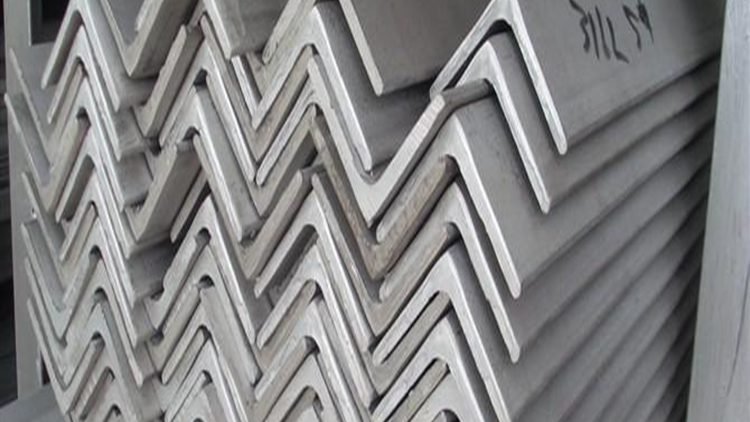
What an Angle Bar Actually Is
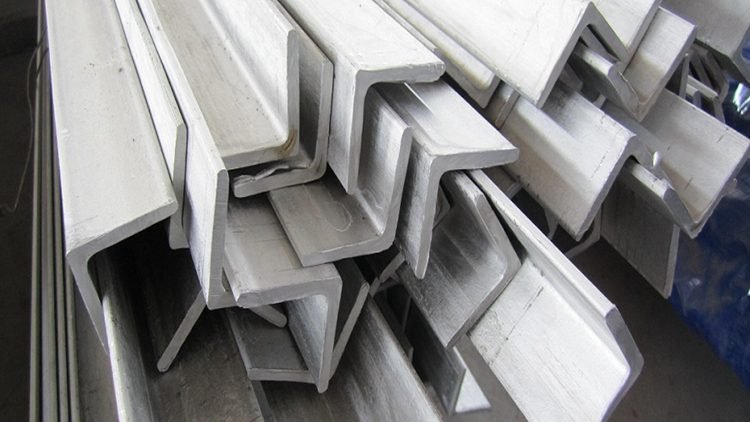
Angle bar is produced in two ways. Hot rolled angle is formed from a reheated billet, so the corner has a defined inner radius and the legs carry a rolling scale that must be removed before welding or painting. Cold formed angle is bent from strip or sheet on a press brake or roll former; the corner is sharper, the thickness stays closer to nominal, and the mechanical properties rise slightly because of work hardening, but residual stress at the bend line is higher and the leg flatness is harder to hold on long lengths.
Equal leg angle has two legs of the same width, which suits symmetrical frames, bracing and general fabrication. Unequal leg angle has one long leg and one short leg, which is used where one face carries the load and the other only locates or stiffens, such as tank rims, trailer edges and door frames. Both types are measured by leg width × leg width × thickness, and for unequal leg the long leg is stated first, till exempel 75 × 50 × 6 mm.
The inner radius matters more than buyers expect. A tight radius concentrates stress at the corner and makes the section harder to seat against a mating surface. A generous radius distributes load and gives room for a fillet weld. When an assembly is welded on the inside corner, the radius effectively becomes part of the weld groove, so a drawing that specifies only leg and thickness is incomplete.
Grades and Chemical Composition
Four grades cover almost every angle bar enquiry: 304, 304L, 316L and 201, med 430 appearing in dry indoor work where cost dominates. The chemistry is what separates them, and the chemistry is what determines where each grade survives.
304 (US S30400) carries 18 till 20 percent chromium and 8 till 10.5 percent nickel, with carbon capped at 0.08 percent. The chromium forms the passive oxide film; the nickel stabilises the austenitic structure and gives the ductility needed for bending and forming. 304L drops carbon to 0.03 percent maximum, which reduces carbide precipitation in the heat affected zone during welding and lowers the risk of intergranular corrosion in welded assemblies that cannot be solution annealed afterwards.
316tillägger L 2 till 3 percent molybdenum and raises nickel to 10 till 14 percent. Molybdenum improves resistance to pitting and crevice corrosion in chloride environments, which is why 316L is specified for coastal structures, brine areas, pulp and paper equipment, and pharmaceutical cleaning rooms. The trade-off is price and slightly lower strength than 304 in the annealed condition.
201 replaces part of the nickel with manganese and nitrogen. It is an austenitic grade with roughly 16 till 18 percent chromium, 3.5 till 5.5 percent nickel, 5.5 till 7.5 percent manganese and up to 0.25 percent nitrogen. Strength is higher and cost is lower, but corrosion resistance in humid or chloride-bearing service is clearly below 304, and the grade becomes magnetic after cold forming. 430 is a ferritic grade with 16 till 18 percent chromium and no nickel; it resists scaling and mild atmospheres but has limited weldability and lower toughness.
| Element | 304 | 304L | 316L | 201 | 430 |
|---|---|---|---|---|---|
| Kol, max % | 0.08 | 0.030 | 0.030 | 0.15 | 0.12 |
| Krom % | 18.0–20.0 | 18.0–20.0 | 16.0–18.0 | 16.0–18.0 | 16.0–18.0 |
| Nickel % | 8.0–10.5 | 8.0–12.0 | 10.0–14.0 | 3.5–5.5 | — |
| Molybden % | — | — | 2.0–3.0 | — | — |
| Mangan % | ≤2.00 | ≤2.00 | ≤2.00 | 5.5–7.5 | ≤1,00 |
| Kisel % | ≤0.75 | ≤0.75 | ≤0.75 | ≤0.75 | ≤1,00 |
| Fosfor, max % | 0.045 | 0.045 | 0.045 | 0.060 | 0.040 |
| Svavel, max % | 0.030 | 0.030 | 0.030 | 0.030 | 0.030 |
A certificate that lists only the grade name is not enough. Ask for the heat number, the actual chromium and nickel values, and the carbon value when 304L or 316L is claimed. Material sold as 304 med 16.5 percent chromium and 7 percent nickel is within some mill tolerances but sits at the bottom of the corrosion envelope, and it behaves noticeably worse than a mid-range heat.
Mekaniska egenskaper
Angle bar is normally supplied in the annealed condition. The values below are minimum requirements aligned with ASTM A240 / A276 practice for the annealed state; actual production heats usually run above them, and cold formed angle will show higher yield because of work hardening.
| Kvalitet | Sträckstyrka, min MPa | Draghållfasthet, min MPa | Elongation in 50 mm, min % | Hårdhet, max |
|---|---|---|---|---|
| 304 | 205 | 515 | 40 | 92 HRB |
| 304L | 170 | 485 | 40 | 92 HRB |
| 316L | 170 | 485 | 40 | 95 HRB |
| 201 | 260 | 655 | 40 | 100 HRB |
| 430 | 205 | 450 | 22 | 89 HRB |
Two practical notes follow from this table. Första, 201 looks stronger on paper, but higher strength does not compensate for lower pitting resistance; specifying 201 to save money in a wash-down area usually produces rust staining within one season. Second, angle bar is rarely used as a pure tension member. It is used as a frame member, where stiffness governs. Stiffness depends on the section geometry and the modulus, and all austenitic grades sit near 193 till 200 GPa, so changing from 304 to 316L does not make a frame stiffer. Only increasing leg width or thickness does.
Storlekar, Weight and Estimating
Common equal leg sizes run from 20 × 20 × 3 mm up to 100 × 100 × 10 mm. The table below gives the nominal mass per metre for stainless angle using a density of 7.93 g/cm³. The formula is mass (kg/m) = (A + B − t) × t × 0.00793, where A and B are leg widths in millimetres and t is thickness in millimetres. The subtraction of t accounts for the corner overlap; using A + B without it overstates the weight by roughly the thickness ratio.
| Storlek, mm | Mass, kg/m | Typisk användning |
|---|---|---|
| 25 × 25 × 3 | 1.12 | Light frames, vakter, trim |
| 30 × 30 × 3 | 1.36 | Equipment covers, hyllor |
| 40 × 40 × 4 | 2.41 | Machine bases, tank supports |
| 50 × 50 × 5 | 3.77 | Ramar, ledstångsstolpar |
| 63 × 63 × 6 | 5.71 | Strukturella ramar, plattformar |
| 75 × 75 × 6 | 6.85 | Heavier frames, conveyor supports |
| 80 × 80 × 8 | 9.71 | Bärande konstruktioner |
| 100 × 100 × 10 | 15.07 | Heavy supports, marina strukturer |
| 75 × 50 × 6 (unequal) | 5.90 | Tank rims, trailer edges |
Tolerances decide fit-up. Under EN 10056-2 practice, leg length tolerances for hot rolled equal angle are typically ±1.0 mm for legs up to 50 mm and ±1.5 mm above that, with tighter control available on request. Thickness tolerance follows the strip or plate tolerance of the input: cold formed angle from precision strip can hold ±0.10 mm, hot rolled angle commonly ±0.3 to ±0.5 mm. Squareness is usually specified as the deviation of one leg from perpendicular per unit length, and straightness as a maximum deviation over a fixed length, till exempel 0.2 percent of length. Internal radius is a mill property; if the drawing requires a specific radius for weld preparation, it has to be agreed before rolling, not after delivery.
Skärande, Welding and Forming
Cutting stainless angle with an abrasive disc or a bandsaw is safe and leaves a clean edge. Plasma cutting is faster on thick legs, but the cut edge oxidises and must be ground back before welding; a contaminated edge is one of the most common causes of weld porosity. Laser cutting gives a narrow kerf and a low heat input, which is useful on thin legs where distortion matters. Waterjet leaves a matte edge with no heat tint and is preferred where the cut face will remain visible.
För 304 till 304, use 308L filler; for 316L to 316L, use 316L filler; för 304 to 316L, 316L filler is the conservative choice. Do not weld 316L with 308L filler to save cost, because the weld deposit will be molybdenum-free and will become the weakest corrosion point in the assembly. För 201, a matching or 308L filler is normally acceptable in dry service, but the weld and the adjacent heat tint must be passivated.
Shielding gas quality decides the result more than amperage does. Use argon with a trailing shield on fillet welds, keep the heat input low enough to avoid carbide precipitation in 304, and purge the back side of enclosed joints. Any heat tint that remains must be removed mechanically or by pickling paste, because the tinted zone is chromium-depleted and will rust first. A wire brush used on carbon steel must never touch stainless; iron contamination from a dirty brush produces rust spots that are routinely blamed on the material.
Forming an angle bar is limited by its leg geometry. Bending across the leg is feasible with a press brake and a suitable die, but the section tends to twist because the neutral axis is offset. Bending along the leg produces a curved member with the other leg acting as a stiffener, which is efficient for arches and rims. Cold bending 304 at a tight radius may require an intermediate anneal if the bend is severe; 201 work hardens faster and may need a larger bend radius. Machining is straightforward but galls easily; use sharp tooling, suitable coolant and lower surface speed than for carbon steel.
Grade Selection by Environment
Dry indoor frames, maskinskydd, covers and shelving in a clean workshop are 304 territory. Coastal installations, swimming pool structures, brine piping supports, food plant wash-down zones and de-icing salt exposure call for 316L. Freshwater tanks, architectural trim and general outdoor work in a low-chloride atmosphere sit with 304 or 304L. 201 is acceptable for dry display frames, furniture and short-life enclosures where humidity stays low; it should not be used outdoors, near the sea, or in any area cleaned with chloride detergents. 430 suits dry indoor decorative work and heat-facing panels where welding is minimal.
Structural duty needs a separate check. Angle bar has an L section, and its resistance to bending about the weak axis is low. When the member carries compression or bending, the leg width and thickness must be checked against the actual span and load, not chosen by habit. A 40 × 40 × 4 mm angle will not replace a 60 × 60 × 5 mm square tube in a load-bearing column, even though the material grade is the same, because the section properties differ by a factor of several.
Mistakes That Repeat on Every Project
Substituting 201 för 304 in a wet area is the most expensive false economy, because the fix requires dismantling the assembly. Welding without back purge on enclosed joints leaves a sugared root that corrodes from the inside. Using a carbon steel grinding disc leaves embedded iron that rusts within weeks. Ignoring the inner radius when designing a fillet weld produces a groove that is too narrow for the torch. Specifying thickness without leg tolerance means the frame will not close squarely. Storing angle bar on the ground without dunnage allows standing water under the legs and produces crevice corrosion at the contact line, which is visible only after installation.
Inspection should be simple and repeatable: verify the heat number against the certificate, measure leg width and thickness at both ends of each length, check straightness on a flat bed, confirm the edge has no burr that would cut the welder, and confirm the surface has no iron contamination by a ferroxyl test on critical assemblies.
Vanliga frågor
Is stainless angle bar magnetic? Glödgat 304 and 316L are essentially non-magnetic, but cold forming and welding can produce a slight magnetic response. 430 is magnetic by nature, och 201 becomes magnetic after cold working. A magnet is therefore not a reliable grade test.
Can angle bar be used as a structural member? Ja, but only after the section is checked for the actual load and span. The L shape is efficient for frames and bracing, weak for pure bending about the minor axis, and its capacity depends on leg width and thickness rather than grade.
What is the difference between hot rolled and cold formed angle? Hot rolled has a defined inner radius, a scale that must be removed, and looser dimensional tolerance. Cold formed has a sharper corner, tighter thickness control and higher strength from work hardening, with more residual stress at the bend.
How is weight calculated for unequal leg angle? Use the same formula with the two different leg widths: massa (kg/m) = (A + B − t) × t × 0.00793. För 75 × 50 × 6 mm this gives approximately 5.90 kg/m.
Does angle bar need polishing after welding? The weld zone and heat tint must be cleaned and passivated. Polishing the whole member is a cosmetic choice, not a corrosion requirement, unless the service environment is aggressive and the surface finish is specified for cleanability.
Buying checklist: grade with actual chemistry, värmenummer, leg and thickness tolerance, inner radius, rakhet, kantskick, surface protection and the welding consumables you intend to use. If any of these is missing from the enquiry, the price comparison will not be like for like.
Angle bar is a simple product that fails for simple reasons: the wrong grade in the wrong environment, a section too small for the load, a weld that was never shielded, or a tolerance nobody checked. Fixing those four points at the enquiry stage costs nothing. Fixing them after installation costs the assembly.
Related material: 304 rostfri stålplåt, 316L rostfri plåt, och Q235B plattstång i kolstål for assemblies that do not need corrosion resistance.

