 FRAMSTEG
Seamless Carbon Steel Pipe ASTM A106 Gr.B: Väggtjocklek, Inspection and Ordering Guide
Seamless Carbon Steel Pipe A106 Gr.B and API 5L Gr.B: Väggtjocklek, Length and Inspection
A seamless carbon steel pipe is produced without a welded seam along its body. The billet is pierced and rolled into a tube, so the pipe wall is continuous from end to end. That single feature drives most of the commercial logic around the product: higher pressure capability, better fatigue behaviour under cyclic loading, and a lower risk of seam defects in service. Buyers who specify this product usually care about three things at the same time, namely the grade, the wall thickness and the evidence that the pipe has been tested.
The two specifications that appear most often on purchase orders are ASTM A106 Grade B and API 5L Grade B. They overlap in chemistry and strength, but they serve different worlds. A106 is a boiler and pressure vessel specification, written around elevated temperature service in steam, water and process lines. API 5L is a line pipe specification, written around the transport of oil and gas. A pipe can meet both, and many mills certify to both on one mill certificate, but the inspection regime and the documentation package follow the specification that was ordered.
This guide explains what the grades mean, how the wall and length tolerances work, how the pipe is made, what the inspection documents should contain, and where buyers most often get the specification wrong. It deals only with seamless carbon steel pipe. Welded pipe, stainless pipe and line pipe with corrosion-resistant cladding are separate products with different rules.
What Seamless Carbon Steel Pipe Means in Practice
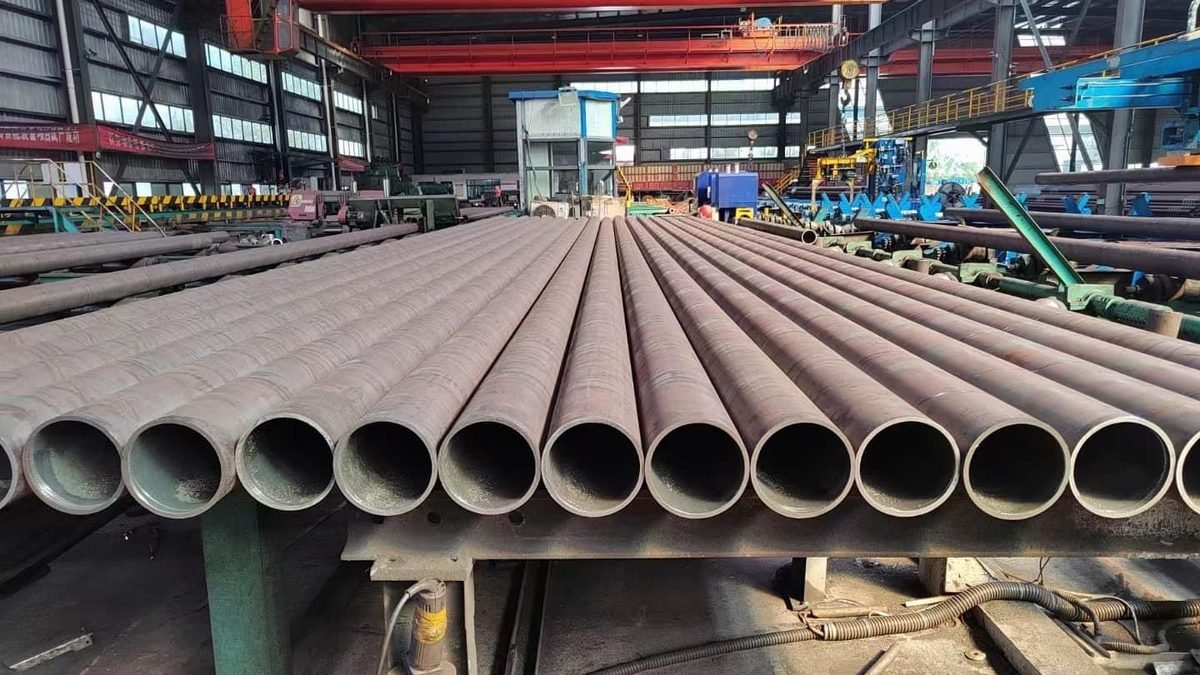
The word seamless describes the manufacturing route, not the steel grade. A solid billet is heated, pierced to create a bore, and then extended over a mandrel or through a plug mill until the wall reaches the required thickness. No longitudinal weld exists anywhere in the body. The only connections in a finished length are the cut ends, which are later joined in the field by the fabricator.
This matters for three practical reasons. Första, a seamless wall has no weld seam to inspect, so the risk of lack-of-fusion or seam corrosion is removed at the source. Andra, the pipe tolerates bending and thermal cycling better because the wall is metallurgically uniform around the circumference. Third, the pressure rating is calculated on a plain cylinder, without a weld efficiency factor.
Typical service includes boiler tubes, superheater and economiser tubing, refinery process lines, steam distribution, high pressure water, hydraulic lines, and oil and gas gathering. Low pressure work such as drainage or structural handrail usually does not justify the cost of a seamless product, and welded pipe is the rational choice there.
Standard Grades and Chemical Composition
ASTM A106 covers three grades, A, B and C, with rising carbon content and rising strength. API 5L Grade B sits in a similar chemistry window but is administered under a different product specification level. The table below lists the limits that appear on most mill certificates. Values are maximum percentages unless a range is shown.
| Element | A106 Gr.A | A106 Gr.B | A106 Gr.C | API 5L Gr.B |
|---|---|---|---|---|
| Kol, max | 0.25 | 0.30 | 0.35 | 0.28 |
| Mangan | 0.27 till 0.93 | 0.29 till 1.06 | 0.29 till 1.06 | 1.20 max |
| Fosfor, max | 0.035 | 0.035 | 0.035 | 0.030 |
| Sulphur, max | 0.035 | 0.035 | 0.035 | 0.030 |
| Kisel | 0.10 min | 0.10 min | 0.10 min | Ej specificerat |
Grade B is the default choice for general service because it combines adequate strength with good weldability and ready availability. Grade A is softer and is sometimes preferred for cold bending or for older equipment designed around lower allowable stress. Grade C is used where higher strength is needed at the same wall, for example in high pressure steam headers with tight weight limits.
API 5L adds a product specification level. PSL1 is the basic level. PSL2 adds mandatory heat treatment identification, stricter chemistry, notch toughness testing, and non-destructive inspection of the weld for welded pipe. For a seamless pipe, PSL2 mainly changes testing frequency, documentation and chemistry control rather than the physical product. Buyers who need traceability for a pipeline should state PSL2 explicitly, because a PSL1 certificate will not satisfy that requirement.
Mechanical Properties and What They Imply
Strength values in the standards are minimums, not targets. A mill typically aims slightly above the minimum to absorb test scatter, which is why a Grade B certificate often shows a tensile strength of 500 till 540 MPa although the standard requires 485 MPa.
| Egendom | A106 Gr.A | A106 Gr.B | A106 Gr.C | API 5L Gr.B PSL2 |
|---|---|---|---|---|
| Draghållfasthet, min | 330 MPa | 485 MPa | 485 MPa | 415 MPa |
| Sträckstyrka, min | 205 MPa | 240 MPa | 275 MPa | 245 MPa |
| Sträckstyrka, max | Ej specificerat | Ej specificerat | Ej specificerat | 450 MPa |
| Förlängning, min | 30 procent | 30 procent | 30 procent | 21 procent |
| Hårdhet, max | Ej specificerat | Ej specificerat | Ej specificerat | Per annex |
The upper yield limit in API 5L PSL2 is not a trivial detail. A pipe that is too strong can be difficult to bend and can behave differently from the rest of the line during hydrostatic testing. PSL2 therefore caps yield strength as well as setting a floor, while A106 does not impose a ceiling. When a project mixes A106 and API 5L pipe in one system, the engineer should confirm that the strength ranges overlap sufficiently for the intended joining method.
Elongation is the property that signals ductility. A106 requires 30 percent in a 50 mm gauge length, which is generous and reflects the boiler service assumption that the tube may see thermal movement. API 5L Grade B requires less elongation because line pipe is primarily loaded in hoop tension and is rarely formed in service.
Väggtjocklek, Diameter and Length Tolerances
Tolerances are the part of the specification that causes the most disputes at goods-in inspection. A pipe that is within the standard can still be outside a buyer expectation that was never written down. The table below shows the values that are commonly applied in commercial mill practice. The governing document always takes precedence over this summary.
| Dimensionera | Typiskt utbud | Common tolerance | How it is checked |
|---|---|---|---|
| Ytterdiameter | 13.7 till 610 mm | plus eller minus 0.5 mm upp till 2 inch, plus eller minus 0.75 percent above | Micrometer or laser gauge, four points |
| Väggtjocklek | 2.77 till 25 mm | minus 12.5 procent, plus 15 procent | Ultrasonic thickness gauge, both ends |
| Längd | 5.8 till 12 m | 0 to plus 50 mm on random lengths | Tape measure, end to end |
| Rakhet | Any | 0.2 percent of length maximum | String line or straightness gauge |
| End squareness | Any | 1.5 mm maximum offset | Square and feeler gauge |
| Ovality | Any | 1 percent of outside diameter | Two-axis micrometer |
The wall thickness tolerance deserves attention because the minus allowance is what governs pressure rating. A pipe ordered at 8.18 mm nominal may be delivered at 7.16 mm and still be compliant. If the pressure calculation was performed on the nominal wall, the margin has quietly disappeared. Experienced buyers order to the minimum wall they need, state that value as a requirement, and let the mill apply its own positive allowance on top.
Length is usually the least examined dimension and the one that creates the most scrap. A pipe cut to 5.8 m cannot be used where the drawing calls for 6 m. Random length bundles are economical for fabrication shops that cut to size, while fixed length orders suit projects with a defined spool schedule. State the length rule, the acceptable range and whether the tolerance is plus only.
How a Seamless Pipe Is Made
The process starts with a round steel billet that has been cast, rolled and cut to weight. The billet is reheated to a uniform rolling temperature and then pierced. In the rotary piercer, two inclined rolls drive the billet forward while a plug creates the initial bore. The result is a thick-walled shell with an eccentric bore.
The shell is then extended. In a plug mill or a mandrel mill, the wall is rolled thinner and the length increases. A stretch reducing mill can further reduce diameter and wall while extending the pipe to its final length. After rolling, the pipe is reheated for normalising, then sized, straightened and cooled. Kapning till längd, weighing and marking follow.
Because no weld exists, the quality risk sits in the billet and in the rolling operation. A centre porosity defect in the billet can survive as an internal lamination. A worn plug can produce a wall eccentricity that later shows up as an off-centre bore. These are the reasons why ultrasonic testing of the body is specified for critical service and why wall eccentricity is checked at both ends.
Inspection, Testing and Documentation
A106 requires a hydrostatic test, unless the buyer waives it, and permits non-destructive electric testing in its place when agreed. The hydrostatic test is normally run at a pressure calculated from the wall and the allowable stress, held for a defined time, with no leakage permitted. API 5L requires hydrostatic testing for PSL2 and offers alternatives for PSL1 depending on the purchase order.
Beyond the pressure test, the common examinations are ultrasonic inspection of the body and ends, eddy current testing for surface and near-surface defects, magnetic particle or dye penetrant inspection of the cut ends, and dimensional checks. For alloy or unknown heats, a positive material identification test confirms the chemistry in seconds.
The document package is where a purchase order is won or lost. At minimum it should contain a mill test certificate with the heat number, den kemiska sammansättningen, the tensile and yield results, the elongation, the hydrostatic test pressure and duration, and the standards claimed. A certificate issued to EN 10204 type 3.1 means the document is issued by the producing mill with independent verification of the test results. A type 2.2 certificate is a statement of compliance without the same test linkage. Buyers who need traceability should ask for 3.1 by name.
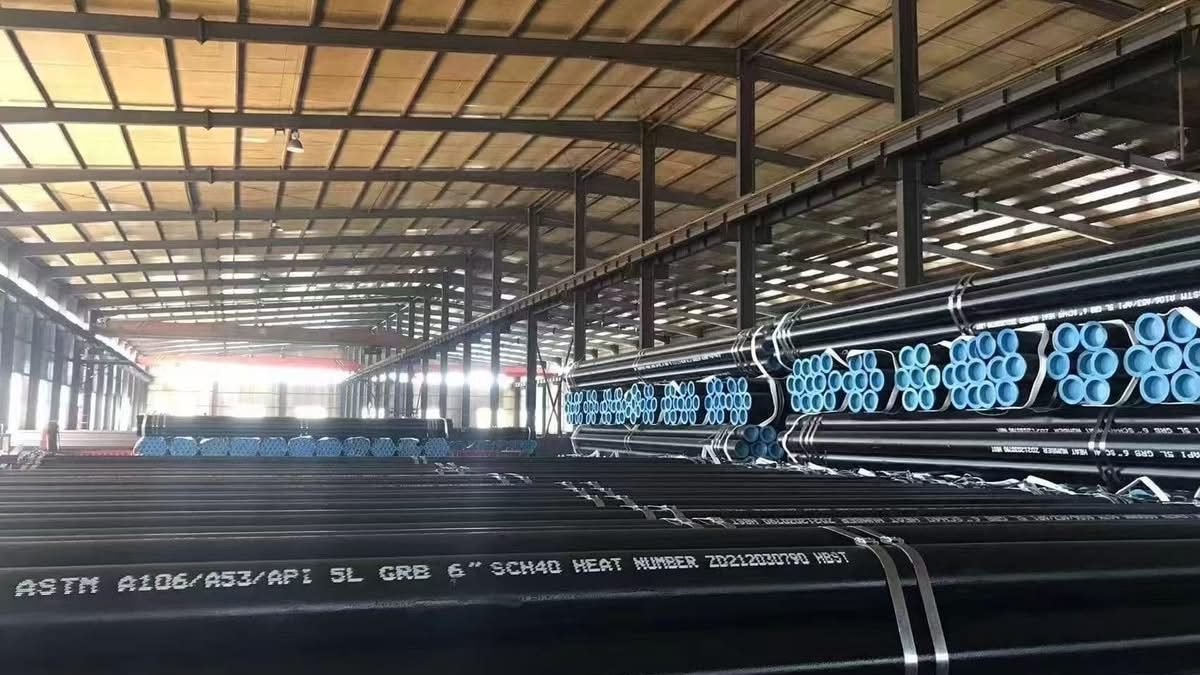
Marking should be legible and permanent. The standard requires the manufacturer, the grade, the heat number and the size to appear on each length or bundle. A stencil that fades before the pipe reaches the site removes the traceability that the certificate was supposed to provide.
Specifying the Right Pipe for Service
The first decision is the design code, because it sets the allowable stress. A boiler built to ASME Section I uses different allowable values from a process line designed to ASME B31.3. The pipe grade is then selected so that the calculated wall at the design pressure and temperature is available in a standard wall schedule.
The second decision is the corrosion allowance. Carbon steel in wet steam or in mildly corrosive process fluid loses wall over time. Adding 1 till 3 mm of allowance is common, and the allowance must be added to the minimum wall, not to the nominal wall. The third decision is toughness. Cold service below the ductile-brittle transition requires impact testing that A106 does not routinely provide. In that case a specification with guaranteed Charpy values is the correct purchase, not an A106 pipe with a request for impact tests added after the fact.
Size selection follows from velocity limits as much as from pressure. A line sized only on pressure will often be noisy or erosive. Steam lines are usually kept below 30 m per second, water lines below 3 m per second, depending on the application. The wall schedule then follows from the diameter and the pressure together.
Fabrication, Bending and Welding Notes
Seamless pipe bends well when the bend radius is generous. Cold bending to a radius of three times the diameter is routine for small sizes. Tight radii require induction bending or hot bending with controlled temperature, and the bend area should be stress relieved afterwards if the design code requires it. Wall thinning on the outside of the bend is normal, and the extent should be measured rather than assumed.
Welding carbon steel pipe of this grade is straightforward with the right consumables. For A106 Grade B, a filler metal matching the strength, such as ER70S-6 for gas shielded processes or E7018 for shielded metal arc welding, is the usual choice. Preheating is generally not required below 20 mm wall in mild ambient conditions, but the joint should be dry and above 5 degrees Celsius. Interpass temperature control matters more than preheat for this grade, because excessive heat input coarsens the grain in the heat affected zone.
Cut ends should be machined or saw cut, not flame cut, when the pipe is to be welded to a high integrity joint. Flame cutting leaves an oxide layer and a heat affected zone that must be removed before welding. For threaded connections, the wall must be thick enough to leave a sound thread root after the thread is cut, which is one reason schedule 80 pipe is used for threaded work.
After welding, the joint is normally inspected visually and by radiography or ultrasonic testing depending on the service. A hydrostatic test of the assembled system follows. The pipe itself does not require heat treatment after welding at these carbon levels unless the wall is heavy and the design code imposes a post-weld heat treatment for thickness.
Common Mistakes Buyers Make
Ordering by nominal wall and expecting the minimum is the most expensive mistake. The standard permits a substantial minus tolerance, and the pressure rating shrinks with it. State the minimum wall if that is what the design needs.
Treating A106 and API 5L as interchangeable is the second. They are close relatives, but the certificates, the testing frequency and the acceptance criteria are not identical. A pipeline inspector will reject an A106 certificate where API 5L PSL2 was specified, even if the steel is perfectly sound.
Third, buyers often forget that the pipe is only one part of the pressure envelope. Beslag, flanges and valves must be rated to match, and the weld procedure must be qualified for the combination. A seamless body joined with an under-matched fitting is not a seamless system.
Fourth, storage practice is routinely ignored. Carbon steel pipe stored outdoors with open ends collects water, and the internal corrosion that follows is often deeper than the corrosion allowance. Caps on the ends and off-ground storage cost almost nothing compared with replacing a bundle.
Fifth, buyers ask for a third party inspection without defining its scope. An inspector with a visual checklist will produce a different result from one with ultrasonic equipment and a written acceptance criterion. The scope belongs in the purchase order.
Vanliga frågor
Is A106 Grade B the same as API 5L Grade B? They share a similar chemistry window and comparable strength, but they are different specifications with different testing and documentation rules. A mill can certify both, and buyers should state which specification governs acceptance.
What does schedule 40 mean? It is a wall thickness series inherited from older pipe standards. Schema 40 is the standard wall, schema 80 is heavier. The schedule does not define the actual wall, so the mill certificate value should always be checked against the design calculation.
Can seamless pipe be galvanised? Ja, hot dip galvanising is common for atmospheric service. The pickling step removes mill scale, and the zinc coating adds atmospheric protection. The process does not change the pressure rating, but it does add thickness that should be considered in threaded work.
Why does the certificate show a higher tensile strength than the standard? Mills aim above the minimum to absorb test scatter and to satisfy customers who order to a minimum wall. A value above the minimum is normal and not a sign of the wrong grade.
How is wall thickness measured in the field? Ultrasonic thickness gauges are the practical tool. Measurements are taken at several points around each end and along the body, and the minimum reading is compared with the design minimum wall, not with the nominal.
What is the difference between PSL1 and PSL2? PSL2 adds mandatory testing, tighter chemistry and traceability requirements. For seamless pipe the physical product may be similar, but the documentation and inspection regime are stricter.
Does a seamless pipe need radiography? The body has no weld to radiograph. Radiography is applied to the field joints after welding, not to the pipe body. Body inspection uses ultrasonic or eddy current methods.
What length should be ordered? Random lengths of 5.8 till 12 m suit fabrication shops. Fixed lengths suit projects with a defined spool schedule. Always state the length rule and the tolerance.
Can the pipe be bent after galvanising? Bending after galvanising cracks the coating at the bend and exposes bare steel. Bend first, then galvanise, or use a coating that can be repaired on site.
How should the pipe be stored? Under cover, on timber or plastic skids, with the ends capped. Avoid ground contact and standing water, and rotate stock so that the oldest heat numbers are used first.
Need a specific wall, length or grade combination for a boiler or line pipe project? Send the size, grade and test requirements for a quotation.
Relaterade produkter
Related pages on this site: Q345D seamless steel pipe, hot dip galvanized round steel tube Q235B, och Q235B plattstång i kolstål.

