 FRAMSTEG
Aluminiumplåt 5052 mot 5083: Marine and Chemical Tank Applications
Aluminiumplåt 5052 mot 5083: Marine and Chemical Tank Applications
Aluminium plate for boats, tankfartyg, silos and chemical equipment is almost always one of two alloys: 5052 eller 5083. Both are non-heat-treatable Al-Mg grades, both resist seawater reasonably well, and both weld with the same filler wire. The difference is magnesium content — ungefär 2.5 % i 5052 och 4.5 % i 5083 — and that difference drives strength, weld behaviour, formbarhet, corrosion performance in alkaline media, and price.
This guide compares the two grades for plate work: kemi, temper designations, mechanical data, corrosion limits, welding metallurgy, toleranser, forming practice and the selection rules that decide which plate belongs on a hull and which belongs on a fuel tank.
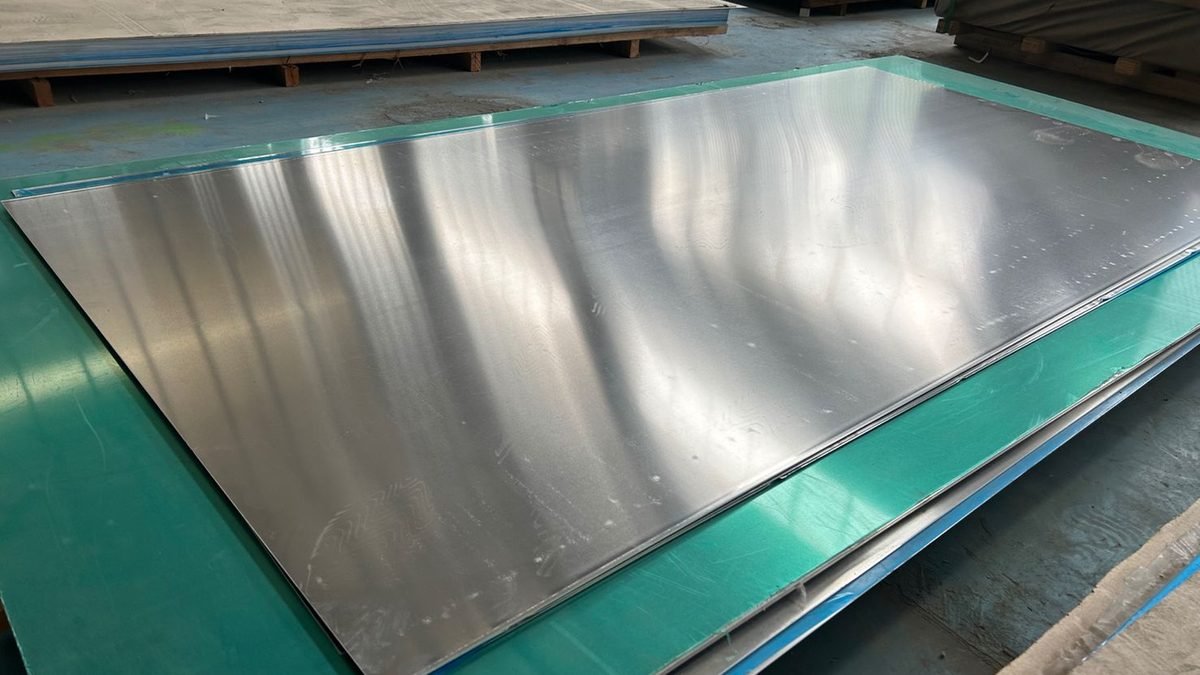
1. What These Two Alloys Are
5052 och 5083 are both solid-solution strengthened alloys. They cannot be hardened by heat treatment; strength comes from magnesium in solution, from manganese and chromium additions that refine the grain structure, and from cold work applied during rolling. That is why the temper designation matters as much as the alloy number.
5052 is the workhorse sheet and plate alloy. It is readily available from 0.5 mm till 150 mm, forms well, welds well, and is the default choice for fuel tanks, oil pans, marine superstructures, VVS-kanaler, pressure vessels and general fabrication. It is supplied in O (glödgat), H32 (quarter hard), H34 and H38 tempers for sheet, and in O or H32 for plate.
5083 is the marine structural alloy. It is available from about 3 mm till 200 mm, usually in O, H111, H116 or H321 temper. H116 and H321 are specially controlled versions for marine service: they specify limits on magnesium content and on the amount of beta-phase precipitate that forms during cooling, because that precipitate is what makes 5083 vulnerable to stress corrosion cracking in alkaline or sensitised conditions.
Neither alloy is suitable for high-temperature service above about 65 °C in welded marine structures without checking sensitisation, and neither should be used for strong alkaline solutions such as caustic soda without a lining or a different alloy.
2. Chemistry
The table shows the standard composition ranges. The magnesium and manganese figures are the commercially decisive ones.
| Element (%) | 5052 | 5083 | Effect |
|---|---|---|---|
| Magnesium | 2.2–2.8 | 4.0–4.9 | Main strengthening element; drives weld strength |
| Mangan | ≤ 0.10 | 0.40–1.00 | Grain refinement and dispersoid formation |
| Krom | 0.15–0.35 | 0.05–0.25 | Corrosion resistance and grain control |
| Järn | ≤ 0.40 | ≤ 0.40 | Impurity; raises strength but reduces ductility |
| Kisel | ≤ 0.25 | ≤ 0.40 | Impurity; affects weld fluidity |
| Koppar | ≤ 0.10 | ≤ 0.10 | Kept low for marine corrosion |
| Zink | ≤ 0.10 | ≤ 0.25 | Impurity; high zinc promotes pitting |
| Titan | — | ≤ 0.15 | Grain refiner in cast slab |
Two practical reading notes. Första, de 5083 magnesium range is capped at 4.9 % in marine tempers; higher magnesium is stronger but sensitises more readily. Second, 5052 carries a deliberate chromium addition, which is part of why it resists fresh water and mildly acidic products better than its magnesium level alone would suggest.
3. Mekaniska egenskaper
Values below are typical minimums for plate to EN 485-2 / ASTM B209. H32 is the common 5052 plate temper; 5083 is normally supplied as O for forming work, or H116/H321 for marine structural work.
| Egendom | 5052-H32 | 5083-O | 5083-H116 |
|---|---|---|---|
| 0.2 % proof stress | ≥ 160 MPa | ≥ 125 MPa | ≥ 215 MPa |
| Draghållfasthet | ≥ 215 MPa | ≥ 275 MPa | ≥ 305 MPa |
| Förlängning, 50 mm | ≥ 7 % | ≥ 16 % | ≥ 12 % |
| Hårdhet | 57 HB | 60 HB | 85 HB |
| Young’s modulus | 68 GPa | 69 GPa | 69 GPa |
| Densitet | 2.68 g/cm³ | 2.66 g/cm³ | 2.66 g/cm³ |
| Värmeledningsförmåga | 138 W/m·K | 117 W/m·K | 117 W/m·K |
The comparison is not straightforward because temper and alloy interact. Against 5052-H32, 5083-O is weaker and much more ductile, which is exactly what you want for forming hull plating before welding. Against the same plate after welding, 5083 recovers far more of its strength in the heat-affected zone than 5052 does, because its higher magnesium content keeps more solute in solution and the weld metal itself is 4.5 % Mg rather than 2.5 %.
That weld strength retention is the practical reason 5083 dominates marine work. A 6 mm 5052-H32 hull welded with 5356 filler loses 30–40 % of its strength across a 25 mm band either side of the weld. The same joint in 5083 loses 15–25 %. Naval architects account for this in the scantling rules; fabricators who ignore it build boats that crack at the weld toe.
4. Corrosion Performance
Both alloys form a passive oxide film and both perform well in neutral seawater. The differences appear in three areas: pitting in chlorides, stress corrosion cracking after sensitisation, and alkaline or acidic chemical exposure.
Seawater pitting. 5052 och 5083 are close in resistance to neutral salt water. 5083’s higher magnesium does not improve pitting resistance; the chromium in 5052 partially compensates. In stagnant seawater, both can pit under deposits, and both benefit from regular cleaning and from avoiding crevices.
Sensitisation and SCC. 5083 with magnesium near the top of the range, cooled slowly through 50–200 °C, precipitates beta phase along grain boundaries. In that condition, the alloy becomes susceptible to stress corrosion cracking in alkaline environments and to intergranular attack. H116 and H321 tempers exist precisely to control this: they limit magnesium to 4.9 % and require a controlled cooling or stabilisation practice, verified by a nitric acid mass loss test. For hull plate thicker than 25 mm, or for structures operating warm, H116/H321 is not optional.
Chemicals. 5052 resists many organic products, fuel, lubricating oil and mildly acidic food products. 5083 resists neutral salts and many chemical cargoes but is less tolerant of strong alkalis. Neither grade is suitable for caustic soda above about 10 % concentration, for wet chlorine, or for concentrated nitric acid. Chemical tankers carrying such cargoes use 316L stainless or a lined tank, not aluminium.
Galvanic corrosion. Aluminium is anodic to steel, stainless steel and copper alloys. In a bilge or a hull, a stainless fastener in an aluminium plate becomes the cathode and the plate around it corrodes. Use isolating washers, aluminium or zinc-plated fasteners, and never allow copper-based antifouling paint to contact bare aluminium.
5. Svetsning
Both alloys weld with 5356 fyllmedel (Al-5Mg) för styrka, eller 4043 (Al-5Si) where crack sensitivity and feedability matter more than strength and colour match after anodising. 5356 is the default for marine plate because the weld metal then matches the magnesium level of 5083 and remains compatible with 5052.
MIG welding is the production process for plate work; TIG is used for root passes, thin plate and repair. Key parameters: cleaned edges (degrease, then stainless brush within the hour), preheat only above 25 mm thickness, interpass temperature below 100 °C for 5083 to limit sensitisation, and a balanced weld sequence to control distortion.
Two metallurgical points are worth stating plainly. Första, aluminium does not show weld colour change, so a welder cannot judge heat input by eye; use a temperature crayon or an infrared thermometer. Second, porosity in aluminium welds comes mostly from hydrogen dissolved in the filler wire and from moisture on the plate surface. Baking filler wire at 120 °C for two hours before use, and storing it in a heated quiver, does more for weld quality than any change in machine settings.
After welding, 5083 structures are often specified with a post-weld treatment: either natural ageing for 30 days or an artificial ageing at 90–120 °C to stabilise the weld zone. This is not the same as heat treatment of a hardenable alloy; it is a stabilisation step that improves corrosion resistance rather than strength.
6. Forming and Fabrication
5052 forms more easily. Its lower magnesium content gives it a wider forming window: bend radii of 1.5–2 times thickness across the grain are achievable in H32 without cracking, and press forming, roll forming and spinning are all routine. Springback is moderate.
5083 is stiffer and springier. In the O temper it forms well, with bend radii around 2–3 times thickness; in H116 or H321 it forms poorly and usually needs to be annealed before tight bends. Rolled hull plate is normally formed in the O temper, welded, and then the whole structure is left in the as-welded condition, with strength taken from the H116/H321 parent plate and the weld derating factor from the classification rules.
Cutting is straightforward with plasma, waterjet or a carbide saw. Plasma leaves a nitride layer on the cut edge that must be removed before welding; a stainless brush or a light grind is enough. Laser cutting is common on thinner plate and gives a weld-ready edge, but the oxide at the cut face still needs cleaning.
Machining 5083 is harder than 5052. The higher magnesium content makes it gummier, and the temper affects chip form. Use sharp, polished carbide, generous feed, and coolant; do not let the tool rub.
For tanks, the fabrication detail that decides service life is not the alloy but the joint design. Lap joints with sealant trap moisture and start crevice corrosion. Butt welds with full penetration, or fillet welds with a sealed faying surface, are the reliable options. Baffles and stiffeners should be continuously welded to the shell, not stitch welded, because a stitch weld creates a series of crevices in the most stressed region.
7. Tjocklek, Tolerances and Availability
| Särdrag | Typical commercial value | Notera |
|---|---|---|
| Thickness 3–6 mm | ± 0.35 mm | Tighter available on request |
| Thickness 6–12 mm | ± 0.45 mm | Crown measured at centre |
| Thickness 12–40 mm | ± 0.60 mm | — |
| Bredd / längd | + 10 / − 0 mm | Saw trimmed edges |
| Flathet | 3 mm/m | Improves with stress-relieved plate |
| Squareness of cut | 1 mm on 1 m | For weld fit-up |
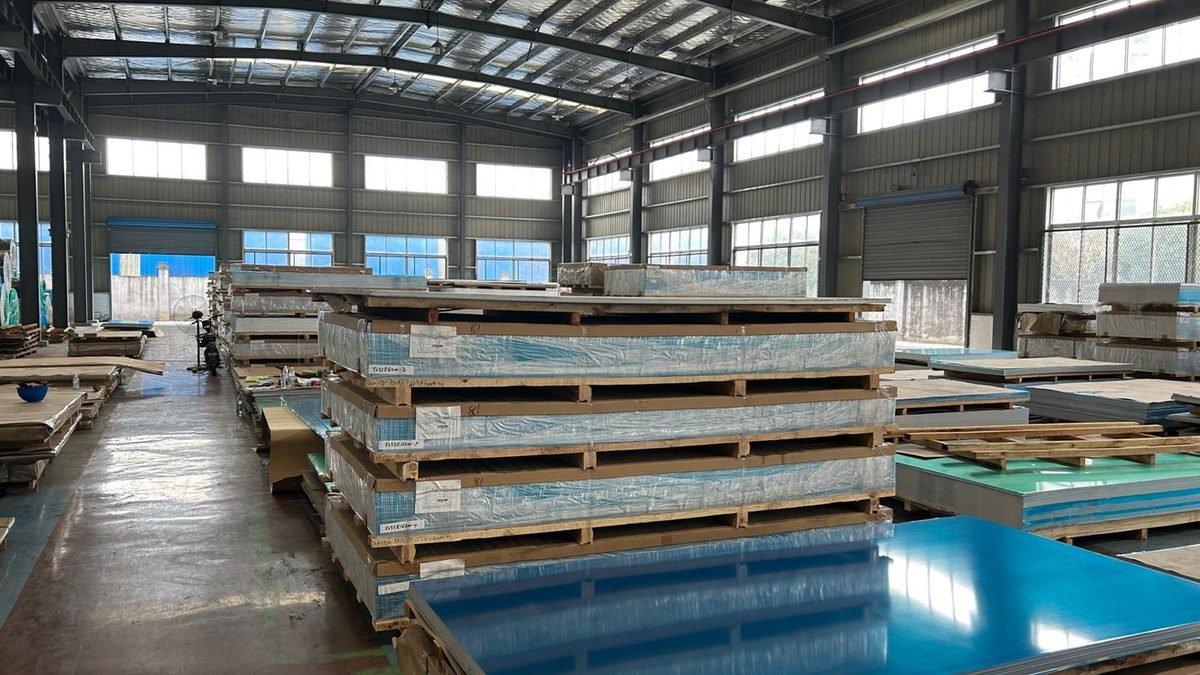
Availability shapes design more than datasheets admit. 5052 is stocked in a wider thickness range and is cheaper and faster to replace. 5083 in H116 above 25 mm is a mill order in many markets, with lead times measured in weeks. If the design can be built from 5052 with a heavier scantling, that is often the faster route to a delivered structure.
Kosta, Weight and Life-Cycle Comparison
On a per-kilogram basis, 5083 plate typically costs 10–20 % more than 5052 of the same thickness, and in the H116 temper the premium is larger because of the extra testing and controlled processing. That premium does not automatically translate into a more expensive structure, because the higher strength of 5083-H116 allows thinner plate for the same scantling.
Work through the numbers for a simple case: a 6 mm 5052-H32 panel replaced by 5 mm 5083-H116 at the same design load. De 5052 panel weighs 16.1 kg/m²; de 5083 panel weighs 13.3 kg/m². Even at a 15 % higher price per kilogram, the finished panel costs about 5 % less, and the structure is 1.7 kg lighter per square metre — which on a 200 m² deck is roughly 340 kg of displacement or payload.
Life cycle reverses the comparison in the other direction. 5052 is easier to repair in a small yard, using stock plate and a standard procedure. 5083-H116 repairs require matching plate, a qualified procedure and, on classified vessels, surveyor involvement. For a vessel operating far from a yard with those capabilities, the repair burden can outweigh the material saving.
Both alloys are fully recyclable and carry a similar scrap value, so the end-of-life calculation is neutral. The real cost driver is the weld procedure and the labour hours around it, not the plate price.
8. Selection Rules
- Hull, deck or superstructure of a working boat: 5083-H116 or H321, with a classification-society-approved weld procedure.
- Fuel tank, oil pan, hydraulic reservoir: 5052-H32. Better formability, adequate fuel resistance, lower cost.
- Chemical tank for neutral salt cargoes: 5083, with full-penetration butt welds and no lap joints.
- Tank for alkaline cargo or caustic cleaning: neither grade; use 316L stainless or a protective lining.
- Pressure vessel: 5083-O for ductility, designed to the applicable pressure vessel code, with impact-tested plate where required.
- Architectural or signage plate: 5052 for formability and finish, 5083 only if strength or marine exposure demands it.
- Repair plate on an existing 5083 hull: match the original alloy and temper. Mixing 5052 into a 5083 hull creates a strength mismatch at the weld.
9. Common Mistakes
Using 5083-O where H116 is specified. The O temper is formable but not approved for the hull scantling, and its sensitisation status is uncontrolled.
Assuming 5083 is automatically more corrosion resistant than 5052. In neutral seawater the two are close; in alkaline media 5083 is the more sensitive of the two once sensitised.
Svetsning 5052 hull plate and designing to parent-metal strength. The heat-affected zone governs, and it is 30–40 % weaker.
Stitch welding stiffeners. Every gap between stitches is a crevice, and crevices in seawater are where pitting starts.
Contact between bare aluminium and copper alloy fittings. The aluminium becomes the anode and the fitting survives while the plate around it disappears.
Buying plate by alloy name only. Humör, sensitisation control and thickness tolerance are the specification. “5083 tallrik” on a purchase order is not a specification.
10. Vanliga frågor
Is 5083 stronger than 5052? In the H116 temper, ja — om 35 % higher proof stress. In the annealed O temper, 5083 is actually softer than 5052-H32, which is the point: it is designed to be formed and then welded.
Can I weld 5052 till 5083? Ja, med 5356 fyllmedel. The joint performs closer to 5052, so design the connection accordingly.
Does aluminium plate need painting in seawater? Below the waterline, ja — an epoxy system with a compatible primer. Above the waterline, kvarn finish 5083 is usually acceptable if it is cleaned regularly and not exposed to copper or steel contact.
Why does 5083 require H116 for boats? Because the temper controls magnesium content and beta-phase precipitation, which together govern resistance to intergranular corrosion and stress corrosion cracking in service.
What thickness plate is used for a 12 m boat hull? Typically 5–6 mm bottom and 4–5 mm sides for a planing hull in 5083-H116, but the scantling must come from the applicable classification rules, not from a rule of thumb.
Can 5052 be anodised? Ja, and it anodises to a cleaner colour than 5083, which is one reason it is preferred for visible architectural work.
11. Sourcing Marine and Tank Plate
QIDAMT supplies 5052-H32 and 5083-O/H116 aluminium plate from 3 mm till 150 mm, skär till storlek, with mill certificates showing alloy, humör, mechanical results and, where required, the nitric acid mass loss test result for sensitisation control. Plate can be supplied with protective film, edge protection and export packing.
Send the structure type, service environment, thickness and quantity. We will confirm the temper, the weld consumables and the certificate package that your classification society or end customer requires.
Behov 5052 eller 5083 plate cut to size?
Tell us the application, thickness and certification requirements for a quotation.
Related specifications: 5052-H32 aluminium sheet, 6061-T6 aluminium plate, och 1060 pure aluminium plate.

