 PROGRESUL
6005 Placa de aluminiu: Aliaj, Temper and Structural Fabrication
6005 aluminium plate is a 6xxx-series Al-Mg-Si alloy supplied in T5 or T6 temper for structural parts that need moderate strength, good extrudability and clean anodised surfaces. It sits between 6063 şi 6061: stronger than architectural 6063, more formable and more weldable than 6061 in some tempers, and widely used for extrusions, scări, balustrade, vehicle frames and structural profiles. This guide covers the 6005 and 6005A distinction, chimie, temper properties, plate sizes, prelucrare, welding and post-weld aging.
Note the naming: EN AW-6005 and EN AW-6005A are related but not identical. 6005A has tighter limits on iron, manganese and chromium to improve extrusion surface and toughness. When a drawing says 6005A, supply 6005A, not plain 6005.
Ce 6005 Plate Is Used For
- Structural extrusions: scări, platforme, walkways and handrails
- Vehicle frames, bus structures, battery trays and mounting brackets
- Rail and transport interior profiles
- Solar mounting rails and framing components
- Machined parts where a clean anodised finish is required
- Heat sinks and housings with moderate strength demand
Compoziție chimică
| Element | 6005 (%) | 6005O (%) | Rol |
|---|---|---|---|
| Magneziu (Mg) | 0.40 – 0.60 | 0.40 – 0.70 | Strengthening with Si |
| Siliciu (Si) | 0.60 – 0.90 | 0.50 – 0.90 | Forms Mg2Si precipitates |
| Fier (Fe) | ≤ 0.35 | ≤ 0.35 | Impuritate; lower is better for finish |
| Cupru (Cu) | ≤ 0.10 | ≤ 0.10 | Impuritate |
| Mangan (Mn) | ≤ 0.10 | ≤ 0.50 | Controls grain structure and toughness |
| Crom (Cr) | ≤ 0.10 | ≤ 0.30 | Rafinează cerealele; îmbunătățește duritatea |
| Zinc (Zn) | ≤ 0.10 | ≤ 0.20 | Impuritate |
| Titan (De) | ≤ 0.10 | ≤ 0.10 | Rafinarea cerealelor |
Single values are maximums unless a range is shown. Confirm the exact registered composition with the mill certificate.
The Mg/Si ratio controls how much of the strengthening phase Mg2Si can form. A heat with magnesium at the low end and silicon at the high end leaves excess silicon, which lowers toughness and can affect anodising colour. For structural parts, ask for the actual Mg and Si values rather than accepting the broad standard range.
Temperatură și proprietăți mecanice
| Temperament | Randament Rp0,2 | Rm de tracțiune | Elongaţie | Utilizare tipică |
|---|---|---|---|---|
| O (recoaptă) | ≈ 110 MPa | ≈ 170 MPa | ≥ 16% | Forming before aging |
| T5 (press quench + age) | ≥ 225 MPa | ≥ 270 MPa | ≥ 8% | Extruded profiles |
| T6 (solution + age) | ≥ 260 MPa | ≥ 290 MPa | ≥ 8% | Machined structural parts |
| T66 | ≥ 270 MPa | ≥ 300 MPa | ≥ 8% | Higher strength, lower elongation |
Minimum values for typical thickness ranges; thin sections usually test higher.
6005 in T5 is the normal temper for extrusions: the profile is quenched at the press and then artificially aged. T6 requires a separate solution treatment and quench, which is practical for plate that will be machined rather than extruded. If a part is welded after T6, the weld zone drops close to O temper and must be re-aged if strength matters.
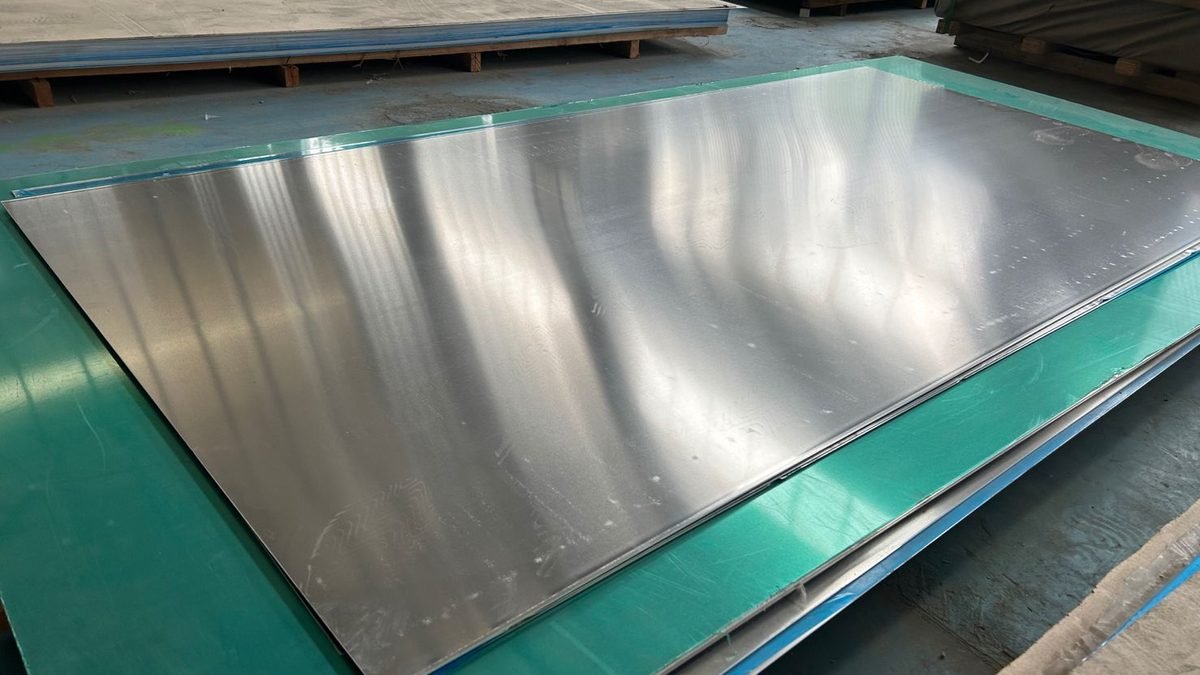
Plate Sizes and Tolerances
| Articol | Gamă | Note |
|---|---|---|
| Grosime | 3 – 150 mm | 5 – 25 mm most common |
| Lăţime | 1,000 – 2,500 mm | Saw cut or mill edge |
| Lungime | 2,000 – 6,000 mm | Cut to size on request |
| Toleranta la grosime | ±0.2 mm typical (rolled plate) | Tighter by agreement |
| Planeitatea | ≤ 3 mm pe metru | Critical for machined parts |
| Suprafaţă | Finisaj moara, anodising quality | Specify if visible |
Prelucrare
6005 machines well in T5 and T6: it is softer than 7075 and less gummy than 5052. Use high spindle speed, sharp carbide and generous chip clearance. The main risks are chatter on thin plate and built-up edge on soft temper.
- Use climb milling for finish passes and air or mist coolant rather than flood where possible.
- Avoid dwelling in a cut; aluminium work-hardens at the surface and a dull tool rubs rather than cuts.
- For tapped holes, use forming taps in T5 and cut taps in T6; check thread depth against the plate thickness.
- Deburr edges before anodising; a rolled-over burr shows as a dark line after anodising.
Welding and Post-Weld Aging
6005 is weldable with 5356 sau 5087 filler in MIG or TIG. The heat-affected zone loses strength in the T5/T6 condition, and the loss is not recovered by natural aging at room temperature. If the welded joint is structural, either design for the annealed strength of the HAZ or re-age the assembly after welding.
| Parametru | Guidance |
|---|---|
| Filler | 5356 (Mg5) sau 5087 for higher strength |
| Current | AC TIG or pulsed MIG; avoid excessive heat input |
| Preheat | Not required; preheat only to dry the surface |
| Post-weld | Mechanical clean, then re-age at 170 – 185 °C if required |
| Anodizare | Weld and HAZ anodise to a different colour; blend or mask |
Filler 5356 anodises darker than 6005 parent metal. For visible architectural joints, either accept the colour difference as a design feature or use a joint design that hides the weld.
Anodising and Surface Finish
6005 takes a clear or colour anodised finish well when the iron content is controlled and the surface is free of embedded iron from tooling. Contamination from carbon steel brushes, files or benches appears as dark smuts after anodising and cannot be removed by polishing.
- Keep aluminum tools separate from steel tools.
- Etch and desmut before anodising; a smutty surface gives a patchy finish.
- Specify the anodising thickness: 10 – 15 µm for indoor, 20 – 25 µm for outdoor.
- Remember that anodising reduces fatigue strength; do not anodise highly stressed parts without review.
Reguli de selecție
6005 sau 6061?
6005 has better extrudability and a smoother anodised finish; 6061 has higher strength, especially in T6, and better machinability. For long extruded profiles and visible anodised frames, 6005 or 6005A is usual. For machined brackets and structural plates carrying higher loads, 6061-T6 is usually the better choice.
6005 sau 6082?
6082 is stronger than 6005 in T6 and is common in Europe for structural profiles. It is less forgiving to extrude and costs more. 6005 is the volume choice for ladders, rails and general framing.
Plate or extrusion?
6005 is primarily an extrusion alloy. Plate is available, but if the part is a long constant section, an extrusion is cheaper per metre and has better surface finish. Use plate when the part is machined, has varying section or needs thickness beyond extrusion capability.
Extrusion Billet or Rolled Plate
Most 6005 in the market is extruded from billet, not rolled into plate. That matters for buyers: an extruded profile has a homogeneous section, a fine surface and a temper set at the press, while a rolled plate has a different grain flow and may need separate solution treatment before aging. If a drawing calls for 6005 placă, confirm whether the mill supplies rolled plate or whether the part can be cut from an extrusion.
- Extrusion gives the best surface for anodising and the lowest cost per metre for constant sections.
- Rolled plate allows thicker sections and machining from solid, but choice of thickness is limited.
- Extruded profiles have longitudinal grain flow; machining across it changes the surface appearance.
- A plate that is T6 may have been solution treated and quenched after rolling, which can introduce residual stress and distortion.
What T5 and T6 Actually Do
T5 means the profile was cooled rapidly at the extrusion press (press quench) and then artificially aged. The quench retains enough magnesium and silicon in solution for the aging step to form fine Mg2Si precipitates. T6 means the part was solution treated at about 530 – 550 °C, stins, then aged; it gives higher strength but requires a furnace and a quench tank, and it can distort thin or asymmetric sections.
| Stage | T5 | T6 |
|---|---|---|
| Solution treatment | Press quench after extrusion | Furnace at 530 – 550 °C |
| Quench | Water or forced air at the press | Water quench |
| Aging | 170 – 185 °C for several hours | 170 – 185 °C for several hours |
| Rezistenţă | Bun | Superior |
| Distortion risk | Scăzut | Higher on thin sections |
| Utilizare tipică | Extruded profiles | Machined plate and critical parts |
Aging temperature and time are not arbitrary. Under-aging leaves strength on the table; over-aging drops strength and can reduce corrosion resistance. For a structural part, ask for the aging curve or at least the hardness after aging, not just the temper letter.
Corrosion and Finish
6005 has good atmospheric corrosion resistance for an aluminium alloy, similar cu 6063 and slightly below 6061 in some environments. It is not a marine alloy in the sense of 5083 sau 5052: in salt spray, 6005 will show surface pitting earlier than the 5xxx grades, although the section loss is usually tolerable for architectural profiles.
- Mill finish is adequate indoors; anodising is the normal outdoor finish.
- Anodising thickness 10 – 15 µm indoors, 20 – 25 µm outdoors, with sealing after anodising.
- Powder coating over a chromate-free pretreatment is an alternative for coloured frames.
- Avoid contact with carbon steel, copper and untreated timber in damp conditions.
- Keep drainage paths open; trapped water at joints causes pitting regardless of alloy.
Application Notes by Industry
Ladders, platforms and access equipment
6005-T5 is common for ladder rails and platform frames because it extrudes to a clean section and keeps strength after the press quench. The design check is deflection, not yield: o 6005 rail is stronger than 6063 but no stiffer, so the section depth still governs.
Vehicle and transport structures
Bus frames, battery trays and mounting brackets use 6005 for weight saving and weldability. Welded joints in T5 lose strength in the HAZ; the joint should be designed for the softened zone or re-aged after welding.
Solar mounting
Rails and clamps are often 6005-T5 or 6005A-T6. The design driver is wind uplift and clamp bearing, not the alloy strength alone; a thin rail that passes the stress check can still crush at the clamp.
Design Values for Structural Checks
Când 6005 is used structurally, the design check uses the certified yield strength for the temper, not the minimum in a catalogue. For T5, the minimum Rp0.2 is around 225 MPa, but production coils commonly test 240 – 270 MPa. Using the minimum is conservative and safe; using a high catalogue value without a certificate is not.
| Verifica | What governs | Common error |
|---|---|---|
| Abatere | Section stiffness (E ≈ 70 GPa) | Assuming higher strength means less deflection |
| Bending stress | Certified Rp0.2 with a safety factor | Using tensile strength instead of yield |
| Local bearing at clamps | Wall thickness and bearing area | Thin wall crushed by clamp load |
| Welded joint | HAZ strength, not parent strength | Designing to T6 parent values |
| Fatigue | Detail category and surface condition | Ignoring anodising and weld toes |
Aluminium modulus is about 70 GPa, roughly one third of steel. O 6005 rail that is strong enough in yield can still deflect too much; the section depth and the support spacing decide the service behaviour.
Surface Preparation before Anodising
Anodising is unforgiving of surface contamination. Iron particles embedded during machining or handling show as black specks; silicone and oil cause patchy etching; a rough saw cut shows a different etch rate from a mill finish.
- Degrease before any mechanical finishing, and again before anodising.
- Use dedicated aluminium files, brushes and gloves; a single steel wire brush ruins a batch.
- Etch uniformly; over-etching rounds edges and changes the appearance of machined faces.
- Desmut after etching so the surface is uniform before anodising.
- Seal after anodising; unsealed anodic film absorbs dye and fingerprints.
Lista de verificare a comenzii
- Aliaj: 6005 or 6005A, stated explicitly
- Temperament: T5, T6 or T66, with the aging condition
- Grosime, latime si lungime, plus flatness requirement
- Suprafaţă: finisaj moara, anodising quality, sau acoperite
- Certificat: chimie, tensile and hardness after aging
- Filler and welding procedure if fabrication is included
- Ambalare: interleaved bundles, edge protection, bundle weight
Greșeli comune
- Substituting 6063 pentru 6005 in a structural extrusion and losing 30 – 40% of yield strength.
- Welding T6 plate and assuming the joint recovers strength without re-aging.
- Using steel brushes and benches, then rejecting the anodised finish.
- Specifying 6005A but accepting plain 6005 because the certificate says ‘6005 series’.
- Machining thin plate without support, then measuring flatness after the clamps are released.
Ambalare, Depozitare și manipulare
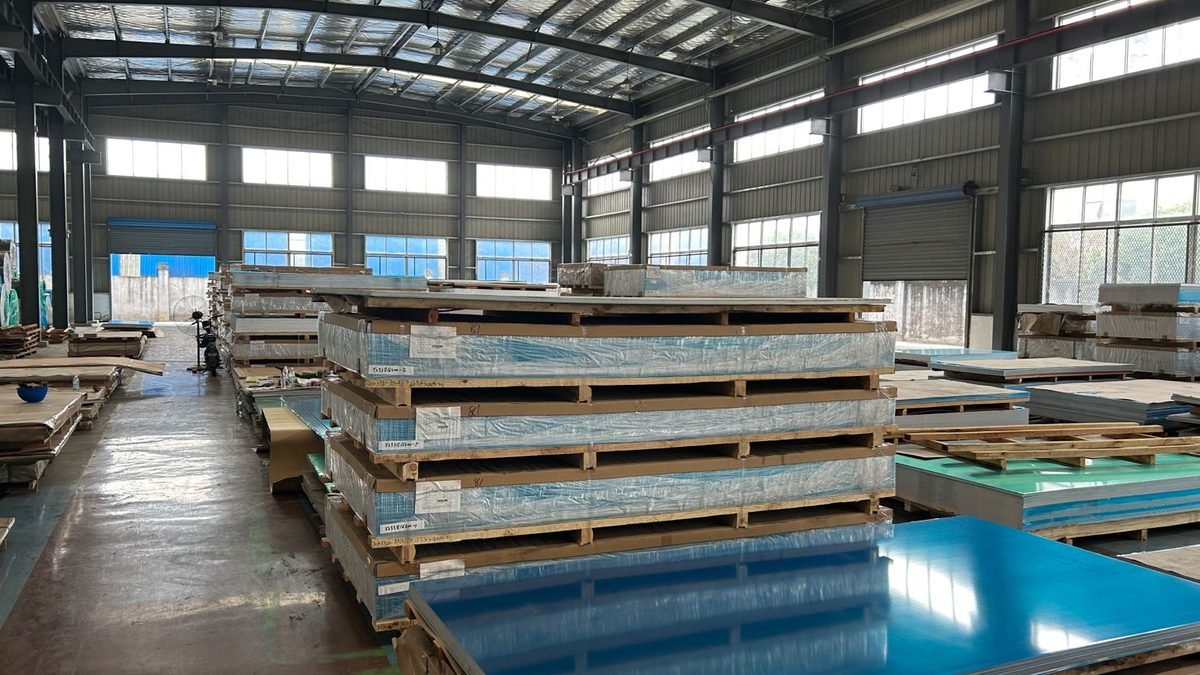
Aluminium plate is light but soft. A stack of 6005 sheets can be scratched by a single grain of grit between them, and a bundle dropped flat can bend a 5 mm plate beyond its flatness tolerance. Packing and site storage deserve the same attention as the alloy selection.
- Interleave sheets with clean paper or board; do not use straw or sawdust that traps moisture.
- Strap the bundle with soft edge protectors; steel straps crush the edges of thin plate.
- Store indoors or under cover, de pe pământ, with ventilation to prevent condensation.
- Do not store aluminium in contact with steel, copper or wet timber.
- Lift bundles with a spreader or forklift with the correct fork spacing; a bundle lifted from one end bends.
For export, ask for a fumigation-free packing declaration if the destination requires it, and confirm the bundle weight against the crane capacity at the site. A bundle that is within the container limit but beyond the site crane limit will sit on the truck until it is broken down by hand. Confirm also that the interleaving paper is dry: damp paper between aluminium sheets causes water staining that cannot be removed by cleaning.
Întrebări frecvente
este 6005 heat treatable?
Da. It is a 6xxx alloy strengthened by Mg2Si precipitation, supplied in T5 or T6 and can be re-aged after welding.
Care este diferența dintre 6005 and 6005A?
6005A has tighter limits on Fe, Mn and Cr for better extrusion surface and toughness. They are not interchangeable on a drawing that specifies 6005A.
Can 6005 fi anodizat?
Da, and it takes a good clear anodised finish when the iron content is controlled and the surface is not contaminated with steel.
este 6005 mai puternic decât 6063?
Da. 6005-T5 has a minimum yield around 225 MPa against roughly 170 MPa for 6063-T5, which is why it is used for structural profiles.
What filler for welding 6005?
5356 sau 5087. The weld and HAZ will be softer than the parent T5/T6 and should be re-aged if the joint is structural.
Do you supply 6005 farfurie tăiată la dimensiune?
Da. Trimite grosimea, lăţime, lungime, temper and quantity; we cut, edge and pack for export.
Related Products on QIDAMT
Nevoie 6005 or 6005A plate for a structural part?
Send temper, grosime, drawing and quantity. We confirm alloy, certificate and lead time within 24 ore.