 PROGRESUL
PPGI Roofing Sheet: Corrugated vs Trapezoidal Profile
PPGI Roofing Sheet: Corrugated vs Trapezoidal Profile
Two roofing sheets can come off the same coil, carry the same colour, and behave completely differently on a roof. The difference is the profile: a corrugated sheet with a sinusoidal wave and a trapezoidal sheet with deep, flat-bottomed ribs use the same steel in different geometries, and that geometry decides span, fixing pattern, walkability and how the roof behaves in wind.
This guide explains what PPGI is, how the coating system is built up, which substrate grades are used, how the two profile families are dimensioned, what span each can carry, how the sheets are fixed and lapped, and where each profile belongs. It covers pre-painted galvanized steel roofing sheet in 0.30–0.80 mm, the thickness range used for industrial sheds, warehouses, agricultural buildings and residential roofing.
1. What PPGI Roofing Sheet Is
PPGI stands for pre-painted galvanized iron, and in practice it means a galvanized steel substrate that has been painted on a continuous coil-coating line before it is profiled. The paint is applied in the flat, cured in an oven, and the coated coil is then roll-formed into the roof profile. That sequence is what separates PPGI from post-painted sheet: the coating is uniform, factory-cured, and wraps slightly around the edges, rather than being sprayed onto a finished profile where the ribs are hard to reach.
The substrate is hot-dip galvanized steel, usually DX51D with a zinc coating of Z100–Z275. The zinc is the corrosion barrier at cuts and scratches; the paint is the weather barrier and the colour. Both are needed, and the failure of either shows up differently: paint failure is a cosmetic and eventually a barrier problem, while zinc failure at a cut edge is red rust.
Coil-coated sheet is supplied either as flat coil for the customer’s own roll-forming line, or as finished profiled sheet cut to length. For a project, profiled sheet is simpler; for a manufacturer, coil is cheaper per square metre.
2. The Coating System
A PPGI coating is a multilayer system, and each layer has a job. A typical build-up from the steel outwards is: zinc coating, a conversion or pre-treatment layer, a primer of 5–8 µm, a topcoat of 15–25 µm, and optionally a back coat of 5–10 µm. The total dry film is usually 25–40 µm on the face and 10–15 µm on the back.
| Coating type | Binder | Service temperature | Colour retention | Cost relativ |
|---|---|---|---|---|
| PE (polyester) | Polyester resin | Până la 80 °C | Bun; fades slowly | lowest |
| SMP (silicone-modified polyester) | Polyester with silicone | Până la 120 °C | Better chalk resistance | low–mediu |
| HDP (high-durability polyester) | Modified polyester | Până la 100 °C | Very good; 15–20 ani | mediu |
| PVDF (fluorocarbon) | Polyvinylidene fluoride | Până la 150 °C | Excelent; 20–25 ani | highest |
PE is the default for industrial and agricultural roofing, and it is adequate where the roof is not exposed to strong sun or chemical attack. PVDF is specified for architectural facades and for coastal or industrial atmospheres where colour stability matters. The price difference between PE and PVDF can be 40–80 % of the coated coil cost, so the choice should follow the exposure, not the sample book.
Back coats matter more than buyers expect. A thin back coat protects the underside from condensation, and in a roof with no internal lining, condensation is continuous. A single-sided coated sheet with a bare galvanized back will show white rust on the underside within a season in a humid building.
3. Substrate Grades and Chemistry
| Element, % | DX51D | S250GD | S320GD |
|---|---|---|---|
| C, max | 0.18 | 0.20 | 0.20 |
| Mn, max | 0.50 | 0.60 | 0.60 |
| Si, max | 0.05 | 0.05 | 0.05 |
| P, max | 0.030 | 0.10 | 0.10 |
| S, max | 0.030 | 0.045 | 0.045 |
| Al, min | 0.020 | 0.020 | 0.020 |
DX51D is the forming grade and is used for most roofing profiles because it bends without cracking in the roll former. The structural grades S250GD and S320GD are used where the sheet itself carries load — a long span roof with purlins at wide centres, or a profile used as a structural deck. The trade-off is formability: a S320GD sheet at 0.40 mm has a much smaller permissible bend radius than DX51D at the same thickness.
| Nota | Yield Re, MPa | Tensile Rm, MPa | Elongation A80, min % |
|---|---|---|---|
| DX51D | 140–260 | 270–410 | 18 |
| S250GD | 250 min | 330–430 | 19 |
| S320GD | 320 min | 390–490 | 17 |
4. Profile Geometry: Corrugated vs Trapezoidal
The two families differ in how the sheet resists bending. A corrugated sheet has a sine-wave section; a trapezoidal sheet has flat ribs with inclined webs and flat troughs. For the same nominal height, the trapezoidal section puts more material far from the neutral axis and is stiffer in bending. That is why a trapezoidal sheet of 0.40 mm can span further than a corrugated sheet of the same thickness.
| Parametru | Corrugated (sinusoidal) | Trapezoidal |
|---|---|---|
| Nominal height | 10–20 mm | 25–45 mm (deep rib) |
| Pas | 76.2 mm sau 150 mm | 200–250 mm |
| Coverage width | 760–1,000 mm after side lap | 1,000–1,100 mm after side lap |
| Thickness range | 0.30–0.55 mm | 0.40–0.80 mm |
| Walking load | Acceptable with care; wave deflects | Better; flat trough takes foot traffic |
| Side lap | One wave overlap | One rib overlap |
| Fixing | Screw into crest, with washer | Screw into trough or crest by system |
| Utilizare tipică | Agricultural sheds, small roofs, placare | Industrial roofs, long spans, ziduri |
The corrugated profile is the older and simpler one. Its sinusoidal section drains well, it is light, and it can be installed by two people without lifting equipment. Its weakness is span: a 0.35 mm corrugated sheet at 76.2 mm pitch is comfortable at 900–1,200 mm purlin spacing and becomes visually springy beyond that.
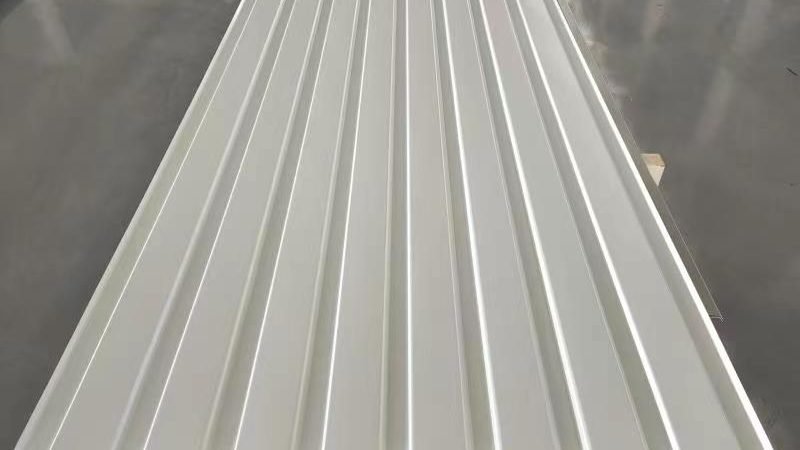
The trapezoidal profile is a structural sheet. The deep ribs give it a much higher section modulus, and the flat troughs mean that a person can walk on it and that snow and debris do not sit in the wave. It also accepts a wider range of accessories — ridge caps, valley gutters, translucent panels — because the rib geometry is standardised across the industry.
5. Span, Load and Purlin Spacing
Roof sheet is designed as a continuous beam over purlins, with the load being the sheet’s own weight plus wind uplift or snow. The governing case is usually wind uplift on the fixings, not downward load on the sheet. That is why the fixing pattern is as important as the profile.
| Profil | Grosime | Max purlin spacing, roof | Max purlin spacing, perete |
|---|---|---|---|
| Corrugated 76 mm pitch | 0.35 mm | 900 mm | 1,200 mm |
| Corrugated 76 mm pitch | 0.45 mm | 1,200 mm | 1,500 mm |
| Trapezoidal 25 mm rib | 0.40 mm | 1,200 mm | 1,500 mm |
| Trapezoidal 35 mm rib | 0.50 mm | 1,500–1,800 mm | 2,000 mm |
| Trapezoidal 45 mm rib | 0.60–0.80 mm | 2,000–2,500 mm | 2,500 mm |
These spans assume a normal wind region and a roof pitch above 10°. In a high-wind area, or on an open-sided building where uplift is severe, the spacing must be reduced or the fixing pattern intensified. A roof that fails in wind almost always fails at the fixings, not in the sheet.
6. Fixing and Detailing
Fixings. Self-drilling screws with an EPDM washer are the standard. The screw must be driven perpendicular to the sheet, into a purlin, with the washer compressed but not crushed. An over-driven screw deforms the crest and creates a leak path; an under-driven screw leaves the washer loose and the hole open to wind.
Model. Every crest at the ends and every second crest in the field is the minimum for a normal roof. In a high-wind zone, every crest at the edges, corners and ridge, and every second crest in the field. The corners of a roof carry the highest uplift, and they are the first place to lose sheets.
Side laps. Corrugated sheets lap one wave; trapezoidal sheets lap one rib. The lap must be in the direction that sheds water — the downwind sheet over the upwind one — and the lap should be fastened at every 300–400 mm.
End laps. For roofs longer than the sheet, an end lap of at least 150 mm with two rows of fasteners is required, and the lap should sit over a purlin. End laps are the weakest point of a metal roof and should be avoided by using longer sheets where transport allows.
Thermal movement. A steel roof expands and contracts with temperature. A 10 m sheet moves about 3 mm over a 40 K swing. Fixings in the middle of the sheet should be in slotted or oversize holes, or the sheet should be fixed only at the ridge end, so that the movement does not tear the fasteners out.
Tăiere. Cut with a nibbler, a shear or a profile saw. An abrasive disc cuts the sheet but overheats the paint at the cut and leaves a burr that rusts; the heat-affected paint edge is the first place a roof shows corrosion.
7. Where Each Profile Belongs
Corrugated sheet is the right choice for a small agricultural building, a shed, a canopy, a site office roof, and for wall cladding where the wave is a visual feature. Este ieftin, light, available everywhere, and easy to install without a crane. It is the wrong choice for a 12 m span industrial roof, for a roof that will be walked on regularly, and for a building where snow load is significant.
Trapezoidal sheet is the right choice for industrial and warehouse roofs, for long spans, for walls that must resist wind, and wherever translucent rooflights and standard accessories must align. It costs more per square metre and needs a roll-forming line or a supplier who can deliver cut-to-length sheets.
Colour is a separate decision from profile. A dark colour absorbs heat and increases the surface temperature of the sheet, which accelerates coating degradation and thermal movement. In a hot climate, a light colour is the better engineering choice even if the architect prefers dark.
8. Depozitare, Handling and Site Practice
Bundles. Sheets arrive in bundles of 20–30, strapped and often with edge protection. The bundle should be lifted with a spreader beam or with slings positioned under the bundle, never by the straps alone, and never dragged across the ground, because the bottom sheet takes the abrasion and the first thing the client sees on site is a scratched sheet.
Depozitare. Store on bearers at 300 mm centres, clear of the ground, with a slight slope so water runs off, and never with a waterproof cover laid directly on the sheets. A tarpaulin that traps condensation against a painted surface produces white rust within weeks, and that is a storage failure that will be blamed on the coating.
Stacking. Stack sheets of the same profile together. Mixing a shallow corrugated sheet under a deep trapezoidal bundle concentrates load on the crests of the lower sheets and deforms them permanently.
Site cutting. Cut on a clean, flat surface away from the roof, with the sheet clamped so it does not vibrate. Swarf must be swept off immediately: steel chips left on a finished roof rust and stain the coating, and the stain does not come off.
Pasarele. If the roof will be serviced regularly, fit permanent walkway boards or a proprietary walkway system. Repeated foot traffic on the same line of crests compresses the profile and cracks the coating along the fold, care este exact locul unde începe coroziunea.
Sequencing. Install the sheets in the direction that lets each new sheet lap over the previous one in the water flow direction, and finish each run before starting the next. A roof installed from both ends towards the middle ends up with a lap facing the wrong way that has to be cut out.
9. Common Mistakes
Buying by profile name only. “Trapezoidal 0.5 mm” does not say which rib height, which coverage width, or which coating. Two suppliers will deliver sheets that do not align with each other’s accessories.
Under-specifying the coating. A PE coating on a coastal roof will chalk and fade within five years. The profile lasts; the colour does not. If the roof is visible from the road or from the office, the coating is the part people judge.
Fixing only in the field. Edge and corner fixings carry the wind uplift. A roof fastened at every second crest in the middle and every fourth at the edge is a roof waiting for a storm.
Walking on corrugated sheet during installation. The wave deflects under a boot and the crest can buckle permanently. Use crawl boards, and walk in the troughs of a trapezoidal sheet, not on the ribs.
Cutting with an angle grinder. The heat destroys the paint and the zinc at the cut edge. Use a shear or nibbler, and touch up any cut with a matching repair paint.
Ignoring condensation. A single-skin metal roof over a humid interior drips. The fix is a vapour barrier or a liner panel, not a thicker sheet.
10. Întrebări frecvente
What does PPGI stand for? Pre-painted galvanized iron. The “iron” is historical; the substrate is steel.
Is PPGI the same as colour-coated steel? Yes in practice. PPGL is the aluminium-zinc variant, which has better heat resistance and a different cut-edge behaviour.
How long does a PPGI roof last? With a PE coating and Z120 substrate, 10–15 years in a moderate climate; with PVDF and Z275, 20–25 ani. The life is set by the coating and the atmosphere, not by the profile.
Can I use 0.30 mm sheet on a 1.5 m span? Not on a roof in a wind zone. 0.30 mm corrugated at 1.5 m purlin spacing will deflect visibly and fatigue at the fixings.
Do I need a purlin at every sheet end lap? Da. An end lap that is not supported will lift and leak.
Why do the sheets come in different lengths? Because they are roll-formed to order from coil, and the length is limited by transport and handling. Longer sheets mean fewer laps and a better roof, up to the point where handling becomes unsafe.
11. Sourcing PPGI Roofing Sheet
QIDAMT supplies pre-painted galvanized steel coil and profiled roofing sheet in DX51D, S250GD and S320GD, thickness 0.30–0.80 mm, zinc coating Z100–Z275, with PE, SMP, HDP and PVDF coating systems, in corrugated and trapezoidal profiles cut to length. Colour, gloss, coating thickness and back-coat are stated on the order and confirmed on the coil certificate.
The base coil is listed here: Galvanized Steel Strip DX51D. For the structural members that carry the roof, vedea Q235B Bară plată din oțel carbon şi Hot-Dip Galvanized Round Steel Tube.
Need a specific profile, colour or coating system?
Send the profile, grosime, coverage width, colour and quantity, and we will confirm the production schedule.
Related reading: Galvanized Steel Strip DX51D · Q235B Flat Bar · Galvanized Round Tube