 PROGRESSO
Galvanized Steel Coil Z350: Heavy Coating for Coastal Service
Z350 galvanized steel coil carries 350 g/m² of zinc across both surfaces — about 24 – 25 µm per side — making it the heavy-coating option for coastal, industrial and ammonia-rich environments. It is the same hot-dip process as Z275, with more zinc and a longer sacrificial margin at cut edges. This guide explains the coating arithmetic, the base grades it is applied to, the environments where Z350 earns its premium, coil tolerances, slitting and forming, soldagem, and the storage rules that decide whether the coating arrives intact.
What Z350 Means
The Z number is the total zinc mass on both surfaces in grams per square metre, measured by the triple-spot test or by weigh-strip. Z350 therefore gives 175 g/m² per side. With zinc density of 7.14 g/cm³, 175 g/m² corresponds to about 24.5 µm of coating per face.
| Revestimento | Total g/m² | Per side g/m² | Approx µm per side | Ambiente |
|---|---|---|---|---|
| Z100 | 100 | 50 | 7 | Interior, seco, pintado |
| Z120 | 120 | 60 | 8.5 | Interior, light outdoor |
| Z180 | 180 | 90 | 12.5 | Sheltered outdoor |
| Z275 | 275 | 137.5 | 19 | Ar livre, cobertura, canalização |
| Z350 | 350 | 175 | 24.5 | Litoral, industrial, ammonia |
| Z450 | 450 | 225 | 31.5 | Severe marine, special order |
The coating mass is not the only variable. Zinc-iron alloy layer thickness, spangle, surface passivation and oiling all affect how the coil performs in forming and how long it survives in storage. Two coils with the same Z350 label can behave differently if one is skin-passed and the other is regular spangle.
Classes de aço básico
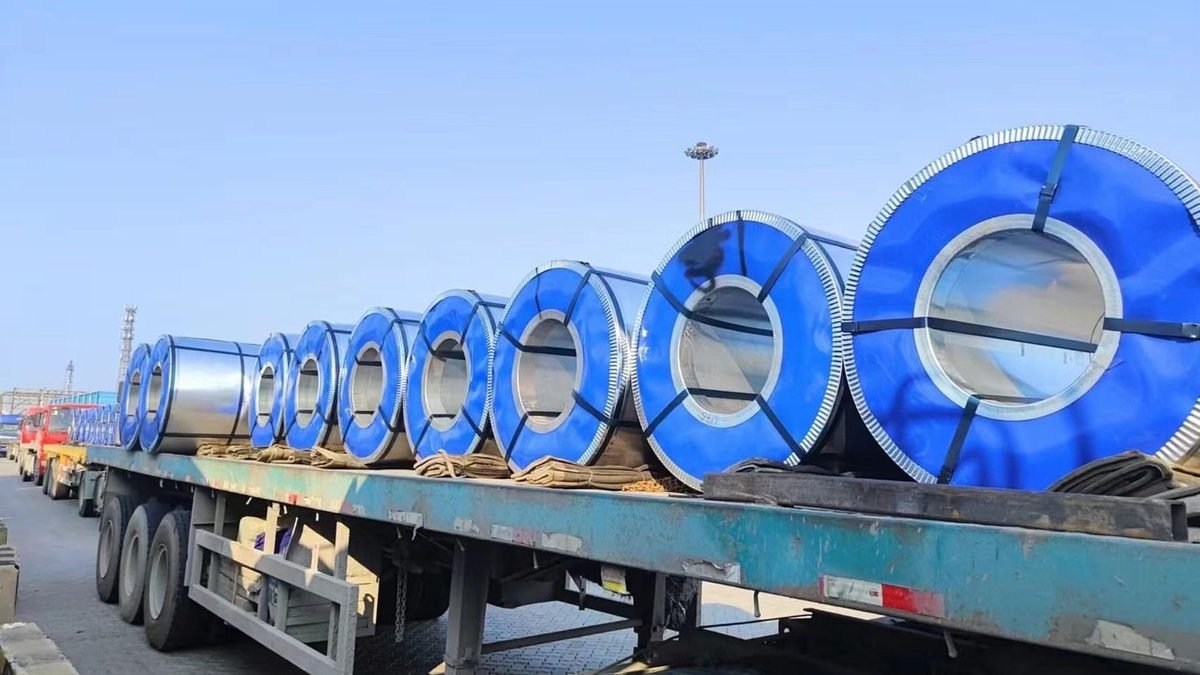
Z350 is a coating designation, not a steel grade. It can be applied to DX51D for general forming, DX52D for drawing, S250GD or S350GD for structural use, or HX340LAD for automotive applications. The base grade must be stated separately.
| Nota básica | Colheita (MPa) | Typical use with Z350 |
|---|---|---|
| DX51D | 140 – 300 | General panels, canalização, cobertura |
| DX52D | 140 – 300 (forming quality) | Formed parts in coastal service |
| S250GD | ≥ 250 | Light structural profiles |
| S350GD | ≥ 350 | Quadros estruturais, montagem solar |
| S450GD | ≥ 450 | High-strength structural |
A Z350 coil on DX51D is not a structural product. If the part carries load, order Z350 on S350GD and check the mechanical certificate, not just the coating line.
Chemical Composition of the Base Steel
| Elemento | DX51D (%) | S350GD (%) | Observação |
|---|---|---|---|
| Carbono (C) | ≤ 0.12 | ≤ 0.20 | Strength and weldability |
| Silício (E) | ≤ 0.50 | ≤ 0.60 | Adesão do revestimento |
| Manganês (Mn) | ≤ 0.60 | ≤ 1.70 | Força |
| Fósforo (P) | ≤ 0.10 | ≤ 0.10 | Impureza |
| Enxofre (S) | ≤ 0.045 | ≤ 0.045 | Impureza |
| Alumínio (Al) | 0.020 min | 0.015 min | Desoxidação |
Silicon is the element most often blamed for coating defects. High silicon with a thick zinc layer can produce bare spots or poor adhesion, so a Z350 order should state the silicon range and require a coating adhesion test on the sample.
Propriedades Mecânicas
| Propriedade | DX51D + Z350 | S350GD + Z350 | Comentário |
|---|---|---|---|
| Força de rendimento | 140 – 300 MPa | ≥ 350 MPa | Certified value governs |
| Resistência à tracção | 270 – 420 MPa | 420 – 560 MPa | Check against design |
| Elongation A80 | ≥ 26% | ≥ 16% | Forming limit |
| Adesão do revestimento | No flaking on bend | No flaking on bend | Test the actual coil |
| ID da bobina | 508 / 610 milímetros | 508 / 610 milímetros | Match uncoiler |
| Peso da bobina | 3 – 10 t | 3 – 10 t | Crane and container limit |
How Long Z350 Lasts
Zinc corrodes at a rate set by the environment, and the coating mass sets how long that rate can be tolerated. The ISO 9223 corrosivity categories give a useful planning basis, but site-specific pollution, salt spray and drainage can shorten life sharply.
| ISO 9223 category | Ambiente | Typical zinc loss (µm/year) | Z350 life estimate |
|---|---|---|---|
| C2 | Interior, seco | 0.5 – 1 | 25+ anos |
| C3 | Urban, sheltered | 2 – 3 | 10 – 12 anos |
| C4 | Industrial, coastal inland | 4 – 6 | 5 – 7 anos |
| C5 | Marinho, heavy industrial | 8 – 12 | 2 – 3 anos |
| CX | Offshore, tropical marine | 15+ | 1 – 2 anos |
Estimates assume uniform exposure and free drainage. Crevices, trapped water and acid run-off shorten life regardless of coating mass.
The table explains why Z350 is specified for coastal and industrial work: at C4, Z275 gives roughly 4 – 5 years before the coating is consumed, while Z350 gives 5 – 7 anos. Neither is a substitute for a protective paint system in C5, but Z350 buys time and protects cut edges better.
Surface Options
| Option | Efeito | When to specify |
|---|---|---|
| Lantejoula normal | Visible zinc crystals | Unpainted, traditional appearance |
| Passado na pele | Suave, low spangle | Pintura, visible parts, formando |
| Chromate-free passivation | Temporary corrosion protection | Storage and transport |
| Oleado | Barrier during storage | Sea freight, long storage |
| Anti-fingerprint | Low-friction, clean handling | Appliance and visible panels |
Oiling and passivation are temporary measures, not permanent protection. A coil stored for six months in a humid warehouse can still develop white rust if water condenses between wraps, even with oil.
Corte, Forming and Welding
Z350 is softer at the surface than the steel underneath, so the coating is easy to mark and easy to smear during slitting. Use sharp slitter knives with correct clearance, and specify deburred edges for parts that will be handled.
- Formação de rolo: set the rolls for the actual yield of the coil; the thick coating does not change springback.
- Dobrando: the coating limits the tightest radius; a Z350 surface cracks before the steel does at a sharp bend.
- Desenho profundo: possible on DX52D base, but use drawing oil and polished dies to avoid coating pick-up.
- Soldagem: remove zinc from the weld zone and provide fume extraction; zinc oxide fumes are harmful.
- Cortar bordas: the thicker coating gives a longer sacrificial margin, but still paint or seal edges in C4/C5 service.
Regras de Seleção
Z350 or Z275?
Z275 for standard outdoor roofing and ducting; Z350 when the site is within a few kilometres of the coast, when the part is unpainted, when cut edges are exposed, or when the structure cannot be repainted easily. The price step is small compared with the cost of early corrosion.
Z350 or a painted system?
In C5 or CX environments, Z350 alone is not enough for a 20-year design life. Use Z350 as the substrate and add a compliant paint system; the zinc protects the steel at scratches and the paint slows the zinc consumption.
Coil or cut sheet?
Coil suits roll forming and continuous lines; cut sheet suits roofing and duct work. Z350 sheet is usually cut from the same coil, so ordering coil and cutting to length is often cheaper than stocking two products.
How the Z350 Coating Is Applied
Hot-dip galvanizing is a continuous line process. The cold-rolled strip is cleaned and annealed, then passed through a molten zinc bath at about 450 – 460 °C. The coating weight is controlled by gas knives that wipe excess zinc from the strip as it leaves the bath: the knife pressure and line speed set the final mass, which is why a Z350 coil is not simply a Z275 coil left in the bath longer.
- The zinc-iron alloy layer at the interface provides the bond; a thicker coating does not mean a thicker alloy layer.
- Cooling rate after the bath controls spangle size; faster cooling gives finer crystals.
- Skin-passing after cooling flattens the surface and eliminates yield-point elongation.
- Passivation and oiling are applied at the exit end of the line, before recoiling.
- Coating mass is checked by weigh-strip or by triple-spot tests at the line ends and centre.
Understanding the line matters when a project asks for ‘Z350 with extra adhesion’. Adhesion is a function of surface cleanliness, bath chemistry and the alloy layer, not of coating mass. A poorly cleaned strip can produce a heavy coating that flakes on the first bend.
Adhesion and Bend Testing
The standard workshop check is a bend test: bend a sample through 180° over a mandrel and inspect the outside of the bend for flaking or cracking of the coating. For Z350, a small amount of surface crazing is normal; exposed steel is not.
| Teste | Método | Acceptance |
|---|---|---|
| Teste de dobra | 180° over mandrel, coating on outside | No flaking or exposure of substrate |
| Adhesion tape test | Pressure tape on a scored grid | No coating lift-off |
| Coating mass | Weigh-strip, triple spot | Within the Z350 class limits |
| Grossura | Micrometer at three points | Within ordered tolerance |
| Superfície | Visual under normal light | No bare patches, dents or white rust |
If the coil will be roll-formed into a profile with a tight radius, test the actual coil, not a sample from a different heat. Adhesion varies with the alloy layer and the strip cleanliness, and a coil that passes a flat bend can still fail on a sharp formed corner.
Cut Edges, Holes and Welds
Every cut, punch and weld interrupts the zinc coating. The thicker Z350 coating protects the exposed steel around a cut edge by sacrificial action, but the protected zone is finite: aproximadamente 2 – 3 mm of lateral protection per 100 g/m² of coating in mild conditions, less in chloride service.
- For holes and slots, the coating on the bore is destroyed; seal or paint the bore in C4/C5 service.
- For welded joints, remove zinc from the weld zone, soldar, clean, then apply a zinc-rich repair coating.
- For sheared edges exposed to weather, a stripe of zinc-rich primer is cheaper than replacing the panel in five years.
- Do not rely on the coating alone at the cut edge of a coastal installation; design the edge so water drains away.
Z350 Compared with Zinc-Aluminium Coatings
Z350 is a pure zinc coating. Zinc-aluminium coatings (Zn-5% Al, Zn-55% Al) offer different performance: the aluminium addition improves high-temperature oxidation and some atmospheric resistance, but changes weldability, cut-edge protection and paint compatibility. Z350 remains the straightforward choice where conventional galvanized steel is specified and where fabrication practices are already established.
| Revestimento | Cut-edge protection | Atmospheric resistance | Soldagem |
|---|---|---|---|
| Z275 / Z350 (zinc) | Sacrificial, well understood | Good in C3/C4 | Standard practices apply |
| Zn-5% Al | Better than pure zinc in some tests | Improved in industrial atmospheres | Similar to zinc |
| Zn-55% Al | Less sacrificial at cut edges | Better in marine and industrial | Different procedure required |
The comparison is not a reason to switch grades mid-project. If the specification says hot-dip galvanized Z350, supply Z350; substituting a zinc-aluminium product changes the corrosion mechanism at cut edges and the welding procedure.
Coating Mass Verification and Disputes
Coating mass is the one property most likely to be disputed at delivery, because it cannot be judged by eye and because the measuring method changes the result. The triple-spot test takes three 100 milímetros × 100 mm samples across the coil width and averages them; weigh-strip dissolves the coating from a known area and weighs the loss. A single spot reading near the coil edge can read low because the gas knives leave a thinner coating at the edges.
- Agree the test method and the sampling positions before shipment.
- Accept the coil only against the certificate and your own check, not against a visual impression.
- Edge thinning is normal; do not reject a coil because the last 20 mm is lighter than the centre.
- If the result is marginal, re-test at three positions before raising a claim.
- Keep the cut samples and the certificate together for traceability.
Lista de verificação de pedidos
- Coating class Z350, with the standard (EM 10346 or ASTM A653)
- Nota básica: DX51D, DX52D, S250GD or S350GD
- Grossura, width and coil weight, plus metres required
- Superfície: regular spangle or skin-passed
- Passivation and oiling for the storage duration
- Coating mass certificate and adhesion test result
- Edge condition and packing for sea freight
Storage and White Rust
- Store coils under cover, off the ground, with ventilation between wraps.
- Never store coils on their side; the edges take the load and deform.
- Dry the coil before re-wrapping if condensation has formed.
- Keep the coil eye clear for lifting; damaged outer wraps are not a coating failure but they are scrap.
- White rust is zinc hydroxide, not steel corrosion; it indicates trapped moisture and must be removed before painting.
Erros Comuns
- Ordering Z350 and then treating it as a structural grade without checking the base steel.
- Assuming a thicker coating also means a harder or stronger sheet.
- Leaving cut edges unsealed in coastal service.
- Welding without removing zinc and without fume extraction.
- Storing coils flat on the ground through a rainy season.
- Comparing Z350 with Z275 by price per tonne rather than by cost per year of service.
Lubrication during Slitting and Forming
Zinc is soft and has a low melting point. In high-speed slitting or roll forming, poor lubrication causes zinc pick-up on the tooling, which then scores the strip and leaves a rough surface that paints badly. Use a lubricant that is compatible with the passivation and with any subsequent paint system; a chlorinated cutting oil can attack the zinc or leave residues that are hard to remove.
- Keep slitter and roll surfaces clean; zinc build-up changes the clearance and the burr.
- Use a light, zinc-compatible forming lubricant, not a heavy drawing compound that must be stripped later.
- For painted products, confirm that the lubricant can be removed by the pretreatment line.
- Clean the strip before recoiling; trapped lubricant between wraps causes staining in storage.
Perguntas frequentes
What is the difference between Z350 and Z275?
Coating mass: 350 g/m² versus 275 g/m² total, sobre 24.5 µm versus 19 µm per side. Z350 lasts longer in corrosive environments and protects cut edges for longer.
Is Z350 available on structural steel?
Sim, on S250GD, S350GD and S450GD. The base grade must be ordered separately from the coating class.
Can Z350 be painted?
Sim, and in C4/C5 service it should be. Use a pretreatment compatible with zinc and a primer designed for galvanized surfaces.
Does Z350 rust at cut edges?
The zinc sacrifices itself at the cut edge, which is why a thicker coating helps. In severe service, seal or paint the edge.
What is the coil inner diameter?
508 milímetros ou 610 mm as standard; state the uncoiler mandrel so the coil fits.
Do you supply Z350 slit to width?
Sim. Send finished width, edge condition and coil weight limit; we slit from master coil and pack for export.
Related Products on QIDAMT
Need Z350 coil for a coastal project?
Send base grade, grossura, largura, coating mass and destination. We confirm certificate, packing and delivery within 24 horas.