 PROGRESSO
8K Mirror Stainless Steel Sheet: Polimento, Thickness and Protection
An 8K mirror stainless steel sheet is not a special alloy. It is an ordinary 304 cold-rolled sheet that has been ground and polished until the surface reflects an image with almost no distortion. The difference between a good mirror sheet and a disappointing one is rarely the steel mill — it is the polishing sequence, the flatness of the base sheet, and the way the material is handled after polishing. This guide sets out what 8K actually means, which thicknesses are practical, how the surface is produced, and the rules that keep a mirror finish intact through fabrication and installation.
What an 8K Mirror Sheet Is and Where It Is Used
In stainless steel finishing, the “K” in 8K refers to the grit size of the abrasive used in the final polishing stage, not to a measured reflectance value. A No.8K finish is produced with abrasives around 8000 grit and typically reaches a surface roughness (Rá) of roughly 0.005 para 0.01 micrometre. Colloquially the trade calls this a super mirror or 8K mirror. The visual result is a sheet that reflects objects with sharp edges and only a slight colour shift, because stainless steel reflects slightly warmer than silvered glass.
The product is supplied as flat sheet or cut-to-size panel, almost always in grade 304, sometimes in 316L for coastal or chemical environments. Standard thicknesses run from 0.3 mm para 3.0 milímetros, com 0.5 milímetros, 0.8 milímetros, 1.0 milímetros e 1.2 mm the most common for interior work. Widths of 1219 milímetros e 1500 mm cover most elevator, column and cladding panels; lengths of 2438 milímetros e 3000 mm are usual, and custom cut lengths are common because mirror surfaces are difficult to join without visible seams.
Typical uses include elevator cars and doors, decorative columns, balcões de recepção, retail display fixtures, kitchen splashbacks, sinalização, mirror walls in gyms and hotels, and appliance fronts. In nearly every case the sheet is a visual element, so the acceptance criteria are cosmetic: no polishing marks, no orange-peel texture, no scratches, and no distortion of reflected straight lines.
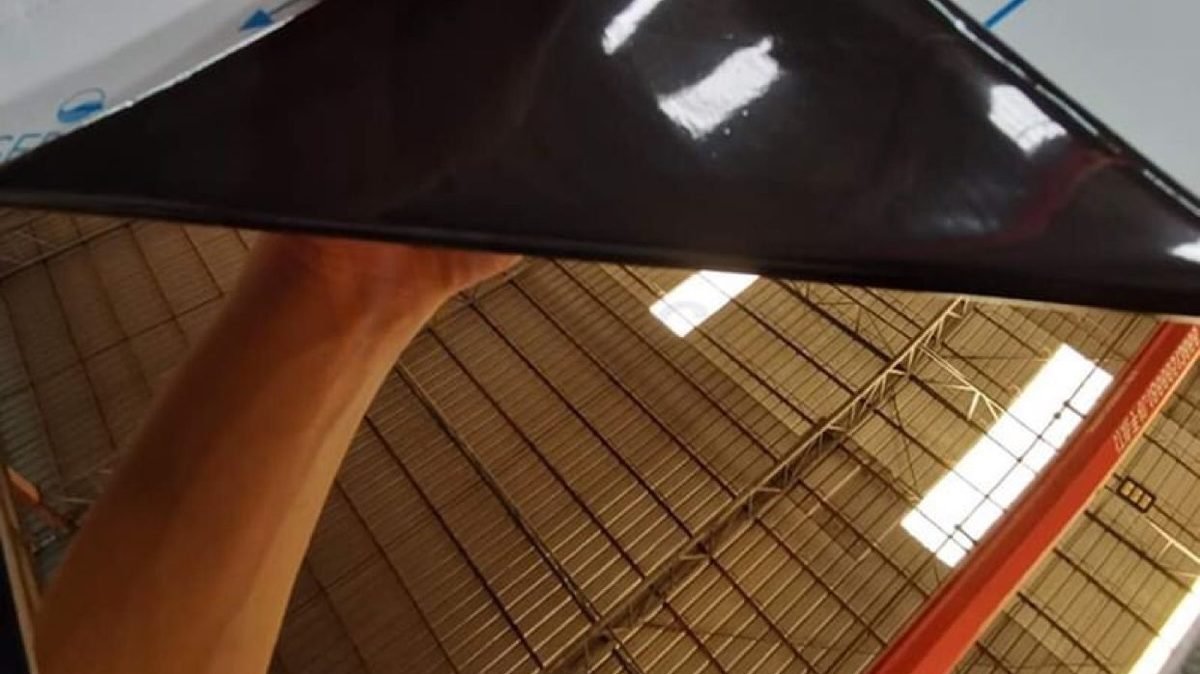
The photograph above shows the property buyers should test first: a reflected straight edge should remain straight. A sheet can be bright and still fail this check if the base coil had poor flatness or if the polishing wheel pressed too hard.
Grade and Chemical Composition
Mirror sheet is a surface product, but the substrate still has to be a sound austenitic stainless steel. Nota 304 (EUA S30400, EM 1.4301, GB/T 3280 06Cr19Ni10) is the default. Its chromium content provides the passive film that keeps the surface from rusting in indoor atmospheres; its nickel content stabilises the austenite so the sheet can be deep-drawn or bent without cracking. Grade 316L is chosen when chlorides are present, because molybdenum improves pitting resistance.
| Elemento | 304 faixa (%) | 316L range (%) | Why it matters for a mirror |
|---|---|---|---|
| Carbono (C) | ≤ 0.08 | ≤ 0.03 | High carbon leaves carbide streaks after polishing |
| Silício (E) | ≤ 1.00 | ≤ 1.00 | Excess silicon makes the surface harder to cut cleanly |
| Manganês (Mn) | ≤ 2.00 | ≤ 2.00 | Deoxidiser; not a corrosion element |
| Fósforo (P) | ≤ 0.045 | ≤ 0.045 | Segregation causes polishing comets |
| Enxofre (S) | ≤ 0.030 | ≤ 0.030 | Inclusions appear as tiny pits under bright light |
| Cromo (Cr) | 18.0–20.0 | 16.0–18.0 | Passive film; the reason the mirror does not tarnish |
| Níquel (Em) | 8.0–10.5 | 10.0–14.0 | Austenite stability, toughness, drawability |
| Molibdênio (Mo) | — | 2.0–3.0 | Chloride pitting resistance for coastal use |
| Ferro (Fé) | Equilíbrio | Equilíbrio | Matriz |
Typical ladle ranges to ASTM A240 / EM 10088-2. Confirm against the mill certificate for the actual heat.
Propriedades Mecânicas
Polishing is a cold-working operation at the surface only. It raises surface hardness slightly and can leave a shallow residual stress layer, but it does not change the through-thickness tensile properties of an annealed sheet. Design values should therefore be taken from the annealed 304 condition, not from a hardness reading taken on the polished face.
| Propriedade | 304 recozido | 316L annealed | Notes |
|---|---|---|---|
| 0.2% estresse de prova (Rp0.2) | ≥ 205 MPa | ≥ 170 MPa | Use for panel stiffener design |
| Resistência à tracção (Rm) | ≥ 515 MPa | ≥ 485 MPa | Minimum in ASTM A240 |
| Alongamento (A50) | ≥ 40% | ≥ 40% | Allows bending and roll-forming |
| Dureza (HBW) | ≤ 201 | ≤ 217 | Polished face may read 10–30 HB higher |
| Densidade | 7.93 g/cm³ | 7.93 g/cm³ | For weight and freight estimates |
| Expansão térmica | 17–18 × 10⁻⁶ /K | 17–18 × 10⁻⁶ /K | Allow movement at panel joints |
| Condutividade térmica | 15–16 W/m·K | 15–16 W/m·K | Baixo; heat stays at the surface during polishing |
Minimum values for annealed product; actual mill values are normally higher.
The practical consequence is that a 1.0 mm mirror panel is not a structural element. It carries its own weight and wind pressure only when fixed to a solid substrate or framed with stiffeners. Where the mirror is used as a load-bearing floor or wall, the specification should move to a thicker sheet and a proper structural calculation.
Dimensões e Tolerâncias
Mirror sheet is bought to thickness, largura, length and flatness. Thickness tolerance matters more than it does for a 2B sheet because polishing removes material unevenly at the edges, and a thin sheet can telegraph the roll marks underneath. Flatness is the single most important commercial tolerance: a panel that is flat before polishing stays reflective, while a panel with a wave will show a distorted image no matter how fine the abrasive.
| Grossura (milímetros) | Thickness tolerance (milímetros) | Typical width (milímetros) | Typical length (milímetros) | Usual use |
|---|---|---|---|---|
| 0.3–0.4 | ±0.04 | 1000–1219 | 2000–2438 | Appliance fronts, small panels |
| 0.5–0.6 | ±0.05 | 1219–1500 | 2438–3000 | Interior cladding, lift doors |
| 0.8–1.0 | ±0.06 | 1219–1500 | 2438–3048 | Colunas, feature walls |
| 1.2–1.5 | ±0.08 | 1219–1500 | 2438–3048 | Heavy doors, kitchen splashbacks |
| 2.0 | ±0.10 | 1219–1500 | 2438–3048 | Worktops, thick edge details |
| 3.0 | ±0.12 | 1219–1500 | 2438–3048 | Special architectural panels |
Indicative tolerances to GB/T 3280 / ASTM A480 for wide sheet. Agree cut-to-size tolerances separately: tipicamente ±1 mm on width and length, ±0.5 mm on diagonal difference.
Flatness for a mirror panel is usually specified as 1 mm or less over a 1 m straightedge, and tighter for elevator doors where a reflected line must not wobble. Buyers should also state the inspection light and viewing distance, because a panel that looks perfect under diffuse workshop light can show every ripple under a low-angle spotlight.
How the Mirror Surface Is Made
1. Base sheet selection
The process starts with a 2B cold-rolled coil. Mills that produce good mirror stock control grain size, residual stress and flatness at the rolling stage, because polishing cannot fix a bad substrate. The coil is cut into blanks, and the blanks are inspected for scratches before any abrasive touches them. A scratch that is present at this stage becomes a permanent line.
2. Moagem
The blank is ground with progressively finer abrasive belts or wheels, typically from 240 grit through 400, 600 e 800 areia. Each stage removes the scratches of the previous stage. Skipping a grit leaves deep marks that show up only after the final polish, when the surface is reflective enough to reveal them. Coolant flow is critical: stainless steel work-hardens quickly, and overheating can leave a blue tint that must be removed by additional grinding.
3. Polimento
Final polishing uses felt, wool or composite wheels with alumina or diamond slurry at 8000 grit equivalent. The operator controls pressure, wheel speed and dwell time. Too much pressure generates heat and “comets” — small teardrop-shaped burns; too little pressure leaves a hazy, grey finish. Large panels are polished on a travelling table so the wheel path is uniform across the full width.
4. Cleaning and passivation
Polishing compounds and iron-bearing residues are removed with alkaline cleaning followed by a nitric or citric passivation step. This is not cosmetic. Embedded iron from a contaminated wheel will rust in a humid lobby and appear as brown specks on an otherwise perfect mirror. Rinsing with deionised water prevents water spots, which are almost impossible to remove without repolishing.
5. Proteção
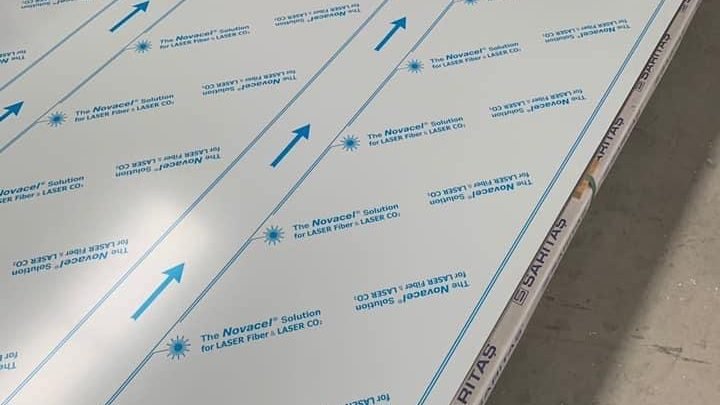
The finished sheet is covered with a PE or PVC protective film, geralmente 50 para 100 micrometre thick, applied with a roller to avoid air bubbles. The film protects against scratches during transport and fabrication. It is not a permanent coating and must be removed before final acceptance, because adhesive can leave a residue if left in direct sun for months.
Regras de Seleção
The following rules avoid most of the failures seen in architectural mirror work.
- Escolher 304 for dry interiors, 316L for chlorides. A mirror in a swimming pool hall, a coastal facade or a food-wash area should be 316L. The polish does not improve corrosion resistance; the alloy does.
- Do not specify 8K for exterior facades without a protective system. Polished surfaces are harder to clean and show fingerprints and rain marks. Exterior mirror work usually needs a hydrophobic coating or a laminated glass build-up.
- Match thickness to fixing method. UM 0.5 mm sheet on a flat substrate is fine; um 0.5 mm sheet spanning a frame will oil-can. Usar 1.0 mm or more for visible spans, or add a stiffener.
- Order cut-to-size with a diagonal check. UM 1 mm error in width is invisible, but a 2 mm difference in diagonals makes a rectangular panel look skewed in a lift lobby.
- Specify the reflective quality by sample. Approve a physical sample under the same lighting as the site. Photographs cannot convey distortion.
- Keep the protective film specification explicit. State film type, thickness and maximum storage time, and require the film to be removed before the final inspection.
Fabrication and Installation Rules
Mirror sheet behaves like any 304 sheet mechanically, but its surface is far less forgiving. Laser cutting through the protective film is standard; the film must be peeled from the cut edge before welding or edge polishing. Shearing without film leaves burrs that scratch adjacent panels during stacking. Bending is possible, but the bend line should be outside the visible mirror field or polished again after forming, because bending stretches the surface and creates a dull band.
Welding a mirror panel is possible but rarely invisible. A TIG weld with matching filler will leave a heat-tinted zone that must be pickled and repolished, and the polished weld will almost never match the original surface exactly. For that reason, mirror walls are usually designed as discrete panels with dark joints, butt-glazed, or fixed to a substrate with concealed clips rather than welded into a continuous sheet.
No local, keep panels vertical or on edge. Storing them flat invites grit underneath and scratches on the face. Handle with clean gloves; a single fingerprint on a polished surface is visible from several metres and cannot be wiped away with a dry cloth, because the oil smears rather than lifts. Use a neutral pH cleaner and a soft microfibre cloth, and never an abrasive cream.
Allow thermal movement at joints. UM 1500 milímetros 304 panel moves about 0.5 mm over a 20 °C swing, which is small but enough to crack a rigidly restrained mirror or to open a visible gap. Silicone or a flexible joint detail absorbs this movement without putting the polished face into tension.
Quality Checks Before Acceptance
Inspect in a room with a straight fluorescent tube or a laser line, not in direct sunlight. Look for distortion of the reflected line, polishing comets, swirl marks, arranhões, water spots, and edge burns from cutting. Check the protective film for bubbles and adhesive residue. Measure thickness at five points and flatness with a straightedge and feeler gauge. Confirm the grade from the mill certificate and, for critical work, a portable X-ray fluorescence check of chromium and nickel.
For elevator and facade work, require a mock-up panel fixed in its final orientation. Reflection distortion depends on the viewing angle and the surrounding light, so a panel that passes on a table can still fail on a wall.
Equívocos comuns
“8K is the same as BA”
BA (recozido brilhante) is a mill finish produced in a controlled atmosphere; it is bright but not mirror-polished. 8K is a mechanical abrasive finish with a much lower roughness. A BA sheet reflects light but does not give a clear image, and its surface still shows rolling texture under low-angle light.
“A higher grit number always means a better mirror”
Grit is a process input, not an output. A 6000-grit finish on a flat, clean base can outperform an 8000-grit finish on a wavy base with embedded iron. Buyers should specify Ra, flatness and a visual sample rather than a grit number alone.
“Mirror sheet cannot be welded or bent”
It can be both, but the surface must be restored afterwards. The limitation is cosmetic, not metallurgical. Designers should decide early whether a joint will be visible, because a welded and repolished joint is expensive and still may not match.
“The protective film can stay on until handover”
Film left in sun or humidity can transfer adhesive and leave a shadow when peeled. Most finishers remove film within weeks of installation and inspect immediately. Leaving film on a finished wall also hides scratches until the client peels it, which is the worst possible time to discover them.
“304 mirror will never rust indoors”
304 resists atmospheric corrosion, but it is not immune. Chloride cleaners, salty humid air, and iron contamination from carbon steel tools can all initiate pitting. A mirror in a kitchen washed with bleach-based cleaner will eventually show pits, and no amount of polishing will restore the affected area.
Perguntas frequentes
What does 8K mean numerically?
It refers to an abrasive grit of about 8000 e, in practice, a surface roughness of roughly Ra 0.005–0.01 µeu. It is not a reflectance percentage; reflectance depends on the alloy and the cleanliness of the surface.
Can I get a mirror finish on 201 ou 430?
Sim, and those grades are used for cost-sensitive indoor work. 201 has lower nickel and less corrosion resistance; 430 is ferritic and magnetic. Both polish well, but neither matches 304 in humid or chloride-bearing service.
What is the maximum panel size?
Width is limited by the polishing line, tipicamente 1500 milímetros; length is limited by handling, commonly 3000–3048 milímetros. Larger visual fields are built from multiple panels with deliberate joints.
How do I clean a mirror sheet?
Use a neutral pH cleaner and a soft microfibre cloth, wiping in one direction. Avoid abrasive powders, steel wool, and chloride-releasing cleaners. Rinse with clean water and dry to prevent spots.
Does the protective film affect the finish?
Não, if it is applied to a clean, dry surface and removed within the stated period. Adhesive residue or long-term sun exposure can leave a faint haze that needs repolishing.
Can mirror sheet be used outdoors?
Only with a protective coating or a laminated glass assembly. A bare polished surface collects dirt and rain marks quickly, and fingerprints are difficult to remove without dulling the finish.
Precisar 304 or 316L mirror sheet cut to size?
Enviar espessura, panel sizes, flatness requirement and viewing conditions to vendas@qidamt.com. Related reading: 316L placa de aço inoxidável for coastal projects, ou request a quotation.
Suprimentos QIDAMT 304 and 316L sheet, cut-to-size panels and polished finishes from Liaocheng, Shandong. Tell us the reflected-line acceptance standard before production, because flatness is agreed at the coil stage, not at the polishing wheel.

