 KEMAJUAN
Aluminium Plate 1060: Purity, Temper and Fabrication
Aluminium Plate 1060: Purity, Temper and Fabrication Guide
Aluminium plate 1060 is a commercially pure aluminium product with a minimum aluminium content of 99.60 percent. It sits at the low-strength, high-conductivity end of the wrought aluminium family: lembut, highly formable, an excellent conductor, and highly resistant to atmospheric corrosion, but with a yield strength low enough that it is never chosen to carry structural load. It is chosen for conductivity, reflectivity, kebolehbentukan, and appearance.
The grade appears in electrical busbar enclosures and heat sinks, signage and nameplates, reflector panels, chemical process equipment linings, architectural cladding, panel hiasan, deep-drawn parts, and thermal insulation jacketing. In each of these uses the buyer wants a metal that is easy to form, does not rust, and presents a clean surface. That is exactly what 1060 delivers, provided the temper and the thickness tolerance are specified correctly.
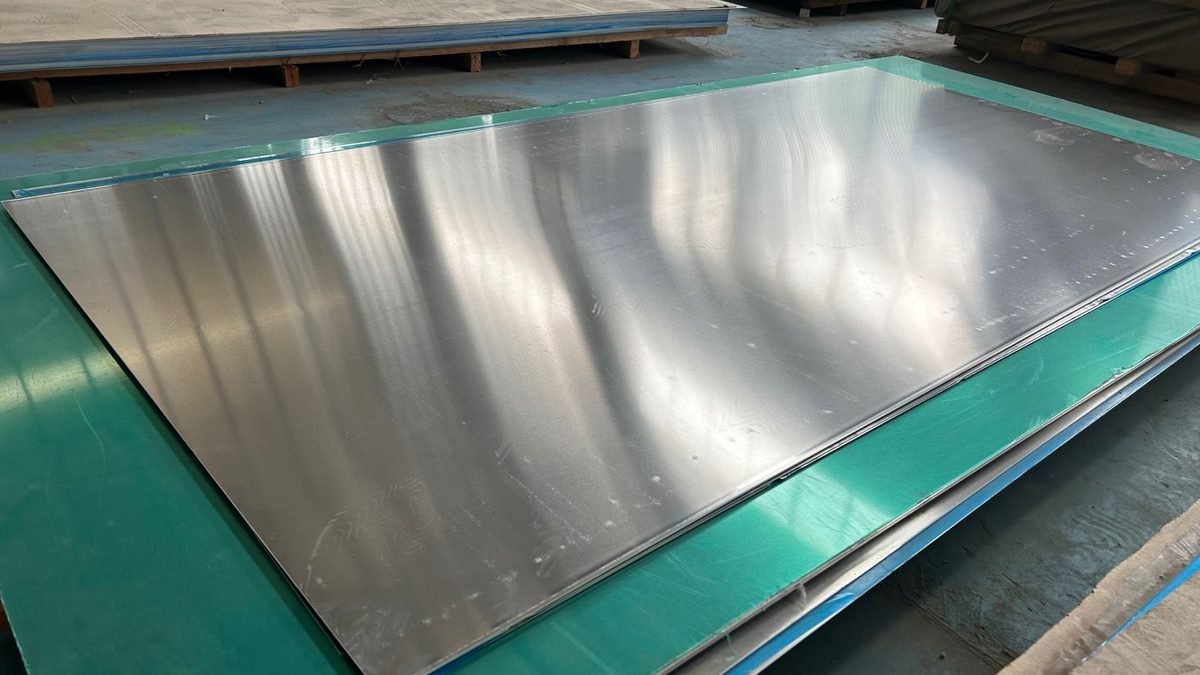
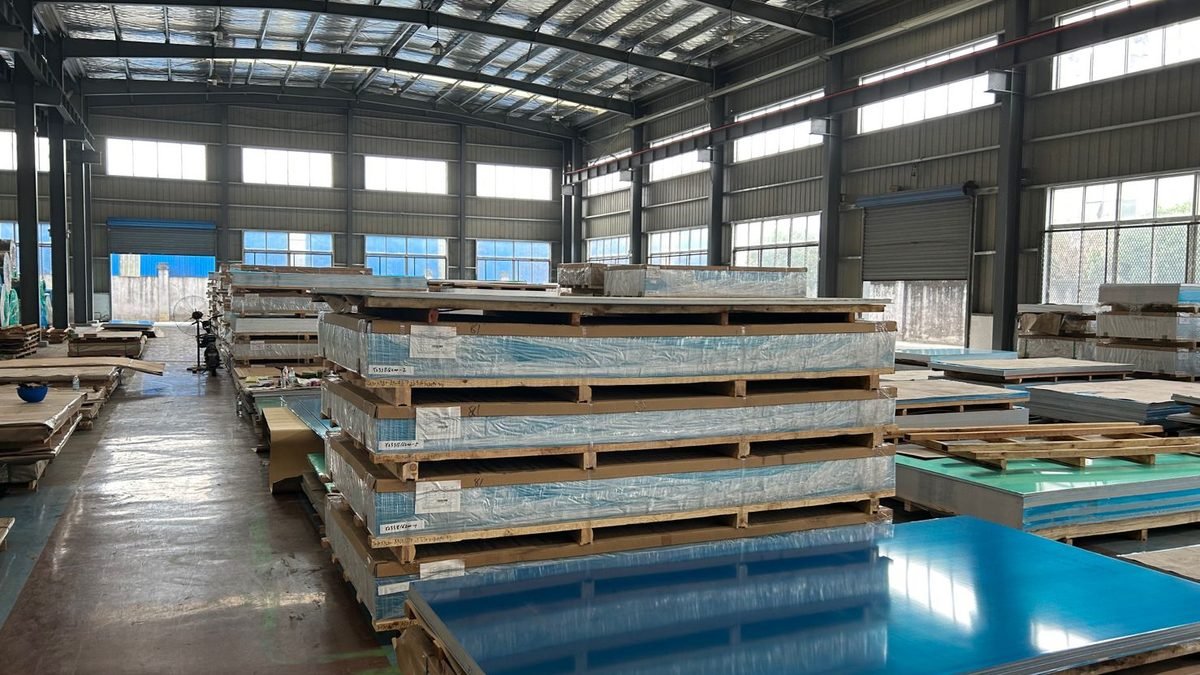
The photographs below show a mill finish 1060 plate on a stack with protective interleaving, and plate stock stored on timber bearers in a warehouse. The surface is bright and uniform, which is the visual signature of a pure grade rather than an alloy with visible second-phase particles.
1. apa 1060 Is and Where It Is Used
The 1060 designation belongs to the 1000 siri, the unalloyed or commercially pure family. The number encodes the purity: 1050 is 99.50 percent, 1060 is 99.60 percent, 1070 is 99.70 percent. The balance is iron and silicon, with trace amounts of copper, mangan, magnesium, zinc and titanium. Because there is no deliberate alloying addition, there is no precipitation hardening, and the only strengthening mechanism available is cold work.
That single fact explains the whole product. 1060 cannot be heat treated. It can only be annealed to the soft O temper or cold rolled to a harder H temper. A 1060 plate ordered as H18 is strong for a pure grade but has very little elongation left, so it will crack if bent sharply. A 1060 plate ordered as O is soft, formable, and almost useless as a structural member but ideal for deep drawing and spinning.
Typical applications break down into four groups. Electrical and thermal: busbar housings, heat sink bases, shielding cans, transformer components. Architectural and decorative: cladding panels, ceiling panels, column casings, papan tanda, anodised nameplates. Chemical and food: tank linings, trays, jatuh, processing equipment where the surface must be non-toxic and corrosion resistant. Formed products: deep-drawn containers, spun reflectors, lamp housings, peralatan memasak.
2. Komposisi Kimia
The 1060 specification limits the impurities tightly so that conductivity and corrosion resistance remain high. Iron and silicon are the dominant impurities, and both reduce conductivity. Tembaga, mangan, magnesium and zinc are limited to a few hundredths of a percent, and titanium is limited because it affects grain structure during casting.
| unsur | 1060 (%) | 1050 (%) | 1070 (%) | 1100 (%) |
|---|---|---|---|---|
| aluminium, min | 99.60 | 99.50 | 99.70 | 99.00 |
| silikon | 0.25 maks | 0.25 maks | 0.20 maks | 1.00 maks |
| besi | 0.35 maks | 0.40 maks | 0.25 maks | 1.00 maks |
| Tembaga | 0.05 maks | 0.05 maks | 0.04 maks | 0.05 kepada 0.20 |
| Mangan | 0.03 maks | 0.05 maks | 0.03 maks | 0.05 maks |
| Magnesium | 0.03 maks | 0.05 maks | 0.03 maks | 0.10 maks |
| Zink | 0.05 maks | 0.05 maks | 0.04 maks | 0.10 maks |
| titanium | 0.03 maks | 0.03 maks | 0.03 maks | not specified |
| Penggunaan biasa | Elektrik, pelapisan, membentuk | General sheet work | Reflectors, high purity | Tujuan umum, lebih kuat |
The difference between 1060 dan 1100 matters more than the table suggests. 1100 carries up to 1 percent silicon plus iron and a little copper, which raises strength and lowers conductivity. A customer who needs 1060 for conductivity should not accept 1100 as a “close enough” substitute, because the conductivity difference is measurable and the certificate will show it.
3. Tempers and Mechanical Properties
aluminium 1060 is supplied in O (anil), H14, H24, H18 and sometimes H112 tempers. The H designation means work hardened, the number means the amount of cold work and the subsequent treatment: H14 is quarter hard, H24 is quarter hard and partially annealed, H18 is full hard. The mechanical values vary by temper and by thickness, and the mill certificate is the governing document.
| perangai | Kekuatan tegangan (MPa) | Kekuatan hasil (MPa) | Pemanjangan (%) | Kebolehbentukan |
|---|---|---|---|---|
| O (anil) | 70 kepada 110 | 25 kepada 45 | 25 kepada 40 | Best; deep drawing and spinning |
| H14 (quarter hard) | 100 kepada 145 | 75 kepada 110 | 10 kepada 18 | bagus; bending and moderate forming |
| H24 (quarter hard, stabilised) | 100 kepada 145 | 70 kepada 105 | 10 kepada 16 | bagus; architectural panels |
| H18 (penuh keras) | 140 kepada 175 | 120 kepada 150 | 4 kepada 8 | Limited; straight sections only |
| H112 (hot worked) | 70 kepada 110 | 30 kepada 50 | 18 kepada 30 | Sederhana; thick plate |
Electrical conductivity follows purity and temper. 1060 in the O temper reaches about 61 kepada 62 percent of the International Annealed Copper Standard, while a work hardened temper is a little lower. The exact figure depends on the impurity level, and it is measured on the finished part, not assumed from the grade.
Thermal conductivity is about 230 watts per metre kelvin in the annealed condition, which is why 1060 is used for heat sink bases and for thermal spreading plates. Specific heat is about 900 joules per kilogram kelvin, melting range is approximately 646 kepada 657 degrees Celsius, and the density is about 2.71 grams per cubic centimetre.
4. Ketebalan, Width and Tolerance
1060 is produced as sheet from about 0.3 mm ke 4.0 mm and as plate from 4.0 mm ke 150 mm, hot rolled or cold rolled depending on thickness. The tolerance regime differs between cold rolled sheet, which is held to a tight thickness band, and hot rolled plate, which carries a heavier allowance and often a machined surface for critical work.
| Parameter | Typical value | Comment |
|---|---|---|
| Ketebalan, canai sejuk | 0.3 kepada 4.0 mm | Tolerance plus or minus 0.08 kepada 0.15 mm depending on gauge |
| Ketebalan, hot rolled plate | 4.0 kepada 150 mm | Tolerance plus or minus 0.3 kepada 1.5 mm; machined on request |
| Lebar | 1000 kepada 2000 mm | Plus 3 / minus 0 for slit coil; plus 5 / minus 0 for plate |
| Panjang | 2000 kepada 6000 mm | Plus 10 / minus 0; state whether saw cut or shear cut |
| Kerataan | 3 kepada 6 mm per metre | Tighter flatness requires levelling or machining |
| Edge condition | sheared, sawn, mill edge | Sheared edge has a small burr; specify deburring for handling |
| Permukaan | kemasan kilang, rolled, disikat, anodised | Mill finish may show rolling lines and slight colour variation |
| Interleaving | paper or film between sheets | Prevents abrasion and water staining in transit |
The thickness tolerance is the single most common source of disagreement on a 1060 order. A sheet ordered at 1.0 mm may measure 0.92 mm at one point and 1.03 mm at another, and both are within specification. A buyer who measures with a micrometer at one point and rejects the delivery is usually measuring a legitimate product. Agree the gauge, the measurement points and the acceptance criterion before the order is placed.
5. How 1060 Is Made and Formed
The process starts with electrolytic aluminium of at least 99.7 percent purity, melted and cast into slabs or continuously cast into strip. Slabs are hot rolled to plate or to coil, then cold rolled to sheet, annealed to the required temper, and finished. Continuous casting and rolling produces a fine, uniform grain structure and is the route for large volumes of thin sheet; direct chill casting followed by hot rolling is the route for thicker plate.
Annealing is the step that decides formability. A soft O temper requires a full anneal at around 340 kepada 400 degrees Celsius with a controlled cooling rate, which recrystallises the grain and removes the work hardening. An H temper stops short of recrystallisation and leaves the strain in the metal, which is why the temper number and the mechanical properties move together.
Deep drawing is the classic 1060 proses. The sheet is blanked, then drawn into a die with a punch, and the metal flows rather than thins. Soft O temper with a fine grain is the correct input; full hard material will tear at the punch radius. Lubricant, die radius and draw speed all matter, and a trial with the actual die is worth more than a table of forming limits.
Bending follows a similar logic. For O temper, a minimum bend radius of about 1.5 kepada 2 times the thickness is achievable with a proper radiused die. For H14, the minimum rises to about 3 times the thickness, and for H18 to 4 atau 5 kali, with cracking likely below that. If a tight bend is required in a hard temper, the part should be bent before the final cold reduction, or locally annealed.
Kimpalan 1060 is done with 4043 atau 1100 pengisi, using AC tungsten inert gas with argon, or with friction stir welding for high integrity joints. The weld zone in a pure grade loses strength and conductivity, and the heat-affected zone softens. For electrical parts, welding should be kept away from the current path or followed by a joint resistance check.
6. Selection Rules
pilih 1060 for conductivity, formability or appearance, not for strength. Its yield strength is a fraction of what 5052 atau 6061 delivers. A 1060 panel spanning a gap will deflect far more than a 5052 panel of the same thickness, and no amount of surface finish will fix that.
Consider 1100 when cost matters and conductivity is not critical. 1100 is slightly stronger and slightly cheaper, with conductivity a little lower. For a decorative panel or a general sheet metal part, 1100 is often the sensible grade. For a busbar or heat sink, stay with 1060.
Consider 3003 for corrosion resistance with some strength. 3003 is an aluminium-manganese alloy with about 40 percent more strength than 1060 and good corrosion resistance. It is the standard choice for sheet metal work that must hold a shape.
Consider 5052 for marine or pressure service. 5052 has far better fatigue resistance and corrosion resistance in salt water, and it is the grade for boat hulls, tanks and pressure vessels. 1060 in seawater is acceptable only as a static, non-loaded cladding, and even then it will pit if chlorides concentrate.
Anodising quality depends on purity. A pure grade anodises to a clear, bright film with good colour consistency. Alloying elements, particularly silicon and iron, produce a darker or greyer film. If the part will be anodised and colour matched, 1060 atau 1070 is the correct base, and the anodiser should confirm the alloy before processing.
Temper must match the forming operation. Ordering O temper for a part that will be stretched and then used as a panel leaves it too soft to hold shape; ordering H18 for a part that must be bent leaves it too hard to form. The temper is a process decision as much as a material decision.
7. Fabrication and Handling Practice
Memotong 1060 is easy, which is part of its appeal. Guillotine shearing is fast and leaves a clean edge on thin sheet, but the blade clearance must be set for aluminium; too much clearance produces a ragged edge and a burr. Laser cutting works well up to about 6 mm, with nitrogen assist to avoid oxidation; plasma cutting is faster on thick plate but leaves a rougher edge and a heat-affected zone that must be removed before welding or anodising. Waterjet cutting leaves no heat-affected zone and is the right choice for thick plate that will be machined afterwards.
Forming tools should be clean and free from steel swarf. Aluminium is soft, and a single chip embedded in a die will score the surface on every stroke. Dedicated tooling for aluminium, with polished faces and a light drawing lubricant, produces a surface that needs no rework.
Surface preparation before anodising or painting is critical. A mill finish carries a rolling lubricant residue that must be removed with an alkaline cleaner, then rinsed and desmutted. A part that is anodised without proper cleaning will show patches, streaks and poor adhesion, and the defect will be blamed on the anodiser when it began in the press shop.
Storage is a genuine quality issue. Aluminium sheet stored in a humid warehouse develops white water stains that cannot be polished out, because the stain is a corrosion product that has eaten into the surface. Sheets should be stored flat on a dry bearer, with interleaving paper, away from direct contact with concrete floors and away from copper or steel parts that could cause galvanic staining. Outdoor storage is acceptable for a short period if the stack is covered and ventilated, but condensation under a plastic cover is worse than rain.
8. Common Mistakes
Using 1060 where strength is required. The grade is soft by design. Panels that must resist wind load, foot traffic or pressure belong in 3003, 5052 atau 6061.
Confusing 1060 dengan 1100. The two look identical and differ in conductivity and strength. Check the certificate, not the colour.
Bending full hard sheet without annealing. H18 has very little elongation, and a tight bend will crack at the outer radius. Bend in the soft temper or use a larger radius.
Measuring thickness at one point. Sheet thickness varies within the tolerance band. Agree the gauge and the measurement method before delivery.
Welding with the wrong filler. 4043 is the usual filler for 1060 and gives good crack resistance, but it lowers conductivity in the joint. For electrical parts, guna 1100 filler or a mechanical joint instead.
Anodising an alloy with visible iron or silicon. The film will be grey or streaked. If colour consistency matters, nyatakan 1070 and confirm the anodising process with the finisher.
Storing sheets in contact with the floor. Water stains are permanent. Use bearers and interleaving, and keep the stack dry.
Assuming 1060 is seawater resistant. It resists atmosphere well but pits in chloride service, particularly where water can stand. guna 5052 atau 5083 for marine work.
9. Soalan Lazim
Is 1060 pure aluminium? It is commercially pure, with a minimum of 99.60 percent aluminium. The balance is iron, silicon and trace elements, not deliberate alloying additions.
Can 1060 be heat treated? Tidak. It has no hardening alloy addition, so it can only be work hardened or annealed. Any claim that a 1060 part was precipitation hardened is wrong.
What temper should I order for deep drawing? Wahai perangai, fully annealed, with a fine uniform grain. Hard tempers tear at the punch radius.
What temper for a flat architectural panel? H24 or H14, which holds shape and still allows slight forming. Full hard is unnecessary and more difficult to bend.
Is 1060 suitable for a busbar? ya, where the current and the required conductivity allow. The conductivity is high, but the mechanical strength is low, so the bar needs adequate cross section and support.
Can 1060 be welded to 5052? ya, dengan 4043 atau 5356 pengisi, but the joint will be a dissimilar strength zone. Design the joint so that the lower-strength side is not the governing section.
Why does my anodised 1060 look yellow? Iron and silicon impurities, or a film thickness that is too high. Check the alloy certificate and the anodising bath.
Does 1060 corrode outdoors? It forms a thin oxide film and performs well in rural and urban atmospheres. In coastal or chloride-rich air, staining and pitting appear, dan a 5052 grade is the better choice.
What is the difference between 1060 sheet and 1060 pinggan? Thickness and process, not grade. Sheet is cold rolled and thin; plate is hot rolled and thicker, with a different tolerance regime and often a different surface.
Can I get 1060 in a mirror finish? ya, by polishing or by bright anodising. The purity of the grade supports a high reflectivity, which is why it is used for reflectors and lamp housings.
Is 1060 food safe? Aluminium in contact with acidic or salty food can corrode and should not be used uncoated for direct food contact in those conditions. For dry handling and non-acidic service, it is widely used, and the final decision should follow the applicable food contact regulation.
Perlu 1060 aluminium plate in a specific temper?
Send the thickness, lebar, panjang, perangai, surface and quantity. We will confirm the rolling programme, tolerance band and mill certificate, and quote against the actual gauge rather than a nominal figure.
Related reading: 1060 pure aluminium plate · 5052 H32 aluminium sheet · 6061 T6 aluminium plate