 KEMAJUAN
Stainless Steel Narrow Strip: Slitting for Stamping
Stainless Steel Narrow Strip: Slitting for Stamping
A stamping press does not buy coil. It buys strip: a narrow, accurately edged, consistently cambered band of stainless steel that will feed through a die thousands of times without wandering, jamming or leaving a burr that fails inspection. The step that turns a 1,219 mm master coil into a 40 mm strip is slitting, and the quality of that step decides how well the press runs.
This guide covers what narrow strip is, how slitting produces it, which grades and tempers are used, the tolerances that matter for stamping, how burr and camber are classified, how die clearance and feed length relate to strip width, and the defects that show up in the press rather than at the slitter. It deals with cold-rolled stainless strip in 304, 304L, 316L, 430 dan 301, thickness 0.10–3.00 mm, widths from 8 mm to 400 mm.
1. What Narrow Strip Is
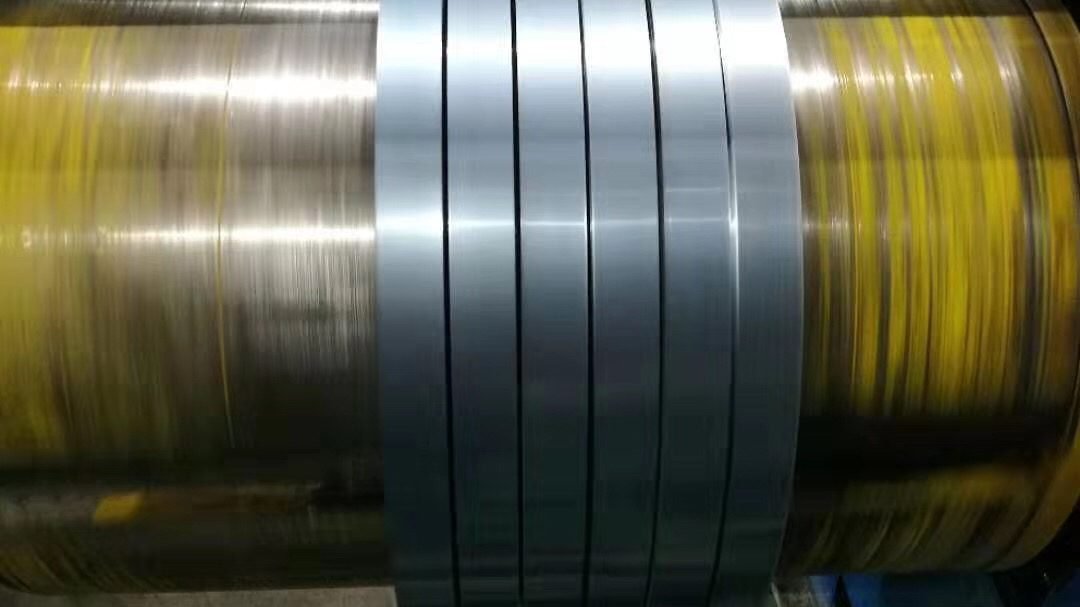
Narrow strip is cold-rolled stainless steel slit from a wide master coil into a band of a defined width, with cut edges on both sides. It is supplied in coils, usually oscillation-wound or traverse-wound, with a defined inner diameter, outer diameter and coil weight. Widths below about 400 mm are conventionally called narrow strip; below 100 mm the term precision strip is used, because the tolerance and edge quality requirements tighten.
The distinction between strip and sheet is not only width. Strip is a continuous product: it is bought by the coil and fed into a process without being cut into blanks first. That continuity is why camber, burr, coil tightness and weldability of the strip ends matter. A sheet can be squared up on a shear; a coil that is cambered cannot be straightened by the press operator.
Narrow strip is used for stamping terminals, penyambung, shims, spring contacts, tab bateri, razor components, syringe needles, watch parts, sensor housings and small brackets. In most of these, the strip is fed into a progressive die and the part is blanked, formed and sometimes pierced in one pass, so the strip’s edge condition becomes the part’s edge.
2. How Slitting Works
Slitting uses two circular knives on arbors, one above and one below the strip, set with a small lateral clearance and a small overlap. The strip is pulled through under tension, and the knives shear it into bands. The process is fast and economical, but it produces a cut edge with a characteristic shape: a rounded shear zone, a straight burnished zone, and a burr where the fracture finishes.
The three parameters that decide edge quality are knife clearance, knife overlap and strip tension. Too much clearance produces a heavy burr and a rough edge; too little produces a rolled edge and rapid knife wear. Too little tension lets the strip wander, so the width varies along the coil; too much tension stretches the strip and leaves it with residual stress that shows up as coil set or as a twist after blanking.
There are two slitting methods. Oscillating slitting uses a single knife that moves across the strip, cutting a narrow band off the edge at each stroke; it is used for very narrow widths and short runs. Rotary slitting uses a set of knives on a common arbor and cuts the whole coil into many strips in one pass; it is the production method for volume. Rotary slitting is faster and produces more consistent width, but the knife set-up is fixed, so a change of width means a change of knives.
After slitting, the strip is usually edge-conditioned. A rolled or rounded edge removes the sharp burr, improves the fatigue life of a stamped part and protects the die. For a part that will be visible or that will be handled, a rounded edge is often specified. For a part that will be welded or that will be coated, a square edge may be preferred because it gives a defined weld face.
3. Grades and Chemistry
| unsur, % | 301 | 304 | 304L | 316L | 430 |
|---|---|---|---|---|---|
| C, maks | 0.15 | 0.07 | 0.03 | 0.03 | 0.12 |
| Cr | 16.0–18.0 | 18.0–20.0 | 18.0–20.0 | 16.0–18.0 | 16.0–18.0 |
| Dalam | 6.0–8.0 | 8.0–10.5 | 8.0–12.0 | 10.0–14.0 | — |
| Mo | — | — | — | 2.0–3.0 | — |
| Mn, maks | 2.00 | 2.00 | 2.00 | 2.00 | 1.00 |
| Dan, maks | 1.00 | 1.00 | 1.00 | 1.00 | 1.00 |
301 is the grade chosen when the part needs strength after forming. Its higher carbon and lower nickel let it work-harden quickly, which is why it is used for springs, clips and contacts. 304 is the general-purpose grade for brackets, shims and terminals. 304L is used where the strip will be welded after stamping. 316L is used where the part sees chlorides, cleaning chemicals or a medical environment. 430 is the low-cost ferritic option for parts that do not need deep drawing, such as appliance trim and decorative inserts.
The narrower the strip, the more the grade matters for edge quality. A 301 strip in a hard temper slits with a cleaner edge than an annealed 304 jalur, because the harder material shears rather than smears. A 430 strip tends to produce a slightly rougher edge than an austenitic grade and needs a different knife clearance.
4. Tempers and Mechanical Properties
| Gred / perangai | Yield Rp0.2, MPa | Tensile Rm, MPa | Pemanjangan, % | HV |
|---|---|---|---|---|
| 304 anil | 205 | 520–720 | 40 | ≤ 200 |
| 304 1/4 keras | 430 | 860 | 10 | 250 |
| 304 1/2 keras | 640 | 1,030 | 6 | 310 |
| 304 penuh keras | 1,030 | 1,350 | 3 | 380 |
| 301 1/2 keras | 760 | 1,150 | 5 | 340 |
| 301 penuh keras | 1,200 | 1,550 | 2 | 430 |
| 430 anil | 205 | 450–600 | 22 | ≤ 200 |
The temper is chosen before the slitting, not after. A full-hard strip is stiff, slits cleanly and holds its width, but it will not accept a tight bend. An annealed strip forms beautifully but is soft enough that a dull slitter will roll the edge rather than cut it. If a part needs both forming and springback control, the usual answer is a 1/2 hard temper and a larger bend radius.
For stamping, the yield strength also sets the blanking force. Force is approximately the shear strength multiplied by the cut perimeter and the thickness; shear strength for austenitic stainless is roughly 0.7–0.8 of tensile strength. A 1.0 mm 304 strip at 700 MPa tensile therefore needs about 0.75× 700 × perimeter× 1.0, expressed in newtons if the perimeter is in millimetres. That figure sets the press tonnage and the die material.
5. Tolerances That Matter for Stamping
| Parameter | Standard | Precision |
|---|---|---|
| Toleransi lebar | ±0.15 mm | ±0.05 mm |
| Thickness tolerance | ±0.05 mm (≤1.0 mm) | ±0.02 mm |
| Camber | ≤ 5 mm per 1,000 mm | ≤ 1.5 mm per 1,000 mm |
| Burr height | ≤ 20 % of thickness | ≤ 10 % of thickness |
| Edge straightness | Visible wave permitted | No visible wave |
| Coil inner diameter | 508 mm | 508 / 610 mm, toleransi +3/0 |
| Berat gegelung | 100–500 kg | ±5 % |
Camber is the parameter that causes the most press problems. A strip with 5 mm of camber per metre will drift sideways as it feeds, and a progressive die with a narrow carrier will jam. For a strip narrower than 100 mm, the camber limit should be 1.5 mm per metre or better, and the strip should be supplied with a straightener pass after slitting.
Burr is the parameter that causes the most customer complaints. A burr of 20 % of thickness on a 1.0 mm strip is 0.2 mm, which is enough to cut a hand and enough to hold two stamped parts apart in a stack. For electrical contacts and medical parts, the burr limit is usually 10 % or less, and the edge is deburred or rolled.
Width tolerance interacts with the die. A progressive die has a fixed pitch and fixed guide rails, so a strip that varies by ±0.15 mm needs 0.3 mm of clearance in the guide, and the part position varies by the same amount. If the part has a tolerance of ±0.1 mm, the strip tolerance must be tighter than the part tolerance allows, not equal to it.
6. Edge Condition and Burr Classification
Slit edges are classified by the shape of the cut. A square edge has a shear zone, a burnished band and a burr at the bottom. A rounded edge has the burr removed and the corners radiused. A rolled edge is formed by pressing the slit edge between rolls, which consolidates the material and produces a smooth, slightly thicker edge.
For stamping, the edge condition affects three things: die wear, part quality and operator safety. A square edge with a heavy burr wears the guide rails and can mark the part as it passes. A rounded edge slides more smoothly but costs more per kilogram because it is a secondary operation. A rolled edge is the best compromise for a strip that will be handled and for a part that will be plated, because the rolled edge takes the plating evenly.
Burr direction matters. In rotary slitting, the burr on one side of the cut faces up and on the other side faces down. If the strips are rewound without flipping, half the coil has the burr on the top surface and half on the bottom. For a part that sits flat in a stack, this is invisible; for a part that is measured on a flat plate, it is a 0.1 mm error. Specify burr direction when the part is critical.
7. Slitting for Stamping: Setup Rules
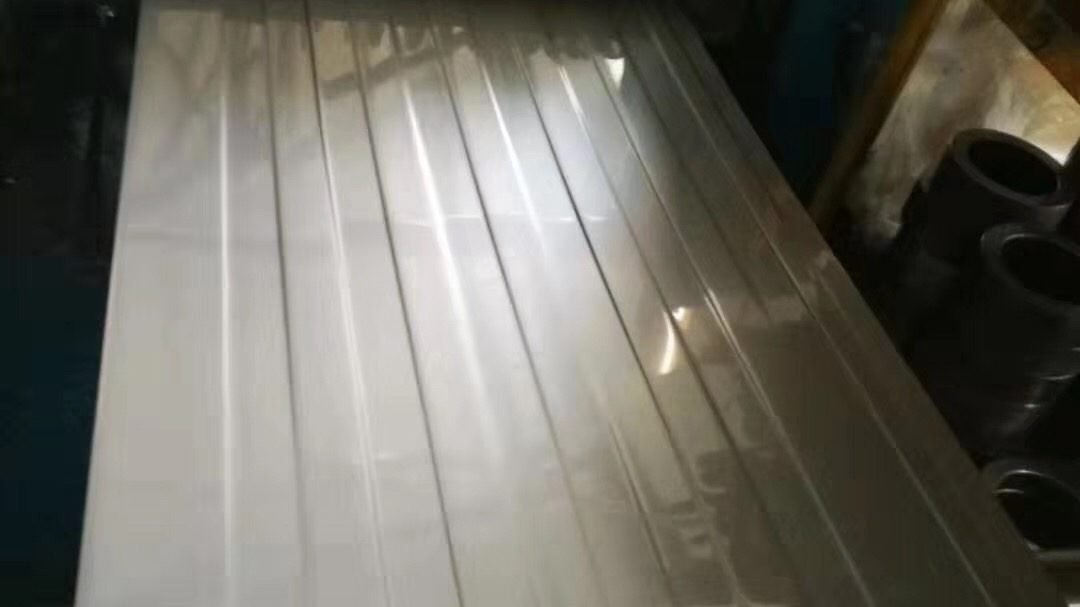
Width selection. The strip width should be the part width plus the carrier width plus a trimming allowance of 1–3 mm on each side. A strip that is exactly the part width has no material for the pilot to locate and no margin for camber. A strip that is far too wide wastes material and increases the blanking force.
Knife clearance. For austenitic stainless at 0.5–1.5 mm, the lateral clearance is typically 3–6 % of thickness per side. Untuk 430, use the lower end. For a hard temper, use the higher end, because the material fractures rather than shears.
Tension. Wind the strip at a tension that keeps the coil tight without stretching it. A simple check is to measure the width at the start and the end of the coil: a difference above 0.05 mm means the tension is too high or the knife is dull.
Straightening. A straightener pass after slitting removes most of the camber and the coil set. For strip below 100 mm, it is not optional.
Winding. Traverse winding, in which the strip is wound across the coil width, gives a more stable coil and is preferred for narrow strip. Oscillation winding, in which the strip is wound back and forth, is used when the strip is very narrow and the coil would otherwise telescope.
Coil handling. A coil that has been dropped will have a flat spot that feeds badly for the first few metres. Pack coils in a crate with a central support, and never stack them on their edges.
8. Die Practice for Stainless Strip
Stainless steel work-hardens, and that changes the die design compared with mild steel. The blanking clearance should be about 8–12 % of thickness per side for 304, compared with 5–8 % for mild steel. Too little clearance causes a secondary shear and a heavy burr; too much causes a torn edge.
Die material should be a powder metallurgy tool steel or a coated carbide for production runs above about 200,000 strokes. Stainless galls easily, so the die should have a hard, polished working surface and a lubricant that contains an EP additive. A chlorinated lubricant must be avoided if the parts will be welded or cleaned for medical use.
Because stainless work-hardens at the cut edge, a part that is blanked and then bent will crack at the bend if the bend line is too close to the blanked edge. A minimum distance of 1.5–2 times the thickness between the cut edge and the bend line is a reasonable rule for 304.
Springback is larger than for mild steel. A 90° bend in 304 at 1.0 mm will spring back 2–4°, and a full-hard strip more. The die should be overbent by that amount, or the part should be coined at the bend.
9. Defects That Show Up in the Press
Wandering. The strip drifts sideways in the guide. Causes: camber, a width that varies along the coil, a guide rail set too loose, or a coil wound with uneven tension. Check the camber first; it is the most common cause.
Jamming at the pilot. The pilot cannot enter the hole because the strip has moved. Causes: feed length error, a worn feed roll, or a strip that has stretched. Check the feed length against the pitch and replace the feed roll if it is polished.
Heavy burr on one side. One knife is dull or the clearance is asymmetric. A burr that appears only on one edge of the strip points to a knife set-up problem, not to the material.
Edge cracking during forming. The slit edge has a micro-crack that opens when the strip is bent. Causes: excessive knife clearance, a hard temper, or a strip that was slit from a coil with an edge defect. Specify a rolled edge for parts that will be formed close to the edge.
Coil set. The strip stays curved after unwinding. Causes: too much tension, a worn straightener, or a coil wound at the wrong diameter. A strip with coil set will not lie flat on the die and will produce parts with a twist.
Oil staining and water marks. These come from the slitting lubricant and from condensation in storage. For a part that will be plated or welded, the strip must be degreased before use, and the coil should be stored in a dry place with a VCI film if the storage is long.
10. Selecting Strip for a Stamping Job
Start from the part. Its width, ketebalan, tolerance and annual volume define the strip width, the temper and the edge condition. Then check the press: the coil inner diameter must fit the uncoiler, the coil weight must be within the uncoiler’s capacity, and the strip width must be within the feed range.
For a part with a tolerance of ±0.05 mm and an annual volume above one million, specify precision strip with ±0.05 mm width, camber below 1.5 mm per metre, a burr limit of 10 % and a rolled edge. For a bracket with a tolerance of ±0.3 mm and a volume of 50,000, standard strip with ±0.15 mm width is adequate and much cheaper.
Do not buy a temper that the part cannot use. A full-hard strip is a poor choice for a part with a tight bend, and an annealed strip is a poor choice for a part that must hold its shape after forming. The temper and the finish are separate decisions: a 2B finish is normal for stamped parts, a BA finish is used where the part will be visible, and a No.4 finish is used where the part will be handled or where a directional texture is wanted.
11. Common Mistakes
Ordering strip by width only. Lebar, ketebalan, perangai, keadaan tepi, burr limit, camber and coil weight are all part of the specification. A purchase order that says “304 strip 40 mm” leaves the rest to chance.
Assuming slitting is a cutting operation with no tolerance. It is a forming operation with a burr, a camber and a residual stress. Those are the properties that decide whether the press runs.
Buying the cheapest edge condition for a part that will be plated. A heavy burr takes the plating unevenly and shows as a dark line along the edge after plating.
Ignoring coil weight. A 500 kg coil that is too heavy for the uncoiler, or a 20 kg coil that runs out in an hour, both cost production time. Specify the weight for the run length.
Storing strip in a humid area. Stainless is corrosion resistant, not corrosion proof. Condensation between the wraps of a coil produces white rust and staining that cannot be removed without re-polishing.
Using a general-purpose lubricant. Stainless needs an EP additive and it needs a lubricant that can be removed before welding. A lubricant that leaves a film will cause porosity.
12. Soalan Lazim
What is the narrowest strip available? Rotary slitting is practical down to about 8 mm; below that, oscillating slitting or a dedicated narrow-strip line is used.
Can strip be supplied with a rounded edge? ya, as a secondary edge-conditioning operation. It adds cost and lead time but improves die life and part safety.
Is slit strip as flat as rolled strip? Not exactly. Slitting releases residual stress in the master coil, so a strip can show coil set that the original coil did not. A straightener pass corrects most of it.
Which temper should I use for a spring contact? 301 dalam 3/4 or full hard, depending on the spring rate. 304 dalam 1/2 hard is used where corrosion resistance matters more than spring force.
Can I slit 430? ya, but the knife clearance and the edge condition need to be set for a ferritic grade, and the strip is more prone to edge cracking in tight bends.
What burr limit should I specify? 10 % of thickness for electrical and medical parts; 20 % for general brackets. Anything above 25 % is a handling hazard.
13. Sourcing Stainless Narrow Strip
QIDAMT supplies cold-rolled stainless narrow strip in 304, 304L, 316L, 430 dan 301, thickness 0.10–3.00 mm, widths 8–400 mm, in annealed, 1/4, 1/2, 3/4 and full-hard tempers, slit to width with a specified burr limit and camber, edge-conditioned on request, and wound to a stated coil weight and inner diameter.
For the master coil the strip is slit from, lihat Gegelung Keluli Tahan Karat 304 2B. For wider cut sheet, lihat 304 Stainless Steel Sheet 2B dan 316L Stainless Steel Plate.
Need strip to a specific width, burr limit or camber?
Send the grade, perangai, ketebalan, lebar, edge condition and coil weight, and we will confirm the slitting option.
Related reading: Stainless Coil 304 2B · 304 Sheet 2B · 316L Plate

