 진전
Aluminium Coil 1060: 성질, Coil Weight and Slitting Tolerances
Aluminium Coil 1060: 성질, Coil Weight and Slitting Tolerances
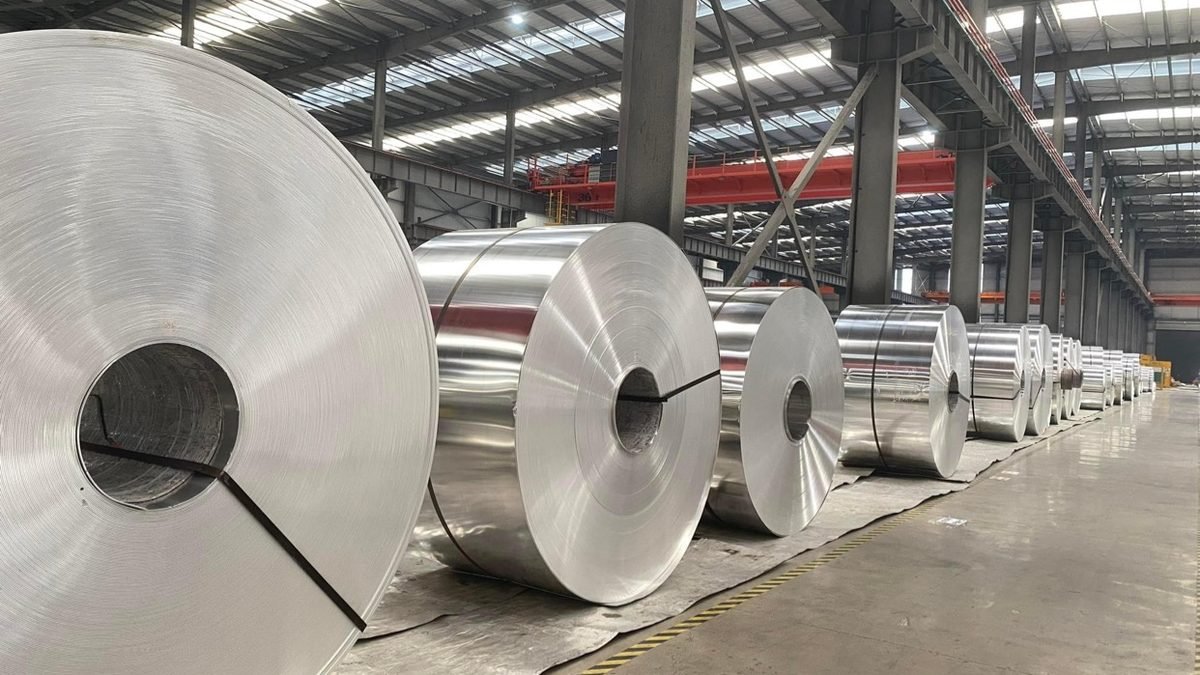
ㅏ 1060 aluminium coil is a continuously rolled strip of commercially pure aluminium, wound on a core and supplied in weights from a few hundred kilograms to several tonnes. The grade is the 99.6 percent pure variant of the 1xxx series, and it is chosen for conductivity, reflectivity, corrosion resistance in mild atmospheres and its response to anodising, rather than for strength. Coils are converted into roofing and insulation facings, signage blanks, 조리기구, 열교환기 핀, cable tape and general sheet.
Buying a coil is not the same as buying a sheet. The buyer is taking a length of strip whose temper, thickness profile, 너비, edge condition and winding tension have all been set by the mill, and every one of those variables will show up downstream in the slitting, levelling, coating or stamping operation. This guide sets out the 1060 grade limits, the temper designations that matter in conversion, the coil geometry and weight arithmetic, and the slitting tolerances that decide whether the strip runs straight through an uncoiler.
One product only is covered here: 1060 coil in the usual thickness range from 0.2 mm 에 4.0 mm. Alloy comparison, plate and sheet in cut lengths, and the coating processes used on other substrates are separate subjects.
무엇 1060 Coil Is and Where It Goes
The designation follows the Aluminium Association system: 1xxx series means aluminium of 99 percent or higher purity, and the last two digits indicate the minimum purity in hundredths of a percent above 99.00. 1060 therefore requires a minimum of 99.60 알루미늄 퍼센트. The remaining fraction is iron and silicon, with small limits on copper, 망간, 마그네슘, zinc and titanium.
The consequences of that purity are useful in specific applications. Electrical conductivity is high, ~에 대한 61 percent of the international annealed copper standard in the annealed condition, which is why 1060 tape is used for cable screening and why the grade appears in busbar and earthing applications. Thermal conductivity is about 234 watts per metre kelvin, which makes it suitable for heat exchanger fins and cookware bases. Reflectivity after polishing or bright annealing is high, which suits lighting reflectors and decorative trim. Corrosion resistance in rural, urban and most indoor atmospheres is good, because the pure metal forms a thin, stable oxide that resists further attack.
무엇 1060 does not offer is strength. In the annealed condition the yield strength is around 30 MPa, which is less than a fifth of that of 3003. Any application where the strip must carry load, resist denting or hold a shape after forming needs a different alloy, and that is the first selection question a buyer should answer.
Grade Chemistry and Limits
The limits below are the registered composition for 1060. They are maximums for the impurities, because the specification is defined by the minimum aluminium content rather than by alloying additions.
| 요소 | Limit, 퍼센트 | Practical effect |
|---|---|---|
| 알류미늄, minimum | 99.60 | 전도도, 부식, anodising colour |
| 규소 | 0.25 최대 | Raises strength, dulls anodised finish |
| 철 | 0.35 최대 | Refines grain, lowers conductivity |
| 구리 | 0.05 최대 | Lowers corrosion resistance if high |
| 망간 | 0.03 최대 | Negligible at this level |
| 마그네슘 | 0.03 최대 | Negligible at this level |
| 아연 | 0.05 최대 | Cathodic to aluminium, avoid high levels |
| 티탄 | 0.03 최대 | Grain refinement during casting |
| Vanadium | 0.05 최대 | Trace impurity limit |
Iron and silicon are the two elements a coil buyer should watch. Both raise strength and both reduce conductivity, and silicon in particular dulls the colour of an anodised film and turns a bright finish slightly grey. ㅏ 1060 coil at the top of the iron and silicon limits will be noticeably less reflective after bright annealing than one at the middle of the range. For reflectors, signage facing and anodised trim, ask for the actual analysis rather than the grade name.
성질: The Variable That Decides Conversion Success
Temper describes the amount of cold work left in the strip after rolling and any final anneal. It is designated by a letter and a number: O는 단련된 것입니다., H for strain hardened, with the digits giving the amount of work and whether the material was partially annealed afterwards.
| 성질 | 상태 | 인장, typical | 생산하다, typical | 연장 |
|---|---|---|---|---|
| 영형 | Fully annealed | 70 MPa | 30 MPa | 35 퍼센트 |
| H14 | 쿼터 하드 | 100 MPa | 85 MPa | 12 퍼센트 |
| H24 | 쿼터 하드, partially annealed | 100 MPa | 80 MPa | 14 퍼센트 |
| H18 | 풀 하드 | 140 MPa | 130 MPa | 4 퍼센트 |
| 밀도 | All tempers | 2.70 g per cubic centimetre | – | – |
The choice is driven by the next operation. If the coil will be deep drawn into cookware or press formed into a reflector, order O temper, because the ductility is what allows the metal to flow. If the coil will be slit and used as an insulation facing or a vapour barrier, H18 gives the stiffness to span and the flatness to lie down. If the coil will be coated and then formed lightly, H24 is a compromise that gives strength without the brittleness of full hard.
A common failure is ordering H18 for a part that needs a bend. 풀 하드 1060 will bend once on a generous radius and will crack on a tight one, and the crack appears at the outside of the bend where the strain is highest. If the part has any bend, specify H14 or H24 and accept the lower stiffness.
코일 기하학, Weight and Length Arithmetic
A coil is defined by four numbers: the inside diameter of the core, the outside diameter, the strip width and the coil weight. Standard core diameters are 150 mm, 405 mm, 505 mm 및 610 mm; 그만큼 505 mm core is the most common for wide strip because it fits the majority of uncoilers. Outside diameters run from about 800 mm 에 1800 mm depending on the mill and the handling equipment. Weights run from 500 kg for narrow slit coils to 8 tonnes for a full mill coil of wide strip.
| 매개변수 | Typical range or tolerance | 메모 |
|---|---|---|
| 두께, 0.2 에게 0.5 mm | plus or minus 0.02 mm | Measured mid width, both ends |
| 두께, 0.5 에게 1.0 mm | plus or minus 0.03 mm | Crown within 1 percent of thickness |
| 두께, 1.0 에게 2.0 mm | plus or minus 0.05 mm | Check at three points across width |
| 두께, 2.0 에게 4.0 mm | plus or minus 0.08 mm | Hot rolled or cold rolled route |
| 너비, mill edge | plus 5 mm, minus 0 mm | Edge may carry a slight roll |
| 너비, 슬릿 가장자리 | plus or minus 0.5 mm | Burr height 0.05 mm maximum |
| Camber after slitting | 3 mm maximum in 2 중 | Measured on a flat table |
| Inside diameter | 150, 405, 505, 610 mm | State the core type with the order |
| 코일 무게 | 500 kg to 8000 kg | Limited by crane and uncoiler capacity |
| Telescoping | None visible | A telescoped coil jams the uncoiler |
The arithmetic is simple and worth doing before the order is placed. The mass of strip is width times thickness times length times 2700 kilograms per cubic metre, with all dimensions in metres. A coil of 3 톤, 1200 mm wide and 0.5 mm thick therefore contains 3000 divided by 2700, which is 1.111 cubic metres of metal, divided by the product of 1.2 그리고 0.0005, which is 0.0006, giving about 1852 metres of strip. If the customer needs 1500 미터, one 3 tonne coil covers the order with a small balance; if the customer needs 2500 미터, two coils are required and the second will be partly used.
Coil weight also drives handling cost. ㅏ 5 tonne coil needs a crane, a coil car and an uncoiler rated for it; 에이 1 tonne coil can be moved with a forklift and loaded by two people. Narrow slitting produces small coils, and the arithmetic of width means a 1250 mm master coil slit into 100 mm strips yields twelve strips of roughly equal weight, minus the edge trim.
How 1060 Coil Is Made and Slit
The route begins with DC cast slab or continuous cast coil, homogenised to even out the segregation of iron and silicon, hot rolled to 4 에게 8 mm, then cold rolled in several passes to the ordered thickness. Annealing between passes restores ductility where the reduction is heavy, and the final anneal sets the temper: a full anneal gives O, a controlled partial anneal after cold work gives the H2x tempers, and no final anneal leaves the H1x tempers.
Slitting is the operation that most often decides whether the coil is accepted. A master coil is loaded on an uncoiler, the strip is threaded through a slitter with circular knives set to the ordered width, and the slit strips are rewound on separate mandrels under controlled tension. Three variables are set at that station: knife clearance, knife sharpness and winding tension. Clearance is normally 5 에게 10 percent of thickness; too much clearance tears the edge and produces a heavy burr, too little produces a rolled edge and excessive knife wear.
Winding tension decides coil shape. Too little tension produces a soft coil that telescopes in handling and traps air between layers; too much produces a hard coil with edge bulge and a risk of the strip cracking at the core. A well slit coil has straight edges, a flat face, no visible telescoping and a burr that can be felt but not caught by a fingernail.

Selection and Handling Rules
Select the temper from the forming operation, the thickness from the mechanical duty, and the width from the slitting plan. For an insulation facing that will be laminated and installed between purlins, 0.05 mm 에 0.2 mm in H18 is typical and the coil is chosen for stiffness and flatness. For a reflector, 0.4 mm 에 1.0 mm in O temper, with a low iron and silicon analysis, is the correct starting point. For cable tape, 0.1 mm 에 0.3 mm in O temper, because the tape must conform and must conduct. For cookware, 1.0 mm 에 4.0 mm in O temper, and the disc blanking follows.
Handling rules are short. Coils should be stored on saddles or padded cradles, never stood on edge on a concrete floor, where the bottom layer takes a flat spot and the edge dents. They should be kept dry and under cover; water between layers produces white stain that cannot be removed from a bright surface. Lifting should use a coil grab or a properly rated sling through the core, never a chain across the outside, which crushes the outer layers.
When the coil is opened, the outer wraps should be inspected before the strip is threaded. Edge damage, telescoping, water stain and a hard, glossy surface from excessive tension are all visible on the outer few layers and are early warnings of what the rest of the coil will be like. A coil that has been dropped shows a flat, bright facet on the outer wrap and a distorted face; it should be quarantined, not loaded.
마지막으로, the purchase order should state the standard. 1060 coil is normally supplied to ASTM B209 or EN 485, and the two differ in thickness tolerance and in the permitted crown. Naming the standard, the temper, the thickness with its tolerance, the width and edge type, the core diameter and the coil weight range removes almost every argument that can arise at receiving inspection.
일반적인 실수
The first is using 1060 where strength is needed. Pure aluminium in O temper dents under a thumb; a panel that must stay flat across a span needs a stronger alloy or a thicker gauge, and no amount of careful packing changes that.
The second is ordering H18 for a part that will be bent or formed. The third is specifying thickness without a tolerance, then rejecting a coil that is within the standard but at the thin end. The fourth is ignoring crown: a coil with 2 percent crown in a 0.5 mm strip has a 0.01 mm thickness difference between the centre and the edges, which is enough to cause tracking problems on a coating line.
The fifth is slitting with worn knives, which produces a burr that cuts operators and jams the strip in the guide. The sixth is winding too tight, which produces edge bulge and a coil that will not sit flat. The seventh is storing coils on the ground, which produces flat spots and stain. The eighth is mixing tempers in one consignment without marking; O and H18 strip look identical on the outside and behave completely differently on the press.
자주 묻는 질문
~이다 1060 the same as 1050? 아니요. 1050 requires 99.50 알루미늄 퍼센트, 1060 requires 99.60 퍼센트. The difference is small in mechanical terms but visible in conductivity and in anodised colour consistency, and the two grades are not interchangeable on a specification that names one of them.
What is the maximum coil weight I can order? It is limited by the mill, by the transport and by the customer’s uncoiler. Standard mill coils run to about 8 톤; slit coils are lighter because the width is reduced. State the maximum your crane and uncoiler can take, and the mill will build the coil to that limit.
How do I calculate the length of strip on a coil? Divide the coil weight in kilograms by 2700 to get cubic metres of metal, then divide by the product of width in metres and thickness in metres. ㅏ 2 tonne coil, 1000 mm wide and 0.3 mm 두께, holds about 2469 미터.
할 수 있다 1060 coil be anodised? 예, and it gives a clear, bright film when the iron and silicon are low. For a decorative anodised finish, specify the analysis and ask for a sample anodised before the full order is slit.
Why does the strip track off centre on my machine? Usually camber from slitting, or uneven winding tension, or a coil that was stored badly. Check the camber on a flat table and check the coil face for telescoping before blaming the machine.
What burr is acceptable on a slit edge? 0.05 mm maximum for strip that will be coated or painted, 그리고 0.1 mm for general conversion. A burr above that will show through a coating as a line and will cut gloves during handling.
필요 1060 Aluminium Coil Slit to Width?
우리는 공급합니다 1060 coil in O, H14, H24 and H18 temper, slit to width with a stated burr limit, on 505 mm cores, with coil weight built to your handling limit. Send the temper, thickness and tolerance, width and edge type, coil weight and the destination port, and we will confirm the slit plan and the price.
Related products on this site: 1060 pure aluminium sheet and plate 그리고 6061-T6 알루미늄 플레이트.

