 PROGRÈS
Bobine d'acier enduit de couleur (PPGI / PPGL): Systèmes de revêtement, Garantie et spécifications
Bobine d'acier enduit de couleur (PPGI / PPGL): Systèmes de revêtement, Garantie et spécifications
Color coated steel coil — known in the trade as PPGI (pre-painted galvanized iron) or PPGL (pre-painted galvalume) — is a cold-rolled or galvanized substrate with an organic coating system applied on a continuous coil coating line. It is the material behind most metal roofing, revêtement mural, sandwich panels, appliance housings and roller shutter doors sold worldwide.
Buyers routinely compare PPGI on price per tonne and colour, then discover eighteen months later that the coating is chalking, the colour has shifted between batches, or the reverse side has rusted through. Those failures are almost never random. They trace back to four specification decisions: substrate, pretreatment, primer and topcoat chemistry, and film thickness. This guide explains each one and how to write a specification that survives a real building site.

The Substrate Layer Decides the Corrosion Story
PPGI starts from hot-dip galvanized steel. The zinc coating on the substrate provides sacrificial protection: when the organic coating is scratched, the zinc corrodes preferentially and protects the steel underneath. PPGL starts from galvalume (55 percent aluminium, 43.4 percent zinc, 1.6 percent silicon), which performs better in high-temperature and long-exposure environments but offers less sacrificial protection at a cut edge.
Substrate zinc mass matters more than most buyers realise. A Z120 coating (120 g/m² total, les deux côtés) will outlast a Z60 coating by roughly a factor of two in the same environment, even with identical paint. For roof panels in coastal or industrial atmospheres, Z180 to Z275 is the practical minimum. For interior wall panels in a dry warehouse, Z60 to Z80 is adequate and cheaper.
Steel grade also matters. DX51D is the standard commercial-quality substrate for general building panels. S250GD and S350GD are structural grades used where the panel carries load. DX52D and DX53D are drawing grades for profiled or deeply formed panels, because their higher ductility prevents coating cracking at tight bend radii. Specifying DX51D for a panel that will be roll-formed into a deep trapezoidal profile is a common cause of coating crazing at the ribs.
| Substrate | Zinc mass | Utilisation typique | Relative life |
|---|---|---|---|
| Z60 – Z80 | 60 – 80 g/m² | Interior wall, dry service | Baseline |
| Z120 – Z150 | 120 – 150 g/m² | General roofing, urbain | 1.6 – 2.0× |
| Z180 – Z275 | 180 – 275 g/m² | Côtier, industriel, coastal roof | 2.4 – 3.4× |
| AZ150 galvalume | 150 g/m² | Long-span roof, high heat | 2.0 – 3.0× (varies) |
Pretreatment: Where Cheap Lines Fail
Before paint, the galvanized surface must be cleaned and chemically converted. The standard sequence is alkaline degreasing, rinsing, and a chromium-free conversion coating or a thin passivation layer. Some lines add a primer coat applied by roll coater at 5 à 8 microns.
Pretreatment failure shows up as intercoat adhesion loss. The symptom is blistering or peeling that starts at a scratch or at a sheared edge and spreads laterally. In a salt spray test it appears as coating lift-off around the scribe rather than rust creep from the scribe. Once adhesion is lost, the organic coating stops protecting anything, and the panel fails far earlier than its nominal warranty.
Buyers cannot inspect pretreatment directly, so they inspect proxies. Ask for the adhesion test result (cross-cut or T-bend), the salt spray hours, and the line’s passivation chemistry. A supplier who cannot state the pretreatment sequence is a supplier who is buying coated coil from an unknown source.
Primer and Topcoat Chemistry
The primer provides adhesion and corrosion inhibition. Epoxy primers are the workhorse for building panels; polyurethane primers are used where flexibility is needed. Primer thickness typically runs 5 à 9 microns.
The topcoat provides colour, gloss, UV resistance and abrasion resistance. The three common systems are polyester (PE), silicon-modified polyester (SMP) and polyvinylidene fluoride (PVDF).
| Topcoat | UV stability | Colour retention | Indice de coût |
|---|---|---|---|
| Polyester (PE) | Modéré | 5 – 8 années | 1.0 |
| SMP | Bien | 10 – 15 années | 1.3 – 1.5 |
| PVDF | Excellent | 20+ années | 2.5 – 3.5 |
PE is fine for interior panels and short-life agricultural buildings. SMP is the sensible default for exposed roofing in temperate climates. PVDF is the choice for coastal, tropical and high-UV locations, and for projects where a formal colour warranty is required.
Backcoat is the layer most buyers forget. A coil coated for roofing usually needs a backcoat of 5 à 8 microns to prevent condensation corrosion from the underside. Without it, the reverse face rusts from the inside out and the panel fails even though the top face still looks perfect.
Film Thickness and the Warranty Number
Total dry film thickness (DFT) is the single number most often quoted and most often misused. UN “20 micron” panel may mean 20 microns total including primer and backcoat, ou 20 microns of topcoat alone. These are very different products. Specify each layer separately: apprêt, topcoat, backcoat.
For exposed roofing, a defensible specification is primer 6 à 8 microns, topcoat 18 à 22 microns, backcoat 6 à 8 microns. For interior wall panels, apprêt 5 microns and topcoat 12 à 15 microns with no backcoat is workable. A topcoat below 12 microns on an exterior surface will chalk and fade noticeably within three to five years regardless of the resin chemistry.
Warranty language should state the test standard and the exposure conditions. “10-year warranty” without a standard is marketing. “10-year colour retention per ASTM D2244 with ΔE ≤ 5, tested per ASTM G154 2000 heures” is a specification. Ask for the actual test report, not the certificate template.
Colour Consistency Between Batches
Colour mismatch between coils is one of the most common complaints in metal roofing projects, and it is usually visible on a finished roof within a day. The root causes are pigment lot variation, line speed variation, and cure temperature variation.
The defence is to order the entire project quantity in one production campaign and to require colour measurement on every coil, reported as ΔE against a master standard under a specified illuminant (typically D65, 10-degree observer). A ΔE below 1.0 is visually indistinguishable; 1.0 à 2.0 is acceptable for most architectural work if coils are not adjacent; above 2.0 will be visible on a roof.
Also fix the gloss level. A 30-gloss panel next to a 50-gloss panel of the same colour reads as two different colours under direct sun. Specify gloss range, not just colour code.
Coil Geometry, Weight and Packing
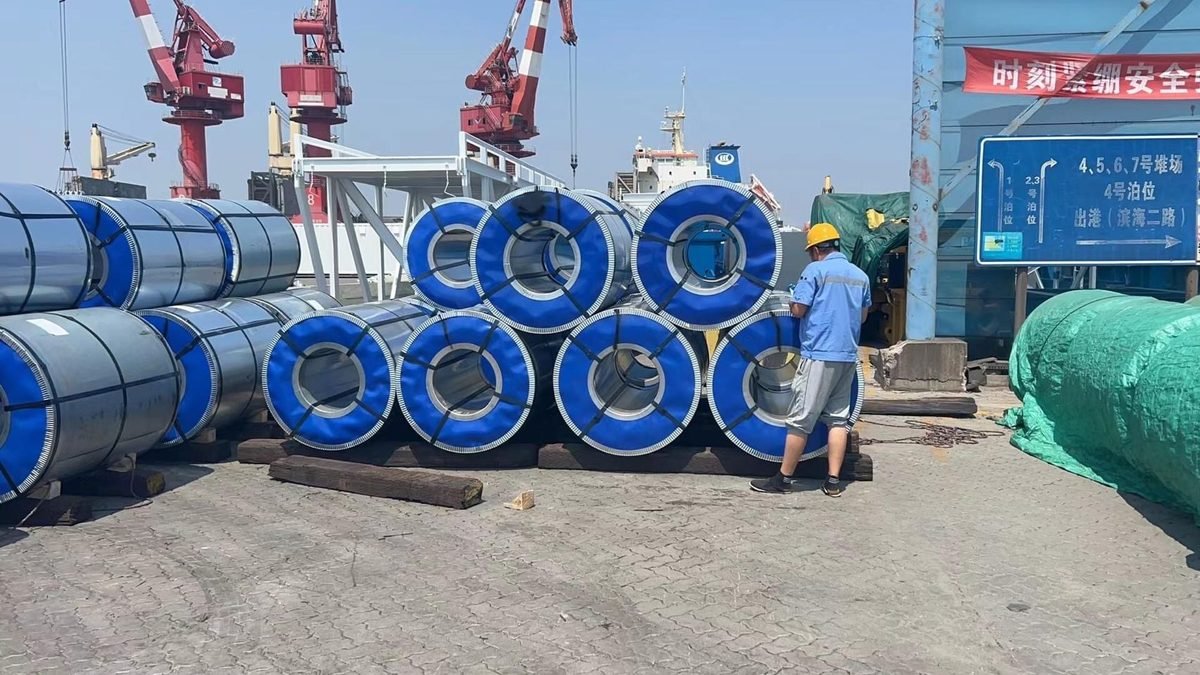
Standard coated coil runs 508 mm ou 610 mm ID, 1000 à 1250 mm width, et 3 à 10 tonnes. Width tolerance is typically 0 à +3 mm for coil coating lines, because the edge is trimmed after coating. Thickness tolerance follows the substrate standard, usually ±0.03 mm for 0.5 mm material.
Edge condition is critical for coated product. The slit or trimmed edge exposes bare steel or bare zinc, which is the first place corrosion starts. Good suppliers apply a chromate or organic edge coating, or at minimum ensure the edge is sheared rather than torn. On a roof, edge corrosion spreads inward under the coating film and produces the familiar “edge creep” that ruins the appearance long before the panel structurally fails.
Packing for export should include edge protectors, a moisture barrier, and desiccant. Coated coil is particularly vulnerable to white rust — zinc oxide and zinc hydroxide forming on wet galvanized surfaces — when condensation forms inside a sealed pack during a sea voyage. Specify VCI film and enough desiccant for the voyage duration, and specify that the coil is dry before packing.
Handling and Fabrication Rules
Coated coil must be handled with a spreader beam or a coil grab, never with a hook through the bore. The coating is soft relative to steel and every contact with a sling, fork or ground leaves a mark that cannot be repaired invisibly.
During roll forming, the coating stretches on the outside of each bend. For a 0.5 mm panel formed into a 30 mm rib, the outer surface elongation is modest, but for tight radii it becomes significant. Specify a drawing-grade substrate and a topcoat with a T-bend rating of 2T or better for demanding profiles.
Cutting should be done with a shear or a saw that produces a clean edge, and the cut edge should be treated with a repair coating if the panel is exposed. Welding coated sheet destroys the coating in the heat-affected zone and must be followed by mechanical removal of the burnt film and application of a zinc-rich repair product.
A Specification Template
| Article | Recommended entry |
|---|---|
| Substrate | DX51D + Z180, or S250GD + Z275 for structural panels |
| Pretreatment | Alkaline degrease + Cr-free conversion, adhesion per T-bend ≤ 2T |
| Primer | Epoxy, 6 – 8 µm |
| Topcoat | SMP or PVDF, 18 – 22 µm, gloss 30 ± 5 |
| Backcoat | 6 – 8 μm epoxy or polyester |
| Colour | RAL code + ΔE ≤ 1.5 per coil, D65 |
| Salt spray | ≥ 500 h, scribe creep ≤ 2 mm |
| Emballage | Edge protectors, VCI film, déshydratant, palette en bois |
Colour and Gloss Control Across a Batch
Colour is the single most visible attribute of a coated coil, and the hardest to keep consistent. The coating is applied at 20 à 40 microns wet film and cured in an oven, and the final colour depends on pigment dispersion, film thickness, curing temperature and substrate colour. Small shifts in any of these produce a visible difference between coils — a problem known as batch-to-batch colour variation.
The instrument for controlling this is a spectrophotometer, not the human eye. Specify a colour target in a recognised system (RAL, Pantone, or a customer master panel) and a tolerance expressed as ΔE. A ΔE of 1.0 is barely visible to a trained observer; ΔE of 2.0 is noticeable side by side; ΔE above 3.0 is obvious on a roof. For architectural work, specify ΔE ≤ 1.0 and require the supplier to state the measurement geometry and illuminant.
The master panel is the practical solution. Both parties sign a physical sample, and all subsequent production is compared against it under the same light. This avoids the endless argument about whether a coil “matches” a colour code that was never physically defined. Store the master panel indoors, away from light, because polyester and PVDF both shift slightly under UV over years.
Gloss is specified separately and is often neglected. A 30-unit gloss and a 60-unit gloss of the same colour look different on a large roof because the specular reflection differs. Specify gloss at 60 degrees, with a tolerance of ±5 units. Matt finishes hide panel distortion and oil canning; high gloss exaggerates them.
Warranty Language and What It Actually Covers
Coil suppliers commonly offer a “colour warranty” de 10 à 20 années. Read the terms, because they usually cover only chalking and colour fade beyond a defined ΔE, not film adhesion, corrosion at cut edges, or damage from the environment.
A typical warranty excludes coastal installations within a defined distance from the sea, industrial atmospheres with specific pollutants, contact with aggressive chemicals, and any panel cut or drilled after coating without edge repair. It also usually requires the building to be washed annually and requires the owner to retain maintenance records. These conditions are reasonable but are frequently not communicated to the end user.
The useful commercial protection is a performance specification rather than a warranty claim. Specify the coating system, the pre-treatment type, the dry film thickness, the adhesion test method and the salt spray hours, and require test reports with the delivery. A supplier who can produce those reports is more reliable than one who offers a longer warranty with vague conditions.
Adhesion is tested by the T-bend or cross-hatch method, and salt spray by neutral salt spray to a defined hours figure. For a Z275 substrate with a 20-micron polyester coating, 500 hours of neutral salt spray without blistering at the scribe is a reasonable requirement for a general-purpose product; 1000 hours indicates a higher-performance system.
For cut edges, the practical rule is that every cut, slit or punched edge on a coated panel must receive a repair coating compatible with the system. On a roof, the cut edge is where water sits and where corrosion begins. Supplying edge-coated coil or specifying on-site edge repair is cheaper than replacing panels in five years.
Foire aux questions
Is PPGI the same as prepainted steel? Oui. PPGI, PPGL, pre-painted steel and colour coated coil all describe the same product family, differing only in substrate and coating system.
Can I bend coated coil without cracking the paint? Oui, if the substrate is a drawing grade and the coating has a T-bend rating of 2T or better. The failure mode to watch is cracking at the outside of a tight bend on a commercial-grade substrate.
Why does my roof show rust at the cut edges? Because the cut edge was never protected. Specify edge treatment and use a repair coating on site cuts.
How long will a PE-coated panel last outdoors? In a temperate climate, roughly five to eight years before noticeable chalking and fade, and longer before structural corrosion if the substrate zinc mass is adequate. In coastal or tropical exposure, PE is the wrong choice.
Does thicker paint always mean longer life? Non. Film thickness beyond the point where UV is fully absorbed buys little; adhesion, substrate zinc mass and edge treatment matter more.
View DX51D galvanized steel strip specifications ou Request a coating quote

