 TOSO
Stainless Steel Perforated Plate: Hole Pattern, Open Area and Screening Use
Stainless Steel Perforated Plate: Hole Pattern, Open Area and Screening Use
Perforated stainless steel plate is a sheet with a regular array of holes punched, lasered or etched through it. It is one of those products that looks trivial and behaves technically: a screen that lets the right particle through, a guard that keeps hands out, a facade panel that shades and ventilates, a basket that drains in a centrifuge. In every one of those roles, the performance is set by three numbers that the buyer must specify together: hole size, hole pitch, and plate thickness. Choose them badly and the screen either blinds, tears, or passes material it was meant to retain.
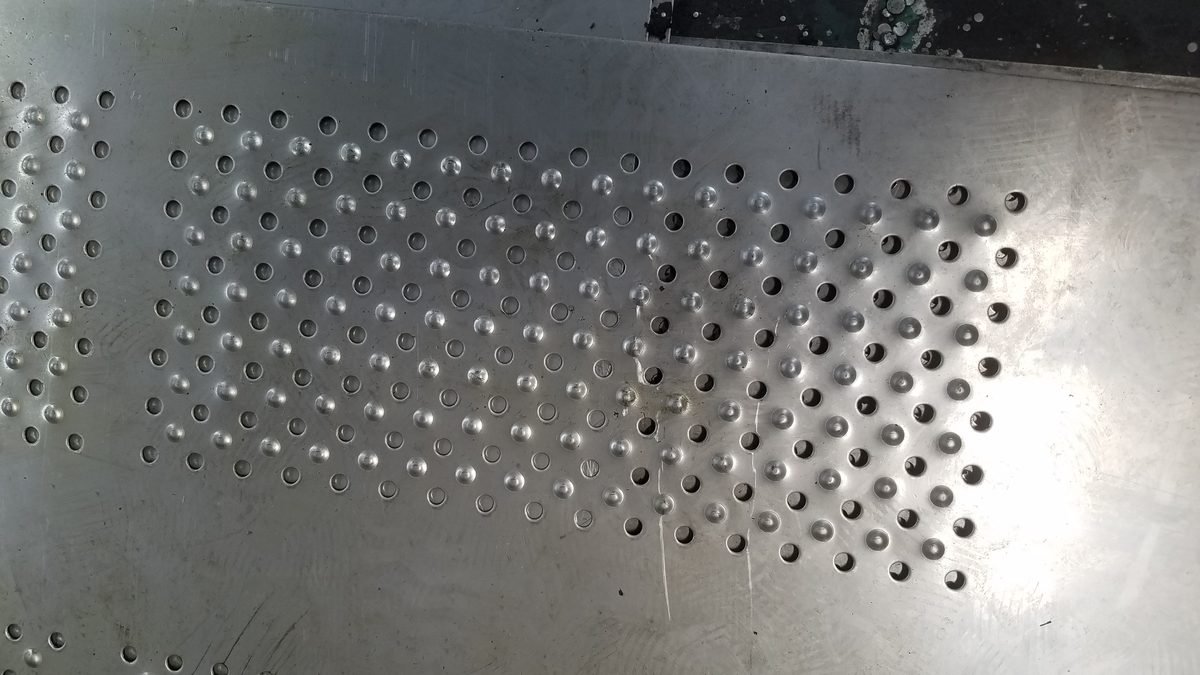
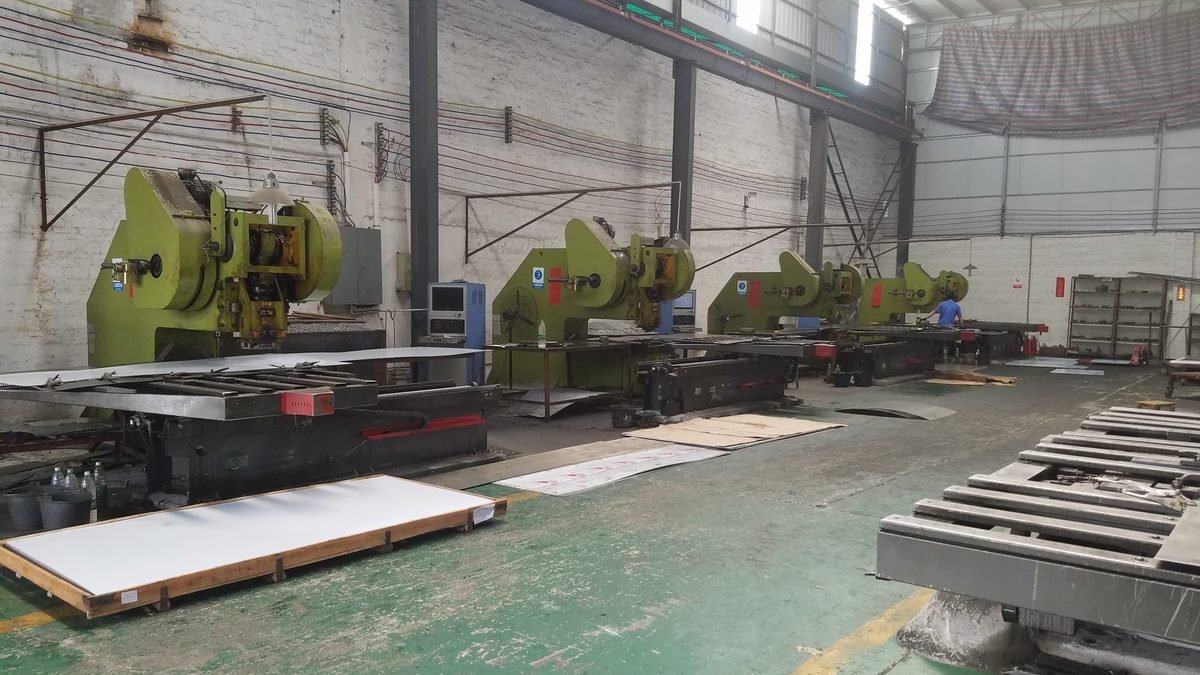
The photographs in this article show a punched stainless sheet with a staggered round-hole pattern and the CNC turret punch press that produced it. The two images say most of what matters about the product: the geometry is decided by tooling, and the quality is decided by how that tooling is maintained.
1. What Perforated Stainless Plate Is and Where It Is Used
Perforated plate begins as a flat stainless sheet or coil, usually between 0.5 kei 6 mm na vavaku, and is processed on a punch press, a laser cutter or a chemical etching line. The holes are cut in a pattern: round holes on a staggered pitch, round holes on a square pitch, square holes, slots, hexagonal holes, or custom shapes. The sheet is then flattened, vakasavasavataki, sometimes rolled into a cylinder or formed into a trough, and finished.
The application list is long because the product solves a universal problem: separating one thing from another while keeping a surface open. Mining and quarrying use it as trommel and vibrating screen media. Food processing uses it as dewatering screens, centrifuge baskets and drying trays. Water treatment uses it as intake screens and strainer baskets. Architectural work uses it as balustrade infill, sunshade panels, ventilation grilles and cladding. Automotive and appliance manufacturing uses it as acoustic and protective guards. Agricultural equipment uses it as grain and seed screens. Chemical plants use it as support grids for catalyst beds and filter media.
Two properties explain why the material is stainless rather than carbon steel. The first is corrosion resistance: a wet screen in a food plant or a coastal facade cannot be allowed to rust, and rust stains are unacceptable on architectural work. The second is cleanability: stainless can be washed, sanitised and passivated, which is why it dominates food and pharmaceutical applications where a carbon steel screen would be a contamination source.
2. Kalasi, Composition and Mechanical Properties
The great majority of perforated plate is made in 304, with 316L for chloride-bearing or aggressive environments, 430 for dry indoor applications where cost matters, kei 201 for decorative indoor work in low-corrosion conditions. The grade must be matched to the environment, not to the price list, because the difference between 304 and 316L in a coastal plant is the difference between a ten-year screen and a two-year screen.
| Ivakatakilakila | 304 (%) | 316L (%) | 430 (%) | 201 (%) |
|---|---|---|---|---|
| Koromi | 18.0 me 20.0 | 16.0 me 18.0 | 16.0 me 18.0 | 16.0 me 18.0 |
| Nikeli | 8.0 me 10.5 | 10.0 me 14.0 | 0.5 max | 3.5 me 5.5 |
| Molipideni | not specified | 2.0 me 3.0 | not specified | not specified |
| Kaboni, max | 0.08 | 0.030 | 0.12 | 0.15 |
| Makanisi | 2.0 max | 2.0 max | 1.0 max | 5.5 me 7.5 |
| Ituvatuva | Austenitiki | Austenitiki | Ferritic | Austenitiki |
| Vakayagataki vakawasoma | General screens, kakana, architecture | Wasawasa, kemikali, baravi, wainimate | Dry indoor guards and panels | Indoor decorative panels |
| Iyau | 304 | 316L | 430 | 201 |
|---|---|---|---|---|
| Fuerza de tensión | rauta ni 520 MPa | rauta ni 485 MPa | rauta ni 450 MPa | rauta ni 650 MPa |
| Na kaukauwa ni solibula, 0.2 % | rauta ni 205 MPa | rauta ni 170 MPa | rauta ni 205 MPa | rauta ni 310 MPa |
| Vakabalavutaki | rauta ni 40 % | rauta ni 40 % | rauta ni 22 % | rauta ni 40 % |
| Dredre, HV | rauta ni 200 | rauta ni 190 | rauta ni 170 | rauta ni 230 |
| Magnetic | Weakly, after forming | Weakly, after forming | Io | Weakly, after forming |
For a perforated plate, the mechanical numbers matter less for the sheet itself than for the ligament between holes. A punched sheet with 50 percent open area has half its original section removed, and the remaining ligament carries the load with a stress concentration at every hole edge. This is why a screen that is strong enough as a flat sheet can tear from a single hole when it is bolted too tightly or supported on too few bearers.
3. Open Area: The Number That Decides Throughput
Open area is the percentage of the sheet surface that is hole rather than metal. It governs flow rate, pressure drop, blinding risk and the strength of the screen. It is calculated from geometry, not measured by eye, and two patterns dominate.
Staggered round holes on a 60-degree triangular pitch. Each hole is surrounded by six neighbours, and the unit cell is an equilateral triangle. The open area is 90.7 percent of the ratio of hole diameter to pitch, squared:
Open area (%) = 90.7 × (d / p)²
Round holes on a square pitch. The unit cell is a square, and the open area is 78.5 percent of the ratio squared:
Open area (%) = 78.5 × (d / p)²
The difference between the two formulas is large in practice. For a hole diameter of 5 mm and a pitch of 8 mm, the staggered pattern gives about 35.4 percent open area and the square pattern about 30.7 percent. The staggered pattern also distributes stress more evenly, which is why screens almost always use it and why decorative square-pitch panels are usually chosen for appearance rather than for flow.
| Hole diameter | Iqaqi (staggered) | Open area | Ligament width | Typical duty |
|---|---|---|---|---|
| 2 mm | 3.2 mm | 35 % | 1.2 mm | Fine filtration, thin sheets only |
| 3 mm | 5 mm | 33 % | 2 mm | Food dewatering, small screens |
| 5 mm | 8 mm | 35 % | 3 mm | General screening, yadra |
| 8 mm | 12 mm | 40 % | 4 mm | Coarse screening, trommels |
| 10 mm | 14 mm | 46 % | 4 mm | Heavy screening, architectural panels |
| 15 mm | 22 mm | 42 % | 7 mm | Drainage gratings, large apertures |
The ligament width, the metal left between adjacent holes, is the number that governs strength and wear. A ligament narrower than the sheet thickness is a weak point in a vibrating screen and will crack at the hole edge. A rule of thumb used by screen fabricators is that the minimum ligament should be at least 1.5 times the plate thickness for static duty and about 2 times for vibrating duty. The table above shows how quickly that limits the achievable open area.
4. Matolu, Hole Size and Sheet Format
There is a hard process limit that buyers discover only when they ask for an impossible combination: the hole diameter must not be smaller than the sheet thickness, and for punching it should be at least 1.2 times the thickness. KEI 3 mm hole in a 4 mm sheet cannot be punched cleanly because the punch has no support and the die would need a taper deeper than the material. Lasers can go further, but at a cost in speed and in heat-affected edge quality.
| Paramita | Typical range | Constraint to respect |
|---|---|---|
| Matolu | 0.5 me 6 mm | Above 6 mm, punching cost rises sharply; laser or drilled plate is usual |
| Minimum hole diameter | 1.0 me 1.2 times thickness | Smaller holes need laser or etching |
| Hole tolerance | plus or minus 0.05 me 0.1 mm | Punch wear widens holes over a production run; check first and last piece |
| Pitch tolerance | plus or minus 0.1 mm | Cumulative error across a wide sheet shows as a visible pattern drift |
| Sheet size | up to about 1500 by 3000 mm | Larger sheets are usually joined or supplied as coil-fed blanks |
| Vakababa | 1 me 3 mm per metre after punching | Punching releases internal stress and the sheet bows; levelling is a separate operation |
| Burr height | 0.05 me 0.15 mm, deburred on request | A burr on a food screen traps material and harbours bacteria |
| Edge condition | sheared, ground or rolled | Sheared edges are not corrosion resistant unless passivated |
Pattern direction also matters and is easy to overlook. A staggered pattern has a natural orientation, and on a vibrating screen the long axis of the pattern should run in the direction of material flow so that near-size particles are carried off the deck instead of wedging between holes. Rotating the pattern ninety degrees changes nothing about open area and everything about blinding behaviour.
5. How Perforated Plate Is Made
Punching is the dominant process for thicknesses from 0.5 me 6 mm and holes larger than about 1 mm. A CNC turret punch press holds a set of tooling stations and moves the sheet on a positioning table while a punch and die pair cycles. For a staggered pattern the press either uses a multi-hole cluster tool or indexes the sheet in a stepped path so that one stroke produces several holes.
Tooling quality sets product quality. A worn punch rounds the hole and raises a burr; a worn die widens the hole and dulls the edge. A shop that changes tooling on a schedule produces consistent screens; a shop that runs until a punch breaks produces a batch with a diameter spread that no open-area calculation can rescue.
Laser cutting is used for small holes, thick plate, and low-volume or custom patterns. It produces a narrow heat-affected zone and a slightly tapered hole, and it is slower per hole than punching. Chemical etching produces burr-free holes with excellent edge quality and is preferred for fine screens and for thin sheet where mechanical punching would distort the pattern. Each process leaves a different edge condition, and each edge condition needs passivation if the sheet is to reach its expected corrosion resistance.
After cutting, the sheet is levelled, vakasavasavataki, cleaned and passivated in a nitric or citric acid bath. Passivation removes free iron left by tooling and restores the chromium oxide film. A punched sheet that is not passivated will show rust spots along the hole edges within weeks in a humid environment, and the rust will be blamed on the material rather than on the process.
6. Selection Rules for Screening Duty
A screen is specified by the aperture it must present to the material, not by the hole it was punched with. The two are related but not identical: a punched hole with a burr presents a slightly smaller effective aperture, and a hole in a worn die presents a slightly larger one. For critical sizing, specify the aperture and the tolerance, and inspect with a pin gauge.
Aperture versus duty. For a classifying screen, the aperture is usually set at the cut point, the size that separates product from oversize. For a dewatering screen, the aperture is set by the finest particle that must be retained, and open area matters more than exact aperture. For a guard or a facade, the aperture is set by the object that must not pass, such as a hand, a foot or a bird.
Open area versus strength. Every increase in open area is a decrease in ligament and in strength. A vibrating screen with 45 percent open area and a 2 mm ligament in a 3 mm sheet will crack; the same duty with 35 percent open area and a 3.5 mm ligament will last. When a customer asks for more throughput, the honest answer is often a larger screen area rather than a thinner ligament.
Blinding and pegging. Near-size particles wedge in holes, a condition called pegging. Slots, tapered holes and a slight relief on the downstream side all reduce it. A round hole in a thick sheet is the worst geometry for pegging, which is why screen media for sticky material is often slotted or uses a different profile altogether.
Abrasion. Kaukauwa, angular material wears the upstream edge of each hole. A harder grade or a thicker sheet extends life; a softer grade with high open area will wear through in months. In severe duty, the screen is a consumable and the specification should say so, with a wear allowance.
Korosi. Chlorides decide the grade. KEI 304 screen in a coastal intake will pit at the hole edges first, because that is where the passivation is weakest. 316L with a molybdenum addition is the minimum for chloride service, and in severe cases a duplex stainless or a non-metallic screen is the correct answer.
7. Installation and Maintenance
A perforated panel is thin, and thin panels fail at their supports. The practical rules are short.
Support the sheet on a frame with bearers at intervals no greater than about 300 me 400 mm for static duty, and closer for vibrating duty. A panel supported only at its edges will drum, fatigue and crack from the centre outward.
Use flat washers or a clamping bar rather than direct bolt heads. A bolt tightened directly onto a perforated sheet crushes the local ligament and starts a crack. A continuous clamp distributes the load and is the standard detail on vibrating screens.
Allow for thermal expansion. Stainless expands more than carbon steel, and a large facade panel restrained at both ends will buckle in summer. Provide a slip joint or a flexible fixing at one end.
Cut and drilled edges must be passivated, and site cuts should be dressed and treated with a suitable paste. A saw-cut edge left bare is where corrosion starts on an otherwise sound installation.
Cleaning depends on the duty. Food screens are cleaned with neutral or mildly alkaline detergent and rinsed; never with chloride-bearing bleach, which will pit 304 within days. Architectural panels are washed with water and a soft brush; abrasive pads scratch the brushed finish permanently.
8. Common Mistakes
Specifying hole size without pitch. KEI 5 mm hole at 8 mm pitch and a 5 mm hole at 12 mm pitch are different products with different strength and flow. The pitch belongs on the drawing.
Asking for a hole smaller than the sheet thickness. It cannot be punched. Either reduce the thickness or change the process, and accept the cost.
Ignoring burr direction. On a screen, the burr should face away from the product flow, or be removed. A burr facing the flow traps material and accelerates wear.
Using a square pitch for a screen. It gives less open area and worse stress distribution than a staggered pattern at the same pitch. Square pitch is a decorative choice.
Using 304 in a chloride environment. Pitting at hole edges is the predictable result. Specify 316L or better.
Bolting directly through the sheet. Local crushing starts cracks. Use washers or a clamp bar.
Skipping passivation. Free iron from tooling rusts within weeks and looks like material failure. Passivation is part of the product, not an extra.
Purchasing on open area alone. The highest open area is not the best screen if the ligament is too thin to survive the duty. Strength and open area trade against each other, and the specification must name both.
9. Taro e dau tarogi wasoma
What is the difference between perforated plate and expanded metal? Perforated plate has holes cut from a solid sheet and remains flat. Expanded metal is slit and stretched, producing a mesh with a raised, ivakarau ni daimani. They are different products with different stiffness and appearance.
What open area should I specify? For screening, 30 me 40 percent is typical; for coarse work, up to about 50 percent is possible with a thick sheet. For guards, the aperture requirement usually sets the open area, and it is often lower than customers expect.
Can holes be smaller than 1 mm? Io, by laser or chemical etching, usually in sheet of 0.5 mm or less. Mechanical punching is not practical below about 1 mm.
Why does my screen blind? Near-size particles, draki, or a pattern orientation that traps material. Try a slot, a relief on the downstream side, or a different pattern orientation before changing the aperture.
Does the pattern direction matter? On a vibrating screen, Io. The pattern should be oriented so that near-size particles are conveyed off the deck rather than wedged.
How thick should the plate be? Thick enough that the ligament survives the duty. For a static guard, 1.5 me 2 mm e dau yaco; for a vibrating screen, 3 me 6 mm. The hole size must be at least the thickness.
Can perforated plate be rolled into a cylinder? Io, and it is standard for centrifuge baskets and trommels. The minimum bending radius depends on thickness and hole pattern; a tight radius over a large hole will distort the aperture.
How is perforated plate cleaned? Water and neutral detergent, then rinse and dry. Avoid chloride bleach on 304, and avoid abrasive pads on brushed finishes.
Is perforated plate available in a brushed finish? Io, and it is common for architectural work. The finish must be specified, because a punched sheet has a different surface appearance from a rolled sheet, and mixing them in one facade is visible.
What tolerance should I ask for on hole diameter? Plus or minus 0.1 mm for general work, tighter for screening where the aperture defines the product. State whether the tolerance applies at the punch or after deburring.
Need perforated stainless plate cut to a pattern?
Send us the grade, matolu, hole diameter, pitch, ivakarau, sheet size and edge finish. We will confirm tooling availability, open area and lead time, and quote with a sample if the pattern is new.
Related reading: 304 2B cold rolled stainless sheet · 316L peleti sitila · 304 2B stainless coil

