 TOSO
Lead Glass for Radiation Shielding: Lead Equivalent, Thickness and Installation
Lead Glass for Radiation Shielding: Lead Equivalent, Thickness and Installation
Radiation shielding is a problem of mass. A wall, a door or a window stops X-rays and gamma rays in proportion to the amount of dense material in the path, and the densest transparent material available at reasonable cost is lead glass. It is a silicate glass loaded with lead oxide, heavy enough to attenuate radiation and clear enough for a radiographer, a dentist or a physician to see through. The engineering challenge is not choosing a glass that looks impressive on a sample board; it is matching the glass thickness to the radiation energy and the room geometry, and then installing it so the frame, the joints and the wall around it do not become the weak path that the glass was meant to close.
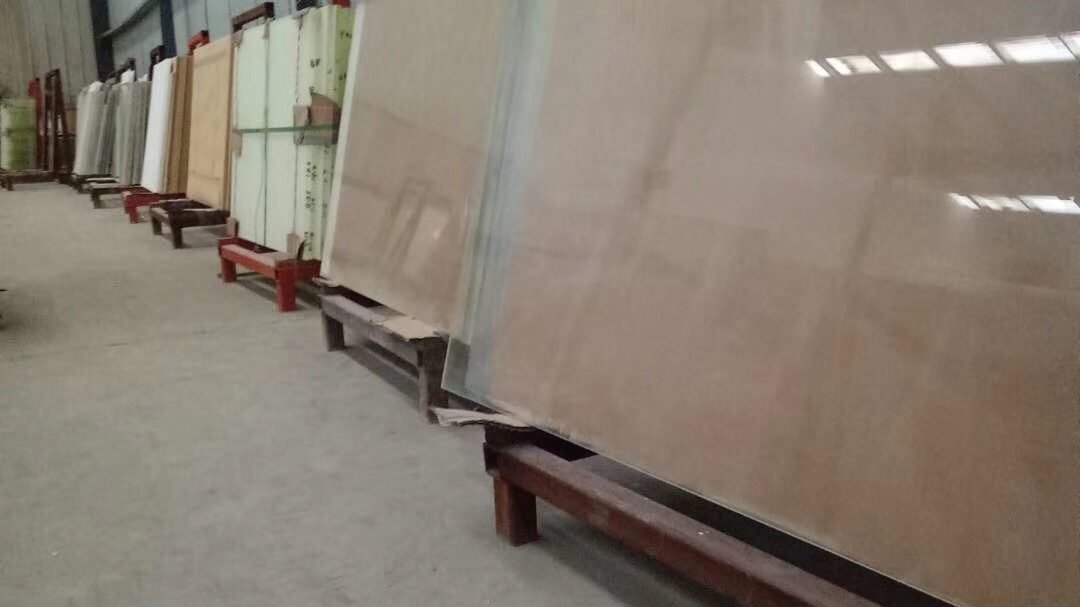
This guide explains how lead glass is specified by lead equivalent rather than by millimetres alone, how the material is made and inspected, what the common thicknesses actually deliver, and where installation practice decides whether a shielding system works. The photographs show lead glass panels stored upright in a factory rack and a completed shielded window set into a wall, which is the two states every purchaser sees: stock and service.
1. What Lead Glass Is and Where It Is Used
Lead glass, also called radiation shielding glass or X-ray protective glass, is a transparent glass in which a substantial fraction of the silica network has been replaced by lead oxide. The lead atoms provide the high atomic number and high density that make photoelectric absorption efficient, while the glass network keeps the material amorphous and therefore transparent. Ordinary window glass contains almost no lead and stops very little radiation; a shielding glass may contain 30 me 70 percent lead oxide by weight, with density from about 3.3 me 5.2 grams per cubic centimetre depending on the grade.
The applications are all places where a person must look through a barrier while radiation is on the other side. Diagnostic X-ray rooms use protective windows so that the technologist can watch the patient during exposure. CT and fluoroscopy suites use larger panes because the equipment moves and the observation area is wider. Dental surgeries use small windows in compact rooms. Industrial radiography cabins use thick panes for weld inspection with high-energy sources. Nuclear medicine departments and hot cells use shielding glass where operators handle radioactive material behind a barrier. Research facilities use it in glove boxes and shielded enclosures. Veterinary clinics, airport baggage inspection and non-destructive testing laboratories are smaller but numerous users.
In every case the glass is part of a shielding envelope that includes lead sheet, lead-lined doors, lead-lined wallboard and a frame. A window that is correct in isolation but set into an unshielded wall is not a shielding system, it is a decorative pane. That is why the specification process begins with the room, not with the glass catalogue.
2. Composition, Density and Grade Families
Shielding glasses are usually grouped by lead oxide content because that single number drives density, refractive index, attenuation and price. Higher lead content means more attenuation per millimetre, a heavier pane and a more expensive material. The table below gives the working ranges used by most manufacturers; exact compositions are proprietary and should be taken from the mill data sheet rather than assumed.
| Grade family | PbO content (wt %) | Kena rawa ni vude (g/sm³) | Refractive index | Vakayagataki vakawasoma |
|---|---|---|---|---|
| Low-lead shielding glass | 30 me 40 | 3.3 me 3.8 | rauta ni 1.65 | Dental and small diagnostic windows, low kV |
| Medium-lead shielding glass | 45 me 55 | 3.9 me 4.4 | rauta ni 1.70 | General X-ray and CT rooms |
| High-lead shielding glass | 60 me 70 | 4.5 me 5.2 | 1.75 me 1.80 | Industrial radiography, high kV, nuclear medicine |
Three practical consequences follow from the composition. Taumada, the glass is heavy: kei 10 mm pane at 4.2 grams per cubic centimetre weighs about 42 kilograms per square metre, so a one square metre window needs two people or a lifting frame. Second, the material is softer and more brittle than soda-lime glass, so edges chip easily and must be ground and usually bevelled at the factory. Third, the coefficient of thermal expansion is higher than that of ordinary glass, which makes it sensitive to uneven heating; a cold pane dropped into a warm room, or a hot pane hit by an air-conditioning draught, can crack without any mechanical load.
3. Lead Equivalent: The Number That Actually Specifies the Glass
Buyers often ask for a thickness in millimetres. Radiation protection specialists ask for a lead equivalent in millimetres of lead, written mm Pb. The lead equivalent is the thickness of pure lead that would attenuate the same radiation by the same factor under the same conditions. It is the only figure that allows a glass pane to be compared with the lead sheet in the adjacent wall and the lead lining in the door, and therefore the only figure that closes the shielding envelope.
Attenuation follows the exponential relation I = I0 multiplied by e raised to the power of minus mu x, where mu is the linear attenuation coefficient of the material at the relevant photon energy and x is the path length. Because mu rises sharply with atomic number, a dense lead-bearing glass can achieve in ten millimetres what concrete needs tens of centimetres to achieve. Because mu also falls as photon energy rises, a pane that is adequate for a 70 kV dental unit is nowhere near adequate for a 150 kV industrial source. The same glass, at the same thickness, has a different lead equivalent at different energies, which is why a test report must state the energy or the standard spectrum used.
| Nominal glass thickness | Indicative lead equivalent range | Weight per m² ena 4.2 g/sm³ | Typical application |
|---|---|---|---|
| 5 mm | rauta ni 0.8 me 1.2 mm Pb | rauta ni 21 kg | Low-power dental and veterinary windows |
| 8 mm | rauta ni 1.4 me 1.9 mm Pb | rauta ni 34 kg | Diagnostic X-ray rooms up to about 90 kV |
| 10 mm | rauta ni 1.8 me 2.4 mm Pb | rauta ni 42 kg | General radiography and CT observation windows |
| 15 mm | rauta ni 2.8 me 3.6 mm Pb | rauta ni 63 kg | Fluoroscopy suites and higher kV diagnostic work |
| 20 mm | rauta ni 3.8 me 4.8 mm Pb | rauta ni 84 kg | Industrial radiography, nuclear medicine, hot cells |
| 30 mm kei na cake | project-specific, from test report | 126 kg and above | High-energy industrial and research shielding |
The ranges above are indicative and deliberately wide. Two manufacturers producing glass of the same nominal thickness with different lead oxide contents will not produce the same lead equivalent. A buyer who accepts a quotation stating “10 mm lead glass” without a lead-equivalent figure has bought a thickness, not a performance. The correct purchase description is a target lead equivalent at a stated energy, plus a permitted tolerance on thickness and on optical quality.
4. Veimama, Thickness and Optical Tolerances
Shielding glass is produced in standard thicknesses and cut to size, but the maximum pane size is limited by the annealing capacity of the plant, not by the cutting equipment. Large panes must be annealed slowly to remove internal stress; a pane that is cooled too quickly will carry residual stress and can shatter spontaneously weeks after installation. This is why very large windows are often built from several panes joined with a lead-loaded mastic rather than from a single sheet.
| Paramita | Typical specification | Comment |
|---|---|---|
| Thickness range | 5 me 30 mm | Above 30 mm usually supplied to order |
| Thickness tolerance | plus or minus 0.3 me 0.5 mm | A minus tolerance reduces lead equivalent, so specify the direction |
| Standard pane size | up to about 1200 by 2400 mm | Larger sizes require confirmation of annealing capacity |
| Cut tolerance | plus or minus 1 mm on each dimension | Frame rebate must allow for this plus a sealing gap |
| Edge finish | qele, chamfered 1 me 2 mm | Prevents chipping during handling and improves fit in the frame |
| Vakababa | visible distortion acceptable only outside the viewing zone | Heavy glass shows slight optical distortion; check a sample against the viewing requirement |
| Bubbles and seeds | small, sparse, outside the critical viewing area | A dense cluster indicates a casting defect, not a cosmetic issue |
| Striae | faint and limited | Strong striae distort the image and suggest poor homogenisation |
| Colour | pale yellow-green to light amber | Colour deepens with lead content and thickness; not a grading criterion by itself |
| Taqomaki ni dela ni qele | PE film on both faces for transport | Remove only after the pane is in the frame |
The thickness tolerance deserves attention because it is asymmetric in effect. A pane that is 0.5 mm thin is still inside a symmetrical tolerance but delivers measurably less lead equivalent. For a room where the shielding calculation has little margin, specify a minus tolerance of zero and accept only the nominal thickness or above.
5. How Shielding Glass Is Made
Lead glass is melted in a furnace from silica sand, lead oxide, and the oxides that stabilise the glass and control its colour. Because lead oxide is volatile at high temperature and aggressive towards some refractories, the melt is handled in a plant designed for it, with dust extraction and careful temperature control. The melt is homogenised, refined to remove bubbles, and then formed.
Two forming routes dominate. Continuous rolling produces sheet glass that is annealed in a lehr and cut to size; it is efficient for standard thicknesses and moderate sizes. Casting into open moulds or onto a table produces thick plates, and these must be annealed for a long time in a slow cycle to remove stress. After annealing, panes are inspected for bubbles, striae, colour and stress, then edged, chamfered, cleaned and packed upright with interleaving.
Optical inspection is part of production, not an optional extra. A pane placed between crossed polarisers shows coloured fringes if residual stress remains. A pane viewed against a grid shows distortion from striae. A pane examined under strong backlight shows bubble clusters. Buyers who visit a factory should ask to see these three checks performed on the actual batch, because they are fast and unambiguous.
6. Installation Rules That Decide Whether the Shield Works
The pane is the easy part. The installation is where shielding systems fail, and they fail at the joints.
Frame continuity. The frame must be lined with lead sheet of the same lead equivalent as the glass, lapped behind the frame rebate so that no direct path exists from the source side to the occupied side. A steel frame without lead lining is a hole with a window in it.
Overlap, not abutment. Glass and lead lining must overlap by at least 10 me 20 mm. Two shielding materials that simply touch leave a joint that radiation follows.
No point loads. Lead glass must never be supported on screws, brackets or clamps that press on the pane face. It sits on a continuous bed of resilient setting blocks at the bottom edge and is restrained at the edges only, with the setting blocks placed at the quarter points so that the pane bears on the frame rather than on the glass edges.
Sealing. The gap between glass and frame is closed with a lead-loaded or radiation-opaque mastic, not with ordinary silicone alone, unless the frame is already fully lined and the joint geometry is designed to be self-shielding. The sealant also keeps cleaning water out of the lead lining.
Thermal movement. The frame and the glass expand differently. Leave a 2 me 3 mm clearance at each edge and use a compressible backer rod behind the sealant. A pane installed tight against a steel frame in a cold room will crack when the heating comes on.
Protection during construction. The protective film stays on until the room is finished. Plaster, paint and abrasive dust damage a lead glass surface permanently, and no polishing will restore it.
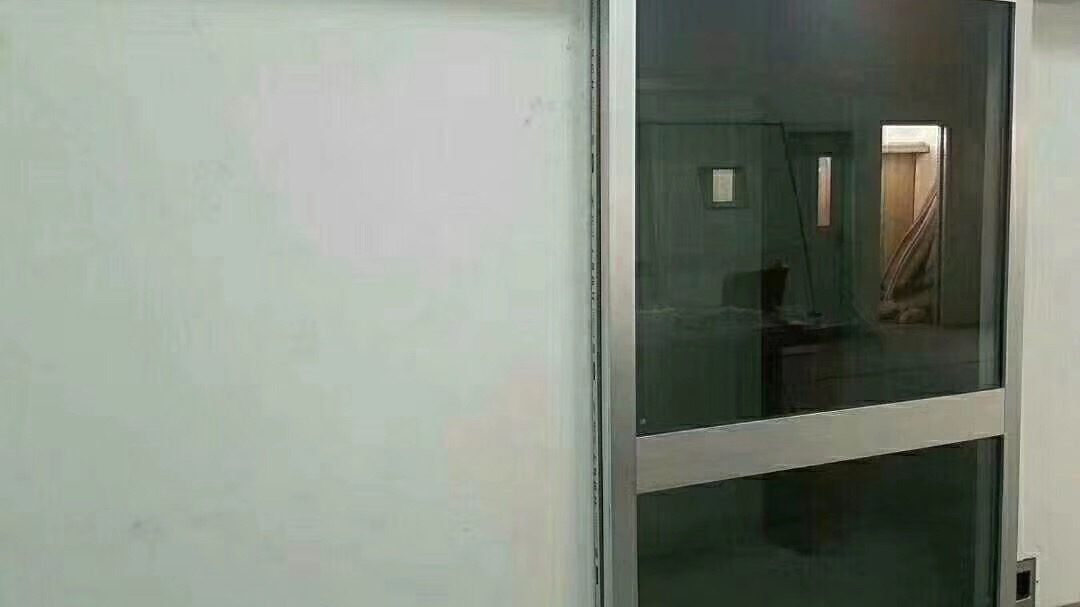
One further rule applies to doors and pass-throughs. A shielded door and a shielded window in the same wall must be specified together, because the door lining, the frame lining and the glass must share a common lead equivalent. Specifying them in separate packages is how gaps appear.
7. Inspection, Cleaning and Long-Term Care
On delivery, inspect each pane before signing. Look for edge chips, which propagate; for surface scratches under raking light; for bubble clusters at the centre of the viewing area; and for the packing orientation. Panes must be carried upright, never laid flat on a truck bed, because the material is heavy and brittle and will crack under its own weight if unsupported.
Cleaning is the long-term risk. Lead glass is softer than ordinary glass and its surface is more easily attacked by alkaline and fluoride-containing products. Use clean water with a small amount of neutral detergent, a soft cloth, and immediate drying. Avoid ammonia-based cleaners, abrasive powders, scouring pads and any product containing hydrofluoric acid. Do not use a squeegee with a metal channel on the edge, and do not let cleaning water pool at the frame joint where it can reach the lead lining.
In service, the glass should not be subjected to local heat. A radiator placed directly below a shielding window, or an air-conditioning vent blowing on one corner, creates a thermal gradient that the material tolerates poorly. This is a design issue for the room, not a property of the glass, and it is best solved before the room is finished rather than after a crack appears.
8. Common Mistakes
Specifying thickness instead of lead equivalent. Two 10 mm panes from different suppliers can differ by more than 25 percent in shielding performance. The lead equivalent at a stated energy is the only comparable number.
Forgetting the frame. A correctly specified pane in an unlined frame is a shielded window with a shielded hole around it. Framing and glass belong in one package.
Joining glass to glass without overlap. Where two panes meet, a lead-loaded mastic with a 10 mm overlap each side is required. Ordinary silicone and a butt joint do not attenuate.
Laying panes flat during transport or storage. The material is heavy and brittle. It must travel and stand on edge in a rack, as shown in the photograph above.
Installing with point loads. Screws bearing on the face, or clamps tightened against the edge, create stress concentrations that lead to cracking.
Using ordinary glass cleaner. Alkaline and fluoride products etch the surface permanently. The cost of a new pane is far higher than the cost of neutral detergent.
Assuming the certificate covers the installed condition. A test report describes a sample pane at a stated energy. Once installed, the joint geometry, the frame lining and the surrounding wall determine the actual protection.
Buying on colour. A darker pane is not necessarily a better shield. Colour tracks lead content and thickness, but only a lead-equivalent figure tells you what the pane does.
9. Taro e dau tarogi wasoma
Is lead glass the same as lead crystal? Sega. Both contain lead oxide, but lead crystal is made for brilliance and tableware, with a lead content chosen for refraction. Shielding glass is formulated for attenuation and is specified by lead equivalent.
Can lead glass be tempered? Generally no. The formulations used for shielding do not lend themselves to the thermal tempering process, and tempering would alter the optical and shielding properties. Panes are annealed instead, and handled as annealed glass.
Can I cut lead glass on site? Not practically. It must be cut and edged at the factory. Site cutting chips the edges and leaves stress raisers, and it removes any hope of a meaningful warranty.
How thick should the glass be for a dental room? That depends on the kV, the distance and the barrier requirements of the room, not on a rule of thumb. A common starting point is 5 me 8 mm glass with a stated lead equivalent, then verified by a radiation protection calculation.
Why does the glass look yellow-green? Lead oxide and trace impurities absorb part of the visible spectrum. The tint is normal, deepens with thickness and lead content, and has no effect on shielding.
Does lead glass block visible light well enough to see through? Io. Transmission is lower than ordinary glass, typically in the range of 70 me 85 percent depending on thickness and grade, which is entirely adequate for observation.
Can lead glass be repaired if it chips? Small edge chips can be ground and polished by a specialist, but the repair is cosmetic and structural strength at the edge is reduced. Report chips before installation and let the supplier decide.
How is lead glass disposed of? As lead-bearing waste, under the hazardous waste rules of the jurisdiction. It must not be mixed with ordinary construction waste.
What is the difference between lead glass and lead acrylic? Lead acrylic is a plastic sheet with similar shielding performance and much lower weight. It is easier to machine and to install in existing frames, but it scratches more readily and has lower temperature tolerance.
Can one pane cover a very large window? Sometimes. Above roughly 1.2 by 2.4 metres, most plants prefer to supply several panes joined with lead-loaded mastic, because annealing a single large plate is difficult and risky.
Specifying a shielded window?
Send us the room kV, the required lead equivalent, the pane size and the frame details. We will quote shielding glass, lead sheet and lead-lined doors as one package so the shielding envelope has no gaps.
Related reading: 316L peleti sitila · 304 2B stainless sheet · Q235B kaboni sitila barasi