 PROGRESO
316L Stainless Steel Coil: Low-Carbon Chemistry, Coil Weight and Slitting Guide
A 316L stainless steel coil is a continuous strip of low-carbon, molybdenum-bearing austenitic stainless steel, supplied in coil form for slitting, roll forming, blanking and automated welding. It is the workhorse material for chemical equipment, food and pharmaceutical lines, marine hardware and architectural products where 304 would pit, and it is bought by thickness, ancho, finalizar, coil weight and edge quality rather than by the grade name alone.
What a 316L Coil Is and Where It Is Used
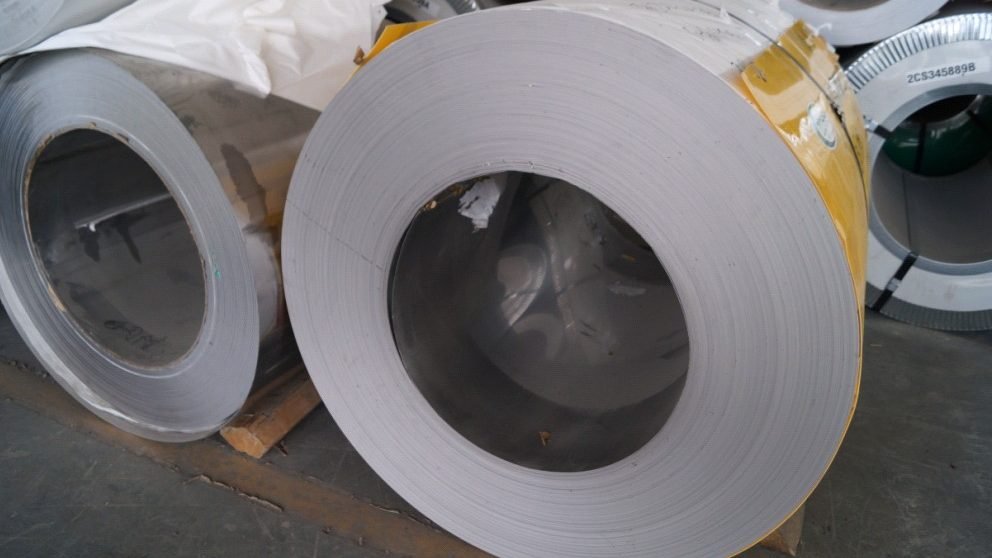
316L is the low-carbon version of the 316 austenitic family. El 2 a 3% molybdenum addition improves resistance to pitting and crevice corrosion in chloride-bearing environments, while the carbon limit of 0.03% reduces the risk of chromium carbide precipitation at grain boundaries during welding. The grade is known as UNS S31603, EN 1.4404 and 022Cr17Ni12Mo2 in Chinese standards. It is normally supplied as cold rolled coil in 2B, licenciado en Letras, No.4 or other finishes, annealed and pickled or bright annealed depending on the finish.
The coil form is chosen when the production line needs a continuous feed. Slitting produces narrow strips for roll-formed profiles, tube mills, cable trays and automotive parts. Blanking lines cut sheets from the coil for tanks, sinks and panels. Automated welding cells consume coil-fed strip for heat exchanger plates, filters and vessels. A coil also reduces handling damage compared with a stack of loose sheets and allows the mill to apply a consistent finish over a long length.
Typical applications include chemical reactor shells, tanques de almacenamiento, tubería, heat exchanger tubes and plates, equipo de procesamiento de alimentos, pharmaceutical clean rooms, accesorios marinos, desalination pre-treatment, flue gas ducts and architectural cladding in coastal areas. 316L is not a universal answer: it is not designed for high-temperature scaling above about 870 degrees C, it is not as strong as duplex or 2205, and it can still pit in warm, concentrated chlorides. The coil buyer should match the grade to the chloride level, temperature and cleaning regime.
Designación de grado y composición química
A 316L certificate should report the heat number, el estándar, the carbon content and the molybdenum range. The word 316L on a label is not enough, because some suppliers sell 316 with a carbon level above 0.03% or a molybdenum content at the bottom of the range and expect the buyer to treat it as L-grade. In welding, that difference can be the line between a sound joint and a sensitised one.
| Elemento | 316L range (%) | Role | Purchasing check |
|---|---|---|---|
| C | 0.03 máximo | Low carbon limits carbide precipitation | Arriba 0.03 is not 316L |
| Y | 0.75 máximo | Desoxidación | Excess silicon affects toughness |
| Minnesota | 2.00 máximo | formador de austenita | Does not replace nickel |
| PAG | 0.045 máximo | Residual impurity | High phosphorus hurts weldability |
| S | 0.030 máximo | Residual impurity | Sulphur lowers corrosion resistance |
| cr | 16.0-18.0 | Passive film | Abajo 16% weakens pitting margin |
| En | 10.0-14.0 | Austenite stability | Low nickel can leave ferrite |
| Mes | 2.0-3.0 | Chloride pitting resistance | Abajo 2% is not 316L chemistry |
| norte | 0.10 máximo | Austenite former and strength | High nitrogen can affect forming |
| fe | Balance | Matrix | Check residuals on the mill certificate |
Typical ASTM A240 / EN 10088-2 / GB/T 4237 window for 316L. Always confirm the current edition and any customer-specific restriction.
El molibdeno es la razón por la que existe el 316L. It raises the pitting resistance equivalent number, commonly estimated from chromium, molybdenum and nitrogen, and it slows the initiation of pits in chloride solutions. A 316L with 2.0% molybdenum is still within the standard, but it has less margin than one at 2.8%. For a coastal architectural panel or a chemical tank that will be cleaned with chlorinated foam, the higher end of the range is worth specifying.
Carbon is the other critical number. El 0.03% limit reduces sensitisation, but it does not make the steel immune. If a 316L weld is held in the 425 a 815 degrees C range for a long time, chromium carbides can still form, and sigma phase can appear after thousands of hours. That is why 316L is not the first choice for high-temperature furnace parts, even though it is often used for exhaust and heat exchanger components at moderate temperature.
Propiedades mecánicas
316L is supplied annealed, with a fully austenitic structure. Its room-temperature yield strength is lower than 304 because the higher nickel and molybdenum content stabilises the austenite and reduces the work-hardening contribution. That lower yield is not a defect; it is the trade-off for better toughness and corrosion resistance. Designers who substitute 316L for 304 without checking the allowable stress can end up with a thinner effective section than intended.
| Propiedad | Typical annealed value | Condición | Design note |
|---|---|---|---|
| Fuerza de producción, Rp0.2 | 170 MPa minimum | temperatura ambiente | Lower than 304; check the design code |
| Resistencia a la tracción, habitación | 485 MPa minimum | temperatura ambiente | Actual values often 520-620 MPa |
| Alargamiento, A50 | 40% mínimo | temperatura ambiente | Good ductility for forming |
| Dureza | 95 HRB maximum | Rockwell B. | High hardness suggests cold work |
| Densidad | 7.93 g/cm3 | Nominal | For coil weight and freight |
| Conductividad térmica | 16-17 W/m.k | 20 degrees C | Low compared with carbon steel |
| Expansión térmica | Acerca de 17 x 10-6/K | 20-100 degrees C | Allow for movement in long runs |
| Continuous service | Up to about 870 degrees C | Oxidising air | Not a high-temperature scaling grade |
| Intermittent service | Up to about 925 degrees C | Short cycles | Thermal shock reduces life |
Typical room-temperature values for annealed 316L. For pressure vessels, use the minimum values in the applicable code and the actual certificate.
Cold work raises strength and hardness and can make the coil slightly magnetic. A heavily slit edge or a tight coil wrap may show higher hardness at the edge than in the centre. That is normal for austenitic stainless, but it matters when the edge is subsequently roll formed or welded. If the part needs a tight bend, specify an annealed or a softer temper rather than accepting a work-hardened edge.
At elevated temperature, 316L retains useful strength to about 870 degrees C, but it is not a substitute for 310S or a nickel alloy. Above that range, oxidation and creep become dominant, and the molybdenum addition does not protect against scaling. For a flue or exhaust part that runs at 900 degrees C, 316L may survive a short trial and then fail by scale spalling or creep. The operating temperature, not the corrosion grade, should decide the alloy.
Dimensiones, Tolerances and Coil Data
Coil ordering is a set of linked decisions: espesor, ancho, finalizar, edge, coil weight and inner diameter. A change in one affects the others. A wider coil may need a heavier crane; a thinner gauge may need a different annealing line; a slit edge may add a burr that has to be removed before painting. The purchase order should read like a process description, not a list of nouns.
| Parámetro | Common range | Tolerancia típica | What to write on the order |
|---|---|---|---|
| Espesor | 0.3-6.0 milímetros | ±0.02 to ±0.10 mm | Nominal, standard and minimum actual |
| Ancho | 600-2000 milímetros | 0 a +2 mm or ±1 mm | Finished width after slitting |
| Coil inner diameter | 508 milímetros o 610 milímetros | ±5 mm | Decoiler mandrel size |
| Coil outer diameter | 1000-2200 milímetros | Mill-dependent | Crane and coil car capacity |
| Peso de la bobina | 3-15 t | ±10% typical | Maximum lift and line capacity |
| Borde | Mill edge or slit edge | Burr limit to agree | Slit edge for welding or exposed edges |
| Finalizar | 2B, licenciado en Letras, No.4, 8k | Por estándar | Sample or Ra range for visible parts |
| Comba | — | Acerca de 3 mm sobre 5 metro | Critical for long roll forming |
| Superficie | Recocido y decapado | No scale or embedded iron | Passivated if specified |
| Embalaje | Eye to sky or eye to side | Export seaworthy | Container and crane method |
Typical commercial data for 316L cold rolled coil. Tolerances vary by mill and width; state the governing standard and the measured acceptance limits.
Thickness tolerance is tighter than for hot rolled plate, but it is still not exact. A 0.5 mm nominal coil may be supplied at 0.48 o 0.52 milímetros, y un 2.0 mm coil may vary by 0.05 mm across the width. If the part is a formed profile that depends on consistent thickness, put the actual range on the order and check it at the head, middle and tail. A coil that is within tolerance at the head can drift at the tail if the mill had a control problem.
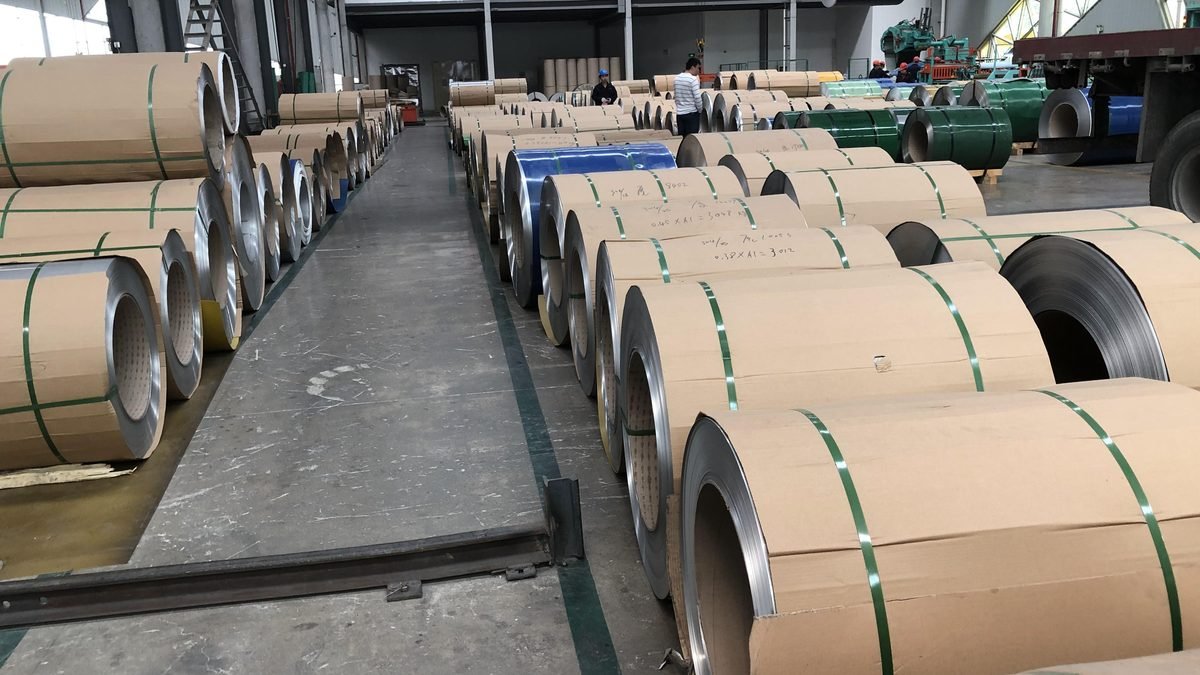
Coil weight is a handling decision. A 15 t coil needs a crane, a decoiler and a coil car rated for it; a 3 t coil is easier to handle but creates more setup time and more leftover ends. For export, the coil should be eye-protected, edge-wrapped, strapped and packed with a moisture barrier that does not trap condensation. A coil that arrives with a broken wrap often has rust spots at the edges, and the buyer may mistake that for a grade problem.
Slitting quality is often the difference between a smooth production run and a line that keeps tearing. A good slit edge is straight, with a controlled burr and no visible step. A poor slit edge can have a wave, a burr that catches on guides or a work-hardened rim that cracks during roll forming. Specify the burr direction and limit, and ask for a sample if the strip will be fed at high speed.
How 316L Coil Is Made
The process begins with a 316L slab that has been continuously cast and surface-ground. The slab is reheated and hot rolled to a transfer gauge, then cold rolled in a reversing mill or a tandem mill to the final thickness. Cold rolling introduces work hardening, so the coil is annealed in a continuous furnace at about 1040 a 1120 degrees C to recrystallise the grain structure and restore ductility.
After annealing, the coil is pickled to remove oxide and the chromium-depleted layer, then skin passed to improve flatness and surface. A 2B finish is produced by cold rolling, recocido, pickling and skin passing; a BA finish is produced by bright annealing in a controlled atmosphere, which avoids the pickling step and gives a brighter surface. No.4 is a polished finish produced with abrasive belts, and 8K is a mirror polish. Each finish has a different cost and a different sensitivity to scratches.
The most common coil defects are residual scale, pickle streaks, edge cracks, comba, variación de espesor, coil telescoping and surface scratches. Residual scale appears as dark patches that do not respond to cleaning; it usually comes from incomplete pickling or from scale rolled into the surface. Pickle streaks are grey bands caused by uneven acid flow. Edge cracks come from slab defects or poor edge trimming. Telescoping is a coil whose wraps have shifted sideways, which damages the edge during handling.
A good mill records the heat number, rolling temperatures, annealing temperature, pickle chemistry and final inspection. The buyer does not need every parameter, but the certificate should connect the coil to a heat number and to the mechanical results. Without that link, a failure investigation has no starting point. For a 316L coil that will be used in a pharmaceutical or food plant, the traceability requirement is usually stricter than for general fabrication.
Selection and Coil Handling Rules
The first selection decision is the chloride exposure. 316L is suitable for many coastal and chemical environments, but it is not seawater-resistant in the way that 2205 or 904L can be. If the part will be immersed in seawater, sprayed with seawater or cleaned with hypochlorite, check the actual chloride concentration and temperature against corrosion data. A 316L coil that passes a salt-spray test may still fail in a warm, stagnant crevice.
The second decision is the finish. 2B is the default for industrial parts that will be formed or welded. BA is chosen for appearance and cleanliness, but it scratches more easily and can show fingerprints. No.4 hides scratches better and is common for architectural and appliance panels. 8K is a mirror finish that requires careful handling and protection; a coil with a mirror finish is difficult to slit without marking the surface.
The third decision is the temper and edge. A coil that will be roll formed into a tight profile needs a soft, annealed condition and a good slit edge. A coil that will be blanked and welded may tolerate a harder edge, but the burr can still affect fit-up. If the part will be polished after forming, specify a finish that leaves enough allowance for polishing without cutting through the surface layer.
- Store coils horizontally on a saddle or timber, never on wet concrete.
- Keep the eye covered and the wrap intact until the coil is on the decoiler.
- Lift with a proper C-hook or coil car; do not lift by the wrap straps.
- Let the coil reach room temperature before precision slitting if it was stored cold.
- Record the heat number and coil number on the slitting plan for traceability.
- Protect the finished strip from iron contamination and chlorinated water.
- Do not drag the coil across a concrete floor; edge damage starts as a crack.
- Inspect the slit edge for burr and wave before running the forming line.
Errores comunes que cometen los compradores
| Mistake | Why it goes wrong | Better practice |
|---|---|---|
| Ordering 316L without a standard | Carbon or molybdenum can sit outside the L-grade window | State ASTM A240, EN 10088-2 or GB/T 4237 |
| Using 316L for high-temperature scaling | Oxidation and creep above about 870 C | Use 310S or a nickel alloy for higher temperatures |
| Assuming 316L is seawater-proof | Pitting and crevice corrosion in warm chlorides | Usar 2205, 904L or a higher-molybdenum grade |
| Using 308L filler on 316L | Lower molybdenum in the weld; corrosion at the joint | Use 316L or 316L-Si filler |
| Ignoring slit edge burr | Burr cracks during roll forming or injures operators | Specify burr limit and direction; deburr if needed |
| Buying a coil heavier than the crane | Unsafe handling and coil damage | Match coil weight to crane and decoiler |
| Storing coils in a humid yard | Edge rust and white spots under the wrap | Store dry, ventilado, with a moisture barrier |
| Polishing through the finish | Spotty appearance and rework | Allow enough stock for polishing; start from a consistent finish |
Most 316L complaints are selection or handling errors, not chemistry failures. A complete order description prevents more problems than a higher grade.
A frequent mistake is to treat 316L as a drop-in replacement for 304 without rechecking the design. The lower yield strength can reduce the pressure rating of a thin wall, and the higher nickel content changes the forming behaviour. If a part was designed around 304, substituting 316L may be safe, but it is not automatic. Run the calculation and check the springback.
Inspection and Acceptance
Receiving inspection starts with the certificate and the coil label. Check the grade, número de calor, espesor, ancho, peso, finish and edge condition against the purchase order. Then measure thickness at several points along the coil width and at the head and tail. Measure width at the same points and check for camber by laying a straight edge along the edge.
Surface inspection should be done after the wrap is opened and under good light. Look for residual scale, pickle streaks, rayones, edge cracks, rust spots and roll marks. A light rust that wipes off may be handling damage; dark pitting that does not wipe off is a material or storage problem. If the coil is for a pharmaceutical, food or pressure application, require PMI on the first piece and a positive material identification report. A magnet test is not a substitute for PMI because 316L can be weakly magnetic after cold work.
- Check the heat number on the coil and on the certificate; they must match.
- Measure thickness at the head, middle and tail, and at three positions across the width.
- Check width, rebaba de borde, camber and coil inner diameter.
- Inspect both faces for scale, streaks, rust and mechanical damage.
- Confirm the coil weight and the number of wraps before signing the delivery note.
- Keep a cut sample and the certificate for traceability.
- Verify the finish against the approved sample, not only against a name.
- Record any deviation before the coil is slit; after slitting, the evidence is gone.
If the coil will be used for a welded pressure part, the acceptance plan should include a weld procedure qualification and a corrosion test if the service is aggressive. A 316L certificate proves the chemistry, not the weldability of a particular heat. Some heats with residual elements at the upper limit can be more sensitive to hot cracking, especially in thick sections.
Preguntas más frecuentes
Is 316L better than 304?
It is better in chloride-bearing and chemical environments because of the molybdenum addition. It is not automatically better at high temperature, and its yield strength is lower. Match the grade to the service.
Can 316L be used for seawater?
It can be used for some marine fittings and splash zones, but it is not recommended for continuous seawater immersion or warm stagnant seawater. Usar 2205, 904L or a higher-molybdenum alloy for those conditions.
What is the maximum service temperature of 316L?
Acerca de 870 degrees C continuous in oxidising air, y sobre 925 degrees C for short cycles. Por encima de eso, oxidation and creep become dominant.
Why is 316L magnetic?
Annealed 316L is austenitic and essentially non-magnetic. Cold work, slitting or welding can transform some austenite to martensite and produce a weak magnetic response.
Can I weld 316L with 316 relleno?
Sí, 316 filler is common for 316L. Use a low-carbon 316L filler for the best corrosion resistance, and purge the back side of the weld on thin tube.
Does 316L need post-weld annealing?
Usually not for thin sections. For thick sections or severe service, a solution anneal may be specified, but it is difficult to perform in the field and should be planned before fabrication.
¿Cuál es la diferencia entre 2B y BA??
2B está laminado en frío, recocido, pickled and skin passed; it has a smooth, matte surface. BA is bright annealed in a controlled atmosphere, giving a brighter, more reflective surface without pickling.
How much does a 316L coil weigh?
Common coils run from 3 a 15 t, depending on thickness, width and mill. The weight must match the crane, decoiler and container payload.
Can 316L be used for food contact?
Sí, with a suitable finish and cleaning regime. 2B or BA is common; passivation and a smooth weld are important. Check the applicable food-contact standard.
Why does 316L rust at the weld?
Heat tint, slag, iron contamination or insufficient shielding can destroy the passive film. Clean and passivate the weld, and use a proper shielding gas and purge.
What is the lead time for a 316L coil?
It depends on thickness, ancho, acabado y cantidad. Stock sizes may ship in days; mill rolling and slitting may take several weeks. Send the full specification for a firm date.
Need a 316L coil with a stated finish, width and slit edge?
QIDAMT supplies 316L stainless coil from Liaocheng. enviar el espesor, ancho, finalizar, peso de la bobina, edge condition and destination for a quotation. Email sales@qidamt.com or call +86 139 6951 8618 during working hours (GMT+8).