 ПРАГРЭС
Q355ND and Q355NE Steel Plate: Normalized Low-Temperature Grades Explained
Q355ND and Q355NE are normalized low-alloy steel plates with guaranteed Charpy impact energy at −20 °C and −40 °C respectively. They are specified for cold-region structures, low-temperature vessels and machinery that must not become brittle. This guide explains the grade suffix system, the chemistry and impact requirements, the thickness range and tolerances, and the fabrication rules that keep the toughness after welding.
What the Grade Designation Means
The designation is read from left to right, and each character carries a separate requirement. Q355 is the minimum yield strength in MPa. The next letter is the quality grade, which sets the impact test temperature and the phosphorus and sulphur limits. The letter N is the delivery condition: normalized. Put together, Q355ND means a 355 MPa yield plate, D quality, normalized; Q355NE is the same plate with E quality and a −40 °C impact test.
| Абазначэнне | Ураджайнасць, МПа | Impact quality | Test temperature | Умова дастаўкі | Звычайнае выкарыстанне |
|---|---|---|---|---|---|
| Q355B | ≥355 | Б | +20 °С | Як закаталі / controlled rolled | General structural work, у памяшканні |
| Q355C | ≥355 | С | 0 °С | Як закаталі / controlled rolled | Outdoor structures in mild climates |
| Q355D | ≥355 | Д | −20 °С | TMCP or as agreed | Cold-region structures, moderate thickness |
| Q355ND | ≥355 | Д | −20 °С | Normalized | Thick plate, low-temperature vessels and structures |
| Q355NE | ≥355 | E | −40 °С | Normalized | LNG, cold storage, severe cold service |
| Q355NF | ≥355 | Ф | −60 °С | Normalized / special | Arctic and cryogenic-adjacent structures |
Quality grades and delivery conditions to GB/T 1591-2018. A plate with the same strength but a different suffix is not interchangeable.
The most common purchasing mistake is to order Q355D and receive a plate that meets the impact test but was produced by TMCP rather than normalized. For thin plate the two may perform similarly; for thick plate, or after welding and stress relief, the normalized product has a more stable toughness through the thickness because the normalization heat treatment refines and homogenises the grain structure across the whole section.
Хімічны склад
Q355ND and Q355NE share the same strength requirement but the E grade is tighter on phosphorus and sulphur, because toughness at −40 °C depends on controlling inclusions and grain-boundary segregation as much as on alloy content.
| элемент | Q355ND | Q355NE | Effect |
|---|---|---|---|
| С | ≤0.20 | ≤0.18 | Сіла; too high reduces toughness and weldability |
| І | ≤0.50 | ≤0.50 | Раскісленне; high Si thickens the zinc coating if galvanized |
| Мн | 0.90–1.65 | 0.90–1.65 | Strength and toughness balance |
| П | ≤0.030 | ≤0.025 | Segregation, embrittlement; tightly controlled for E |
| С | ≤0.025 | ≤0.020 | Inclusions, lamellar tearing; tightly controlled for E |
| Nb + В + з | ≤0.22 total | ≤0.22 total | Micro-alloying for grain refinement |
| У | ≤0.40 | ≤0.50 | Toughness; increased for low-temperature service |
| Ал (soluble) | ≥0.015 | ≥0.015 | Fine grain practice |
| Н | ≤0.012 | ≤0.012 | Free nitrogen reduces toughness |
| CEV (CEV max) | ≤0.45* | ≤0.45* | Зварваемасць; calculated from C, Мн, кр, мо, В, У, Cu |
Typical limits to GB/T 1591-2018. *Carbon equivalent limits depend on thickness and grade; confirm the applicable table for the ordered thickness.
Two elements deserve a note. Nickel is deliberately allowed up to 0.50% in the E grade because it improves low-temperature toughness without raising strength much. Sulphur is held to 0.020% because manganese sulphide inclusions elongate during rolling and act as crack initiation sites; a plate that passes the Charpy test in the rolling direction can still fail in the through-thickness direction if the sulphur is high.
Mechanical Properties and Impact Test
Strength falls with thickness, and the impact requirement is the part of the specification that actually distinguishes the grades. The table below gives the minimum values that appear on a mill certificate.
| Таўшчыня, мм | Yield Re, МПа | Tensile Rm, МПа | Падаўжэнне А, % | Impact KV2, Дж |
|---|---|---|---|---|
| ≤16 | ≥355 | 470–630 | ≥22 | Д: ≥27 у −20 °С; E: ≥27 у −40 °С |
| >16–40 | ≥345 | 470–630 | ≥22 | same test temperatures |
| >40–63 | ≥335 | 470–630 | ≥21 | same test temperatures |
| >63–80 | ≥325 | 470–630 | ≥21 | same test temperatures |
| >80–100 | ≥315 | 470–630 | ≥21 | subject to agreement; often tested at the design temperature |
Minimum values to GB/T 1591-2018 for normalized plate. Charpy specimens are longitudinal unless the order specifies transverse; sub-size specimens have reduced acceptance values.
A Charpy value of 27 J is a minimum, не мэта. Good normalized Q355NE plate typically tests at 100–200 Дж ат −40 °С, and the mill certificate will show the actual absorbed energy for each specimen. When a project specifies “27 J minimum”, the value that matters is the lowest single specimen, not the average, and the test temperature must be the one on the drawing.
Impact testing is sensitive to specimen orientation and position. Specimens are taken from the plate surface region unless the order says otherwise, and transverse specimens normally absorb less energy than longitudinal ones. For a critical low-temperature application, specify the sampling position relative to the surface and the rolling direction, and ask for the individual readings rather than only the pass/fail statement.
Таўшчыня, Size and Tolerances
| Параметр | Тыповы дыяпазон / памяркоўнасць | Даведка |
|---|---|---|
| Таўшчыня | 6–100 мм (normalized); wider by agreement | GB/T 709 |
| Допуск па таўшчыні | −0.3 / +0.5 mm for 6–16 мм; wider band above 16 мм | GB/T 709, class N |
| Шырыня | 1500–2500 мм | +10 / 0 мм |
| Даўжыня | 6000–12000 мм | +15 / 0 мм |
| Пляскатасць | ≤8 мм на метр, ≤10 mm over a 12 m plate | GB/T 709 |
| Стан краю | Sheared or gas-cut; mill edge on wide plate | Specify on the order |
| Паверхня | No cracks, no laps; scale allowed unless pickled | Visual and UT |
| Ultrasonic test | Optional to GB/T 2970 class I–III | Specify class for pressure work |
Normalizing requires a heat-treatment furnace large enough for the plate, and that furnace sets the practical width limit. Plates wider than about 2500 mm are difficult to normalize without distortion, which is why very wide normalized plate is scarcer and more expensive than TMCP plate of the same strength. When a design can use 2200 mm width instead of 2500 mm, the normalized supply and the delivery time usually improve.
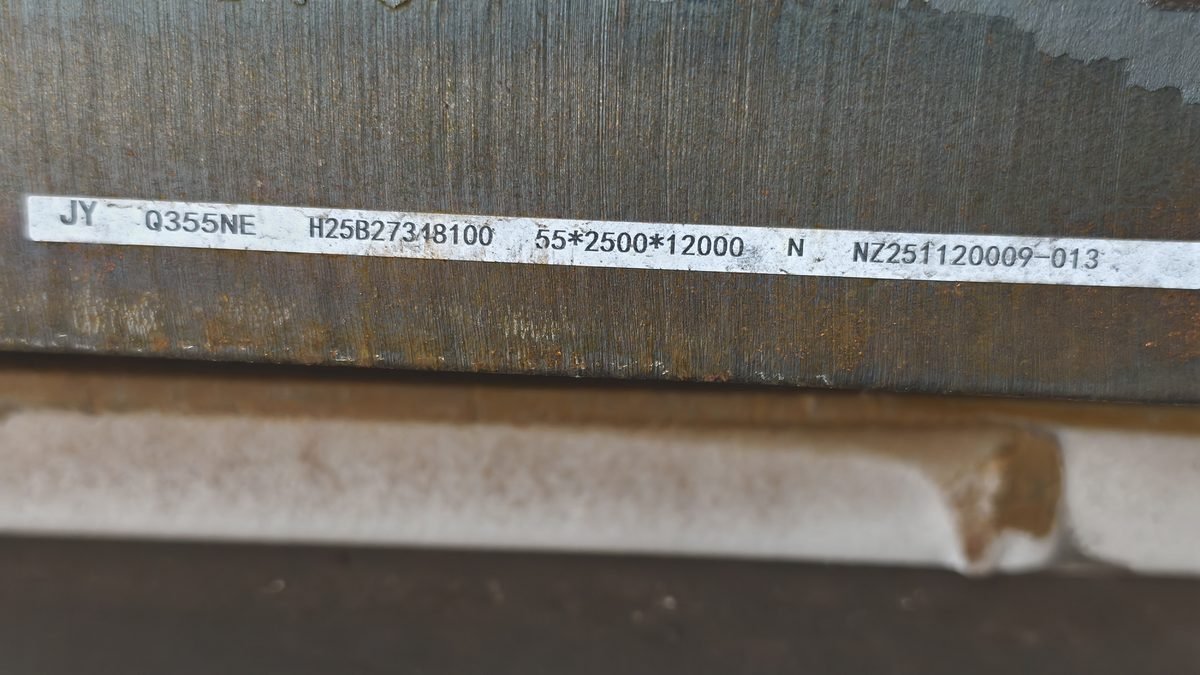
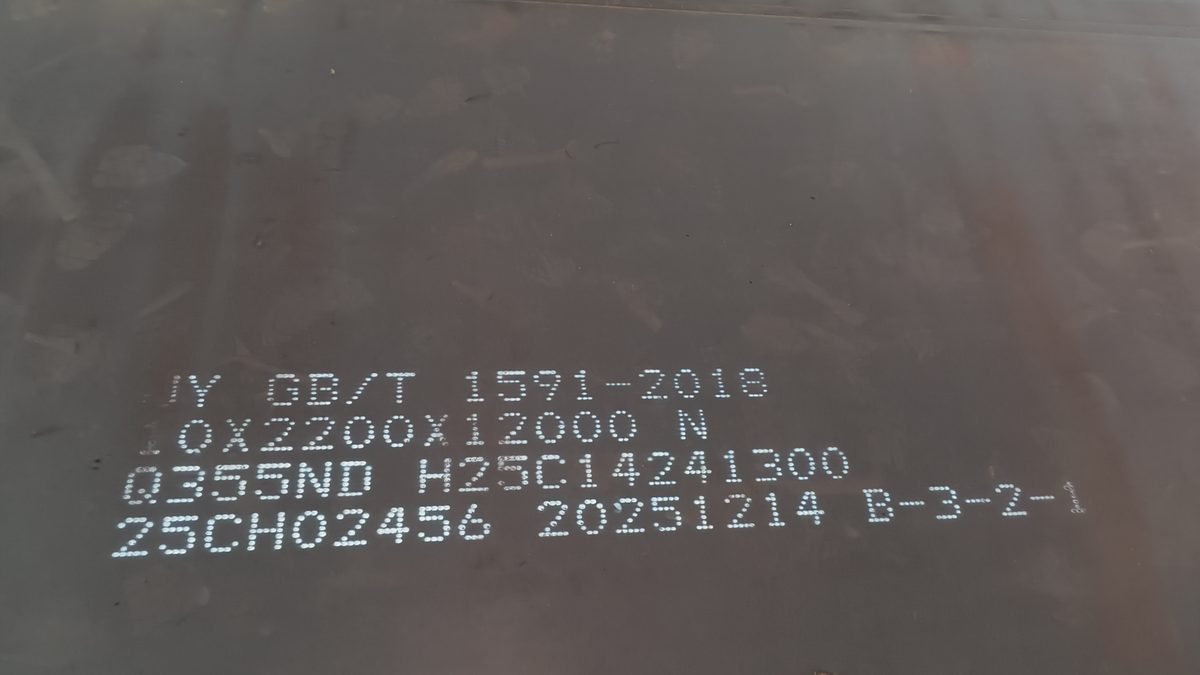
The mill marking is part of the traceability chain. A normalized plate carries the grade, the heat number, the plate number, the size and the standard on the surface or on the edge, and those characters must match the mill certificate and the packing list. When a plate is cut, the marking is transferred to each piece, either by hard stamping or by a documented transfer record, or the low-temperature traceability is lost.
Normalizing and Fabrication
Why normalize
Normalizing heats the plate to about 890–920 °С, holds it until the section is through-heated, and then air-cools it. The treatment refines the austenite grain size, homogenises the banded microstructure produced by rolling, and removes the residual stresses of the rolling process. The result is a plate with consistent toughness through the thickness and a more predictable heat-affected zone after welding.
Зварка
Q355ND and Q355NE are weldable with low-hydrogen processes: shielded metal arc with E7018-type electrodes, MIG/MAG with matching wire, or submerged arc with a basic flux. For thickness above about 25 mm, preheat to 100–150 °C and control interpass temperature; for very thick sections, a post-weld heat treatment may be specified. The heat input should be kept within the procedure qualification range, because excessive heat input coarsens the grain in the HAZ and reduces the toughness that the normalization provided.
Do not assume that the plate’s Charpy result transfers to the weld. The HAZ is a new microstructure, and the procedure qualification has to demonstrate the required impact energy at the same test temperature. For E-grade work this is usually the controlling test in the whole fabrication package.
Cutting and forming
Normalized plate cuts and bends like any low-alloy structural plate. Thermal cutting leaves a hardened edge on thick sections; for fatigue-loaded or low-temperature details, the cut edge is dressed or ground and inspected for cracks. Cold bending across the rolling direction is preferred, and the bend radius should be large enough to avoid surface cracking on the outside of the bend.
Правілы адбору
- Pick the suffix from the service temperature, not from the strength. А −20 °C design does not become a −40 °C design by ordering a thicker plate.
- Use N for thick plate and critical welds. Normalized plate gives more consistent through-thickness toughness; TMCP is fine where the thickness and the welding procedure support it.
- Check the impact test direction. Longitudinal and transverse specimens are not equivalent, and the drawing must state which is required.
- Specify the UT class where the plate is for pressure or lifting equipment. Internal discontinuities are not visible on the surface and are not covered by the Charpy test.
- Order with the marking transfer requirement. Low-temperature traceability lives or dies with the marking.
- Keep the carbon equivalent within the welding procedure. A plate that meets the mechanical properties but exceeds the CEV limit may not be weldable without preheat beyond what the shop can control.
Тыповыя прымянення
The grade choice is almost always driven by the lowest temperature the steel will see, plus the consequence of a brittle failure. Four applications account for most normalized Q355ND and NE plate.
- Cold-region bridges and infrastructure — steel girders, bearing plates and connection details in regions where winter temperatures fall below the D-grade test point. The plate is usually 20–60 mm thick and welded, so the HAZ toughness is the controlling qualification.
- Low-temperature pressure vessels — storage and process vessels for refrigerated media, where the design metal temperature is the vessel’s own specification and the plate is ordered with UT and impact testing.
- Cold storage and refrigeration structures — racking, platforms and supports inside freezers, where the steel sits at −25 каб −40 °C for its whole life and maintenance is difficult.
- Construction and mining machinery — booms, chassis and frames used in winter conditions, where impact loading and low temperature combine.
What these applications share is that the steel is not just cold, it is also welded and often thick. A 10 mm plate in a freezer is a different problem from a 60 mm welded girder at −40 °С: the thin plate is limited by its own toughness, while the thick welded section is limited by the heat-affected zone and by the through-thickness restraint at the joint.
Inspection and Documentation
Low-temperature plate is bought on evidence. The plate that arrives on site without the right documents is, for engineering purposes, an unknown material, whatever its stamp says.
- Mill certificate — лік цяпла, chemical analysis, tensile results, individual Charpy readings, delivery condition and standard. The heat number must match the plate marking.
- Impact test report — specimen orientation, sampling position, test temperature and the energy for each specimen, not only the minimum.
- Ultrasonic inspection report — where the plate is for pressure, lifting or critical structure; the class must match the purchase order.
- Dimensional check on receipt — thickness at several points, шырыня, даўжыня, пляскатасць; a plate that is 0.5 mm under tolerance is a different structural element.
- Marking transfer record — every cut piece traceable to the original plate and heat number.
A practical receiving check that catches most problems: measure thickness with a calibrated gauge at five points, read the marking against the certificate, and confirm the grade suffix on both. If the marking says Q355D and the certificate says Q355ND, stop and resolve it before the plate is cut, because after cutting there is no way to prove which plate the piece came from.
Тыповыя памылкі
- Treating Q355D and Q355ND as the same product. The D suffix sets the impact temperature; the N sets the delivery condition. Only the ND/NE combination guarantees normalized toughness.
- Accepting a certificate without the individual impact readings. A pass statement hides whether the lowest specimen was 28 J or 180 J.
- Ordering E grade and welding it with a procedure qualified on D grade. The HAZ toughness requirement is different and must be re-qualified.
- Cutting without transferring the marking. The plate becomes untraceable the moment the original stamp is cut away.
- Ignoring through-thickness properties. A plate can pass longitudinal Charpy and still be susceptible to lamellar tearing at a T-joint.
- Using normalized plate as a substitute for a proper low-temperature design. Toughness is a material property; it does not fix a detail that concentrates stress.
FAQ
What is the difference between Q355ND and Q355NE?
Both are normalized Q355 plate. ND guarantees 27 J Charpy impact at −20 °С; NE guarantees the same energy at −40 °C and holds phosphorus and sulphur to tighter limits. NE is the grade for severe cold service and for LNG-adjacent structures.
Can Q355D be used at −40 °С?
Not on the basis of its certificate. Q355D is tested at −20 °С; using it at −40 °C requires a design assessment and usually a re-test, and the safe route is to order Q355NE or Q355NF.
Why is normalized plate used for thick sections?
Because normalization refines the grain through the full thickness. A thick as-rolled or TMCP plate can have a tougher surface and a less tough centre, and the difference only shows up in through-thickness testing or in a welded T-joint.
Does the Charpy test temperature matter for indoor structures?
It matters wherever the steel can reach the design temperature in service, including during transport, storage and construction in winter. A warehouse in a cold region can see −20 °С, which is exactly the D-grade case.
Can the plate be galvanized?
так, but the silicon content affects the coating. Q355 with silicon near the upper limit can produce a thick, dark coating; discuss the chemistry with the galvanizer before committing to a coating class.
What documents should come with the plate?
Mill certificate with heat number, chemical analysis, tensile and individual Charpy results, the delivery condition, and the UT report if ordered. The marking on the plate must match all of them.
Спадарожныя тавары
For structural sections in the same grade family, у Плоскі брусок з вугляродзістай сталі Q235B page covers the flat bar sizes used for stiffeners and connection plates; for stainless components in low-temperature equipment, 316L пласціна з нержавеючай сталі covers the austenitic option where low-temperature toughness is required without a Charpy transition.
Need Q355ND or Q355NE plate quoted with impact test evidence?
Адправіць таўшчыню, шырыня, даўжыня, колькасць, design temperature and the required UT class. We will quote with the normalized delivery condition and individual Charpy results on the certificate.