 ПРАГРЭС
6061-T6 Aluminium Flat Bar: Талерантнасць, Machining and Supply Guide
An aluminium flat bar is a solid rectangular section, extruded rather than rolled from plate, with a rectangular cross-section that is wider than it is thick. In 6061-T6 it is the default material for machine frames, крапежныя пласціны, guide rails and automation structures that need stiffness without the weight of steel. The two numbers that decide whether a bar works are the width and thickness tolerance and the straightness after heat treatment, not the alloy name on the invoice.
What an Aluminium Flat Bar Is
The section is described by width and thickness, напрыклад 50 × 10 мм або 100 × 12 мм, and supplied in random lengths of 3 каб 6 metres or cut to a fixed length. It is a solid product, not a hollow section, so it carries load in two directions and can be drilled, tapped, milled and bolted on any face. Extruded flat bar has a fine surface and straight edges, which makes it usable as a machine bed, a linear rail base or a mounting plate without planing.
The alternative is plate cut into strips. Plate-derived strip is cheaper at large widths but has rolled edges, looser width tolerance and a different grain direction. Extruded bar holds a sharper corner, a tighter width tolerance and a consistent cross-section along the length, which is why fixture builders buy bar rather than plate when the section is under about 150 мм шырынёй.
Where 6061-T6 Flat Bar Is Used
The biggest volume goes into industrial automation: машынныя рамы, guarding posts, sensor mounts, pneumatic manifold blocks, robot end-effectors and conveyor brackets. A second group is tooling: крапежныя пласціны, джыгі, check gauges, mould inserts and vacuum tables, where the T6 temper gives enough yield strength to resist clamping loads and the material machines cleanly. A third group is transport and consumer equipment: багажнікі на даху, лесвічныя рэйкі, cycle components, marine fittings and structural trim.
6061-T6 is chosen where a combination of moderate strength, добрая ўстойлівасць да карозіі, weldability and anodising response is needed. It is not the right choice for high-strength aerospace fittings, where 7075-T6 or 2024 is used, or for complex bent sections, where the T6 temper cracks at tight bend radii and a T4 or O temper would be safer.
Grade and Chemical Composition
6061 is a magnesium-silicon alloy with a small copper addition. The magnesium and silicon form magnesium silicide, which is the phase that responds to the T6 heat treatment; the copper improves strength without destroying corrosion resistance; the chromium controls grain structure and limits stress-corrosion sensitivity.
| элемент | І | Fe | Cu | Мн | Mg | кр | Зн | з | Іншыя |
|---|---|---|---|---|---|---|---|---|---|
| Wt. % | 0.40-0.80 | 0.70 макс | 0.15-0.40 | 0.15 макс | 0.80-1.20 | 0.04-0.35 | 0.25 макс | 0.15 макс | 0.05 максімум кожны |
Composition limits per ASTM B221 / У 573-3 для 6061. Total of unspecified others must not exceed 0.15 працэнтаў.
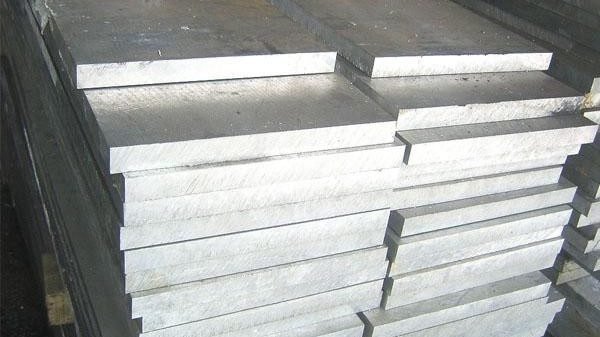
Механічныя ўласцівасці
T6 means solution treated and artificially aged. For extruded bar the more precise designation is often T6511, which adds a controlled stretch after quenching to relieve residual stress before ageing. The difference matters: a T6 bar that has not been stress relieved will move after a large face is machined away, і а 2 mm bow over a 1 metre fixture is enough to scrap the part.
| Уласнасць | Т6 / T6511 typical | Test basis |
|---|---|---|
| Трываласць на разрыў | 310 MPa minimum | ASTM B221 |
| Мяжа цякучасці, 0.2% | 276 MPa minimum | ASTM B221 |
| Elongation in 50 мм | 8-12% | ASTM B221 |
| Цвёрдасць | 95 HB typical | Brinnell |
| Shear strength | 207 MPa typical | Derived |
| Elastic modulus | 68.9 ГПа | Тыповы |
| Цеплаправоднасць | 154-167 Вт/м·К | Т6 |
| Шчыльнасць | 2.70 г/см³ | Nominal |
Minimum values apply to bar in the longitudinal direction at room temperature. Short transverse properties are lower and should be tested when the part is heavily machined.
Памеры і допускі
Extruded bar is ordered by width, thickness and length. Width and thickness tolerances are normally taken from EN 755-9 for European enquiries or ASTM B221 for North American ones, and they are not identical. Прамалінейнасць, twist and squareness are separate requirements: a bar can be within thickness tolerance and still be 3 mm out of straight over a metre.
| Параметр | Тыповы дыяпазон | Commercial tolerance | Заўвага |
|---|---|---|---|
| Шырыня | 10-200 мм | ±0.5 to ±1.5 mm | Depends on width band |
| Таўшчыня | 3-100 мм | ±0.10 to ±0.50 mm | Depends on thickness band |
| Даўжыня | 3-6 m random | +2 / -0 mm cut | Saw cut, square within 0.5° |
| Прамалінейнасць | — | ≤ 1 мм на метр | Measured on edge |
| Твіст | — | ≤ 1° per metre | Over the full length |
| Squareness of cut end | — | ≤ 0.5° | Relative to axis |
| Радыус кута | — | 0.5-2.0 мм | Extrusion die dependent |
| Паверхня | — | No laps, die lines ≤ 0.05 мм | Візуальны + profile check |
Tighter tolerances are achievable by controlled straightening and machining, at a higher price and longer lead time.
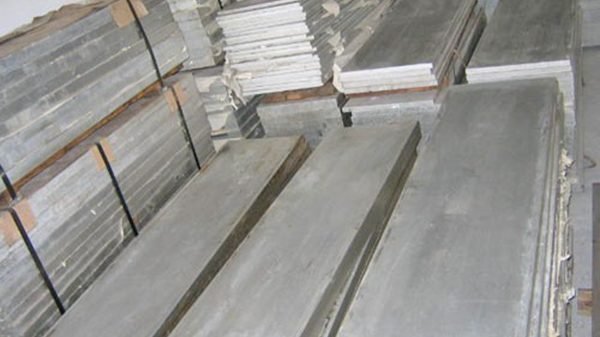
How the Bar Is Made
Extrusion
А 6061 billet is heated to 450 каб 500 °C and pushed through a rectangular die on a press of 8 каб 25 MN, depending on the section. Billet quality decides the surface: a homogenous billet with a clean shell and correct homogenisation gives a bar free of dark streaks and hard inclusions. The extrusion speed is set by the section ratio; a thin, wide bar runs slower than a compact square because the die faces more friction and a greater temperature gradient.
Quench, stretch and age
The bar leaves the die at 500 °C and is quenched in water or a water-air mist to hold the alloying elements in solution. It is then stretched 1 каб 3 percent to relieve quench stress, straightened, and cut to length. Ageing takes place in an oven at about 175 °C for 8 гадзіны, which precipitates the magnesium silicide and develops the T6 strength. The stretch is what separates T6511 from plain T6; without it, machining releases the residual stress and the part bows.
Finishing and inspection
Bar is inspected for width, таўшчыня, прамалінейнасць, twist and hardness on a sampling basis, and a mill certificate is issued with the heat number. Optional operations include precision sawing to fixed length, face milling, CNC machining to drawing, anodising and hard anodising. When the bar will be anodised after machining, specify the anodic film class and the colour; a 10 micrometre clear film is decorative, у той час як а 25 каб 50 micrometre hard film is a wear surface.
Machining and Fabrication Rules
6061-T6 machines well but is gummy at high speed without coolant. Use carbide tooling with polished flutes, 250 каб 400 m/min surface speed for milling, 0.05 каб 0.15 mm per tooth feed, and generous water-soluble coolant. Keep the tool engaged rather than rubbing, because rubbing work-hardens the surface and causes chatter on the next pass. For drilling, use a 118° or 130° point and peck deeper than 3D to clear chips.
Clamp the bar on a sacrificial face where possible, and release the clamps before the final finish pass so the part can relax. If the bar is T6511 and the machining removes less than 20 percent of the section, distortion is usually small; if it removes more than half, expect movement and plan a stress-relief or a second finishing pass. Avoid sharp internal corners: a 0.5 mm radius at the bottom of a pocket reduces the stress concentration and prevents crack initiation under vibration.
Welding 6061-T6 is possible with 4043 filler and AC TIG or MIG, but the heat-affected zone drops to roughly half the T6 yield strength. If the joint carries load, either redesign to bolted construction, use a 5083 or 6061-O detail and re-heat-treat, or accept a reduced allowable stress in the HAZ. Never weld a precision fixture after it has been machined and expect the geometry to hold.
Tolerance Stack-Up in Fixture Design
A fixture built from flat bar accumulates error from four sources: bar thickness tolerance, bar width tolerance, cut-length tolerance and the squareness of the cut end. If each bar is ±0.20 mm on thickness and five bars are stacked, the stack can be 1 mm out before any machining. Designers who ignore this end up shimming the assembly or machining every spacer individually. The cheaper route is to specify a machined thickness for the load-bearing bars and leave the cosmetic bars at commercial tolerance.
Straightness matters in a different way. А 1 mm bow over a metre is invisible on a single bar but becomes a 1 mm gap when two bars are bolted face to face, and a gap of that size will not close under bolt tension without distorting the section. For rail beds and linear-motion bases, удакладніць 0.3 mm per metre or less, and ask for the measurement method: feeler gauge on a surface plate, dial indicator on a bench, or laser over the full length. A certificate that says “прамыя” without a number is not a specification.
Thermal movement is the fourth source. Aluminium expands about 0.024 mm per metre per degree Celsius, roughly twice steel. А 3 metre fixture that sees a 20 °C shop swing moves 1.4 мм; if it is bolted to a steel frame at both ends, something has to give. Leave clearance at one end, or use a sliding joint, and keep the design symmetrical so the movement does not twist the assembly.
Corrosion Behaviour and Anodising Response
6061 has good atmospheric corrosion resistance because the magnesium and silicon additions do not depress the oxide layer the way copper-rich alloys do. It performs well in rural, urban and most industrial atmospheres, and it resists mild chemical exposure. It is not a marine alloy in the same class as 5083: in continuous salt immersion or a splash zone it pits, and the pits deepen under deposited chloride. For a coastal structure, either move to 5083 or specify a sealed anodised finish and inspect it annually.
Anodising response is one of the reasons 6061 is so widely used. Clear sulfuric anodising at 10 каб 15 micrometres gives an even, bright film with good dye uptake. Hard anodising at 25 каб 50 micrometres produces a wear surface of 400 каб 500 HV, useful for slideways and gripper jaws, but it reduces fatigue strength by 20 каб 40 percent and must be specified with a radiused part design. Black dye on a hard film is less colour-stable than on a decorative film, so do not assume one process covers both appearance and wear.
Where the bar is machined after anodising, mask the electrical contact faces and any threaded holes. Anodising is an insulator: a 20 micrometre film will stop a grounding path, and a tapped hole will grow tight by twice the film thickness. Specify masking, or chase the threads after coating, before the first part is made rather than after the hundredth.
Selection and Purchase Rules
- Specify the temper as T6 or T6511; for machined fixtures, T6511 is the safer default.
- State width, thickness and length in millimetres plus the tolerance standard (У 755-9 or ASTM B221).
- Add straightness and twist limits separately; they are not covered by thickness tolerance.
- For anodised parts, state the film class and whether colour matching is required.
- For welded structures, state the allowable stress in the heat-affected zone or ask for a welded detail in a lower-strength temper.
- Ask for the heat number and mill certificate before release, especially for safety-related fixtures.
- For long bars, agree the packing method: wooden cradle, paper interleave and edge protection prevent transit damage.
Тыповыя памылкі
- Buying T6 bar and bending it like 5052. T6 has low elongation and cracks on a tight radius; use T4, O or a smaller section.
- Machining a large pocket out of plain T6 and wondering why the part bows. The residual stress was never relieved.
- Мяркуючы 6061 is seawater-proof. It is adequate for splash zones but pits in continuous immersion; 5083 або 6063 with a proper anodise is better.
- Specifying anodising thickness in “мікрон” without a class. Class I and Class II are different warranties.
- Ignoring the corner radius and then cracking the part at the pocket corner in service.
- Welding a T6 frame and designing it with the parent-metal yield strength.
- Using a bar with a 3 mm bow as a machine bed and shimming the whole frame instead of rejecting it.
- Mixing 6061 і 6082 bars on one fixture; the two alloys have different strength and anodising response.
FAQ
What is the difference between 6061-T6 and 6061-T6511?
Both are solution treated and aged. T6511 adds a controlled stretch of 1 каб 3 percent after quenching, which relieves residual stress. For a bar that will be heavily machined, T6511 holds shape better and is normally the correct call.
Can I bend 6061-T6 flat bar?
Only on a generous radius. Т6 мае 8 каб 12 percent elongation, so a bend radius below about 3 times the thickness risks cracking on the outside of the bend. For tight bends, specify T4 or O temper and heat treat after forming.
ёсць 6061 або 6082 better for a machine frame?
Both work. 6082 is slightly stronger and common in Europe; 6061 is more available in North America and has a broader anodising supply base. Do not mix them in one structure without checking galvanic and strength assumptions.
How straight is a standard extruded bar?
Commercial straightness is about 1 мм на метр, with twist up to 1 degree per metre. Precision straightening or machining can reach 0.2 мм на метр, at a price.
What surface finish can I expect?
Extrusion leaves fine die lines and a matte-to-satin surface. Machining gives Ra 0.8 каб 1.6 micrometres with a good face mill; anodising adds 5 каб 25 micrometres of film and changes the colour and gloss.
Can the bar be supplied cut to exact length?
так. Precision sawing holds ±0.5 mm on lengths up to 3 metres and ±1 mm beyond that. State whether the cut face must be square to the axis or just clean.
For sheet and plate in the same alloy family, see the 1060 aluminium sheet and plate page. Flat bar enquiries are quoted faster when the section, нораў, length list and tolerance standard arrive together.
Send Your 6061-T6 Flat Bar List
Раздзел, нораў, length and tolerance standard are enough for a firm quotation.

