 تقدم
NM400 Wear-Resistant Steel Plate: صلابة, Thickness and Fabrication
NM400 is a wear-resistant steel plate with a nominal Brinell hardness of 400 اتش بي دبليو, used where abrasive material slides, impacts or crushes against steel. It is not a structural plate with extra hardness: it is a quenched and tempered plate designed so the surface resists gouging while the core stays tough enough to absorb impact. This guide covers the grade definition, كيمياء, hardness and toughness limits, thickness range, cutting and welding rules, and the mistakes that turn a wear part into a cracked plate within a month.
QIDAMT supplies NM400 plate from 3 مم ل 100 مم, in widths up to 2,500 مم, with mill test certificates and hardness verification on request.
What NM400 Is and Where It Is Used
Wear plate grades are written as NM plus a hardness number in the Chinese GB/T 24186 system: نم400, نم450, نم500, NM550 and NM600. The number is the nominal Brinell hardness, not a tensile class. NM400 sits in the middle of the range: hard enough to resist sliding abrasion from sand, gravel, ore and coke, and tough enough to survive the impact of a loaded bucket or a falling rock.
Typical applications include:
- Dump truck bodies, liners and tailgates in mining and quarrying
- Excavator and loader buckets, cutting edges and side plates
- Hoppers, يقع, transfer points and silo liners
- Crusher feed plates, grizzly bars and screen decks
- Concrete mixer drums, asphalt plant wear parts and paver screeds
- Scrap handling grapples, shredder housings and recycling equipment
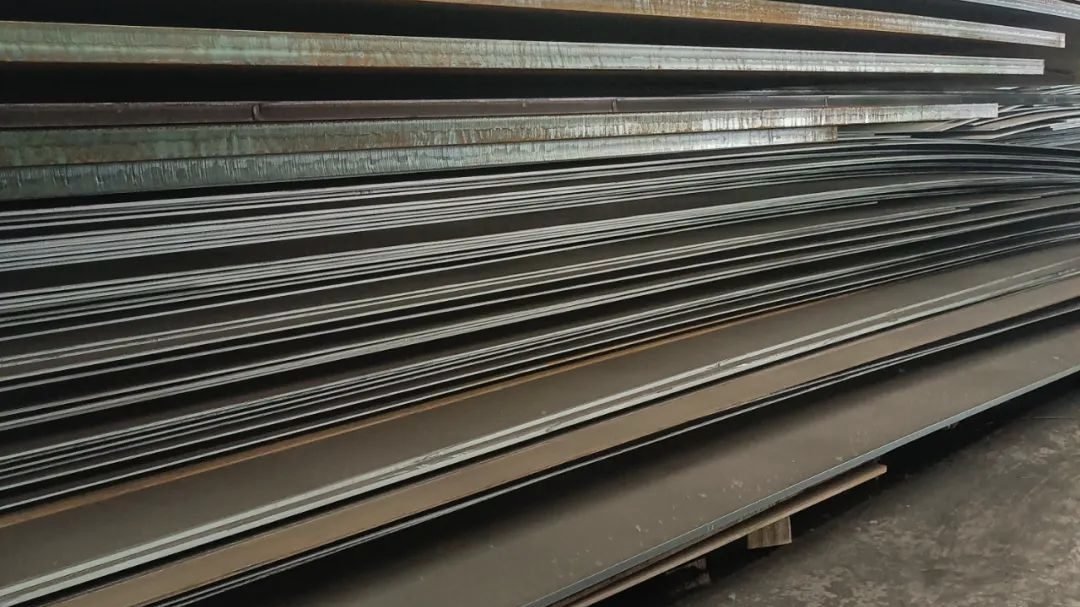
The grade is usually supplied as a quenched and tempered plate with a clean, scale-free surface. It is not intended to be welded into a pressure-retaining structure, nor used as a substitute for structural plate where design relies on ductility rather than hardness.
صلابة, Wear Resistance and the Trade-off
Brinell hardness is measured on the plate surface, usually with a 10 mm ball and a 3,000 kgf load. NM400 is specified as 360 - 430 اتش بي دبليو, with most mills aiming at the middle of the band. Hardness is the single best predictor of sliding abrasion resistance for the same microstructure, but it is not a complete description of wear performance.
| درجة | Nominal hardness | الاستخدام النموذجي | Relative wear life |
|---|---|---|---|
| NM360 | 330 - 390 اتش بي دبليو | Light abrasion, truck liners | مرجع |
| نم400 | 360 - 430 اتش بي دبليو | General mining and quarry wear | 1.1 – 1.2× NM360 |
| نم450 | 420 - 480 اتش بي دبليو | Heavy abrasion, بطانات شلال | 1.3 – 1.4× NM360 |
| نم500 | 470 - 530 اتش بي دبليو | Severe abrasion, crusher parts | 1.5 – 1.7× NM360 |
| NM550 / NM600 | 530 - 600 اتش بي دبليو | ارتداء المدقع, limited forming | 1.8 – 2.0× NM360 |
Relative wear life is an industry rule of thumb for comparable abrasive conditions; it is not a guarantee for a specific site.
Two plates with the same hardness can wear differently if the microstructure, inclusion content or surface decarburisation differs. A hardness reading taken on a decarburised surface layer can read low by 20 - 40 اتش بي دبليو; the test should be taken after removing at least 0.5 mm from the surface, or on a prepared cross-section.
التركيب الكيميائي
NM400 is a low-alloy, boron-treated steel. The exact chemistry is mill-specific, but the following ranges describe the family. Boron is the key element: a few parts per million dramatically increase hardenability, which allows the plate to through-harden during quenching.
| عنصر | نطاق نموذجي (%) | وظيفة |
|---|---|---|
| كربون (ج) | 0.10 - 0.30 | Hardness and strength; too high hurts toughness |
| السيليكون (و) | 0.15 - 0.50 | Deoxidation and strength |
| المنغنيز (مينيسوتا) | 0.80 - 1.60 | Hardenability and toughness |
| الفوسفور (ص) | ≤ 0.025 | النجاسة; control for toughness |
| الكبريت (س) | ≤ 0.010 | النجاسة; low sulphur improves through-thickness toughness |
| الكروم (سجل تجاري) | 0.20 - 1.20 | Hardenability and wear resistance |
| النيكل (في) | 0 - 1.00 | Toughness |
| الموليبدينوم (شهر) | 0 - 0.60 | Hardenability in thick plate |
| Boron (ب) | 0.0005 - 0.0050 | Hardenability; the defining addition |
Mill-specific. Always work from the heat certificate supplied with the plate, not from a generic table.
الخصائص الميكانيكية
| ملكية | متطلبات نموذجية | تعليق |
|---|---|---|
| Surface hardness | 360 - 430 اتش بي دبليو | Measured after removing decarburised layer |
| قوة الشد | ≥ 1,200 الآلام والكروب الذهنية | Conversion from hardness is approximate |
| قوة العائد | ≥ 1,000 الآلام والكروب الذهنية | عالي, but not a design substitute for structural grade |
| Elongation A50 | ≥ 10% | Limited ductility; bending radii must respect it |
| طاقة التأثير (20 درجة مئوية) | ≥ 20 - 24 ج | شاربي V, transverse; mill-specific |
| Through-thickness hardness | Uniform within 20 - 30 اتش بي دبليو | Thick plate may show a softer core |
The low elongation is deliberate. أ 400 HBW plate cannot be treated like Q235B: it will not tolerate tight bends, flame-cut sharp internal corners or uncontrolled weld thermal cycles. Design the part so the hard plate sees sliding wear and the structural loads are carried by a softer, tougher grade behind it where possible.
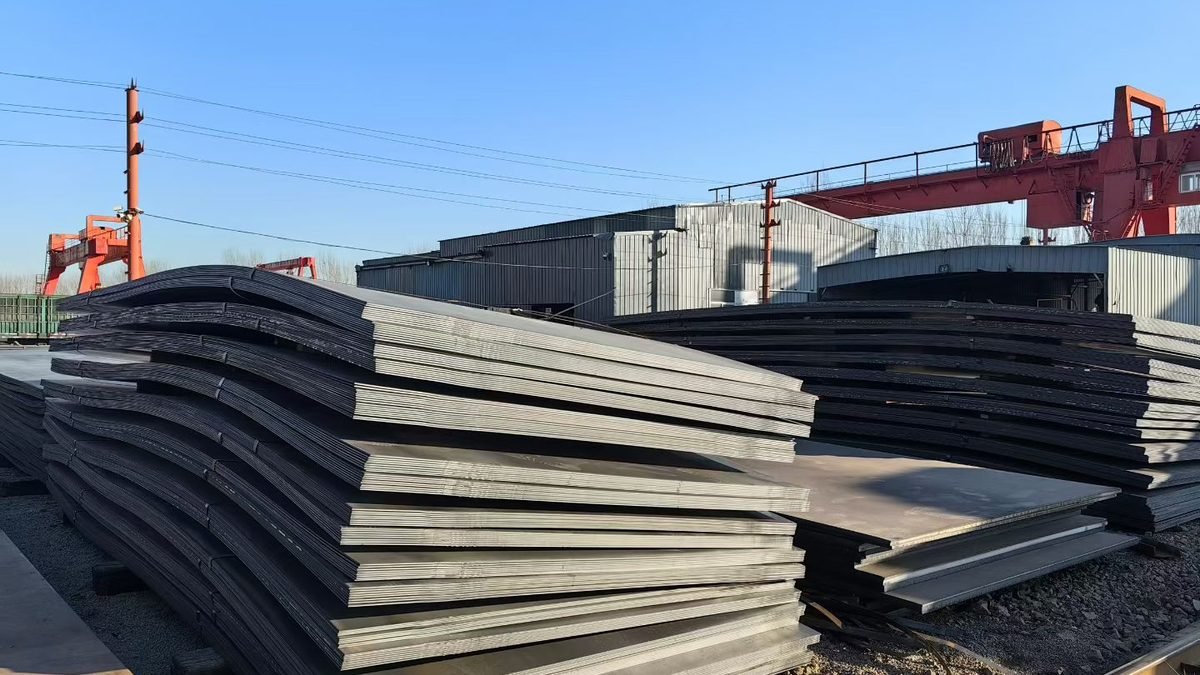
سماكة, Width and Tolerances
| غرض | يتراوح | ملحوظات |
|---|---|---|
| سماكة | 3 - 100 مم | 3 - 20 mm most common for liners |
| عرض | 1,000 - 2,500 مم | Wider plate reduces weld seams |
| طول | 2,000 - 12,000 مم | Cut to size on request |
| Thickness tolerance | Per GB/T 709 / في 10029 | Class B or C for liners |
| التسطيح | ≤ 8 mm per metre typical | Critical for bolted liners |
| سطح | Shot blasted or rolled | Scale removed before painting |
| Hardness depth | ≥ 90% of nominal to 0.8 × thickness | Verify on thick sections |
Thickness tolerance matters more than it looks. A liner ordered at 20 mm that arrives at 19.2 مم يخسر 4% of its wear volume before it is installed, and a plate that is thick in the middle and thin at the edge will wear unevenly. For critical wear parts, specify the thickness class and ask for measurements at the plate edges as well as the centre.
Cutting and Edge Preparation
NM400 can be cut by plasma, waterjet, laser or abrasive saw. Plasma is the workhorse for thicknesses up to 40 مم; waterjet gives a cold-cut edge with no heat-affected zone, which is preferable for parts that will be welded or for thick sections where a hard cut edge can initiate cracks.
- Flame cutting is possible but leaves a hardened, brittle edge; grind back 2 - 3 mm before welding.
- Keep cut edges square and free of notches. A sharp internal corner is a stress concentrator in a 1,000 MPa steel.
- Drill or punch holes before hardening if the design allows; حفر 400 HBW plate is slow and consumes carbide.
- Deburr all edges that will be handled; a burr on a hard plate cuts gloves and slings.
For liner plates, the edge quality also decides how the plate sits against the supporting structure. A bowed or burred edge holds the plate off the frame, concentrates bolt load and causes the plate to crack around the bolt holes rather than wear out.
حفر, Machining and Countersinking
بالقطع 400 HBW plate requires rigid tooling, carbide or ceramic inserts, high feed per revolution and low cutting speed. Work-hardening is not the main problem; the problem is heat at the cutting edge and the risk of chipping the hard surface layer.
- Use cobalt or carbide drills with through-tool coolant; peck drilling avoids work-hardening at the tip.
- For countersunk bolt heads, machine the seat with a carbide countersink and check that the seat is perpendicular to the hole.
- Avoid carbide end mills with long overhang; chatter chips the edges of a hard plate quickly.
- If many holes are needed, consider waterjet cutting the pattern instead of drilling.
Bending and Forming
NM400 can be bent, but the minimum bend radius is large: as a rule, the inside radius should be at least 3 - 4 times the thickness for 90° bends, and more for thick plate. Bend lines should run across the plate rather than along the rolling direction where possible, and the bend should be made in one slow stroke rather than in several small increments that work-harden the outer surface.
Preheating is not normally recommended for NM400: it softens the surface and defeats the purpose of the grade. If a bend is unavoidable at a tight radius, a stress-relief treatment after bending is difficult without losing hardness, so the design should be changed instead.
Welding Wear Plate
Welding is the highest-risk operation on wear plate. The weld heat-affected zone softens below the nominal hardness and, in thick plate, can become the initiation point for a crack under impact.
- Use low-hydrogen consumables (E7018 or a matching low-alloy electrode) and bake them according to the manufacturer’s instruction.
- حافظ على انخفاض مدخلات الحرارة: a stringer bead technique with 0.8 - 1.5 kJ/mm is typical; avoid wide weaving.
- Preheat is generally not required for thin plate; for thick sections and cold workshops, a modest 100 - 150 °C preheat reduces cracking risk without destroying hardness.
- Interpass temperature should stay below 200 درجة مئوية. Let the part cool between passes rather than stacking heat.
- Do not weld a hard plate to a structural plate with a single heavy pass; use a buttering layer or a tougher transition plate.
- بعد اللحام, inspect the HAZ visually and with dye penetrant on load-bearing joints.
Where the wear surface must remain hard, design the joint so the weld is outside the wear zone, or use bolted and clamped liner plates instead of welded ones.
قواعد الاختيار
NM400 or NM450?
Choose NM400 when the wear is abrasive but the part also sees impact, and when the plate must be formed or welded. Choose NM450 or NM500 when the wear rate justifies the shorter service interval and the part is flat, bolted and protected from impact. Going harder is not automatically better: أ 500 HBW plate that cracks after two weeks is worse than a 400 HBW plate that wears for six months.
Wear plate or structural plate?
Use a structural grade such as Q235B or Q355B for the load-bearing frame, and NM400 only as the sacrificial liner. A common design is a 6 - 10 mm NM400 liner bolted or plug-welded onto a 10 - 20 mm structural backing plate. This separates the wear function from the strength function.
How thick should the liner be?
Thickness is set by the allowed wear allowance and the impact energy, not by the strength. أ 6 mm liner in a low-impact chute may last as long as a 20 mm liner in a high-impact truck bed. Calculate the wear rate in mm per 1,000 hours from site records, then choose a thickness that gives the maintenance interval you want.
Installation and Wear-Part Design
- Support the liner continuously; an unsupported plate flexes under load and cracks at the bolt holes.
- Use countersunk or plow bolts so the fastener head does not stand proud and wear away.
- Leave a small gap between adjacent plates for thermal expansion and to avoid edge-to-edge contact under load.
- Stagger the joints between liner layers so that material does not find a straight path to the backing plate.
- Radius the internal corners of chutes and hoppers; a square corner creates a dead zone that wears through first.
- Paint the back and edges of the plate if the structure is exposed to weather; the wear face is usually left bare.
الأخطاء الشائعة
- Specifying hardness by grade name only, without a certificate or a surface hardness check.
- Measuring hardness on the decarburised surface and rejecting a good plate, or accepting a soft plate that reads high on scale.
- Welding a thick NM400 liner with a single high-heat pass and finding a crack in the HAZ a week later.
- Bending a 20 mm plate to a radius suited to 8 لوحة مم.
- Using NM400 as a structural member and relying on its high yield strength in a welded connection.
- Bolting a liner directly to a thin frame without a backing plate, then blaming the plate when the frame deforms.
- Cutting holes with a torch and leaving a hardened, ragged edge that initiates cracks.
Repair, Overlay and Rebuild
Worn liners are often repaired rather than replaced, and the repair method decides how much life the part gets back. Hardfacing with a chromium carbide or tungsten carbide overlay can restore the wear surface, but the overlay must be applied to a clean, preheated and properly prepared plate, and the heat input must be controlled so the base plate does not crack.
- Cut out cracks before hardfacing; welding over a crack only hides it until the next impact.
- Preheat according to the filler supplier, not by guesswork, and keep the interpass temperature controlled.
- Do not hardface a plate that has already lost more than about 30% of its thickness; the remaining section is too thin for the load.
- For bolted liners, replace the plate rather than patching it; a patch creates a step that wears faster than the original surface.
- Record the wear pattern and the hours to failure; that record is what sizes the next liner correctly.
Inspection and Documentation
A wear plate order should arrive with a mill test certificate showing chemistry, hardness and impact results, plus the heat number stamped or written on the plate. عند الاستلام, check the heat number against the certificate, measure thickness at several points and take a hardness reading on a ground spot. For thick plate, ask for a through-thickness hardness traverse if the part will be machined on both faces.
الأسئلة المتداولة
Is NM400 the same as Hardox 400?
They are equivalent in concept, not in designation. هاردوكس 400 is a SSAB brand with its own guaranteed properties; NM400 is a Chinese standard grade. A project that specifies Hardox should receive a certificate against that brand, not a generic NM400 plate relabelled.
Can NM400 be bent to a tight radius?
لا. The practical minimum inside radius is about 3 - 4 times the thickness for a 90° bend, and more for thick plate. Tighter radii cause cracking or a softened bend zone.
Can NM400 be welded?
نعم, with low-hydrogen consumables, low heat input and controlled interpass temperature. The HAZ will soften; design the joint so the softened zone is outside the wear area.
Does higher hardness always mean longer wear life?
Only for sliding abrasion. Under impact, a harder plate can crack earlier, and a softer, tougher grade may give a longer total service life.
What thickness should I order for a chute liner?
Base it on the measured wear rate and the maintenance interval you want, عادة 6 - 12 mm for chutes and 10 - 25 mm for truck beds. The supporting structure decides the minimum, not the grade.
Do you supply cut-to-size wear plates?
نعم. Send the drawing, سماكة, hole pattern and quantity; we cut, drill and chamfer, and can supply with a hardness certificate for each plate.
Related Products on QIDAMT
- Wear Resistant Steel Plate – NM400 / نم500 / Hardox Range
- Q235B Hot Rolled Steel Plate – Structural Backing Plate
- ASTM A36 Carbon Steel Plate – Hot Rolled
Need NM400 wear plate cut to a liner drawing?
إرسال سمك, plate size, hole pattern and the wear environment. We confirm hardness, tolerance and delivery within 24 ساعات.