 ПРОГРЕСС
Оцинкованная стальная катушка: Z40 vs Z120 Coating Mass Selection
Оцинкованная стальная катушка: Z40 vs Z120 Coating Mass Selection
Two galvanized coils can look identical on the outside and fail six months apart in service. The difference is usually not the steel — it is the zinc. A Z40 coil and a Z120 coil are made on the same line, from the same substrate, at the same width, and the only thing that separates them is how many grams of zinc were deposited per square metre. That single number decides how long the part survives outdoors, how it behaves when it is slit and corrugated, and what it costs per tonne.
This guide explains what the Z designation actually means, how coating mass is converted to microns and to service life, which substrate grades are used underneath, how thickness and width tolerances are specified, and where Z40 is sufficient and where it is a false economy. It covers continuously hot-dip galvanized coil in the thickness range 0.20–1.50 mm used for roofing, воздуховод, Техника, cable trays and light structural sections.
1. What a Galvanized Coil Is
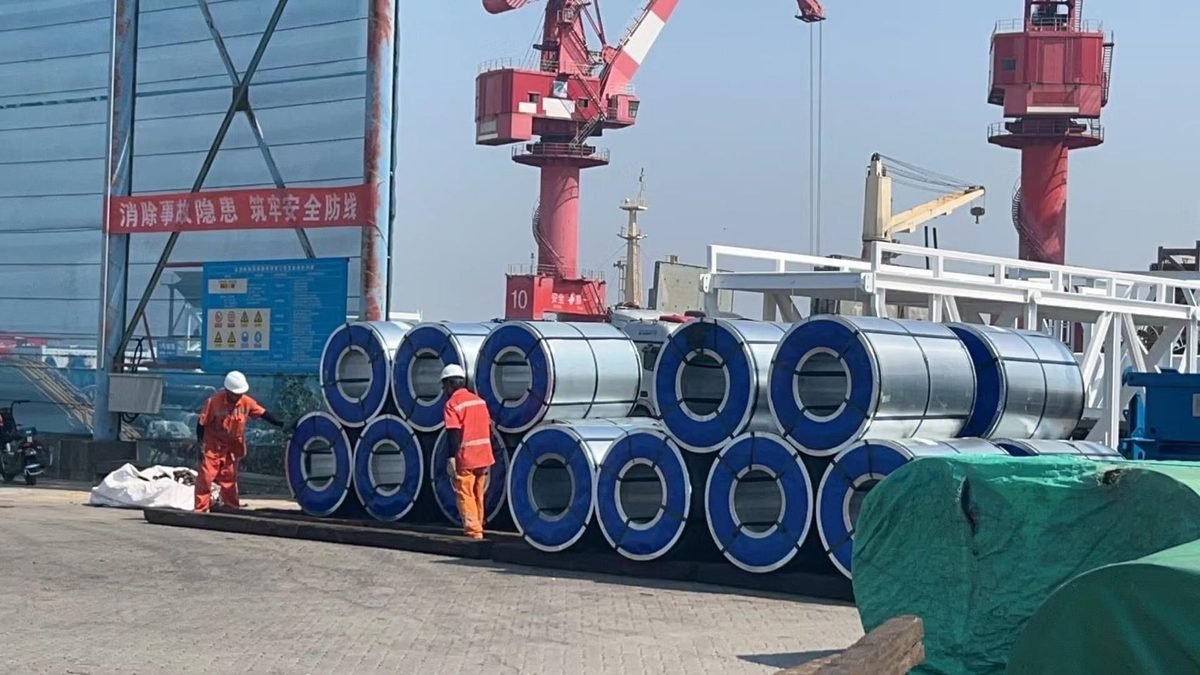
Galvanized coil is cold-reduced steel strip that has passed through a continuous hot-dip line: the strip is cleaned, annealed in a reducing atmosphere, dipped into a molten zinc bath at about 450°С, wiped by gas knives to a controlled coating weight, cooled, and then given a surface treatment. The zinc does not simply sit on the steel as paint does. At the interface, a thin iron–zinc alloy layer forms, and that intermetallic bond is what allows the coating to survive bending and drawing without flaking.
The coil leaves the line either skin-passed or not. Skin-passing is a light cold reduction of 0.5–1.5 % that flattens the surface, suppresses the yield-point elongation that causes stretcher strains during forming, and gives a slightly rougher surface that holds paint. Coils intended for direct painting are usually skin-passed; coils intended for corrugating may be supplied without it.
Three surface conditions are common: dry (no oil), смазанный маслом (a light protective oil), and anti-fingerprint (a thin chromate-free film that prevents white staining from fingerprints and condensation during handling). The choice is not cosmetic. An oiled coil that is stored without ventilation forms a sticky emulsion with condensate; a dry coil handled with bare hands marks within days.
2. How the Coating Is Specified
The Z-number is the total zinc mass on both surfaces, in grams per square metre. Z40 means 40 g/m² total, which is nominally 20 g/m² per side. Because zinc has a density of 7.14 g/cm³, one gram per square metre corresponds to roughly 0.14µm of coating. The conversion is therefore direct:
| Designation | Total mass | Per side | Nominal thickness per side | Typical exposure |
|---|---|---|---|---|
| Z40 | 40 g/m² | 20 g/m² | 2.8 µм | Indoor, temporary, dry interior |
| Z60 | 60 g/m² | 30 g/m² | 4.2 µм | Sheltered interior, light handling |
| Z100 | 100 g/m² | 50 g/m² | 7.0 µм | General indoor and covered outdoor |
| Z120 | 120 g/m² | 60 g/m² | 8.4 µм | Exposed rural and urban outdoor |
| Z180 | 180 g/m² | 90 g/m² | 12.6 µм | Прибрежный, промышленный, heavy exposure |
| Z275 | 275 g/m² | 137.5 g/m² | 19.3 µм | Морской, химический, long-life structural |
Two traps sit inside this table. The first is the difference between total and per-side mass: a supplier quoting “60 g/m²” without saying which convention is being used may be offering Z60 total or Z120 total. The second is that the standard permits a minimum single-spot value below the nominal, so a coil sold as Z120 can have local readings in the 90 g/m² диапазон. Both are normal, and both matter when the specification is being compared between suppliers.
The coating mass is also not the whole story. Цинк–aluminium coatings (ZnAl 5 % and ZnAl 55 %) give a different balance of durability and cut-edge protection, and zinc–iron alloy coatings are used where paint adhesion matters more than sacrificial protection. This article deals with pure zinc, which is still the workhorse for general steel strip.
3. Substrate Grades Underneath the Coating
The zinc is only a skin. The steel underneath does the structural work, and it is specified separately. In EN 10346 the common designations are DX51D and DX52D for forming and drawing quality, and S250GD, S280GD, S320GD and S350GD for structural quality. The “D” suffix means the steel is intended for hot-dip coating.
| Элемент | DX51D | DX52D | S250GD | S350GD |
|---|---|---|---|---|
| С, Макс % | 0.18 | 0.12 | 0.20 | 0.20 |
| Мин., Макс % | 0.50 | 0.50 | 0.60 | 0.60 |
| И, Макс % | 0.05 | 0.05 | 0.05 | 0.05 |
| п, Макс % | 0.030 | 0.030 | 0.10 | 0.10 |
| С, Макс % | 0.030 | 0.030 | 0.045 | 0.045 |
| Ал, мин % | 0.020 | 0.020 | 0.020 | 0.020 |
The aluminium is not incidental. It deoxidizes the steel and controls the nitrogen, and a low aluminium content shows up later as a coating that adheres poorly after bending. Carbon is kept low so the strip stays formable; the structural grades give away some formability in exchange for yield strength, and that trade is visible in the mechanical table below.
4. Механические свойства
| Оценка | Yield strength Re, МПа | Tensile Rm, МПа | Elongation A80, мин % | Типичное использование |
|---|---|---|---|---|
| DX51D | 140–260 | 270–410 | 18 | General forming, воздуховод, panels |
| DX52D | 140–260 | 270–380 | 20 | Deeper drawing, complex profiles |
| S250GD | 250 мин | 330–430 | 19 | Light structural, рамки, прогоны |
| S350GD | 350 мин | 420–520 | 16 | Load-bearing sections, racking |
The elongation figures are minimums for the transverse direction; longitudinal values are higher. What matters in practice is the ratio between yield and tensile strength. A DX51D coil with a 0.85 yield ratio has almost no capacity left for forming before it cracks, and that condition is usually a sign of insufficient annealing rather than of the grade.
5. Coating Mass and Service Life
Zinc protects steel in two ways. It is a barrier while it lasts, and it is sacrificial when the barrier is broken: at a scratch or a cut edge, the zinc around the exposed steel corrodes first and the steel stays intact. That is why a galvanized part tolerates abuse that a painted part does not — and why the mass of zinc, not the thickness of paint, sets the life.
Service life is not linear in coating mass, because the corrosion rate depends on the environment. In a rural atmosphere zinc corrodes at roughly 1–2 µm per year once the surface is weathered; in an industrial or coastal atmosphere the rate can reach 4–8 µm per year. On that basis a Z120 coating at 8.4µm per side has a first-maintenance interval of four to eight years in a moderate environment, and much less near the sea.
| Environment | Zinc loss, µm/year | Z40 life, годы | Z120 life, годы | Z275 life, годы |
|---|---|---|---|---|
| Dry interior | 0.5–1 | 3–6 | 8–17 | 19–38 |
| Rural outdoor | 1–2 | 1.5–3 | 4–8 | 10–19 |
| Urban / промышленный | 2–4 | 0.7–1.5 | 2–4 | 5–10 |
| Прибрежный, within 500 м | 4–8 | 0.4–0.7 | 1–2 | 2.5–5 |
These figures are indicative and assume the coating is intact. They also assume the cut edges are not the dominant exposure. On a slit strip that is 30 mm wide, the cut edge is a much larger fraction of the surface than on a 1,200 mm wide sheet, and the edge is bare steel protected only by whatever zinc can creep over it. That is the real reason narrow slit galvanized strip performs worse than the coating mass suggests.
Accelerated salt-spray testing condenses this into hours. A Z120 coating typically reaches first red rust somewhere between 240 и 480 hours in neutral salt spray, while Z275 often passes 700 часы. The spread is wide because salt spray punishes the cut edge and the surface treatment more than it punishes coating mass. Treat the salt-spray number as a comparative ranking, not a life prediction.
6. Thickness and Width Tolerances
Galvanized coil is bought by thickness, and the coating is not usually included in that figure. The quoted thickness is the base steel, which is why a “0.50 mm Z120” coil measures about 0.517 mm with a micrometer over the zinc. Buyers who measure the total and compare it to the nominal will conclude, wrongly, that the coil is oversize.
| Base thickness, мм | Normal tolerance, мм | Restricted tolerance, мм | Примечание |
|---|---|---|---|
| 0.20–0.40 | ±0.04 | ±0.03 | Most ducting and trim |
| 0.40–0.60 | ±0.05 | ±0.04 | Кровельные работы, panels, trays |
| 0.60–0.80 | ±0.06 | ±0.05 | Structural sections |
| 0.80–1.00 | ±0.07 | ±0.06 | Рамки, поддерживает |
| 1.00–1.50 | ±0.09 | ±0.07 | Heavy profiles |
Width tolerance is conventionally unidirectional: the coil may be slightly over the ordered width but not under it, because a narrow strip cannot be widened later. Typical values are +3/0 mm for widths up to 600 mm, +4/0 mm to 1,200 mm, and +5/0 mm above that. Camber is limited to a few millimetres over a 2 m length, and the mill’s edge condition — mill edge or slit edge — changes how much of that allowance is available.
Coils are normally supplied with an inner diameter of 508 mm or 610 mm, an outer diameter up to about 1,900 mm, and a weight between 3 и 10 тонны, with 5–8 tonnes being the practical norm for container and truck loading. A coil that is too heavy for the customer’s decoiler is not a bargain; it is a handling problem that ends with a partly used coil sitting in the yard.
7. Fabrication: резка, Corrugating and Welding
Galvanized strip is fabricated in four main ways, and each of them attacks the coating differently.
резка. The rotary knives cut the strip and leave a burr on one side. A sharp, well-set knife produces a small burr and a clean edge; a worn knife drags the coating and leaves a ragged edge with exposed steel along its length. Slitting also releases internal stress, so a wide coil can come out of the slitter with camber that was not visible in the master coil.
Roll forming and corrugating. The coating survives bending because the zinc–iron alloy layer at the interface deforms with the steel. The limit is the bend radius: at a radius below about one thickness, the coating on the outside of the bend starts to crack, and cracking is visible as a fine crazing that later becomes red rust. Forming tools should be clean and lubricated, and the strip should be formed at a temperature above about 10°С; cold strip cracks more readily.
Сварка. Zinc boils at 907°С, well below the steel melting point, so any fusion welding of galvanized steel vaporizes the coating in the heat-affected zone and leaves bare steel that must be repaired. Resistance welding is practical for thin sheet because the zinc is pushed aside at the electrodes, but electrode life is short. For structural work, the coating is usually removed within 25 mm of the weld and the joint re-protected with a zinc-rich compound afterwards.
Cutting and punching. Shearing leaves a burr and a bare edge. A punched hole has a bare inner wall and a small ring of damaged coating around it. Neither is catastrophic in a dry interior, but both are the first place to look when a galvanized part rusts early.
8. Selecting Between Z40 and Z120
The selection is a function of environment, edge exposure, expected life and the cost of recoating. Z40 is a valid choice in three situations: an interior space that stays dry, a part that is painted or powder-coated after fabrication so the zinc is only a primer, and a temporary or short-life item where the coil cost dominates.
Z120 is the default for anything that will see weather. A roofing sheet, an outdoor cable tray, an exposed duct, a fence panel — all of these sit in the range where Z40 gives one to three years of appearance and Z120 gives four to eight. The price difference between the two is usually 3–6 % of the coil cost, which is far less than one repaint.
Above Z120 the choice is about the environment, not the budget. Within 500 m of the coast, or in an industrial atmosphere with sulphur dioxide, Z180 or Z275 is the only sensible specification, and even then the design should keep the steel out of standing water and away from contact with copper or graphite, both of which accelerate zinc consumption galvanically.
There is also a geometry argument. A small part with a high edge-to-area ratio, such as a narrow slit strip or a perforated panel, loses coating performance at every edge. Specifying Z120 on a 25 mm wide strip does not give the durability that Z120 on a 1,200 mm sheet gives, because the cut edges dominate. For narrow parts, going up one coating class is cheap insurance.
9. Storage and the White Rust Problem
Galvanized coil fails in the warehouse more often than on the roof. When moisture condenses between tightly wrapped turns and air cannot reach the surface, zinc hydroxide and basic zinc carbonate form as a white, powdery deposit. White rust is not a coating defect in the mill sense; it is a storage condition, and it consumes zinc at a rate far higher than outdoor exposure does.
The rules are simple. Store coils on a raised, drained pallet, not on the ground. Keep the wrap intact until the coil is used, but do not seal a damp coil inside plastic. Avoid stacking coils so that water can pool in the eye. Let a cold coil reach room temperature before unwrapping it in a warm, humid space, or condensation will form on every turn within minutes. If white rust has already appeared, it can be removed with a dilute acid wash followed by thorough rinsing and drying, but the zinc that was consumed is gone.
10. Распространенные ошибки
Buying by thickness only. A purchase order that says “0.5 mm galvanized coil” and nothing else can be filled with Z40, dry, unskinned material. The coating mass, surface treatment and substrate grade have to be on the order.
Comparing Z-numbers across conventions. One supplier quotes total mass, another quotes per-side. The difference is a factor of two, and it is invisible until the parts rust.
Assuming salt-spray hours equal years. A 480-hour salt-spray result is a comparative indicator, not a service-life guarantee. The same coating in a sulphur-dioxide atmosphere and in a dry interior will differ by a factor of ten.
Welding without repairing the coating. The heat-affected zone is bare steel. A zinc-rich paint repair is not optional on an outdoor structure; it is the only thing standing between the weld and red rust.
Storing coils flat on the ground. Ground moisture plus a wrapped coil is the standard recipe for white rust, and the damage is usually discovered after the coil has been cut.
Specifying Z275 for a painted part. If the part is painted, the paint does the barrier work and the zinc only needs to protect the cut edges. Paying for Z275 under a full paint system is money spent twice.
11. Frequently Asked Questions
Is Z120 the same as 120 g/m² per side? Нет. Z120 is 120 g/m² total, which is 60 g/m² per side, or about 8.4µm per side. A supplier quoting 120 g/m² per side is describing a Z240 coil.
Can galvanized coil be painted directly? Да, if the surface is prepared. The coil must be clean, dry and free of oil; a chromate-free anti-fingerprint treatment is designed to accept paint, while a heavy oil film must be removed. A primer is still recommended on exposed surfaces.
Why does the coil have a spangle pattern? The spangle is the visible grain of the zinc crystals, controlled by the cooling rate and by the addition of antimony or lead. A regular spangle is decorative; a minimized spangle gives a smoother surface for painting. Neither affects corrosion resistance much.
Does thicker zinc mean a harder coil? Нет. Coating mass has no meaningful effect on the mechanical properties of the substrate. A Z275 coil and a Z40 coil of the same grade have the same yield and tensile strength.
What is the difference between galvanized and galvalume? Galvanized is pure zinc. Galvalume is 55 % aluminium, 43.4 % zinc and 1.6 % silicon, with better high-temperature oxidation resistance and longer life in some atmospheres, but weaker sacrificial protection at cut edges.
How do I check the coating mass on receipt? Weigh a measured area, strip the coating chemically, and weigh again; or use a magnetic or eddy-current gauge calibrated for zinc on steel. A gauge reading taken at five points per coil is enough to catch a mis-declared coil.
Can Z40 be used outdoors if the part is painted? Да, in a moderate environment, provided the paint system is intact and the cut edges are primed. Once the paint breaks down, the thin zinc is consumed quickly.
12. Sourcing Galvanized Coil
QIDAMT supplies continuously hot-dip galvanized coil and strip in DX51D, DX52D, S250GD and S350GD, with coating masses from Z40 to Z275, thickness 0.20–1.50 мм, widths up to 1,250 mm, in dry, oiled or anti-fingerprint condition. Coils can be slit to width and supplied with mill edge or slit edge, and the coating mass is stated unambiguously as total mass per the EN 10346 convention.
See the standard product page for the current range and thickness combinations: Galvanized Steel Strip DX51D. For tube and pipe made from galvanized strip, the matching product is Hot-Dip Galvanized Round Steel Tube Q235B.
Need a specific coating mass, width or substrate grade?
Send the thickness, ширина, Z-number, surface treatment and tonnage, and we will confirm availability and lead time.
Related reading: Плоский стержень из углеродистой стали Q235B · Galvanized Round Steel Tube · Оцинкованная стальная полоса