 FRAMGANG
Copper Tube Coil: Pancake Coil vs Straight Length for HVAC
Copper Tube Coil: Pancake Coil vs Straight Length for HVAC
A copper tube coil is the single most specified item in a split air-conditioning installation, and also the one most often bought on price alone. The choice between a pancake coil and straight length tube decides how much brazing the crew performs, how much refrigerant the system holds, how the line set is routed around a building, and how the installation behaves after ten years of vibration and thermal cycling.
This guide compares the two forms on metallurgy, temperament, dimensional standards, pressure rating, installation practice, and the failure modes that show up in service. It deals with C12200 deoxidized copper, the alloy used for practically all refrigeration and plumbing tube, and with the two delivery forms rather than with the alloy itself.
1. What the Two Forms Actually Are
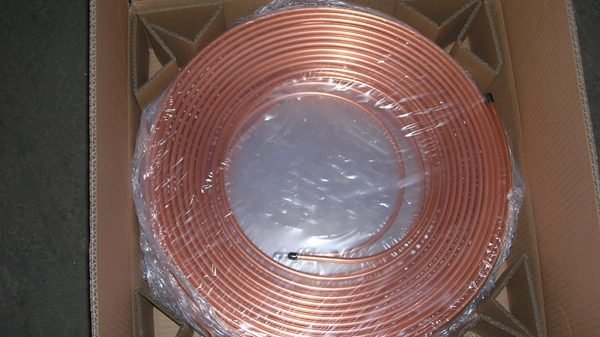
Pancake coil is soft-annealed tube, coiled flat in a single continuous length, vanligvis 15 m, 25 m or 50 m, with both ends capped and the coil wrapped for transport. Because it is annealed, the tube bends easily by hand or with a simple bender, and the coil can be unrolled along a wall or across a ceiling void.
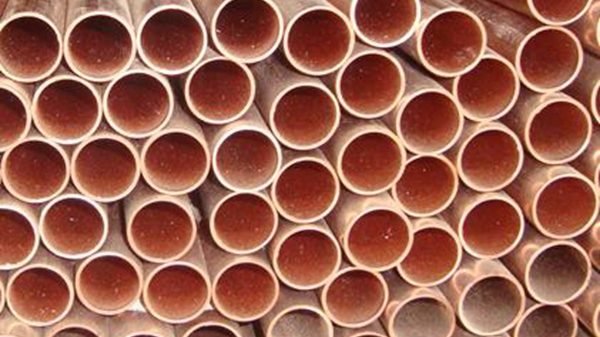
Straight length is hard-drawn or half-hard tube supplied in fixed lengths, commonly 3 m og 6 m, in a plastic sleeve or bare bundle. It is straighter, stiffer, dimensionally more consistent over its length, and cheaper per metre in large sizes. It cannot be bent sharply without annealing, so it is used where the route is straight and the joints can be made at fixed positions.
The two forms come from the same billet and the same extrusion or rolling process. The difference is the final thermal treatment and the packaging. That matters because annealing lowers yield strength and raises elongation: the same nominal size in soft temper and hard temper behaves differently under pressure, bending and vibration.
2. Alloy and Chemistry
HVAC and refrigeration tube is C12200, also designated DHP copper (deoxidized high phosphorus). The phosphorus addition is what makes the alloy suitable for brazed assemblies: it deoxidizes the melt, so the finished metal contains essentially no cuprous oxide, and it suppresses the hydrogen embrittlement that affects oxygen-bearing copper when it is brazed or annealed in a reducing atmosphere.
| Element | C12200 requirement | Why it matters |
|---|---|---|
| Kopper | 99.90 % minimum, Cu + P | Conductivity and thermal performance |
| Fosfor | 0.015–0.040 % | Deoxidation; brazing without flux |
| Oxygen | Ikke spesifisert; kept very low | Prevents porosity at the braze joint |
| Other elements | 0.1 % total maximum | Keeps conductivity predictable |
The phosphorus content costs conductivity: C12200 runs at roughly 85 % IACS, against 100–101 % IACS for oxygen-free or oxygen-bearing electrical copper. For a refrigerant line that is irrelevant. For a busbar it would be a defect, which is why the two alloys are not interchangeable in electrical work.
Thermal conductivity of C12200 is around 340 M/(m·K), ca 15 % lower than pure electrical copper. In a condenser or evaporator circuit that is still excellent, and the heat transfer is limited by the refrigerant side, not the tube wall.
3. Temperament, Strength and Pressure
I 1057 and ASTM B280 both classify tube by temper state, and the state determines strength, bendability and the pressure the tube can carry at temperature. Soft temper (R220/O60) is fully annealed: lowest strength, highest elongation, easiest to bend. Half-hard (R250) sits in the middle. Hard (R290/H04) is cold drawn: highest strength, limited bendability.
| Temperament | Strekkstyrke | 0.2 % proof | Forlengelse | Typical form |
|---|---|---|---|---|
| Soft R220 / O60 | 220–260 MPa | 60–70 MPa | 40 % min | Pancake coil |
| Half-hard R250 | 250–290 MPa | 80–110 MPa | 30 % min | Spole, some straight |
| Hard R290 / H04 | 290 MPa min | 110 MPa min | 25 % min | Straight length |
For R410A and R32 systems, design pressures sit around 4 MPa at high ambient, so wall thickness matters more than temper. A soft coil with adequate wall carries the same pressure as a hard tube with the same wall; what changes is the ability of the joint to resist vibration and the behaviour of the tube when it is bent in a tight radius.
The practical rule: use soft coil where the route has bends and where the line set is installed as one continuous run; use hard straight tube where the run is straight, where the tube must be supported at long spans without sagging, and where the size is large enough that a coil becomes physically awkward.
4. Dimensions and Tolerances
HVAC tube is specified by outside diameter in inches or millimetres, with wall thickness in millimetres or by gauge. The common line-set sizes and their typical walls are below. Wall thickness is the number that should be on the purchase order; “1/4 inch copper tube” alone does not define a product.
| Nominal OD | OD tolerance | Typisk vegg | Pancake lengths |
|---|---|---|---|
| 6.35 mm (1/4″) | ±0.05 mm | 0.71–0.81 mm | 15 / 25 / 50 m |
| 9.52 mm (3/8″) | ±0.05 mm | 0.76–0.89 mm | 15 / 25 / 50 m |
| 12.70 mm (1/2″) | ±0.05 mm | 0.81–1.02 mm | 15 / 25 / 30 m |
| 15.88 mm (5/8″) | ±0.06 mm | 1.02–1.14 mm | 15 / 25 m |
| 19.05 mm (3/4″) | ±0.06 mm | 1.07–1.27 mm | 15 / 20 m |
| 22.22 mm (7/8″) | ±0.08 mm | 1.14–1.40 mm | Coil or straight |
ASTM B280 requires the tube to be cleaned, capped and dry, with a maximum residue limit and a specified internal cleanliness for refrigerant service. That cleanliness is not cosmetic: oxide scale inside a line set migrates to the expansion valve and the compressor, and it is the most common cause of a blocked strainer on a new installation.
Straight lengths are usually supplied in 3 m or 6 m, hard temper, with the ends capped. The length tolerance is typically ±10 mm on a 6 m length, and the tube is checked for straightness so that it can be cut and joined without a visible kink.
5. Installation Practice
Bøyning. Soft coil can be bent to a radius of roughly three times the outside diameter without a bender, and tighter with a proper lever or spring bender. Below that radius the tube ovalizes, the wall thins on the outside of the bend, and the joint becomes a fatigue crack waiting for the compressor to start. The correct bend radius for a permanent installation is usually five times the OD.
Cutting and flaring. Cut with a wheel cutter and deburr both inside and out. A flare made on a tube with an internal burr will leak at the flare face, and the burr is also a particle source. Flare torque should follow the fitting maker’s table; over-tightening cracks the flare cone, under-tightening leaves a leak that appears only at pressure test.
Brazing. Purge with dry nitrogen while brazing, at a low flow, until the joint has cooled below about 200 °C. Without purge, the inside of the tube oxidizes into a black scale that is almost impossible to remove from a completed line set. Use a phosphorus-copper filler for copper-to-copper joints; the phosphorus in the tube makes flux unnecessary. For copper-to-brass or copper-to-steel joints, use a silver filler with the correct flux.
Support and isolation. Soft coil sags between supports; the maximum span for a 12.7 mm line is around 2 m, less for smaller sizes. Isolate the tube from the structure with rubber grommets, because a vibrating copper line work-hardens and cracks at the support point.
Pressure test. Test with dry nitrogen at 1.5 times the design pressure, hold for at least 24 hours on a large system, and record the ambient temperature, since a pressure change of 0.01 MPa can be explained by a few degrees of temperature shift.
6. Selection Rules
- Split system line sets up to 7/8 inch, with bends: pancake coil. One continuous length means fewer joints and a faster, cleaner installation.
- Long straight runs in plant rooms, risers and chases: straight length. Better straightness, easier support, and no coil to unroll in a confined space.
- Large diameters above 7/8 inch: straight length. EN 1-1/8 inch coil is heavy and awkward, and the cost advantage disappears.
- VRF and multi-split headers: straight length for the main, coil for branch runs.
- Buried or embedded lines: neither, unless the tube is protected and the installation allows access. Copper in contact with concrete or soil corrodes, and a leak in an embedded line is a demolition job.
- Coastal or industrial atmosphere: either form, but specify capped ends and clean promptly; copper exposed to chloride develops a green patina that eventually pits.
- Low-temperature refrigeration: soft coil for evaporator connections, but verify the temper is suitable for the pulldown temperature and the vibration duty.
7. Line-Set Sizing and Oil Return
The form of the tube does not change the physics of the line set, but it changes what the installer can do about it. Two constraints drive the selection as much as pressure does: refrigerant charge and oil return.
Charge. Every metre of liquid line adds refrigerant. EN 9.52 mm tube holds about 0.06 kg of R410A per metre; a 15.88 mm tube holds about 0.19 kg. On a system with a factory charge sized for a 5 m line set, adding 20 m of large-diameter line can push the charge well beyond the receiver or accumulator allowance, and the result is a unit that floods or short-cycles. A smaller diameter reduces charge but raises pressure drop; the manufacturer’s line-set table resolves the trade-off, and it is not negotiable.
Oil return. Compressor oil travels with the refrigerant and must come back. In a horizontal run, the gas velocity must stay above the minimum that carries oil — roughly 4–6 m/s for common refrigerants, depending on the oil type. That is why a line set should not be oversized “for safety”: too large a diameter drops the velocity below the oil-return threshold, and oil accumulates in the low points and in the evaporator. A soft coil that sags creates exactly those low points, and a straight run with a deliberate slope back to the compressor avoids them.
The practical consequence: a pancake coil is a good choice for sizes up to 15.88 mm and lengths up to about 30 m, where the bend radius and the route can be controlled. Above that, the charge and oil-return calculations usually push the design toward straight tube with a smaller diameter and a controlled slope, plus an oil separator or a trap where the manufacturer requires one.
Where a vertical rise is involved, the rule is a minimum gas velocity at the riser and an inverted trap at the top of the riser on some systems. Check the equipment manual: the requirement differs between manufacturers and between R410A and R32, and a wrong trap is worse than no trap.
8. Common Mistakes
Buying “copper tube” without wall thickness. A thin-wall coil and a standard-wall coil look identical in the box and differ in pressure capability by 30 %.
Bending a hard straight tube without annealing. It splits at the outside of the bend, usually after the joint has been brazed and the system charged.
Brazing without nitrogen purge. The resulting internal oxide is the single largest cause of capillary blockage and compressor wear in new systems.
Using a phosphorized tube for an electrical joint. C12200 is a fine HVAC alloy and a poor conductor. Busbars require C11000.
Storing coils on the ground. Damp soil, grit and chloride attack the outside of the coil and the ends collect dirt. Coils should stay on pallets, capped, and indoors.
Over-tightening flares to stop a leak. The flare cone cracks, and the leak returns as a slow loss of refrigerant that is diagnosed weeks later.
9. Quality Checks on Delivery
Check the caps are still on both ends. A coil with an open end has been breathing humid air and may be wet inside. Check the label for alloy, temperament, veggtykkelse, length and standard. Measure the wall at both ends with a wall thickness gauge or a micrometer on a cut sample. Look for surface defects: rullemerker, scratches deeper than 10 % of the wall, and any dark oxide patches that suggest the annealing atmosphere was off.
For a large order, ask for the mill test certificate showing chemistry, tensile properties and the cleanliness test result. On refrigerant tube, the certificate should also state that the tube is capped and dried, and that the residual moisture is within the standard.
10. Ofte stilte spørsmål
Can a pancake coil be used for a horizontal run? Ja, but it must be straightened section by section and supported. A coil left with residual curvature will sag and collect oil at the low point.
Is soft temper weaker in pressure service? The burst pressure depends mainly on wall thickness and diameter. Soft temper has lower yield, so it deforms more before failure, but a properly walled soft tube passes the same pressure test.
Which temper for a line set that will be bent on site? Myk, R220. Half-hard is acceptable for gentle bends only.
Can copper tube be used with ammonia? Ingen. Ammonia attacks copper. Use steel for ammonia systems.
How long can a copper line set be? The manufacturer’s limit for the equipment, usually 15–50 m depending on the model, and it includes the vertical rise. Exceeding it costs capacity and oil return.
Does the tube need to be insulated? The suction line does, to prevent condensation and capacity loss. The liquid line needs insulation only where solar gain or freezing is a concern.
What causes green stains at a joint? A slow leak plus moisture. The verdigris is copper salts, and it usually means the joint is wet and the braze was poor.
11. Sourcing Copper Tube Coil
QIDAMT supplies C12200 copper tube in pancake coil and straight length, soft and hard temper, 6.35–22.22 mm, wall thickness to ASTM B280 or EN 1057, cleaned and capped for refrigerant service, with mill certificates and length marking. Coils are palletized and wrapped for export; straight lengths are bundled in 3 m og 6 m.
Send the size, vegg, temperament, length per coil and the standard you work to. We will confirm availability and packing before shipment.
Need copper tube coil or straight length?
Send the diameter, wall thickness and temper for a quotation with mill certificate.
Related specifications: copper tube C12200, copper coil C11000 ETP, og C11000 kobberplate.

