 FRAMGANG
Aluminium Plate 5052 vs 6061: Styrke, Formability and Application Guide
Aluminium plate buyers usually arrive with one of two alloys: 5052 eller 6061. They look the same on the rack, both are corrosion resistant, both weld and both machine, so the choice often gets made by whoever quotes first. That is a mistake, because the two alloys behave very differently once they leave the warehouse. 5052 is a formable, marine-grade sheet alloy with excellent corrosion resistance and poor machinability in the soft condition. 6061 is a heat-treatable structural alloy that machines cleanly at T6, welds with a strength loss in the heat affected zone, and cracks if it is bent too tightly in the wrong temper. This guide compares chemistry, mekaniske egenskaper, corrosion behaviour, forming, sveising, maskinering, anodising and cost, and gives the application rules that follow.
Kjemisk sammensetning
5052 is an aluminium-magnesium alloy with chromium added for grain structure control. Magnesium is the main strengthener in solid solution; 2.2 til 2.8 percent gives a useful combination of strength, formability and corrosion resistance without the stress corrosion sensitivity of the higher-magnesium 5xxx alloys. It is not heat treatable, so all strengthening comes from strain hardening, which is why temper designation matters: O for annealed, H32 for strain hardened and stabilised, H34 for a higher level of cold work.
6061 is an aluminium-magnesium-silicon alloy with copper and chromium additions. It is heat treatable: solution treatment dissolves the magnesium silicide phase, quenching holds it in supersaturated solution, and artificial ageing precipitates it as fine particles that raise strength. T6 means solution treated and peak aged; T651 means the same with a controlled stretch to relieve residual stress, which matters for machined parts that must stay flat.
| Element, % max unless range given | 5052 | 6061 |
|---|---|---|
| Magnesium | 2.2–2.8 | 0.8–1.2 |
| Silisium | 0.25 | 0.40–0.8 |
| Kopper | 0.10 | 0.15–0.40 |
| Krom | 0.15–0.35 | 0.04–0.35 |
| Stryke | 0.40 | 0.70 |
| Mangan | 0.10 | 0.15 |
| Sink | 0.10 | 0.25 |
| Titanium | — | 0.15 |
| Aluminium | Balansere | Balansere |
The copper in 6061 is the reason it machines so well and also the reason its corrosion performance in some environments is below 5052. Copper-bearing phases raise strength but act as cathodic sites when the surface film breaks. The chromium in both alloys controls grain growth and improves toughness; i 5052 it also reduces the tendency to sensitise at elevated temperature, which matters for tanks and vessels that see warm service.
Mekaniske egenskaper
The numbers below are typical minimum values for plate in the stated temper, consistent with ASTM B209 practice. They are the values to compare when an application is strength-driven.
| Legering og temperament | Strekkstyrke, MPa | Flytestyrke, MPa | Forlengelse, % | Hardhet, HB |
|---|---|---|---|---|
| 5052-O | 195 | 90 | 18 | 47 |
| 5052-H32 | 228 | 193 | 12 | 60 |
| 5052-H34 | 260 | 215 | 8 | 68 |
| 6061-O | 125 | 55 | 25 | 30 |
| 6061-T4 | 240 | 145 | 22 | 65 |
| 6061-T6 | 310 | 276 | 12 | 95 |
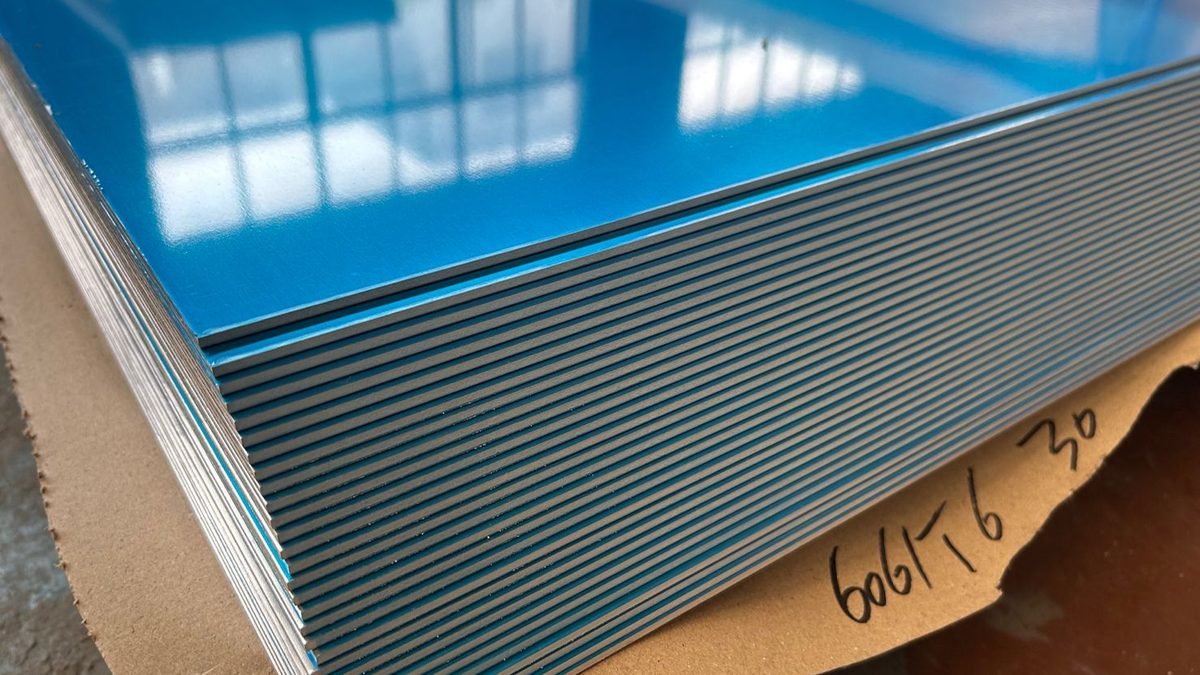
6061-T6 is roughly 35 percent stronger than 5052-H32 in yield and about 36 percent stronger in tensile, which is why structural brackets, machine frames and moulds default to 6061. The gap narrows in T4, and it disappears in the annealed condition. Where the design is stiffness-driven rather than strength-driven, the difference matters less than people expect: both alloys sit near 68 GPa elastic modulus, so deflection depends on plate thickness and geometry, not on alloy choice.
Fatigue behaviour follows a similar pattern: 6061-T6 has a higher endurance limit in proportion to its strength, but welded 6061 loses much of that advantage because the heat affected zone drops towards the annealed strength. Design codes normally require the welded joint to be checked against the lower HAZ values rather than the parent T6 values.
Korrosjonsmotstand
5052 is the better alloy in marine and industrial atmospheres. It resists salt water, splashes and chloride-bearing dust, and it does not suffer the intergranular attack that some high-magnesium 5xxx alloys show after prolonged exposure to elevated temperature. It is widely used for boat hulls, drivstofftanker, lastebilkarosserier, pressure vessels and chemical equipment where chlorides are present.
6061 resists atmospheric corrosion well and is acceptable in fresh water, but it is more sensitive to chlorides and to galvanic coupling. Copper-bearing 6061 in contact with stainless steel, carbon steel or copper alloys becomes the anode in a wet joint and corrodes at the contact line. The fix is to break the electrical path with an insulating gasket or a coated interface, not to change the alloy.
Neither alloy should be used in strong alkalis or in acids that attack aluminium. Both need a clean surface for the oxide film to reform; embedded iron from a contaminated grinding disc will produce rust spots that look like a material failure and are actually contamination.
Anodising changes the comparison slightly. 6061 anodises to a uniform, hard coating that is well suited to machined parts, instrument panels and architectural fittings. 5052 also anodises, but the coating is less uniform in appearance and the magnesium content can produce a slightly darker tone. Where the finish is decorative and must be consistent, 6061 has the advantage; where the finish is functional and the environment is chloride-bearing, 5052 with a chromate-free conversion coating or a suitable paint system performs better.
Forming and Fabrication
5052 is the formability alloy. In the O or H32 condition it bends to a tight radius without cracking, stretches, rolls and deep draws. A rule of thumb for 5052-H32 sheet is a minimum bend radius of about 1.5 times the thickness for a 90 degree bend across the grain, and about 2.5 times the thickness if the bend line runs along the grain. Annealed O temper allows tighter radii still.
6061-T6 is a different proposition. At peak hardness the elongation is only about 12 percent, and bending to a tight radius on a press brake will crack the outer fibre, especially if the bend line runs across the grain. Practical rules: use a bend radius of at least 3 til 4 times the thickness for T6, orient the bend line across the grain where possible, and if a tight radius is mandatory, specify T4 or anneal the bend zone, form, then re-age. A T6 plate bent like a 5052 sheet will fail at the bend, and the failure will be blamed on the supplier rather than the temper.
Sveising: both alloys weld well with the correct filler and process. 5052 bruker 5356 filler for strength and corrosion resistance; 4043 is sometimes used but gives lower ductility and a darker anodised colour. 6061 also uses 5356 for structural welds, mens 4043 is common where crack sensitivity matters more than strength. The critical point for 6061 is the heat affected zone: welding overages the T6 condition locally and drops the strength towards the annealed values. A welded 6061 structure must be designed on the HAZ allowables, or re-heat-treated after welding, which is impractical for most fabrications. 5052 loses strength in the HAZ as well, but because it is strain hardened rather than precipitation hardened, the loss is less dramatic and more predictable.
Machining: 6061-T6 machines cleanly at high speed with good chip control and a fine surface finish. 5052 in H32 is gummy, built-up edge forms on the tool, and the surface tears unless feeds, speeds and lubricant are carefully chosen. If the part is mostly machined, 6061 is the economic choice even at a higher material price, because machining time dominates the cost.
Kutting: both cut with a guillotine, a router, a laser or a waterjet. Laserskjæring 5052 at thickness above about 6 mm can leave a rough dross edge; 6061 cuts more predictably. Waterjet leaves a matte edge and no heat affected zone, which is useful for parts that will be anodised.
Størrelser, Tolerances and Availability
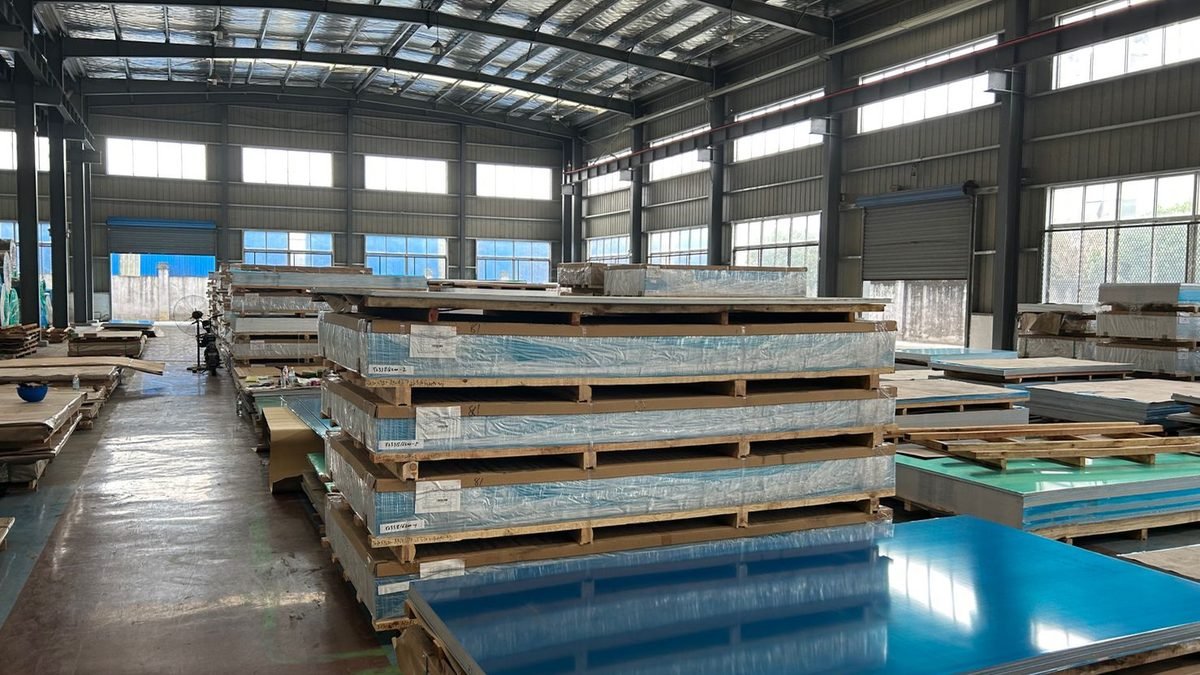
Both alloys are stocked as sheet and plate from 0.5 mm til 150 mm in various widths and lengths. 5052 is most common in the 0.5 til 6 mm range as sheet for forming; tykkere 5052 plate exists but is less available than 6061. 6061 is widely stocked from 6 mm til 100 mm in T6 and T651, which is the range used for tooling plates, moulds, machine bases and fixtures.
Thickness tolerance for plate follows ASTM B209 or EN 485 practice: til 6 mm plate, tolerance is typically ±0.5 mm; til 50 mm plate, roughly ±1.5 mm or tighter by agreement. Flatness matters for machined parts: 6061-T651 is stretched to relieve residual stress, and a plate cut from the centre of a T651 block will stay flatter after machining than the same part cut from T6. For large moulds and fixtures, specify T651 and machine symmetrically to balance the residual stress on both sides.
Overflatebeskyttelse: PVC film is standard on sheet that will be formed or shipped. The film must be removed before welding and before anodising, and it should not be left on a plate that will sit in sunlight for months, because the adhesive can bake onto the surface.
Applications and Selection Rules
Velge 5052 when the part is formed, welded, exposed to salt water or chlorides, or used as a tank, enclosure, truck body, marine panel or sheet metal component. Choose 5052-O when the forming is severe and strength is not the governing case, and 5052-H32 for general sheet metal work that needs a balance of strength and bendability.
Choose 6061-T6 when the part is machined, bolted, strukturelle, or must hold a precise shape. Typical uses: maskinrammer, fixture plates, moulds, vacuum chucks, robot end effectors, sykkelrammer, strukturelle braketter, pneumatic manifolds and heat sinks. Choose 6061-T651 for thick plates that will be heavily machined and must remain flat.
Choose neither when the service is strongly alkaline, when the part will be continuously wet in chlorides at elevated temperature, or when the strength requirement exceeds what aluminium can deliver. In those cases the answer is stainless steel, copper alloy or a different design.
| Requirement | Better choice | Grunn |
|---|---|---|
| Marine or chloride exposure | 5052 | No copper, higher magnesium, better pitting resistance |
| Tight-radius bending | 5052-O / H32 | Høy forlengelse, strain hardened not precipitation hardened |
| Machined precision part | 6061-T6 / T651 | Rens chips, fine finish, dimensional stability |
| Structural strength | 6061-T6 | Avkastning 276 MPa versus 193 MPa |
| Deep draw or roll forming | 5052-O | Maximum ductility in the annealed state |
| Decorative anodising | 6061 | Uniform coating colour and hardness |
Koste, Lead Time and Stock
5052 sheet is normally cheaper per kilogram than 6061 plate in the common thickness range, and it is more widely stocked in thin gauges. 6061-T6 and T651 plate carry a premium that rises with thickness, because thick plate requires more rolling, more careful heat treatment and, for T651, a stretching operation. On a per-part basis the comparison often reverses: a machined bracket made from 5052 may cost more than the same bracket made from 6061, because the machining time on gummy 5052 can be twice as long and the tool life is shorter.
Availability follows the same pattern. Thin 5052 sheet in 1.0 til 3.0 mm is a stock item at most service centres. 6061-T6 plate from 6 til 25 mm is also stock, but 6061 in thicknesses above 50 mm, or in T651, may need to be ordered, and the lead time can extend from days to weeks. A project that needs a 100 mm mould plate should confirm stock before the design is frozen, because changing from 6061 to a substitute alloy at that thickness is rarely possible without redesign.
Cut-to-size adds cost but removes waste. For a part that uses 70 percent of a standard sheet, buying the full sheet can be cheaper than paying a cutting charge, but the offcut has to be stored and may never be used. For a part that uses less than half, cut-to-size is usually the better buy.
Endelig, consider the finishing cost. If the part will be anodised, 6061 gives a more consistent colour, which reduces rework. If the part will be left mill finish, 5052 hides handling marks better. If the part will be painted, both alloys need the correct pretreatment, and the paint system should be specified with the alloy rather than after the plate arrives.
Common Mistakes
Bending 6061-T6 like sheet metal and blaming the alloy when it cracks. Sveising 6061 and designing the joint for parent-metal strength. Using 5052 for a machined part and then complaining about tool life and surface finish. Specifying 6061 for a boat hull because it is stronger. Anodising 5052 and expecting the same colour as 6061. Leaving PVC film on during welding, which releases chloride-bearing adhesive residue into the weld pool. Cutting plate without checking the temper marking against the certificate, because T6 and T651 behave differently after machining. Storing plate flat on the ground without dunnage, which allows condensation under the plate and leaves water stains that etch into the surface.
Ofte stilte spørsmål
Is 5052 stronger than 6061? Ingen. 5052-H32 yields at about 193 MPa and 6061-T6 at about 276 MPa. 5052 is the more formable and more corrosion resistant alloy, not the stronger one.
Can 6061-T6 be welded? Ja, med 5356 filler and a qualified procedure, but the heat affected zone loses strength. Welded joints should be designed on HAZ allowables, typically well below the T6 parent values.
Which alloy is better for anodising? 6061 gives a more uniform colour and a harder coating, which suits machined and decorative parts. 5052 anodises but with less colour consistency.
Why does 5052 machine poorly? Its high magnesium content and low hardness promote built-up edge and galling. Use sharp tooling, high rake, generous coolant and a feed rate that keeps the tool cutting rather than rubbing.
Is T651 better than T6? For thick plate that will be heavily machined, ja. T651 is stretched to relieve residual stress, so the part stays flatter after material is removed.
Enquiry checklist: legering og temperament, thickness with tolerance, flathet, surface protection, certificate with heat number, and the fabrication route (bøye, sveis, maskin, anodise). A quotation without the temper is not a quotation for the part you need.
Valget mellom 5052 og 6061 is not about which alloy is better. It is about which alloy matches the forming route and the service environment. Decide the route first, then the alloy, and most of the failures described above disappear before the first cut is made.
Related material: 1060 pure aluminium plate, 6061-T6 aluminium plate, 5052-H32 aluminium sheet, og C11000 kobberplate for conductive parts.

